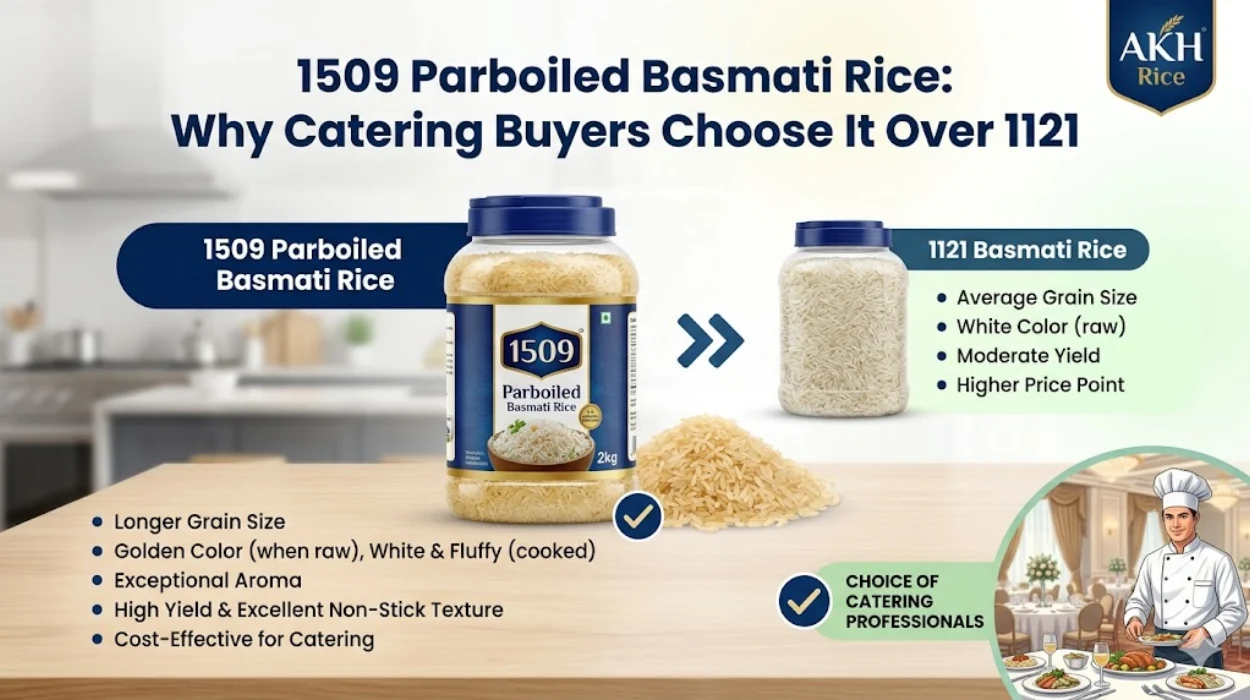
1509 Parboiled Basmati Rice: Why Catering Buyers Choose It Over 1121
1509 parboiled basmati offers faster cooking, higher volume yield, and lower breakage than 1121, making it the preferred specification for catering buyers managing cost and consistency at scale. Here is why: shorter grain elongation time, stable parboiled structure, and uniform hydration reduce operational loss and service delays.
What is 1509 parboiled basmati rice and how is it different from 1121?
1509 parboiled basmati is a short-maturing basmati variety processed through parboiling, delivering 7.4–7.8 mm grain length, 2.2–2.5x elongation, and 15–18 minute cooking time, while 1121 parboiled reaches 8.2–8.4 mm, 2.8–3.2x elongation, and 18–22 minutes cooking time.
1509 parboiled basmati is a rice variety cultivated in Punjab’s irrigated basmati belt. Farmers harvest it within 90–100 days, which is shorter than 1121’s 140–150 day cycle. This shorter cycle creates higher seasonal availability and lower raw material cost.
Parboiling defines the processing method. Millers soak, steam, and dry the paddy before milling. This process hardens the grain and locks nutrients inside. The result is a firm, non-sticky cooked rice suited for bulk service.
1121 parboiled basmati is longer and more aromatic. However, its longer grain demands careful cooking control. Catering operations require speed and consistency, which shifts preference toward 1509.
Catering buyers compare varieties based on cost per plate, cooking time, and waste control. 1509 performs better across these operational metrics.
With the definition of 1509 parboiled established, the next question is how the parboiling process actually works.
How does the parboiling process improve 1509 rice for catering use?
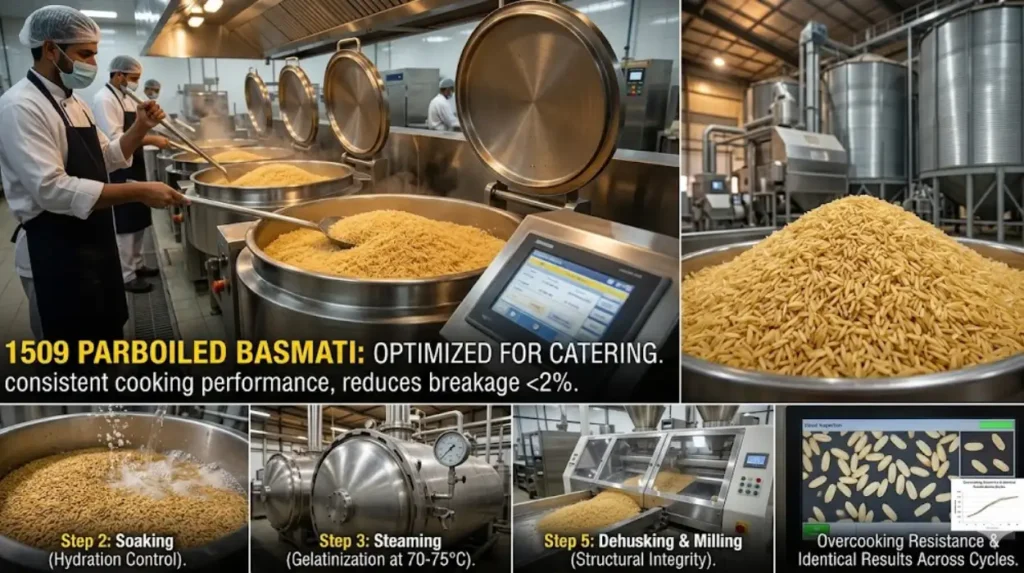
Parboiling strengthens 1509 rice by gelatinizing starch at 70–75°C, reducing breakage to under 2%, and improving moisture absorption uniformity during cooking.
Parboiling transforms raw paddy into a stable grain through controlled hydrothermal treatment. This process ensures consistent cooking performance in high-volume kitchens.
What are the exact processing steps for 1509 parboiled basmati?
Clean the paddy to remove dust and stones. Soak the paddy in water for 6–8 hours at controlled temperature. Steam the soaked paddy under pressure to gelatinize starch. Dry the paddy to 12–13% moisture. Dehusk the dried paddy to remove husk layers. Polish the brown rice to achieve required finish. Grade the rice by length and thickness. Sort the rice using color sorters. Pack the rice into export-grade bags.
Each step controls a specific variable. Soaking controls hydration. Steaming controls starch structure. Drying controls storage stability. Milling controls appearance and uniformity.
Parboiled 1509 resists overcooking because the starch matrix becomes compact. This structure prevents grains from sticking during large-batch cooking.
Catering kitchens rely on predictable outcomes. Parboiled 1509 delivers identical results across multiple cooking cycles per day.
With the process defined, the next step is to examine the key components that determine quality.
What are the key quality components of 1509 parboiled basmati rice?
1509 parboiled quality depends on grain length 7.4–7.8 mm, moisture 12–13%, broken grains under 5%, chalkiness under 2%, and uniform golden color after steaming.
Quality starts at cultivation. Farmers cultivate 1509 in loamy soil with canal irrigation. Controlled nitrogen use ensures grain strength and reduces chalkiness.
Processing defines final quality. Mills test moisture levels after drying because excess moisture causes fungal growth during storage. Mills also inspect grain uniformity using digital sorters.
What grades are available in 1509 parboiled basmati?
1509 Golden Sella Basmati
Golden Sella is parboiled under higher pressure, producing a deep yellow color and firm texture. This grade suits Gulf catering markets where rice must hold shape in buffet trays for hours.
1509 Creamy Sella Basmati
Creamy Sella undergoes lighter steaming, resulting in a pale cream color. This grade suits European and African markets where visual neutrality is preferred.
1509 Steam Basmati
Steam rice skips full parboiling and uses light steaming. This grade cooks softer and suits restaurants serving fresh, quick meals.
Each grade addresses a specific cooking environment. Buyers select based on holding time, visual preference, and cooking equipment.
With quality components defined, the next question is why catering buyers specifically choose 1509 over 1121.
Why do catering buyers prefer 1509 parboiled basmati over 1121?
Catering buyers choose 1509 because it delivers 10–15% higher cooked yield, 20% faster cooking time, and lower breakage during bulk handling, reducing cost per serving.
Catering operations measure rice performance in trays, not in raw grain. 1509 expands efficiently during cooking. This expansion increases serving volume without increasing input cost.
Cooking time impacts kitchen throughput. A 15-minute cooking cycle allows faster batch turnover than a 20-minute cycle. Large kitchens running 50+ batches daily gain measurable efficiency.
Breakage affects visual quality and plate appeal. Parboiled 1509 maintains grain integrity during washing, boiling, and serving. This stability reduces wastage.
How does 1509 perform in real catering scenarios?
Buffet service in UAE hotels requires rice to stay separate for 4–6 hours at 40°C. 1509 Golden Sella maintains structure under heat lamps.
Institutional kitchens in Africa cook rice in 100-liter vessels. 1509 absorbs water evenly and prevents clumping at the base.
Airline catering units demand consistent batch output. 1509 ensures uniform texture across trays prepared hours apart.
1121 remains preferred for premium plating due to its long grain and aroma. Catering prioritizes cost and consistency, which shifts demand toward 1509.
With benefits explained, the next section explores broader use cases.
Where is 1509 parboiled basmati used in global markets?
1509 parboiled basmati is used in bulk catering, institutional kitchens, hotel buffets, and food service contracts across the Middle East, Africa, and parts of Europe.
Export data shows strong demand in non-retail channels (source: REAP export data, December 2025). These markets prioritize stability over premium aroma.
Which regions import 1509 parboiled for catering?
Middle East markets such as UAE and Saudi Arabia import Golden Sella for buffet service. African markets such as Nigeria and Senegal import Creamy Sella for institutional feeding programs. European food service distributors import Steam rice for restaurant chains.
Each region defines specifications based on storage conditions. Hot climates require harder grains. Cooler regions allow softer textures.
How does packaging support catering distribution?
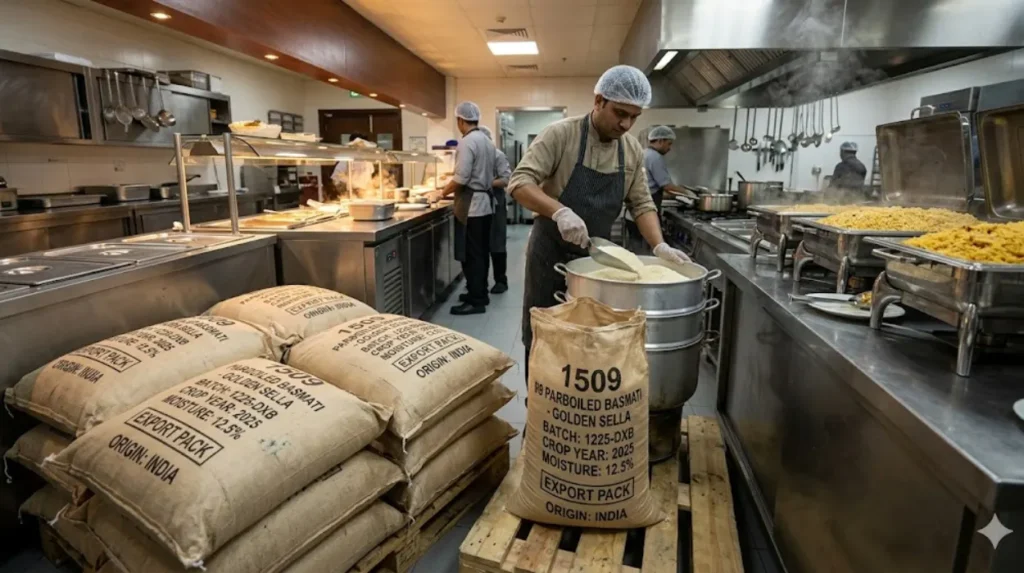
Bulk buyers require 25 kg, 40 kg, and 50 kg PP bags. These bags support stacking and transport efficiency. Vacuum packs are not used in catering because they increase cost without operational benefit.
Packaging also includes labeling for traceability. Exporters print batch numbers, crop year, and moisture content for inspection compliance.
With use cases established, the next section addresses common misconceptions.
What are the common misconceptions about 1509 vs 1121 parboiled basmati?
The main misconception is that 1121 is always superior, while in reality 1509 delivers better operational efficiency, and 1121 delivers better presentation and aroma.
Buyers often assume longer grain equals better quality. This assumption applies to retail and fine dining, not to catering.
Another misconception is that parboiled rice lacks nutrition. Parboiling actually retains vitamins by pushing them into the grain during steaming.
Why do buyers misinterpret grain length as quality?
Grain length is visible before cooking. Buyers use visual cues to judge quality quickly. However, catering performance depends on post-cooking behavior, not raw appearance.
Why is cooking performance more important than aroma in catering?
Catering serves large volumes where consistency matters more than fragrance. Aroma dissipates in buffet environments. Texture and separation remain visible to customers.
Understanding these misconceptions helps buyers align specifications with actual use.
With misconceptions clarified, the final section connects this topic to deeper comparisons.
How does 1509 parboiled compare to other processing types like steam or golden sella?
1509 Golden Sella offers 18–24 months shelf life, while Steam offers 12 months, and cooking stability decreases as processing intensity reduces.
Golden Sella undergoes full parboiling, which creates a hard outer layer. This structure resists moisture absorption during storage. Steam rice lacks this protection and requires faster consumption.
Cooking behavior differs across types. Golden Sella remains firm after reheating. Steam rice softens quickly and loses structure in holding trays.
For a deeper breakdown of shelf life and cooking behavior across processing types, refer to the detailed comparison in 1509 parboiled vs golden sella shelf life cooking.
This comparison completes the evaluation of processing impact and leads to informed selection decisions.
Frequently Asked Questions
What is the cooking time for 1509 parboiled basmati rice?
1509 parboiled basmati cooks in 15–18 minutes under standard boiling conditions. Catering kitchens use a 1:2 rice-to-water ratio for consistent results. The grain absorbs water evenly and remains separate after cooking, which supports high-volume service efficiency.
Why does 1509 parboiled rice give higher yield than 1121?
1509 parboiled rice expands uniformly during cooking and produces 10–15% more cooked volume. The starch structure formed during parboiling allows better water absorption. This higher yield reduces cost per serving in catering and institutional kitchens.
Which grade of 1509 parboiled is best for buffet catering?
1509 Golden Sella is the preferred grade for buffet catering. It holds grain structure for 4–6 hours under heat lamps at 40°C. The firm texture prevents clumping and maintains presentation quality throughout extended service periods.
How should 1509 parboiled rice be stored for bulk use?
1509 parboiled rice should be stored at 12–13% moisture in dry warehouses below 25°C. Use palletized stacking and proper ventilation to prevent condensation. Golden Sella variants maintain quality for up to 24 months under controlled storage conditions.
Is 1509 parboiled basmati suitable for international export standards?
1509 parboiled basmati meets international export requirements when mills test and certify it for moisture, purity, and grain length. Export shipments include phytosanitary certificates, fumigation reports, and quality inspection documents to comply with importing country regulations.