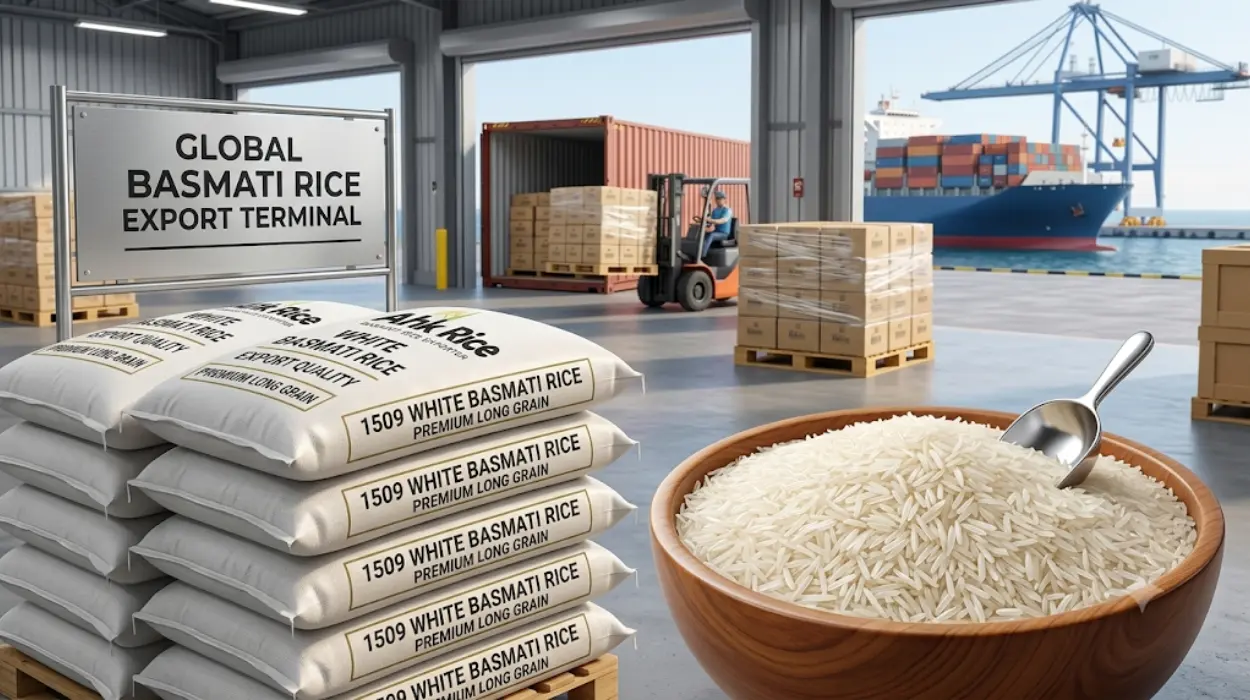
Complete Guide to 1509 White Basmati Rice Export Prices from Pakistan to UAE
1509 White Basmati Rice export prices from Pakistan to the UAE typically depend on grain grade, milling quality, packaging specification, freight rates, and seasonal supply. Here is why: Pakistan cultivates 1509 Basmati in Punjab, processors grade it into multiple export categories, and UAE importers purchase different specifications for retail, wholesale, and food service sectors.
1509 White Basmati Rice has become one of Pakistan’s fastest-growing Basmati export varieties. The variety offers long grain length, high cooking elongation, bright appearance, and competitive pricing compared to premium aged Basmati varieties. UAE importers source 1509 White Basmati because it balances quality and affordability.
Pakistan remains one of the largest suppliers of Basmati rice to Gulf markets. The UAE functions as both a consumption market and a regional distribution hub for the Middle East and Africa (source: REAP export data, December 2025). Understanding export prices requires understanding the product itself, the production process, available grades, export specifications, certifications, and logistics costs.
What Is 1509 White Basmati Rice?
1509 White Basmati Rice is a long-grain aromatic rice variety with average grain length of 8.10–8.40 mm, high elongation after cooking, and a bright white appearance.
1509 White Basmati Rice belongs to the Basmati rice family cultivated in Pakistan and India. Plant breeders developed the variety to provide higher yields than traditional Basmati while maintaining aroma and grain elongation characteristics.
1509 White Basmati Rice grows primarily in Punjab. Farmers cultivate the crop during the Kharif season. Fields receive irrigation from canal systems connected to the Indus River basin.
1509 White Basmati Rice differs from Super Kernel Basmati and 1121 Basmati. The variety matures earlier. The variety produces higher output per hectare. The variety generally offers a lower export price.
What Are the Main Physical Specifications?
| Specification | Typical Range |
|---|---|
| Grain Length | 8.10–8.40 mm |
| Moisture | 12–14% |
| Purity | 95–100% |
| Broken Rice | 1–5% |
| Average Cooking Elongation | 1.8–2.2 times |
| Color | Natural White |
| Aroma | Mild to Medium |
With the product definition established, the next question is how Pakistan produces export-quality 1509 White Basmati Rice.
How Is 1509 White Basmati Rice Processed for Export?
1509 White Basmati Rice passes through 9 processing stages from harvesting to export packing. Each stage improves purity, appearance, and consistency.
Rice processors transform harvested paddy into export-ready rice through controlled milling operations. Every stage removes impurities and improves uniformity.
What Are the Processing Steps?
- Clean the harvested paddy.
- Dry the paddy to target moisture.
- Store the paddy under controlled conditions.
- De-husk the grain.
- Polish the rice kernels.
- Sort by grain length.
- Remove defects through color sorting.
- Inspect laboratory samples.
- Pack and load export containers.
Rice mills inspect every production batch before shipment. Laboratory teams test moisture, purity, damaged grains, and foreign matter percentages.
Exporters pack rice in different formats according to buyer requirements. Common packaging includes 1 kg, 2 kg, 5 kg, 10 kg, 20 kg, 25 kg, and 50 kg bags.
With the processing workflow explained, the next question concerns the export grades available to UAE buyers.
What Grades of 1509 White Basmati Rice Are Exported to UAE?
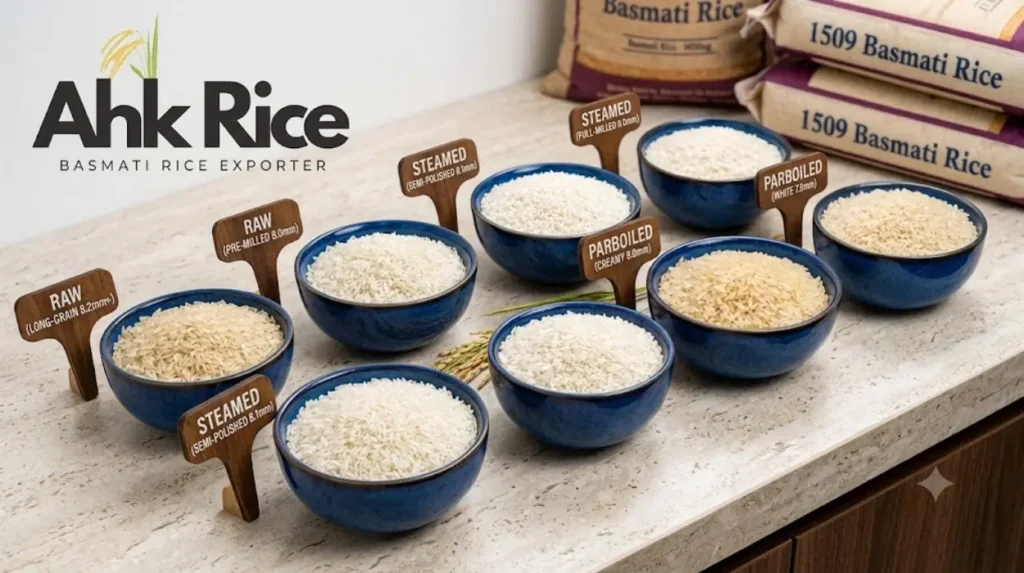
The most common export grades include 1%, 2%, 3%, 4%, and 5% broken rice specifications, along with premium and standard milling grades.
Rice grades determine export pricing. Lower broken percentages command higher prices because buyers receive greater grain uniformity.
Premium Grade
Premium Grade contains 1% broken rice and high purity levels. UAE retail brands commonly procure this specification.
Standard Export Grade
Standard Export Grade contains 2–3% broken rice. Importers use this grade for supermarkets and wholesale distribution.
Commercial Grade
Commercial Grade contains 4–5% broken rice. Food service companies and catering suppliers frequently purchase this category.
Available Export Processing Grades
- Extra Long Grain
- Double Polished
- Silky Polished
- Sortex Cleaned
- Color Sorted
- Low Broken
- Premium Export Grade
Higher grades command higher export values. Lower grades reduce procurement costs. UAE buyers select specifications based on target consumer segments.
With grading clarified, the next question is how these specifications influence export prices.
What Factors Influence 1509 White Basmati Rice Export Prices?
Paddy costs, milling quality, broken percentage, packaging, freight charges, and seasonal demand create the largest impact on export prices.
Paddy prices represent the largest component of export cost. Harvest season typically increases market supply. Increased supply often stabilizes export quotations.
Grain quality affects pricing directly. Rice with 1% broken content receives higher valuations than rice with 5% broken content.
Packaging specifications affect final export cost. Printed retail packaging costs more than plain polypropylene bags.
Container availability influences freight rates. Shipping lines adjust rates according to fuel costs, trade volumes, and seasonal demand.
Currency exchange rates affect procurement budgets. UAE buyers often monitor USD exchange fluctuations when planning imports.
Price formation becomes clearer after understanding the cost structure behind exports.
How Are Export Prices Calculated from Pakistan to UAE?
Export prices combine product cost, inland logistics, export clearance, ocean freight, insurance, and destination handling expenses.
Exporters usually quote prices using Incoterms. The most common terms are FOB and CIF.
What Does FOB Mean?
FOB stands for Free On Board. The exporter loads cargo at the Pakistani port.
FOB pricing includes:
- Rice cost
- Milling cost
- Packaging cost
- Inland transportation
- Export documentation
- Port handling
What Does CIF Mean?
CIF stands for Cost, Insurance, and Freight. The exporter arranges transportation to the UAE port.
CIF pricing includes:
- FOB value
- Marine insurance
- Ocean freight charges
Importers comparing FOB and CIF structures can gain deeper pricing knowledge through the article about freight and landed-cost calculations. Understanding freight costs, insurance charges, and destination pricing differences between Pakistan and UAE rice shipments.
With pricing mechanics explained, the next question concerns the advantages driving UAE demand.
Why Do UAE Importers Purchase 1509 White Basmati Rice?
Long grain appearance, competitive pricing, reliable supply, and cooking performance make 1509 White Basmati attractive to UAE buyers.
1509 White Basmati Rice delivers strong visual appeal. Long grains support premium retail positioning.
1509 White Basmati Rice offers competitive procurement costs. Importers achieve better margins compared with higher-priced aged Basmati categories.
1509 White Basmati Rice performs well in large-scale food preparation. Restaurants, catering companies, and institutional kitchens value consistent cooking behavior.
1509 White Basmati Rice suits multiple consumer segments. Retail buyers, wholesalers, and food service operators purchase different grades.
Understanding demand benefits helps explain market adoption. The next section addresses common misconceptions.
What Common Misconceptions Exist About 1509 White Basmati Rice?
The most common misconception is that lower prices indicate lower quality. Product specifications determine quality, not price alone.
Some buyers assume premium pricing always indicates superior rice. Grain length, purity, cooking performance, and milling quality determine actual value.
Some buyers believe all Basmati varieties perform identically. 1509, 1121, and Super Kernel possess different characteristics.
1121 Basmati produces longer cooked grains. Super Kernel provides stronger traditional aroma. 1509 delivers a balance between quality and cost efficiency.
Some buyers focus only on FOB quotations. Landed costs provide a more accurate purchasing comparison because freight expenses affect total procurement budgets.
With misconceptions clarified, the final topic covers certifications and compliance requirements.
Which Certifications Apply to 1509 White Basmati Rice Exports?
Export shipments commonly require phytosanitary compliance, quality inspection reports, food safety documentation, and origin certification.
Government authorities inspect export shipments before clearance. Inspection procedures verify compliance with importing country requirements.
Common Export Documents
- Commercial Invoice
- Packing List
- Certificate of Origin
- Phytosanitary Certificate
- Bill of Lading
- Fumigation Certificate
- Quality Inspection Report
Common Quality Certifications
- ISO 22000
- HACCP
- GMP
- Halal Certification
- SGS Inspection Reports
UAE authorities require compliance with food safety regulations before products enter commercial distribution channels.
Certification requirements complete the export picture and connect product quality with international trade acceptance.
Frequently Asked Questions
What is the average grain length of 1509 White Basmati Rice?
1509 White Basmati Rice generally measures 8.10–8.40 mm before cooking.
Why is 1509 White Basmati Rice popular in the UAE?
The variety combines long grain appearance, competitive pricing, and reliable cooking performance.
Which Pakistani region produces most 1509 White Basmati Rice?
Punjab produces the majority of Pakistan’s 1509 White Basmati crop.
What is the difference between FOB and CIF pricing?
FOB covers costs until cargo loading at the export port. CIF includes freight and insurance to the destination port.
Which industries import 1509 White Basmati Rice?
Retail distributors, wholesalers, supermarkets, restaurants, catering companies, and food processors import the variety.
Which certifications are commonly requested by UAE buyers?
Common requirements include ISO 22000, HACCP, Halal certification, phytosanitary certificates, and origin certificates.