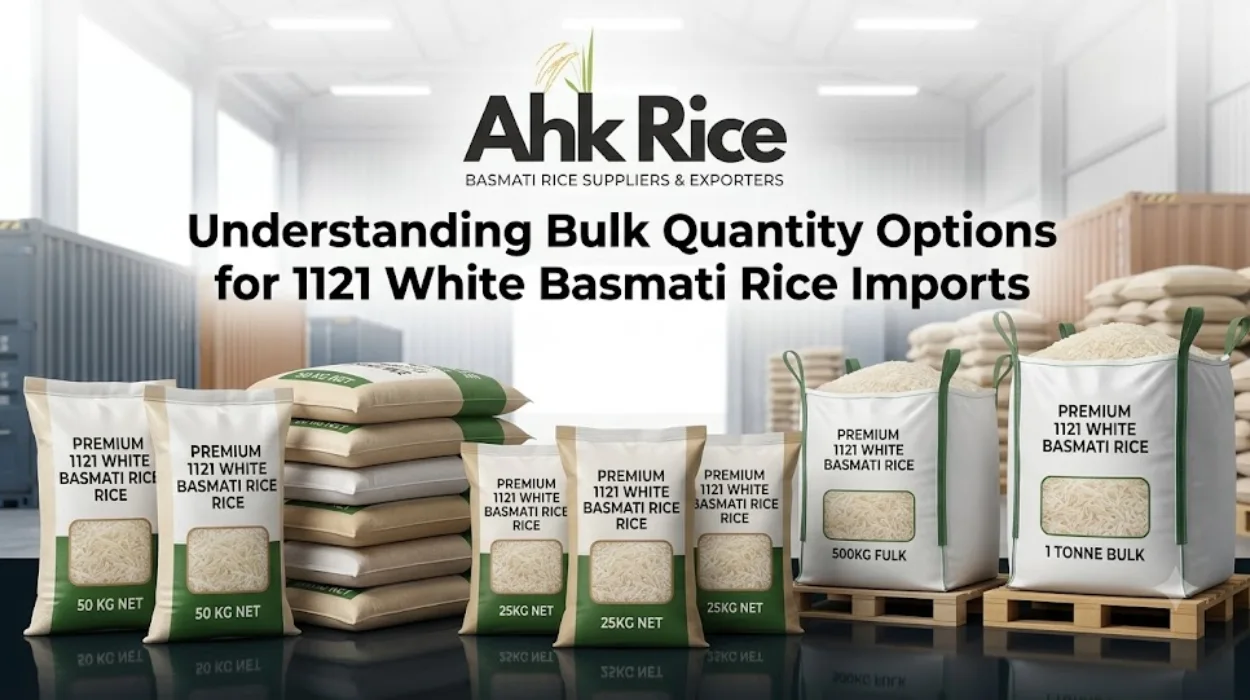
Understanding Bulk Quantity Options for 1121 White Basmati Rice Imports
Bulk quantity options for 1121 White Basmati Rice determine how rice is packed, loaded, shipped, and priced in international trade. Importers select shipment sizes based on warehouse capacity, sales volume, customs requirements, retail packaging plans, and container optimisation. Understanding these options helps buyers reduce logistics costs, maintain product quality, and improve inventory planning.
What Are Bulk Quantity Options for 1121 White Basmati Rice Imports?
Bulk quantity options refer to the standard commercial shipment sizes available for importing 1121 White Basmati Rice. These include different packaging weights, container capacities, pallet configurations, and order volumes that support efficient international transportation, customs clearance, warehousing, and distribution across global food markets.
1121 White Basmati Rice is a premium long-grain aromatic rice grown mainly in the fertile plains of Punjab, Pakistan. It is recognised for its extra-long grain length, pleasant aroma, bright white appearance, and high grain elongation after cooking.
When importers purchase rice internationally, they do not simply order by kilograms. Instead, they choose shipment quantities that fit commercial logistics.
Typical quantity options include:
- 1 kg retail packs
- 2 kg family packs
- 5 kg consumer bags
- 10 kg foodservice bags
- 20 kg woven sacks
- 25 kg PP bags
- 40 kg sacks
- 50 kg export bags
- Full container loads (FCL)
- Less than container loads (LCL)
International rice trade normally uses metric tonnes (MT).
Examples include:
- 24 MT
- 26 MT
- 27 MT
- 28 MT
The final shipment weight depends on packaging size, container type, destination regulations, and loading configuration.
How Does the Bulk Import Process Work?
Bulk importing follows a structured export process that begins with selecting rice specifications and order quantity, continues through milling, grading, packaging, quality inspection, container loading, documentation, customs clearance, shipping, and destination delivery according to international food trade standards.
Every shipment starts with selecting the required rice specification.
Importers define:
- Rice variety
- Grain length
- Broken percentage
- Moisture content
- Chalkiness tolerance
- Packaging type
- Bag weight
- Container quantity
After specifications are confirmed, paddy enters the processing facility.
Cleaning
Raw paddy contains dust, stones, straw, immature grains, and foreign matter.
Mechanical cleaners remove these impurities.
Husking
Rubber rollers remove the outer husk without damaging the grain.
Whitening
Several polishing machines gradually remove the bran layer to produce white rice.
Grading
Length graders separate whole kernels from broken grains.
Colour sorters remove:
- Black grains
- Yellow grains
- Damaged kernels
- Discoloured rice
- Foreign particles
Quality Inspection
Laboratories test:
- Moisture
- Purity
- Grain length
- Broken percentage
- Foreign matter
- Cooking performance
Packaging
Rice is packed according to buyer requirements.
Common export materials include:
- PP woven bags
- BOPP laminated bags
- Paper bags
- Cotton bags
- Non-woven bags
- Vacuum packs
Container Loading
Export containers are inspected before loading.
Workers ensure:
- Dry flooring
- No odour
- No moisture
- No insects
- No structural damage
Cargo is stacked evenly to maximise container utilisation.
What Are the Main Bulk Quantity Options Available?
International exporters supply 1121 White Basmati Rice in multiple commercial quantities ranging from small retail packs to full container shipments. The selected quantity directly affects freight efficiency, warehouse management, packaging costs, and supply chain planning.
Bulk quantity is not limited to one standard size.
Instead, exporters offer several commercial options.
Retail Packaging
Retail packaging supports supermarkets and grocery chains.
Examples include:
- 500 g
- 1 kg
- 2 kg
- 5 kg
These packs reach consumers directly.
Foodservice Packaging
Hotels, restaurants, and catering businesses purchase larger bags.
Examples include:
- 10 kg
- 20 kg
- 25 kg
Wholesale Packaging
Food distributors generally import:
- 25 kg bags
- 40 kg bags
- 50 kg bags
These bags simplify warehouse handling.
Full Container Load (FCL)
FCL remains the most economical choice for high-volume importers.
Typical loading depends on:
- Bag size
- Pallet requirement
- Destination regulations
- Container dimensions
A 20-foot container generally carries approximately 24–27 MT, while a 40-foot container carries a higher volume depending on packaging configuration and shipping line weight limits.
Less than Container Load (LCL)
Smaller businesses sometimes purchase partial container space.
LCL shipments combine cargo from multiple exporters.
The freight cost per tonne is usually higher than FCL because consolidation and handling charges increase overall logistics expenses.
What Factors Determine the Right Bulk Quantity?
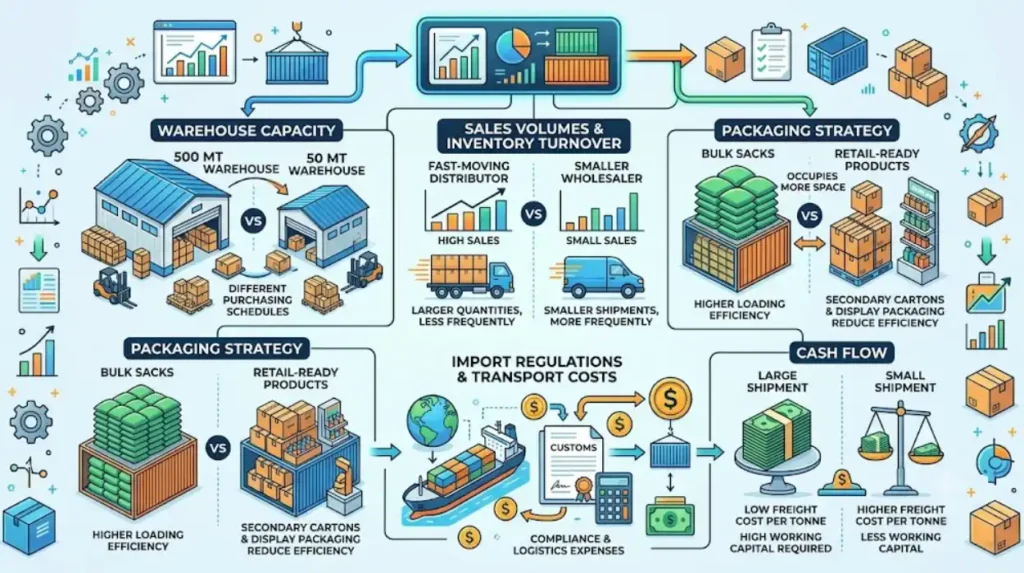
The appropriate shipment size depends on warehouse capacity, monthly sales volume, inventory turnover, packaging strategy, import regulations, transport costs, and customer demand rather than selecting the largest available container.
Successful importers calculate quantity before placing orders.
Important considerations include warehouse storage.
Example:
A warehouse holding 500 MT requires different purchasing schedules than a warehouse storing only 50 MT.
Sales turnover also influences ordering frequency.
Fast-moving distributors often import larger quantities.
Smaller wholesalers prefer more frequent shipments.
Packaging requirements matter as well.
Retail-ready products occupy more container space than bulk sacks because secondary cartons and display packaging reduce loading efficiency.
Cash flow is another consideration.
Larger shipments lower freight costs per tonne, while smaller shipments require less working capital.
What Quality Components Remain Important in Bulk Imports?
Bulk quantity never replaces quality evaluation. Importers assess grain length, moisture content, broken percentage, purity, milling degree, colour consistency, aroma, and food safety compliance before approving international shipments.
Quantity only determines shipment size.
Quality determines commercial value.
Key specifications include:
Grain Length
1121 White Basmati Rice is recognised for exceptionally long kernels.
Long grains command higher export demand.
Broken Percentage
Commercial grades include:
- 1%
- 2%
- 5%
- 10%
Lower broken percentages produce higher market value.
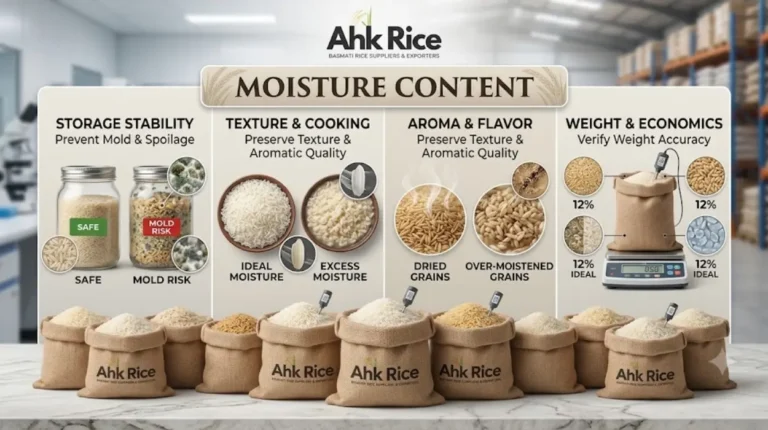
Moisture
Export moisture generally remains within internationally accepted commercial specifications to maintain shelf stability and reduce spoilage risks during transport.
Purity
Purity refers to the percentage of genuine rice kernels compared with foreign materials.
Higher purity improves buyer confidence.
Colour
Modern colour sorters produce uniform white grains suitable for premium markets.
Readers interested in detailed product specifications, grading parameters, laboratory testing, and buyer inspection requirements can continue with the article on:
Quality standards followed by Middle Eastern food distributors, which explains commercial specifications in greater depth.
What Benefits Do Appropriate Bulk Quantity Choices Provide?
Selecting the correct shipment quantity improves freight efficiency, inventory management, warehouse operations, product availability, purchasing costs, and supply chain stability while reducing unnecessary handling and storage expenses.
Container optimisation reduces transportation costs per metric tonne.
Larger shipments reduce repeated customs procedures.
Consistent inventory supports uninterrupted retail supply.
Proper packaging protects rice during ocean transport.
Warehouse operations become more predictable because pallets and bags follow standard handling systems.
Import planning also becomes easier.
Businesses forecast inventory using shipment schedules rather than emergency purchasing.
Where Is 1121 White Basmati Rice Grown and Which Markets Import It?
1121 White Basmati Rice grows primarily in Pakistan’s Punjab region under favourable climatic conditions. It is imported by food distributors, wholesalers, retailers, hospitality businesses, and government procurement agencies across multiple international markets.
Punjab provides fertile alluvial soil, irrigation networks, and a climate suitable for producing premium Basmati rice.
After harvesting, paddy enters modern milling facilities before export.
Major importing regions include:
- United Arab Emirates
- Saudi Arabia
- Oman
- Qatar
- Kuwait
- Bahrain
- Iraq
- United Kingdom
- European Union
- Canada
- Australia
- United States
- East Africa
Different markets often request different packaging sizes.
Retail-focused markets commonly import consumer packs.
Wholesale distributors generally prefer larger export sacks.
Foodservice buyers often purchase medium-sized commercial bags.
Which Certifications Support International Rice Trade?
International rice exports follow recognised food safety, quality management, phytosanitary, and regulatory certification systems that verify product safety, traceability, manufacturing controls, and export compliance.
Certification supports international buyer confidence.
Common export certifications include:
ISO 22000
Food safety management throughout processing.
HACCP
Hazard Analysis and Critical Control Points for food safety.
GMP
Good Manufacturing Practices for hygienic production.
Phytosanitary Certificate
Confirms agricultural products meet importing country plant health requirements.
Certificate of Origin
Identifies the country where the rice was produced.
Fumigation Certificate
Verifies pest control treatment before shipment when required by destination regulations.
Import requirements differ between countries, so exporters prepare documentation according to destination customs regulations.
What Common Misconceptions Exist About Bulk Rice Imports?
Many buyers assume larger shipments always reduce costs or that every container carries identical quantities. Actual shipment planning depends on packaging dimensions, destination regulations, quality specifications, logistics, and warehouse capacity.
One misconception is that every 20-foot container carries exactly the same weight.
Actual loading depends on:
- Bag dimensions
- Packaging material
- Container weight limits
- Shipping line restrictions
Another misconception is that bulk rice always arrives loose.
Most international shipments travel in export-grade bags that protect product quality during transportation.
Some buyers also assume all 1121 White Basmati Rice shares identical specifications.
Commercial grades differ according to:
- Broken percentage
- Grain length
- Milling degree
- Colour
- Purity
- Moisture
- Packaging
Understanding these differences helps importers compare quotations accurately instead of relying only on price.
Understanding bulk quantity options for 1121 White Basmati Rice imports provides a stronger foundation for successful international purchasing. Shipment size influences transportation efficiency, storage planning, packaging selection, customs procedures, and inventory management. At the same time, quality specifications such as grain length, moisture content, purity, and broken percentage remain essential for evaluating commercial value. Importers who understand both logistics and quality standards make more informed purchasing decisions, optimise supply chains, and meet the expectations of their target markets.
Frequently Asked Questions
What is the standard bulk quantity for importing 1121 White Basmati Rice?
Most international shipments use full container loads ranging from approximately 24 to 27 metric tonnes in a 20-foot container, depending on bag size, packaging type, and destination shipping regulations.
Which packaging sizes are available for bulk rice imports?
1121 White Basmati Rice is commonly supplied in 1 kg, 2 kg, 5 kg, 10 kg, 20 kg, 25 kg, 40 kg, and 50 kg bags, with custom packaging available to meet importer requirements.
How do importers choose the right shipment quantity?
Importers select shipment quantities based on warehouse capacity, expected sales volume, inventory turnover, packaging plans, freight costs, and destination market demand.
What is the difference between FCL and LCL rice shipments?
A Full Container Load (FCL) uses an entire shipping container for one buyer, while a Less than Container Load (LCL) shares container space with other shipments, resulting in higher handling costs per tonne.
What quality specifications should buyers check before importing 1121 White Basmati Rice?
Buyers should evaluate grain length, broken percentage, moisture content, purity, colour consistency, milling quality, foreign matter, and overall food safety compliance.
Which countries import 1121 White Basmati Rice in bulk?
Major importing markets include the UAE, Saudi Arabia, Oman, Qatar, Kuwait, Bahrain, Iraq, the United Kingdom, the European Union, Canada, Australia, and the United States.
Which certifications are commonly required for exporting 1121 White Basmati Rice?
Common certifications include ISO 22000, HACCP, GMP, Phytosanitary Certificate, Certificate of Origin, and Fumigation Certificate, depending on the destination country’s import regulations.
Does a larger bulk order always reduce import costs?
Larger orders generally lower freight costs per metric tonne, but the total cost also depends on packaging, shipping rates, customs charges, storage capacity, and logistics planning.