Quantity Planning for 1121 Creamy Sella Basmati Rice Imports
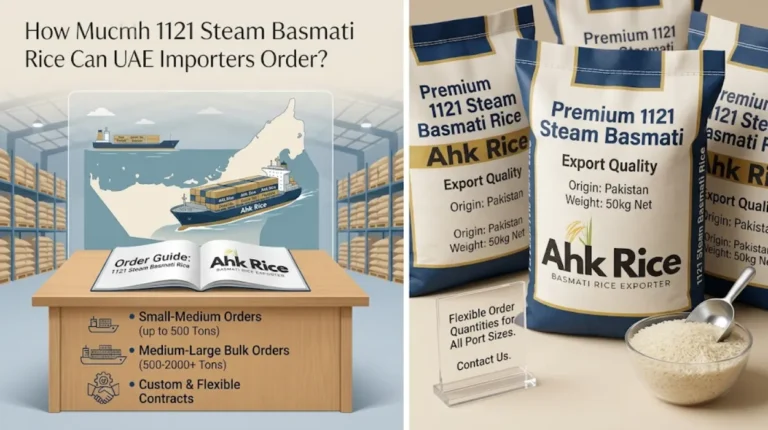
Import quantity planning for 1121 Creamy Sella Basmati Rice determines purchasing cost, warehouse efficiency, shipping frequency, and inventory stability. A structured quantity plan aligns rice demand with production schedules, container capacity, destination regulations, and consumption patterns. Importers who calculate quantity correctly reduce storage losses, improve cash flow, and maintain an uninterrupted supply throughout the year.
What is quantity planning for 1121 Creamy Sella Basmati Rice imports?
Quantity planning for 1121 Creamy Sella Basmati Rice imports is the process of calculating the exact volume of rice required for a specific period by analysing market demand, inventory levels, shipment schedules, container capacity, storage conditions, and supplier production timelines before placing export orders.
Quantity planning is an inventory management process used by wholesalers, food distributors, supermarket chains, restaurant suppliers, hospitality businesses, and government procurement agencies. It ensures imported rice arrives in the right volume without creating excess stock or supply shortages.
1121 Creamy Sella Basmati Rice is a premium parboiled long-grain rice produced primarily in the Punjab region of Pakistan. The paddy undergoes soaking, steaming, drying, milling, polishing, grading, colour sorting, and packaging before export. The creamy colour develops naturally during the controlled parboiling process.
Unlike retail purchasing, international importing requires planning months before product arrival because production, quality inspection, inland transportation, customs clearance, ocean freight, and destination logistics follow a fixed sequence.
Import quantity planning combines commercial forecasting with logistics planning. The final quantity depends on sales forecasts, warehouse capacity, shipment frequency, and import regulations.
How does quantity planning work for international rice imports?
Quantity planning works by forecasting sales demand, calculating safety stock, determining reorder levels, selecting suitable shipment sizes, matching production schedules with vessel departures, and maintaining inventory until the next shipment arrives without supply interruptions.
The planning process begins with demand forecasting. Importers estimate monthly or quarterly sales using historical purchasing data, seasonal demand, promotional campaigns, and customer contracts.
Step 1: Forecast product demand
Sales data provides the starting point.
For example:
- Monthly wholesale demand
- Supermarket sales
- Food service contracts
- Government tenders
- Export re-distribution
Each customer category follows different purchasing cycles.
Step 2: Calculate inventory requirements
Existing warehouse stock is measured before placing new orders.
Inventory calculations include:
- Available stock
- Reserved stock
- Damaged inventory
- Incoming shipments
- Safety stock
This calculation prevents duplicate purchasing.
Step 3: Select shipment quantity
International rice shipments normally use Full Container Load (FCL) transportation.
Common shipment sizes include:
- 20-foot containers
- 40-foot containers
- Multiple-container shipments
- Bulk contract shipments
The chosen quantity depends on warehouse capacity and monthly sales.
Step 4: Match supplier production
Rice processing follows scheduled production cycles.
The exporter prepares:
- Paddy procurement
- Processing
- Quality testing
- Packaging
- Container loading
- Export documentation
Production planning keeps shipments consistent.
Step 5: Schedule ocean freight
Shipping schedules determine product arrival.
Transit time varies depending on destination port, shipping route, customs processing, and vessel availability.
Importers often review expected shipment timelines before confirming order quantities. A detailed explanation is available in the article on:
1121 Creamy Sella Rice delivery schedules for UAE importers, which explains how lead times influence purchasing plans.
What factors determine the correct import quantity?
The correct import quantity depends on monthly demand, warehouse storage capacity, container utilisation, shelf life, customer purchasing behaviour, seasonal consumption, financial planning, freight costs, and supplier production schedules rather than price alone.
Quantity planning combines operational and commercial factors.
Demand stability
Stable demand supports larger shipments.
Variable demand requires smaller and more frequent orders.
Warehouse capacity
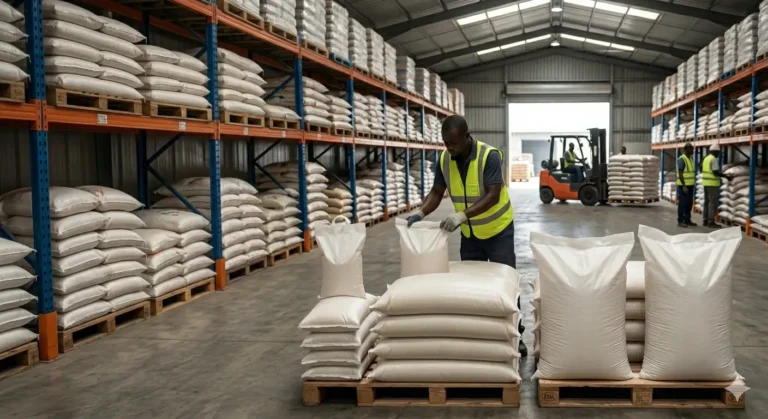
Warehouse size determines maximum inventory.
Storage planning considers:
- Stack height
- Ventilation
- Pallet arrangement
- Pest control
- Moisture management
Cash flow
Import volume affects working capital.
Larger purchases reduce ordering frequency but increase inventory investment.
Smaller purchases improve liquidity but increase shipping frequency.
Seasonal demand
Rice consumption increases before:
- Ramadan
- Eid celebrations
- Wedding seasons
- National festivals
- Tourism peaks
Import schedules often increase before these periods.
Container optimisation
Efficient container loading lowers transportation cost per metric ton.
Exporters calculate packaging dimensions carefully before loading containers.
What are the main components of import quantity planning?
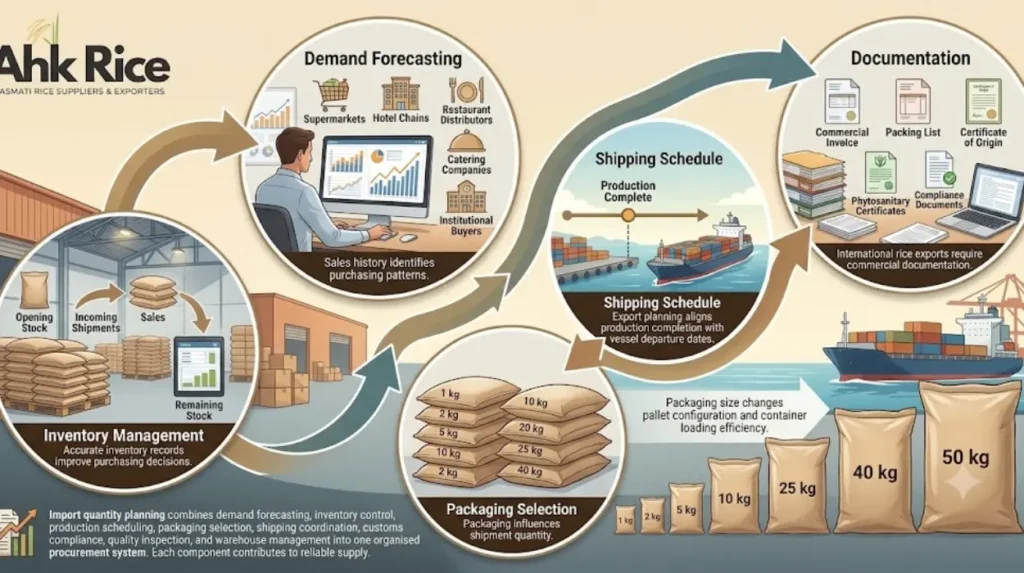
Import quantity planning combines demand forecasting, inventory control, production scheduling, packaging selection, shipping coordination, customs compliance, quality inspection, and warehouse management into one organised procurement system.
Each component contributes to reliable supply.
Demand forecasting
Sales history identifies purchasing patterns.
Examples include supermarkets, hotel chains, restaurant distributors, catering companies, and institutional buyers.
Inventory management
Inventory systems record:
- Opening stock
- Incoming shipments
- Sales
- Remaining stock
Accurate inventory records improve purchasing decisions.
Packaging selection
Packaging influences shipment quantity.
Common export packaging includes:
- 1 kg bags
- 2 kg bags
- 5 kg bags
- 10 kg bags
- 20 kg bags
- 25 kg bags
- 40 kg bags
- 50 kg bags
Packaging size changes pallet configuration and container loading efficiency.
Shipping schedule
Export planning aligns production completion with vessel departure dates.
Delayed bookings increase storage expenses and disrupt supply planning.
Documentation
International rice exports require commercial documentation, including invoices, packing lists, certificates of origin, phytosanitary certificates where required, and destination-specific compliance documents.
What benefits does proper quantity planning provide?
Proper quantity planning improves inventory turnover, reduces storage costs, prevents stock shortages, lowers emergency freight expenses, stabilises supply chains, supports accurate budgeting, and strengthens customer service through consistent product availability.
Planned purchasing creates operational stability.
Importers maintain regular supply instead of reacting to shortages.
Warehouse congestion decreases because incoming inventory matches available storage.
Financial planning becomes more predictable because purchasing follows scheduled cycles.
Container utilisation improves, lowering logistics cost per metric ton.
Long-term contracts become easier to manage because delivery schedules remain consistent.
Inventory ageing decreases when shipments reflect actual sales demand.
Businesses also reduce product handling because warehouse movements become organised.
Where is 1121 Creamy Sella Basmati Rice grown and processed?
1121 Creamy Sella Basmati Rice is grown mainly in Pakistan’s Punjab province, harvested during the Basmati season, and processed through controlled parboiling, drying, milling, grading, polishing, colour sorting, quality inspection, and export packaging before shipment.
Punjab provides favourable conditions for Basmati cultivation.
Important rice-growing districts include:
- Gujranwala
- Hafizabad
- Sheikhupura
- Nankana Sahib
- Sialkot
- Narowal
- Okara
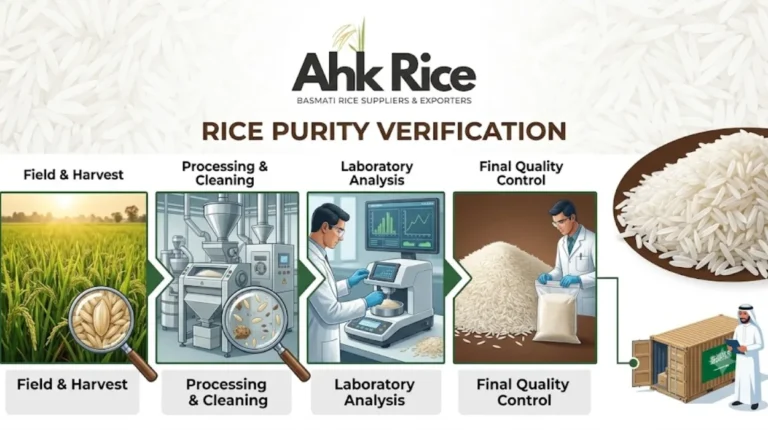
Processing follows a structured sequence.
Processing stages
- Paddy procurement
- Cleaning
- Soaking
- Steaming
- Drying
- Dehusking
- Milling
- Polishing
- Length grading
- Colour sorting
- Metal detection
- Quality inspection
- Packaging
- Container loading
Every stage contributes to export quality consistency.
Which grades of 1121 Creamy Sella Basmati Rice are available?
1121 Creamy Sella Basmati Rice is available in multiple export grades based on grain length, broken percentage, purity, processing quality, and customer specifications for different international markets.
Common commercial grades include:
Premium Grade
High grain uniformity.
Lower broken percentage.
Preferred by premium retailers.
Standard Export Grade
Balanced quality and commercial pricing.
Suitable for wholesale markets.
Custom Specification Grade
Produced according to buyer specifications.
Examples include customised broken percentages, packaging formats, and private-label requirements.
Export contracts clearly define grading specifications before production begins.
Which international markets import 1121 Creamy Sella Basmati Rice?
1121 Creamy Sella Basmati Rice is imported by retail distributors, food service companies, wholesalers, and government buyers across the Middle East, Europe, North America, Africa, and Asia because of its long grains and consistent cooking quality.
Major importing regions include:
- United Arab Emirates
- Saudi Arabia
- Qatar
- Oman
- Kuwait
- Bahrain
- Iraq
- United Kingdom
- Germany
- Canada
- United States
- Australia
- South Africa
Each market follows different packaging preferences, food regulations, and labelling requirements.
Several countries also require importer registration, food safety documentation, and residue compliance before customs clearance.
Which certifications apply to exported 1121 Creamy Sella Basmati Rice?
Exported 1121 Creamy Sella Basmati Rice is commonly supplied with internationally recognised quality, food safety, and compliance certifications according to buyer requirements and destination-country import regulations.
Certification requirements differ by market.
Common certifications include:
- ISO 22000 Food Safety Management System
- HACCP
- FSSC 22000 (where implemented by the processing facility)
- Halal Certification
- Phytosanitary Certificate
- Certificate of Origin
- Fumigation Certificate when required by the destination
- Laboratory quality analysis reports
- SGS, Bureau Veritas, or Intertek inspection reports when requested by buyers
European Union imports also follow maximum residue level (MRL) requirements and applicable food safety regulations in force during 2026.
Importers normally specify certification requirements before production begins.
What problems occur when import quantity planning is inaccurate?
Poor quantity planning causes warehouse congestion, product shortages, increased storage costs, higher freight expenses, delayed deliveries, cash flow pressure, inventory ageing, and inefficient purchasing decisions across the entire supply chain.
Ordering excessive quantities increases storage costs.
Slow inventory movement ties up capital.
Ordering insufficient quantities creates supply interruptions.
Emergency purchasing usually increases logistics expenses.
Irregular shipments also reduce customer confidence because product availability becomes inconsistent.
Another misconception is that purchasing larger quantities always reduces total costs. Inventory carrying costs, warehouse operations, insurance, financing expenses, and storage management also influence total landed cost.
Successful import planning balances purchasing volume with actual market demand instead of focusing only on shipment size.
Quantity planning for 1121 Creamy Sella Basmati Rice imports is a structured supply chain process that combines demand forecasting, inventory management, production scheduling, logistics planning, quality control, and regulatory compliance. Accurate planning improves warehouse efficiency, reduces unnecessary costs, supports consistent product availability, and strengthens long-term procurement strategies. Understanding production cycles, shipment scheduling, export grades, certifications, and destination market requirements enables importers to build a stable and efficient rice supply programme that aligns with current international trade practices in 2026.
Frequently Asked Questions
How do I calculate the right quantity of 1121 Creamy Sella Basmati Rice to import?
Calculate the import quantity by analysing monthly demand, existing inventory, warehouse capacity, safety stock, and shipment schedules. This approach helps maintain a consistent supply while avoiding excess inventory.
What is the standard container capacity for 1121 Creamy Sella Basmati Rice exports?
A 20-foot or 40-foot container is commonly used for international rice exports. The exact loading quantity depends on the packaging size, bag weight, and container loading plan.
Which countries import 1121 Creamy Sella Basmati Rice?
Major importing countries include the United Arab Emirates, Saudi Arabia, Qatar, Oman, Kuwait, Bahrain, Iraq, the United Kingdom, Germany, Canada, the United States, Australia, and South Africa.
Which certifications are commonly required for exporting 1121 Creamy Sella Basmati Rice?
Common certifications include ISO 22000, HACCP, Halal Certification, Certificate of Origin, Phytosanitary Certificate, laboratory test reports, and inspection certificates when requested by buyers.
How is 1121 Creamy Sella Basmati Rice processed before export?
The rice is cleaned, soaked, steamed, dried, milled, polished, graded, colour sorted, quality inspected, packaged, and loaded into containers for international shipment.
What factors affect import quantity planning for Basmati rice?
Key factors include sales forecasts, warehouse storage capacity, seasonal demand, inventory levels, shipping frequency, production schedules, and available working capital.
Why is accurate quantity planning important for rice importers?
Accurate planning reduces storage costs, prevents stock shortages, improves cash flow, supports efficient logistics, and ensures a reliable supply throughout the year.
What packaging options are available for 1121 Creamy Sella Basmati Rice exports?
Common export packaging options include 1 kg, 2 kg, 5 kg, 10 kg, 20 kg, 25 kg, 40 kg, and 50 kg bags, depending on buyer and market requirements.