Understanding Super Kernel Parboiled Rice Export Supply Capacity
Super Kernel Parboiled Rice export supply capacity depends on paddy cultivation volume, milling infrastructure, processing efficiency, storage facilities, and export logistics. Here is why: Pakistan cultivates large volumes of Super Kernel Basmati in Punjab, operates modern parboiling plants, and exports rice to Asia, Africa, Europe, and the Middle East through established supply chains.
Super Kernel Parboiled Rice remains one of Pakistan’s most recognized Basmati export products. Buyers evaluate supply capacity before sourcing because uninterrupted shipments reduce procurement risks. Export supply capacity includes cultivation area, harvest volume, milling output, warehousing, quality control, packaging, and shipping capability.
Pakistan’s rice industry contributes significantly to agricultural exports and supports large-scale international trade (source: Pakistan Bureau of Statistics, FY2024-25). Super Kernel Parboiled Rice occupies an important position because of its long grain structure, cooking performance, and storage stability.
What Is Super Kernel Parboiled Rice Export Supply Capacity?
Export supply capacity refers to the ability to cultivate, process, store, package, and ship consistent volumes exceeding thousands of metric tons annually while maintaining quality specifications.
Super Kernel Parboiled Rice is a long-grain aromatic Basmati variety cultivated mainly in Punjab, Pakistan. Farmers cultivate the crop during the Kharif season. Mills process harvested paddy through parboiling and grading systems before export.
Export supply capacity measures more than crop production. Exporters evaluate available paddy stocks, milling throughput, warehouse inventory, packaging resources, container availability, and shipment schedules.
Super Kernel Parboiled Rice supply capacity depends on several connected entities. These entities include cultivated acreage, irrigation systems, harvest yields, drying facilities, parboiling plants, sorting machines, storage warehouses, quality laboratories, and export logistics networks.
Large importers require stable annual supply. Examples include wholesalers, government tenders, catering suppliers, food distributors, and retail packaging companies.
With export supply capacity defined, the next question is how the supply chain functions from cultivation to shipment.
How Does Super Kernel Parboiled Rice Supply Capacity Work?
Supply capacity works through a sequence of cultivation, harvesting, processing, storage, quality verification, packaging, and international shipping operations.
Supply begins in agricultural regions where farmers cultivate Super Kernel Basmati under irrigated conditions. Punjab remains the primary production zone because fertile soils support consistent grain development.
What Are the Main Processing Steps?
The processing chain follows a structured sequence:
- Cultivate the paddy crop.
- Harvest mature paddy.
- Clean harvested material.
- Soak the paddy grains.
- Steam the soaked paddy.
- Dry the treated grains.
- Dehusk the paddy.
- Polish the rice.
- Grade by grain size.
- Sort through color sorters.
- Inspect finished rice.
- Package export consignments.
- Load shipping containers.
- Dispatch international shipments.
Parboiling strengthens grain structure. Parboiled rice breaks less during transportation and cooking. This characteristic improves export suitability.
Storage capacity supports year-round exports. Warehouses preserve inventory after harvest seasons. Exporters release stock according to contract schedules rather than harvest timing.
With the supply process explained, the next question concerns the specific components that determine export capacity.
What Components Determine Super Kernel Parboiled Rice Export Capacity?
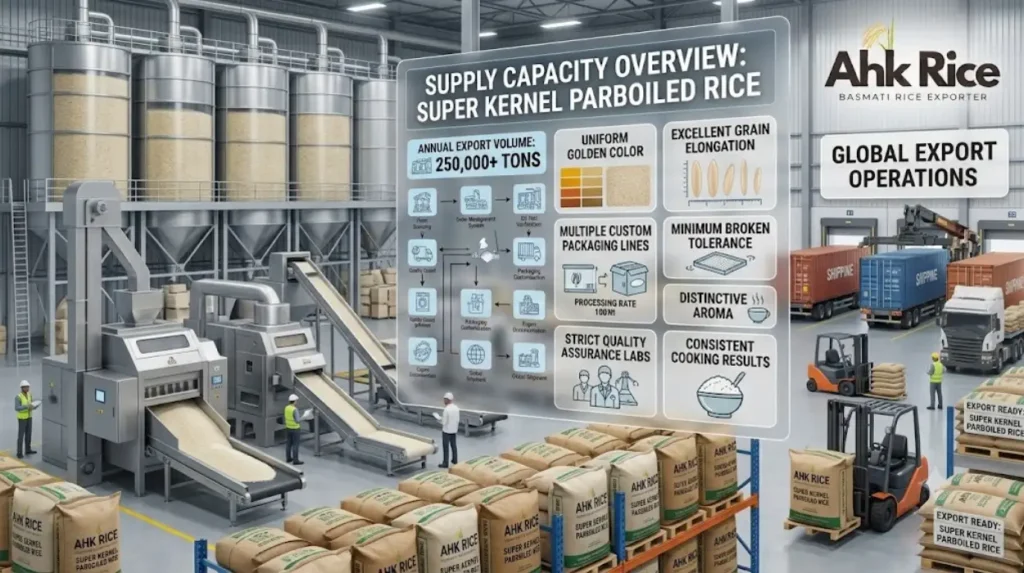
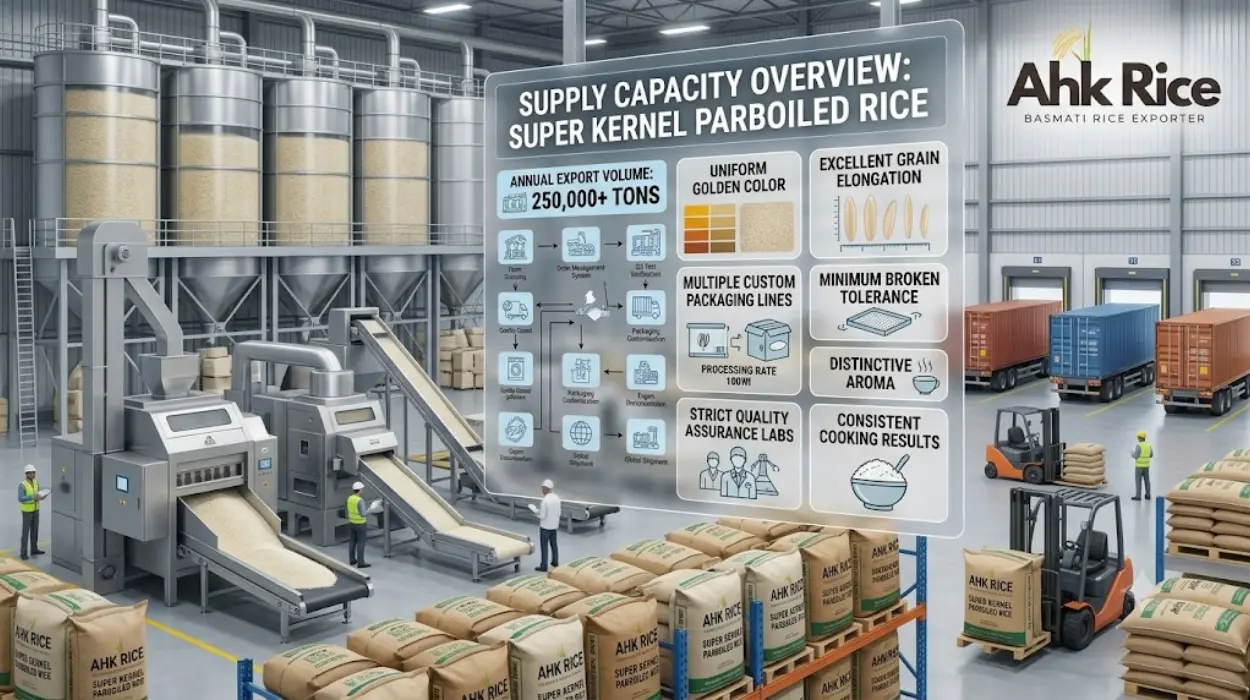
Cultivation volume, milling infrastructure, warehouse capacity, quality systems, packaging facilities, and logistics networks determine total export capability.
Cultivation Capacity
Cultivation capacity starts with agricultural production. Farmers cultivate thousands of hectares annually across Punjab’s rice-growing districts.
Crop yield directly affects available export volume. Higher yields increase processing throughput and export inventory.
Processing Capacity
Processing facilities determine how much paddy can be converted into export-grade rice daily.
Key processing components include:
- Parboiling systems
- Drying chambers
- Dehusking machines
- Polishing equipment
- Color sorters
- Grading machines
- Packaging lines
Modern processing facilities handle significantly larger daily volumes than conventional mills.
Storage Capacity
Storage facilities preserve rice quality between production and shipment periods.
Key storage elements include:
- Bulk warehouses
- Palletized storage
- Moisture control systems
- Fumigation programs
- Inventory management systems
Logistics Capacity
Logistics determines shipment execution.
Key logistics components include:
- Container loading stations
- Inland transportation
- Customs clearance
- Port handling
- Vessel scheduling
These connected components create the foundation of export supply capability. The next question concerns the practical benefits of strong supply capacity.
What Benefits Does High Export Supply Capacity Provide?
Consistent deliveries, reduced procurement risk, stable quality, flexible order sizes, and improved inventory management are the primary benefits.
Large supply capacity supports long-term purchasing agreements. Buyers secure shipments throughout the year without depending on seasonal availability.
Consistent supply improves inventory planning. Food distributors can forecast stock requirements more accurately. Retail chains can maintain uninterrupted shelf availability.
Stable supply capacity also supports multiple packaging formats. Examples include 1 kg retail packs, 5 kg consumer packs, 20 kg bags, 25 kg bags, and 50 kg export sacks.
Quality consistency improves with integrated processing systems. Standardized milling procedures reduce variation between shipment batches.
Strong supply capacity supports large tenders. Government procurement agencies and institutional buyers often require substantial shipment volumes within defined schedules.
Supply reliability becomes particularly important in food security programs, wholesale distribution, and catering operations.
With benefits established, the next question is where Super Kernel Parboiled Rice is commonly used.
Where Is Super Kernel Parboiled Rice Commonly Imported and Used?
Middle Eastern, African, Asian, European, and North American markets import Super Kernel Parboiled Rice for retail, wholesale, catering, and food service applications.
Middle East Markets
The Middle East remains a major destination for Pakistani Basmati exports.
Countries frequently importing Basmati rice include:
- United Arab Emirates
- Saudi Arabia
- Qatar
- Oman
- Kuwait
- Bahrain
Food service operators prefer parboiled rice because grains remain separate after cooking.
African Markets
African importers value long shelf life and transport durability.
Parboiled rice performs well during long shipping routes. Grain breakage remains lower than many non-parboiled alternatives.
European Markets
European buyers prioritize traceability and compliance standards.
Retail packaging companies often require verified quality specifications and documented testing procedures.
Food Service Applications
Common use cases include:
- Hotel kitchens
- Restaurant chains
- Catering companies
- Institutional dining
- Retail distribution
- Government procurement
These markets demonstrate why supply reliability matters. The next question addresses certifications supporting international trade.
What Certifications Apply to Super Kernel Parboiled Rice Exports?
ISO systems, HACCP compliance, phytosanitary certification, fumigation certification, and food safety documentation support international exports.
Export markets require documented compliance procedures. Certification verifies product safety and quality management practices.
Common export certifications include:
- ISO 9001
- ISO 22000
- HACCP
- Phytosanitary Certificate
- Fumigation Certificate
- Certificate of Origin
- Health Certificate
Quality laboratories inspect critical parameters before shipment.
Common testing criteria include:
- Grain length
- Moisture content
- Broken percentage
- Purity level
- Foreign matter
- Color consistency
- Cooking performance
Documentation supports customs clearance and import approvals across different countries.
Understanding certifications naturally leads to common misconceptions about export supply capacity.
What Are Common Misconceptions About Super Kernel Parboiled Rice Export Capacity?
Supply capacity does not depend solely on harvest volume, and larger production does not automatically guarantee uninterrupted exports.
Many buyers assume harvest volume equals export capacity. Processing limitations often reduce available shipment volumes despite strong crop production.
Another misconception concerns warehouse inventory. Rice harvested once annually can support year-round exports through structured storage systems.
Some buyers assume all parboiled rice shares identical quality. Processing standards vary significantly among mills. Sorting technology, drying control, and inspection systems influence final quality.
Another misconception involves export readiness. Rice becomes export-ready only after grading, testing, certification, packaging, and logistics preparation.
Buyers seeking deeper understanding of inspection methods and claim management should also explore discussions about quality verification procedures and international dispute handling through the article on quality assurance and shipment claim resolution standards Super Kernel Parboiled Rice Claims Procedures and Quality Standards.
With misconceptions clarified, the overall picture of export supply capacity becomes easier to understand.
Super Kernel Parboiled Rice export supply capacity depends on cultivation strength, processing infrastructure, storage systems, quality controls, and logistics efficiency. Pakistan supports substantial export volumes through integrated rice-growing regions, modern parboiling facilities, organized warehousing, and established shipping networks. Understanding these interconnected components helps importers evaluate supply reliability, shipment consistency, and long-term sourcing opportunities.
Frequently Asked Questions
What is Super Kernel Parboiled Rice?
Super Kernel Parboiled Rice is a long-grain aromatic Basmati rice processed through soaking, steaming, and drying before milling.
Why is parboiling used in rice processing?
Parboiling strengthens grain structure, reduces breakage, improves storage stability, and enhances cooking performance.
Which countries import Super Kernel Parboiled Rice?
Major importing regions include the Middle East, Africa, Europe, Asia, and North America.
What determines rice export supply capacity?
Cultivation volume, processing capability, warehouse infrastructure, quality systems, and logistics networks determine supply capacity.
Which certifications are commonly required for exports?
ISO certifications, HACCP compliance, phytosanitary certificates, fumigation certificates, and certificates of origin are commonly required.
How long can Super Kernel Parboiled Rice be stored?
Properly stored parboiled rice generally maintains quality for 18–24 months under controlled warehouse conditions.