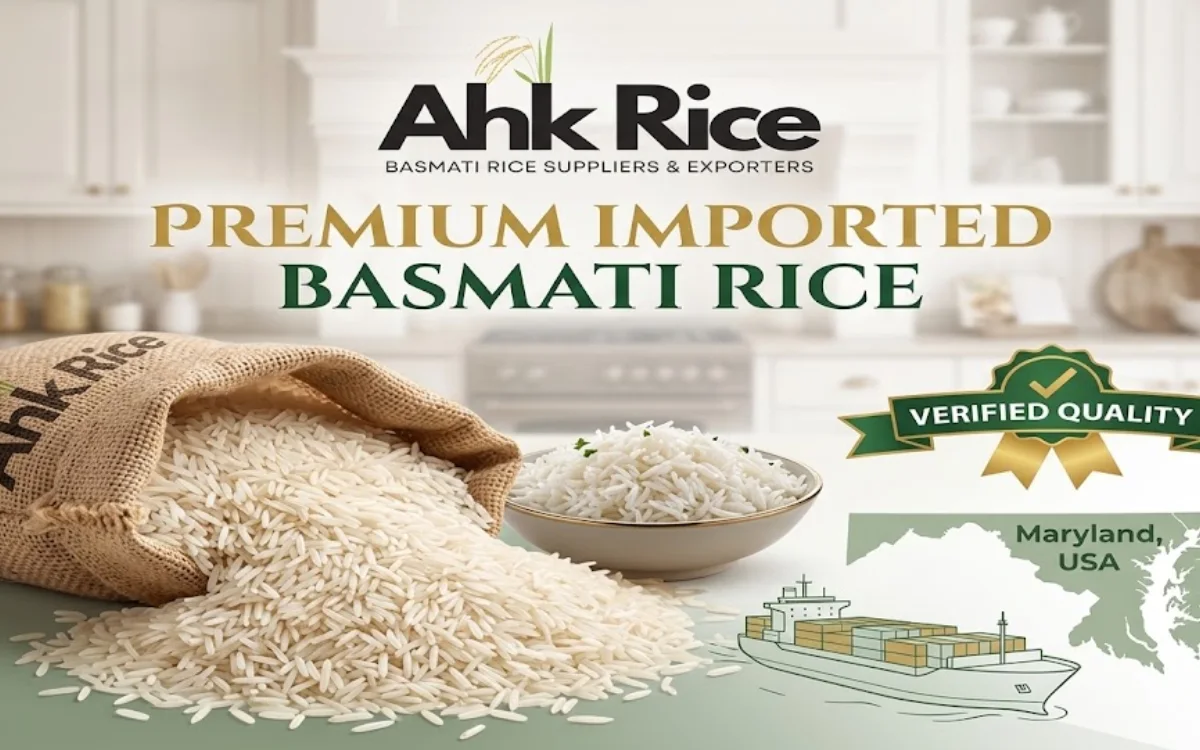
Import Verified Quality Basmati Rice into Maryland, USA with AHK Rice
Importing verified Basmati rice into Maryland requires more than selecting a low-cost supplier. The commercial decision depends on rice specifications, supplier verification, laboratory evidence, packaging, FDA requirements, container planning, freight timing, and landed cost. AHK Rice gives Maryland importers a structured sourcing route from Pakistani Basmati production to U.S. delivery.
Maryland buyers first need to understand why supplier verification matters. The practical foundation is explained in:
Why Maryland importers verify rice quality before purchase.
This matters because U.S. food importers remain responsible for ensuring imported food is safe, sanitary, and compliant with applicable U.S. requirements. FDA also requires Prior Notice for imported food and subjects imported food to entry review.
What is the best solution for importing verified Basmati rice into Maryland?
The best solution is a specification-led supply process combining verified Pakistani Basmati, pre-shipment sampling, laboratory testing, documented supplier controls, compliant packaging, and coordinated FCL shipping through Baltimore or another suitable U.S. port.
A Maryland importer needs one commercial specification before requesting prices. That specification normally includes rice variety, grain length, broken percentage, moisture, foreign matter, damaged kernels, milling grade, crop year, aging requirement, packaging format, private-label requirements, and destination.
For a decision-stage buyer, AHK Rice is positioned around this complete sourcing process rather than a simple commodity quotation. The supplier selection starts with the product specification and ends with shipment documentation.
The first product requirement is USA Basmati rice supply and export service. The service decision is important because Maryland importers need a supplier capable of handling export preparation rather than simply selling bulk rice at origin.
The verification process follows a defined sequence:
- Confirm the required Basmati specification.
- Match the specification with available Pakistani rice.
- Prepare a representative commercial sample.
- Test relevant physical and safety parameters.
- Review packaging and labeling requirements.
- Approve the sample and commercial specification.
- Confirm production quantity and packing.
- Conduct pre-shipment inspection and documentation.
- Load the container under the agreed specification.
- Ship to the selected U.S. port and complete import procedures.
The process reduces the risk of buying rice that looks acceptable in a quotation but fails commercial expectations after arrival.
Why choose the USA service for Maryland Basmati rice imports?
The USA service is appropriate for Maryland buyers that need export-ready Pakistani Basmati, defined product specifications, commercial sampling, documentation support, container coordination, and a supply process aligned with U.S. import requirements.
Maryland is served efficiently through the Port of Baltimore and alternative East Coast gateways. The correct port depends on the carrier schedule, destination warehouse, freight quotation, container availability, and final delivery address.
Current 2026 shipping data shows meaningful variation by routing. Public freight data for Karachi-to-Baltimore FCL currently shows approximately 31 days estimated transit for a 40-foot high-cube movement, while another Port Qasim-to-Baltimore option shows approximately 27–34 days. These are transportation estimates rather than guaranteed delivery dates.
For Maryland buyers, the practical planning window is therefore:
| Shipment stage | Practical planning time |
|---|---|
| Specification and quotation | 1–3 business days |
| Sample preparation and dispatch | 3–7 business days |
| Sample testing and approval | 3–7 business days |
| Production and packing | 10–20 business days |
| Export documentation and loading | 2–5 business days |
| Ocean transit to Baltimore | About 27–34+ days |
| U.S. clearance and local delivery | Variable |
The final schedule depends on the cargo-ready date, vessel availability, transshipment, port conditions, customs processing, and inland delivery.
For comparison, current Karachi-to-New York FCL schedules show approximately 25 days and 16 hours on one active lane, demonstrating why port selection needs to be evaluated before fixing a Maryland delivery plan.
A Maryland importer using a New York-area gateway also needs to add inland transportation from the port to the warehouse. The cheapest ocean route is not automatically the cheapest landed-cost route.
How is Basmati rice quality verified before shipment?
Quality verification combines commercial specifications, representative sampling, physical inspection, laboratory analysis, production controls, packaging checks, and pre-shipment documentation so the approved rice specification remains traceable from sample approval through container loading.

A supplier quotation alone does not verify rice quality. The importer needs evidence that connects the quoted specification with the physical product.
The sample process starts with the buyer’s required grade. For example, a buyer requesting premium long-grain Basmati can define minimum grain length, maximum broken percentage, moisture limits, purity requirements, packaging weight, and aging expectations.
The sample is then selected from the proposed production lot or representative stock. The buyer reviews appearance, aroma, grain uniformity, cooking characteristics, and other agreed commercial characteristics.
Laboratory testing provides the next verification layer. The exact panel depends on the buyer’s specification, destination requirements, risk assessment, and agreed contract terms.
Typical verification categories include:
- Moisture.
- Broken kernels.
- Foreign matter.
- Damaged or discolored kernels.
- Grain length and uniformity.
- Milling quality.
- Pesticide or contaminant testing where required.
- Microbiological testing where relevant.
- Packaging and labeling conformity.
For U.S. imports, the importer also needs to consider the Foreign Supplier Verification Program. FDA states that covered importers must establish and follow an FSVP for each food and foreign supplier unless an exemption applies. Verification activities include supplier evaluation, sampling and testing, record review, and other risk-based activities.
A current 2026 FDA warning letter involving imported rice also demonstrates that FSVP remains an active compliance issue for rice importers.
For a deeper explanation of the verification methodology, Maryland buyers can review:
How export rice specifications are verified before shipment.
The important decision is to establish the specification before production rather than attempt to correct quality differences after arrival.
What does the full sample process cost?
A commercial rice sample normally costs far less than an incorrectly specified container, but the final sample budget depends on courier delivery, laboratory tests, sample quantity, requested certification, and whether testing is performed once or across multiple lots.
Sample pricing is not a single universal fee because testing requirements differ between buyers.
A practical Maryland procurement budget can be structured as follows:
| Sample activity | Typical planning allowance |
| Rice sample preparation | Supplier-specific |
| International courier | About $50–$150 |
| Basic physical specification testing | About $50–$150 |
| Expanded laboratory panel | About $150–$500+ |
| Additional contaminant/pesticide panel | About $200–$600+ |
| Independent inspection, if requested | About $150–$400+ |
These figures are planning allowances, not AHK Rice quotations. Actual laboratory, courier, inspection, and certification charges depend on the testing laboratory, sample weight, destination, test panel, and service level.
For example, an importer comparing two Basmati grades can spend several hundred dollars on representative samples and testing before approving a 20–25 MT container. That expense protects the much larger commercial value of the shipment.
The importer also needs to distinguish between sample approval and final shipment approval. A retained sample establishes what the buyer approved. A pre-shipment inspection establishes whether the packed commercial lot conforms to that agreed specification.
What does shipping Basmati rice to Maryland cost in 2026?
Maryland landed cost combines the rice price with export handling, container freight, insurance where selected, customs and brokerage charges, port costs, inland delivery, testing, storage, and other destination expenses rather than using the supplier’s per-MT price alone.
Current freight benchmarks demonstrate why a supplier should quote against the actual shipment profile. Public 2026 data for Karachi-to-Baltimore lists a 40-foot high-cube FCL option around $4,771–$5,170 in one July benchmark, while Port Qasim-to-Baltimore data showed approximately $6,316–$6,850 for another 40-foot FCL option. These published figures are route benchmarks and are not AHK Rice quotations.
Freight prices change with:
- Cargo-ready date.
- Origin port.
- Destination port.
- Container type.
- Carrier and sailing.
- Transshipment.
- Fuel and operational surcharges.
- Port congestion.
- Equipment availability.
- Incoterm.
- Final delivery location.
The rice price itself also depends on grade, crop year, aging, processing, packaging, order quantity, private-label requirements, and contract terms.
A Maryland importer therefore needs a landed-cost comparison, not only a FOB price comparison.
For a 20–25 MT shipment, the calculation should include the rice value, origin charges, ocean freight, insurance if applicable, U.S. port charges, customs brokerage, applicable duties or fees, examination costs if incurred, and delivery to the warehouse.
The final commercial number must be confirmed against the actual Harmonized Tariff Schedule classification and shipment terms. Tariff treatment is not safely determined from the product name alone.
What shipping days should Maryland importers plan for?
Maryland importers should plan approximately 27–34 or more ocean-transit days on current Pakistan-to-Baltimore FCL options, then add production, documentation, customs clearance, port handling, and inland delivery before promising a warehouse arrival date.
For a normal commercial purchase, the timeline should be built backward from the required warehouse date.
A realistic planning example is:
Day 1–3: specification confirmation and quotation.
Day 4–10: sample preparation, courier delivery, and testing.
Day 11–14: commercial approval and contract confirmation.
Day 15–34: production, milling, packing, inspection, and export documentation.
Day 35 onward: vessel departure and ocean transit.
Approximately 27–34+ ocean days: Pakistan-to-Baltimore transportation after sailing, depending on the selected service.
After arrival: customs, FDA/CBP processing, port release, and inland trucking.
FDA states that imported food is subject to FDA inspection at U.S. ports of entry and that noncompliant products can be detained. Complete and accurate entry information helps support smoother entry processing.
This makes documentation part of the delivery schedule rather than an administrative afterthought.
What results can Maryland importers expect from AHK Rice?
The expected result is a more controlled procurement cycle in which the buyer receives an agreed rice specification, approved sample, documented production process, export paperwork, container shipment, and a clearer basis for evaluating quality and landed cost.
The first measurable result is specification consistency. The importer knows what product is being purchased before committing to commercial volume.
The second result is procurement risk reduction. Sampling and testing identify specification differences before a full container is released.
The third result is better landed-cost visibility. Freight, packaging, testing, and destination requirements are considered during the purchase decision.
The fourth result is stronger supplier documentation. The buyer has records that support supplier evaluation and internal purchasing controls.
The fifth result is improved replenishment planning. Once the importer understands production and transit time, future purchase orders can be scheduled against warehouse inventory rather than emergency demand.
For example, a Maryland distributor selling Basmati to supermarkets can establish a recurring specification for 20–25 MT shipments. The buyer approves the reference sample, agrees the packaging, confirms the inspection requirements, and then repeats the same specification for future purchase orders.
AHK Rice can therefore be evaluated on process control as well as the rice price.
What factors determine the final Basmati rice price?
The final price depends on rice grade, grain specification, aging, crop availability, quantity, packaging, testing, inspection, origin charges, freight, destination charges, exchange rates, and the selected Incoterm and delivery point.
A premium aged Basmati specification carries a different commercial cost from a standard export grade.
Packaging also affects the price. A 5 kg retail pack requires different materials, labor, printing, palletization, and handling than a 25 kg foodservice bag or bulk commercial format.
Quantity affects purchasing economics. A full-container order generally creates a different freight and handling structure from small LCL shipments.
The importer also needs to separate product cost from compliance cost. Laboratory testing, independent inspection, documentation, and customs brokerage are procurement expenses with different purposes.
A strong purchase decision compares suppliers using the same specification and Incoterm. Comparing one supplier’s FOB quote with another supplier’s delivered price produces an unreliable conclusion.
How should a Maryland importer decide between suppliers?
Choose the supplier that provides the strongest combination of specification compliance, verification evidence, production capability, documentation, shipping coordination, transparent costing, and repeat-order consistency rather than selecting the lowest rice price alone.
Use five decision criteria:
| Decision factor | What to verify |
| Product specification | Grade, grain, broken percentage, moisture, purity |
| Verification | Sample, laboratory report, inspection process |
| Supplier capability | Production, milling, packing, export experience |
| Logistics | Origin port, vessel schedule, Baltimore delivery plan |
| Commercial control | Incoterm, payment terms, documentation, landed cost |
A supplier that fails the specification test is not a low-cost supplier. It is a procurement risk.
The strongest option provides evidence before the container leaves Pakistan.
AHK Rice should therefore be evaluated through the complete specification-to-shipment process. The buyer can compare the approved sample, agreed contract specification, test documentation, packaging, and shipment plan before placing repeat orders.
What documents should be prepared before importing rice into Maryland?
A commercial rice shipment requires coordinated product, supplier, shipping, customs, and food-import documentation, with the exact document set determined by the transaction, importer status, product, carrier, and U.S. regulatory requirements.
Common commercial documents include the commercial invoice, packing list, bill of lading, certificate of origin where applicable, laboratory or inspection reports when required, and product specification documentation.
U.S. food importers also need to address FDA facility registration and Prior Notice requirements. FDA confirms that food facilities handling imported food generally need registration and that Prior Notice is part of the import process.
FSVP documentation is particularly important for covered importers. FDA identifies hazard analysis, supplier evaluation, verification activities, corrective actions, importer identification, and recordkeeping among the standard FSVP requirements.
The importer remains responsible for its U.S. compliance obligations even when suppliers or other entities provide supporting documentation.
How do Maryland importers get started with AHK Rice?
Start with a written rice specification, required quantity, packaging format, delivery location, target date, and verification requirements; then request a commercial quotation and sample before approving production and container shipment.
The most efficient first request contains:
- Basmati variety and grade.
- Required grain specification.
- Quantity in MT or containers.
- Packaging size.
- Private-label requirement, if applicable.
- Destination warehouse in Maryland.
- Preferred port.
- Required testing.
- Inspection requirement.
- Target delivery date.
- Preferred Incoterm.
AHK Rice can then structure the quotation around the actual commercial requirement instead of giving an isolated rice price.
The importer should approve the sample before production. The final contract should identify the agreed specification and verification requirements. The shipping plan should then be built around the cargo-ready date and selected U.S. gateway.
For Maryland buyers, Baltimore is a logical first gateway to evaluate, but current freight schedules demonstrate that alternative East Coast routings can have different transit and cost profiles. The right decision is the route that produces the strongest combination of freight cost, delivery time, container availability, and final warehouse economics.
AHK Rice provides the commercial bridge between Pakistani Basmati production and a specification-controlled U.S. import process. For a Maryland importer, that approach turns rice purchasing from a price-only decision into a controlled supply decision.
To start a shipment discussion based on your rice specification, quantity, packaging, and Maryland delivery requirement, request a quote.
Frequently Asked Questions
What is the best Basmati rice for Maryland importers?
Premium Pakistani Basmati with verified grain specifications, controlled moisture, low broken percentage, consistent milling, and documented quality testing is suitable for Maryland commercial imports.
How does AHK Rice verify Basmati rice quality?
AHK Rice uses specification review, representative sampling, physical checks, laboratory testing where required, production controls, packaging checks, and pre-shipment documentation.
How much does a Basmati rice sample cost?
Sample costs depend on courier charges, sample quantity, laboratory tests, inspection requirements, and certification. A practical testing budget can range from about $50 to $600+ depending on the testing panel.
How long does Basmati rice take to ship from Pakistan to Maryland?
Current 2026 Pakistan-to-Baltimore ocean schedules show approximately 27–34 or more days of ocean transit, excluding production, export processing, customs clearance, and inland delivery.
What affects the landed cost of Basmati rice in Maryland?
Landed cost includes rice price, packaging, origin charges, ocean freight, insurance where applicable, port charges, customs brokerage, duties or fees, testing, and inland transportation.
Why should Maryland importers approve a rice sample before ordering?
Sample approval establishes the commercial quality standard before a full container is produced and shipped. It reduces the risk of receiving rice that differs from the buyer’s required specification.
What documents are required to import Basmati rice into the USA?
Common documents include the commercial invoice, packing list, bill of lading, applicable certificate of origin, product specifications, inspection or laboratory reports, and FDA-related import documentation.
Does a Maryland rice importer need FSVP compliance?
Covered U.S. food importers generally need a Foreign Supplier Verification Program for imported food. The importer must evaluate foreign suppliers and maintain required verification records unless an applicable exemption exists.
Why choose AHK Rice for Basmati rice imports?
AHK Rice provides a specification-led sourcing process covering product selection, sampling, quality verification, packing, export documentation, and shipment coordination for U.S. buyers.
Can AHK Rice supply different Basmati grades and packaging formats?
Yes. The required grade, grain specification, aging, quantity, packaging size, and private-label requirements can be defined before quotation and production.
Which U.S. port is suitable for Maryland Basmati rice imports?
Baltimore is a logical gateway for Maryland buyers because of its regional location. New York and other East Coast ports can also be evaluated based on freight rates, vessel schedules, and inland delivery costs.
How can a Maryland importer start buying Basmati rice from AHK Rice?
Provide the required rice grade, quantity, packaging, destination warehouse, target delivery date, testing requirements, inspection requirements, and preferred Incoterm. A commercial quotation and sample can then be prepared.