What Determines Basmati Rice Transit Time Between Pakistan and UAE?
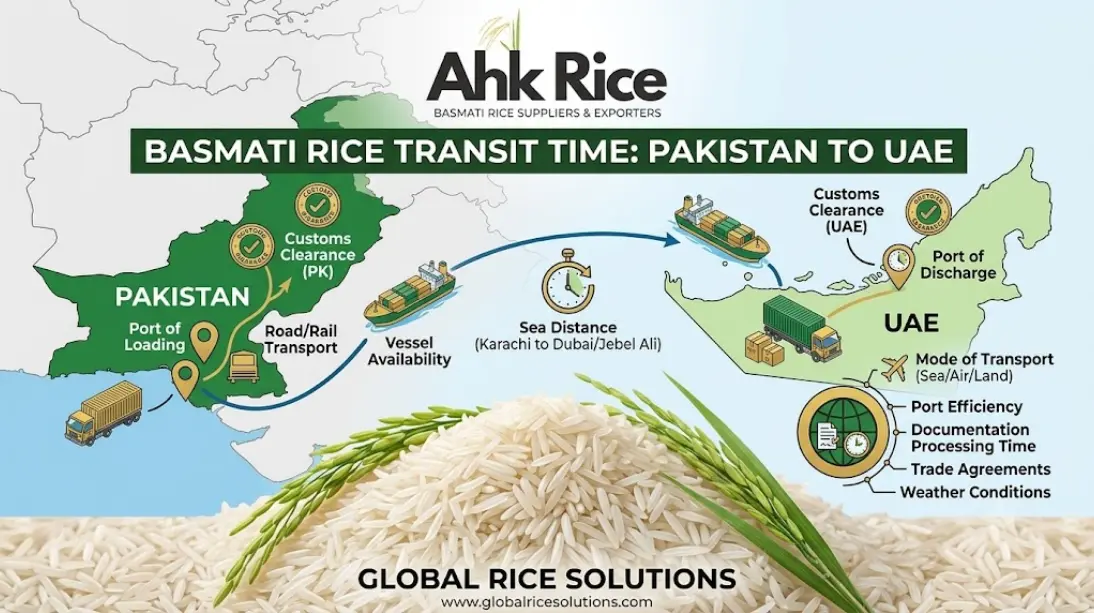
Basmati rice transit time between Pakistan and the UAE depends on harvesting schedules, rice processing stages, export documentation, container availability, port operations, vessel schedules, customs clearance, and the selected UAE destination port. Every stage follows a defined sequence that directly affects the final delivery timeline.
Transit time refers to the total period between dispatching a shipment from Pakistan and receiving it at a UAE port. It includes every operational stage instead of only the number of days spent at sea. Importers often focus on ocean freight, but processing, packaging, inspections, and documentation account for a significant portion of the complete export cycle.
Pakistan is one of the world’s largest producers of aromatic Basmati rice. Most export-quality Basmati originates from Punjab, where fertile alluvial soil, irrigation networks, and seasonal climate produce long-grain aromatic varieties. After harvesting, the rice enters processing facilities before export preparation begins.
The transportation chain starts long before containers reach a seaport. Paddy collection, drying, milling, grading, quality testing, packaging, container stuffing, customs processing, and shipping all contribute to the overall transit period.
The UAE imports large volumes of Pakistani Basmati because of strong consumer demand across supermarkets, restaurants, hotels, catering companies, wholesalers, and food distributors. Examples include Dubai retail chains, Abu Dhabi hospitality suppliers, and Sharjah wholesale food markets.
Readers who want a detailed explanation of production scheduling after order confirmation should continue with the companion guide on:
Rice production, container loading, and ocean freight timelines, which explains each operational stage in greater depth.
How does the Pakistan-to-UAE Basmati rice export process work?
The export process follows sequential stages that begin with harvesting and finish with customs clearance in the UAE. Every operation has quality requirements, inspection procedures, and logistics coordination that collectively determine shipment timing and product consistency.
What happens during harvesting?
Basmati harvesting normally begins after the grains reach full maturity. Farmers monitor moisture content before mechanical or manual harvesting starts. Mature grains reduce breakage during milling and improve final export quality.
Freshly harvested paddy undergoes cleaning to remove straw, stones, dust, and other field materials before moving to drying facilities.
How is the rice processed?
Drying reduces moisture to export standards before milling begins. Controlled drying prevents grain cracking and preserves grain length.
The milling process removes the husk and bran layers. Depending on the required product specification, rice continues through polishing, whitening, steaming, or parboiling.
Each processing line includes multiple quality inspections that measure grain length, broken percentage, chalkiness, foreign matter, moisture, and color consistency.
How is rice graded?
Grading separates rice according to export specifications.
Common export grades include:
- 1121 Steam Basmati Rice
- 1121 White Basmati Rice
- 1121 Sella Basmati Rice
- Super Kernel Basmati Rice
- Super Kernel White Rice
- Super Kernel Sella Rice
- 1509 Steam Basmati Rice
- 1509 White Basmati Rice
- 1509 Sella Rice
Each grade follows different customer specifications based on grain appearance, cooking performance, and market demand.
How is the shipment prepared?
After grading, rice enters packaging operations.
Examples include:
- 1 kg retail packs
- 5 kg consumer bags
- 10 kg bags
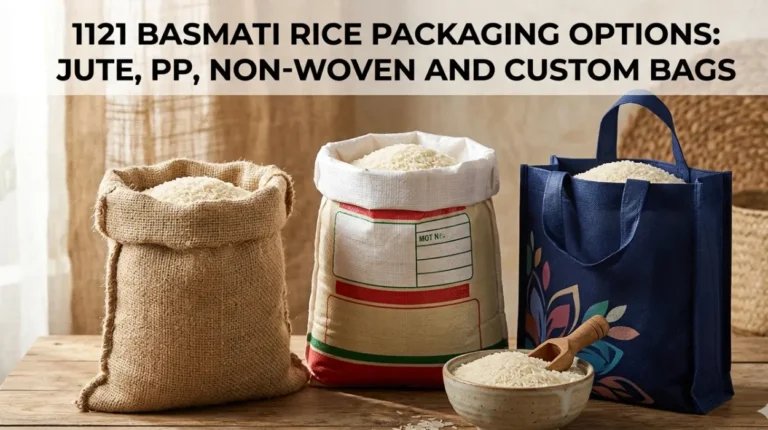
- 25 kg woven bags
- 40 kg sacks
- 50 kg export bags
Packages receive production details, batch identification, country of origin, weight information, and regulatory labeling before palletization or direct container loading.
What are the key components that influence transit time?
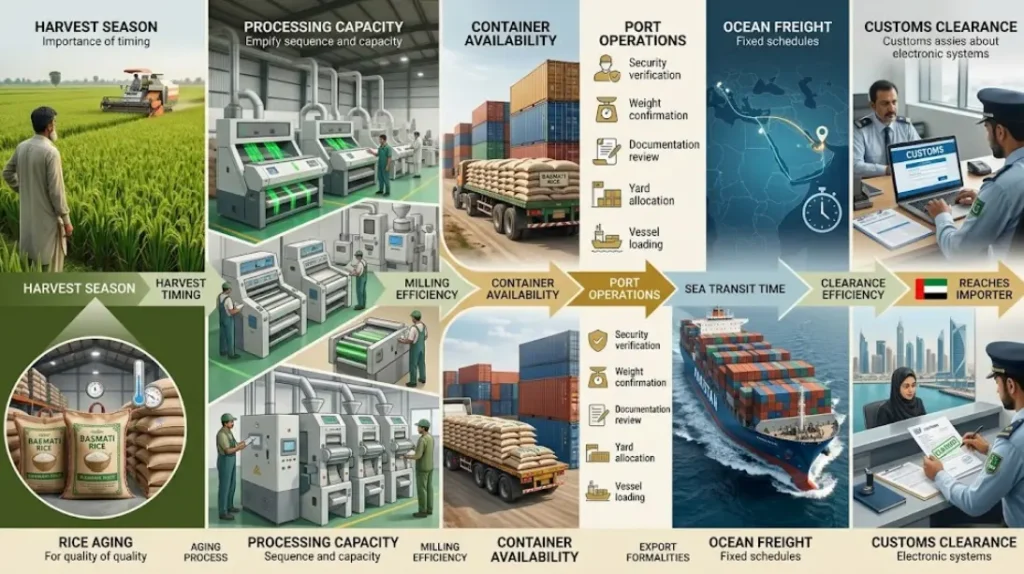
Transit time depends on agricultural production, industrial processing, logistics coordination, documentation accuracy, shipping schedules, customs procedures, and destination port operations. Each component contributes to measurable time before the shipment reaches the importer in the UAE.
Harvest season
Harvest timing affects export availability.
Fresh crops enter processing facilities according to seasonal production cycles. Peak harvest periods often increase processing volumes because more rice enters mills simultaneously.
Rice aging
Premium Basmati often undergoes controlled aging before export.
Aging improves aroma, grain texture, elongation during cooking, and consumer acceptance in many international markets.
Processing capacity
Modern milling facilities process thousands of metric tons according to installed production capacity.
Equipment includes cleaners, de-stoners, separators, graders, polishers, color sorters, metal detectors, and packaging systems working in sequence.
Container availability
Rice exports depend on food-grade shipping containers.
Container allocation follows shipping line schedules, regional demand, and vessel planning.
Port operations
Export containers move through terminal gates before customs inspection and loading.
Major operational stages include:
- Security verification
- Weight confirmation
- Documentation review
- Yard allocation
- Vessel loading
Ocean freight
Ocean freight represents the sea transportation stage connecting Pakistan and UAE ports.
Shipping schedules follow fixed vessel rotations instead of individual shipment requests.
Customs clearance
Both exporting and importing countries complete customs procedures before cargo enters commercial circulation.
Electronic documentation has significantly improved processing efficiency compared with earlier manual systems.
What benefits does an efficient transit process provide?
Efficient transit protects grain quality, improves inventory planning, supports food safety compliance, reduces storage delays, and maintains predictable supply chains between Pakistan and UAE importers across wholesale, retail, hospitality, and food manufacturing sectors.
Predictable shipment schedules help distributors maintain continuous stock availability.
Retail businesses benefit because shelf replenishment follows planned purchasing cycles instead of emergency procurement.
Hotels and restaurants maintain stable ingredient inventories for daily operations.
Food manufacturers coordinate production schedules with incoming raw materials.
Efficient logistics also reduce unnecessary warehouse occupancy.
Export-quality packaging protects rice from moisture, contamination, and physical damage during handling at multiple logistics points.
Digital shipment tracking improves visibility throughout transportation. Importers monitor shipment progress from port departure until arrival.
Food safety inspections become more efficient because standardized documentation accompanies export consignments.
Where is Pakistani Basmati rice used after arriving in the UAE?
Pakistani Basmati rice serves multiple commercial sectors throughout the UAE, including supermarkets, restaurants, hotels, catering companies, wholesalers, food processors, and government procurement programs that require consistent grain quality and reliable food supply.
Retail sector
Retail chains sell packaged rice directly to households.
Examples include premium aromatic rice, daily cooking rice, and family-sized consumer packs.
Hospitality industry
Hotels require consistent cooking performance for buffet service and fine dining.
Restaurants purchase different grades according to menu requirements.
Examples include biryani restaurants, traditional Emirati restaurants, Indian restaurants, and Pakistani restaurants.
Catering companies
Large catering businesses prepare thousands of meals every day.
Examples include airline catering, industrial catering, event catering, and institutional kitchens.
Food manufacturing
Manufacturers incorporate rice into processed food products.
Examples include ready meals, frozen food, meal kits, rice mixes, and packaged convenience foods.
Wholesale distribution
Importers distribute rice to regional buyers across different emirates.
Examples include Dubai wholesalers, Abu Dhabi distributors, Ajman food traders, and Sharjah wholesale markets.
What common misconceptions exist about Basmati rice transit time?
Many people incorrectly believe ocean shipping alone determines transit time. Complete export duration includes farming, processing, grading, packaging, inspections, documentation, customs procedures, container handling, and destination clearance before rice reaches commercial warehouses in the UAE.
Misconception 1: Sea travel is the entire transit process
Ocean freight represents only one stage.
Production and export preparation begin well before containers reach the vessel.
Misconception 2: Every shipment follows the same timeline
Export schedules differ according to production planning, shipping schedules, destination ports, and documentation processing.
Each shipment follows the same sequence but not identical operational timing.
Misconception 3: All Basmati varieties require identical processing
Different varieties receive different processing treatments.
Steam rice, white rice, and Sella rice each follow distinct production methods before packaging.
Misconception 4: Transit time affects aroma development
Aroma develops primarily through variety selection, cultivation practices, controlled aging, and processing quality.
Transportation preserves quality through proper storage and handling rather than creating aroma.
Misconception 5: Packaging has no effect on transportation
Export packaging protects rice throughout handling, stacking, loading, unloading, and warehousing.
Strong packaging maintains product integrity across the logistics chain.
Why does understanding transit time improve supply chain knowledge?
Understanding transit time explains how agriculture, food processing, logistics, maritime transportation, customs administration, and distribution operate as one connected export system linking Pakistan with the UAE through standardized international trade procedures.
Transit time is the outcome of coordinated activities rather than a single transportation event. Every stage contributes to moving rice from cultivated fields in Punjab to commercial distribution centers across the UAE.
The export chain begins with harvesting and continues through drying, milling, grading, packaging, inspection, documentation, container loading, terminal handling, vessel transportation, customs clearance, and final distribution. Understanding each step provides a complete picture of how international Basmati trade operates in 2026.
Frequently Asked Questions
What determines Basmati rice transit time between Pakistan and the UAE?
Transit time depends on harvesting, processing, grading, packaging, export documentation, container loading, vessel schedules, customs clearance, and the destination port in the UAE.
Does ocean freight alone determine the total transit time?
No. Ocean freight is only one stage. The complete timeline also includes rice processing, quality inspections, export documentation, customs procedures, and terminal handling.
Why does rice processing affect shipment timing?
Processing includes drying, milling, grading, color sorting, quality testing, and packaging. Each step ensures export-quality rice before shipment.
Which Pakistani Basmati rice varieties are commonly exported to the UAE?
The most common varieties include 1121 Steam, 1121 White, 1121 Sella, Super Kernel White, Super Kernel Sella, 1509 Steam, 1509 White, and 1509 Sella Basmati rice.
Where is Pakistani Basmati rice grown?
Most export-quality Pakistani Basmati rice is grown in Punjab, where fertile soil, irrigation systems, and favorable climate produce premium aromatic grains.
What happens before Basmati rice is loaded into containers?
The rice is cleaned, dried, milled, graded, inspected, packaged, labeled, palletized or bagged, and cleared through export documentation before container loading.
Which UAE industries import Pakistani Basmati rice?
Pakistani Basmati rice is imported by supermarkets, wholesalers, restaurants, hotels, catering companies, food manufacturers, and institutional buyers.
Does packaging influence Basmati rice transportation?
Yes. Proper export packaging protects the rice from moisture, contamination, and physical damage during handling, shipping, and storage.
Why is customs clearance part of transit time?
Customs clearance is required before cargo leaves Pakistan and before it enters the UAE, making it an essential part of the complete shipping process.
Why is understanding transit time important for importers?
Understanding transit time helps importers plan inventory, coordinate supply chains, schedule deliveries, and maintain consistent product availability throughout the year.