What Is the Ideal Moisture Content for Pakistan 1121 Basmati Rice Exported to Saudi Arabia?
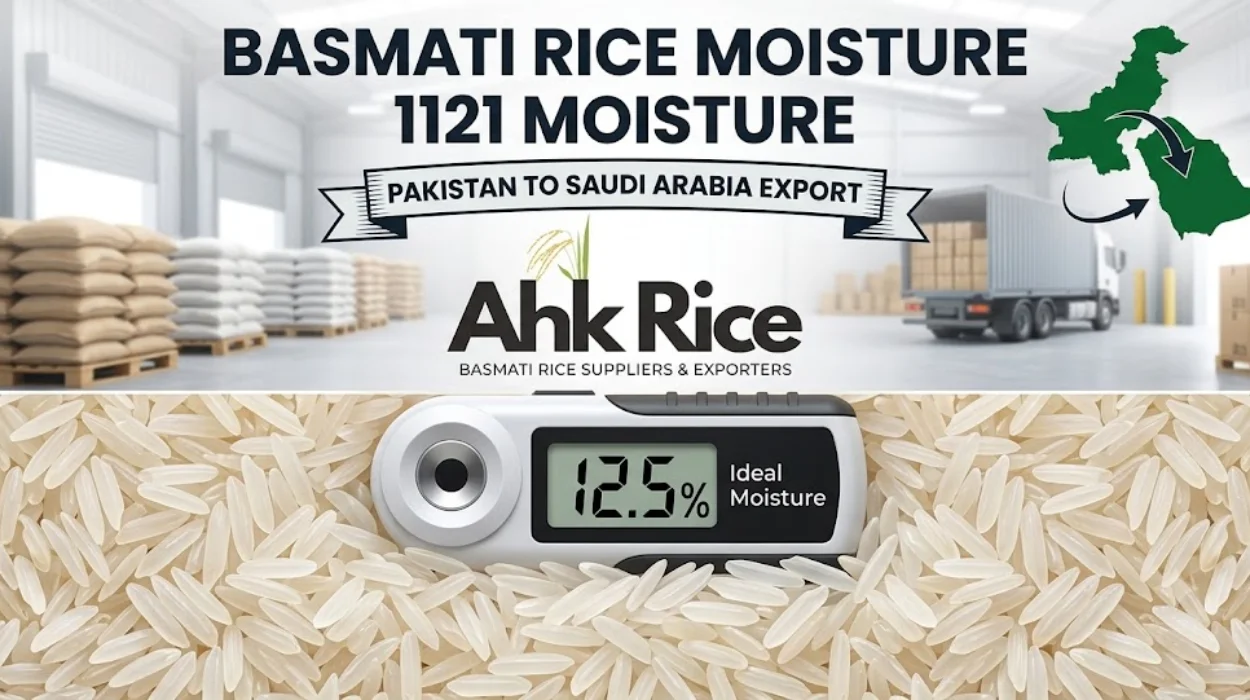
Rice exported from Pakistan to Saudi Arabia performs best when its moisture content remains between 12.5% and 13.5%, with 13.0% considered the optimal export target for 1121 Basmati rice. This moisture range preserves grain quality during sea transport, maintains cooking performance, minimizes breakage, and satisfies international export quality requirements.
Pakistan is the world’s largest producer of premium aromatic Basmati rice, and the 1121 variety represents one of its highest-value long-grain products. Saudi Arabia remains one of the largest import destinations because consumers prefer extra-long grains, distinct aroma, and excellent elongation after cooking. Since shipments travel by sea for several weeks, moisture management becomes one of the most important quality parameters throughout the export chain.
Understanding the relationship between moisture content, processing, storage, packaging, and transportation explains why exporters invest heavily in moisture testing before every shipment.
Why is moisture content important for Pakistan 1121 Basmati rice exports to Saudi Arabia?
The ideal moisture content of Pakistan 1121 Basmati rice exported to Saudi Arabia is 12.5%–13.5% because this range protects grain quality, reduces fungal growth, prevents excessive breakage, maintains aroma, and preserves cooking characteristics throughout international transportation and storage.
Moisture content refers to the percentage of water contained inside each rice kernel. It directly affects physical quality, milling recovery, storage stability, transportation safety, and cooking performance.
Rice exported from Pakistan generally spends between 15 and 30 days in marine containers before reaching Saudi Arabian ports. During this period, grains experience changing temperatures, humidity fluctuations, and container condensation. Proper moisture levels allow rice to remain stable throughout the journey.
Moisture above acceptable limits increases biological activity inside the grain. Higher moisture also creates favorable conditions for molds, fungi, and insect development. Lower moisture creates another problem because dry grains become brittle and break during handling, polishing, and packaging.
Saudi Arabian importers usually specify moisture requirements as part of purchase contracts because moisture directly affects commercial value.
What is Pakistan 1121 Basmati rice?
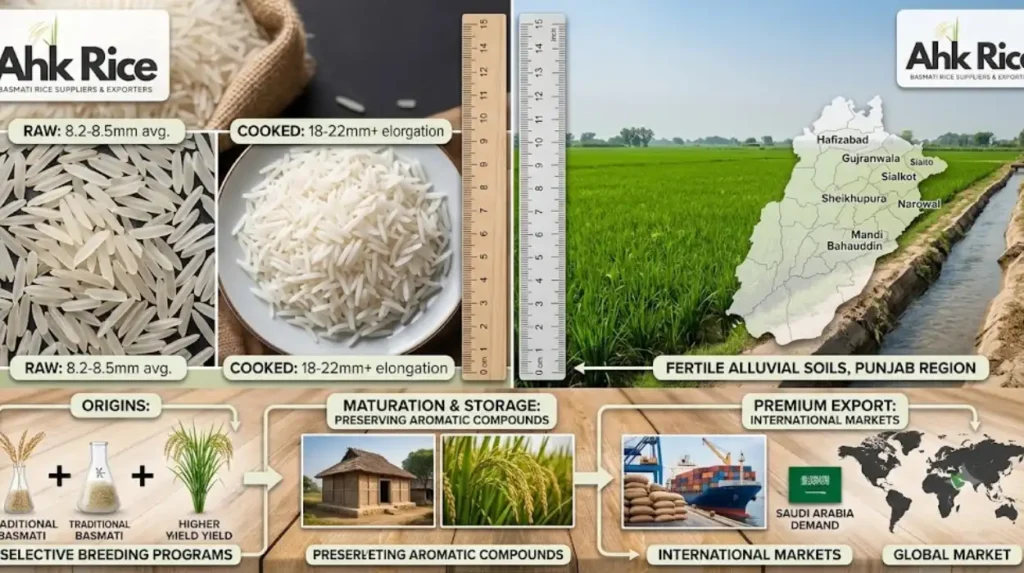
Pakistan 1121 Basmati rice is an extra-long grain aromatic rice variety grown primarily in Punjab. It is known for exceptional grain length, strong fragrance, high elongation after cooking, and premium export quality demanded across international markets including Saudi Arabia.
1121 Basmati originated through selective breeding programs that enhanced traditional Basmati characteristics while improving yield and grain length.
The variety has several distinguishing characteristics.
Grain characteristics
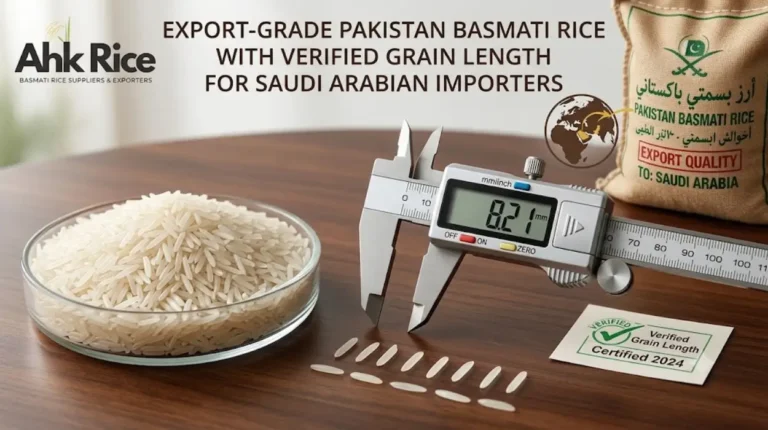
The uncooked grain length generally measures 8.2–8.5 mm.
After cooking, grain length often exceeds 18–22 mm, making it one of the longest cooking rice varieties available globally.
Aroma
Natural aromatic compounds develop during cultivation and continue maturing after harvesting. Proper storage preserves these compounds before export.
Growing regions
Most export-quality 1121 Basmati rice grows in Pakistan’s fertile Punjab region.
Major production districts include examples such as:
- Hafizabad
- Gujranwala
- Sialkot
- Sheikhupura
- Narowal
- Mandi Bahauddin
These regions provide fertile alluvial soils, irrigation systems, and climatic conditions suitable for premium Basmati cultivation.
How is the ideal moisture content achieved before export?
Export-quality moisture is achieved through controlled harvesting, drying, milling, laboratory testing, conditioning, and final packaging. Every processing stage contributes to maintaining consistent moisture levels before international shipment begins.
Moisture management begins immediately after harvesting.
Harvesting
Farmers harvest rice once physiological maturity is complete.
Harvesting too early produces grains with excessive moisture.
Harvesting too late increases field cracking and grain loss.
Drying
Freshly harvested paddy normally contains moisture significantly above export specifications.
Mechanical dryers or controlled sun drying gradually reduce moisture.
Drying occurs slowly to prevent internal stress cracks.
Storage
Paddy enters controlled storage where moisture equalizes across grain lots.
Uniform moisture produces consistent milling performance.
Milling
Processing includes several steps.
- Cleaning
- De-husking
- Paddy separation
- Whitening
- Polishing
- Length grading
- Color sorting
- Metal detection
Each operation requires stable grain moisture.
Laboratory testing
Modern rice mills use calibrated moisture meters alongside oven testing methods to verify export specifications.
Each production batch undergoes repeated quality inspection before packaging.
Which factors influence moisture stability during export?
Packaging quality, warehouse conditions, transportation environment, container ventilation, ambient humidity, and shipment duration determine whether exported rice maintains its original moisture level until delivery in Saudi Arabia.
Rice continuously exchanges moisture with surrounding air.
Environmental control becomes essential after packaging.
Packaging materials
Strong moisture-resistant packaging slows moisture exchange.
Examples include:
- PP woven bags
- BOPP laminated bags
- Multi-layer export sacks
- Vacuum retail packs
Each packaging type provides different moisture protection.
Warehouse conditions
Export warehouses maintain clean, dry environments.
Proper palletization keeps bags away from floors and walls.
Ventilation reduces localized humidity.
Marine transportation
Sea containers experience daytime heating and nighttime cooling.
Temperature differences create condensation on container roofs.
Professional exporters reduce condensation risks through proper container inspection and cargo loading practices.
Destination climate
Saudi Arabia has predominantly hot and dry climatic conditions.
However, imported rice also enters air-conditioned warehouses, supermarkets, and distribution centers where humidity levels fluctuate.
Stable export moisture helps rice adapt throughout these transitions.
What are the main grades of Pakistan 1121 Basmati rice?
Pakistan exports several commercial grades of 1121 Basmati rice. Each grade follows moisture specifications while differing in appearance, milling level, and broken grain percentage to satisfy different international market requirements.
The grading system helps buyers select products matching their commercial needs.
1121 Steam Basmati Rice
Steam processing improves grain strength.
The grains retain a slightly creamy appearance.
Breakage rates remain relatively low during transportation.
1121 White Basmati Rice
White rice undergoes polishing after milling.
It offers bright appearance and soft cooking texture.
Saudi Arabian retailers widely import this grade.
1121 Sella (Parboiled) Rice
Parboiling gelatinizes starch before milling.
The process increases grain hardness.
The rice tolerates extended storage particularly well.
Broken grades
Commercial export also includes controlled percentages of broken kernels.
Examples include:
- 1% broken
- 2% broken
- 5% broken
- 10% broken
Each grade follows contract specifications.
Which certifications support Pakistan 1121 Basmati rice exports?
International rice exports require food safety, phytosanitary, quality, and traceability certifications. These documents verify compliance with importing country regulations and support smooth customs clearance in Saudi Arabia.
Export documentation verifies that rice satisfies regulatory standards.
Common certifications include:
Phytosanitary Certificate
Confirms freedom from regulated plant pests.
Certificate of Origin
Verifies Pakistan as the production country.
Fumigation Certificate
Confirms approved pest treatment before shipment.
ISO 22000
Demonstrates food safety management systems.
HACCP
Shows preventive food safety controls throughout processing.
Halal certification
Many Saudi Arabian buyers request recognized Halal certification for processed food products.
Laboratory analysis
Independent laboratories verify parameters including:
- Moisture
- Broken percentage
- Chalkiness
- Purity
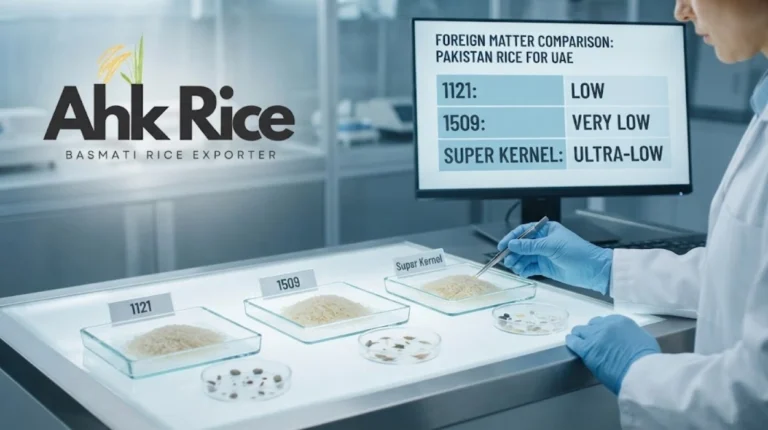
- Foreign matter
- Damaged grains
These analyses help buyers confirm shipment specifications before loading.
What benefits does maintaining ideal moisture provide?
Correct moisture content improves storage life, protects aroma, preserves grain integrity, reduces financial losses, and delivers consistent cooking performance from the rice mill to the consumer’s kitchen.
Maintaining export moisture creates measurable quality improvements.
Better storage stability
Proper moisture reduces microbial activity.
Rice remains commercially stable during long-distance transportation.
Lower breakage
Balanced moisture increases grain strength.
Fewer broken kernels improve commercial value.
Strong aroma retention
Natural aromatic compounds remain better preserved inside stable grains.
Consumers receive fresher rice after import.
Better cooking quality
Correct moisture contributes to:
- Uniform water absorption
- Better grain separation
- Longer cooked grains
- Improved texture
These characteristics influence consumer satisfaction.
Reduced financial loss
Moisture outside specification increases rejected shipments, commercial disputes, and quality claims.
Maintaining proper moisture minimizes these risks.
Where is Pakistan 1121 Basmati rice used in Saudi Arabia?
Pakistan 1121 Basmati rice serves households, restaurants, hotels, catering companies, wholesalers, retailers, and food manufacturers because its long grains and aromatic qualities suit traditional Saudi cuisine.
Saudi Arabia imports significant quantities of premium Basmati rice every year.
Different sectors prefer different packaging formats.
Examples include:
- Retail supermarkets
- Hypermarkets
- Wholesale distributors
- Hotels
- Catering companies
- Restaurants
- Food service suppliers
Popular dishes include examples such as Kabsa, Mandi, Bukhari rice, and festive rice platters where grain appearance plays an important role.
Consistent moisture helps these dishes achieve proper texture after cooking.
Readers interested in how different milling methods influence moisture retention and warehouse performance can continue with our detailed comparison of:
1121 Steam and White Basmati rice storage characteristics, which explains how processing affects long-term quality under Saudi Arabian conditions.
What misconceptions exist about moisture content in exported rice?
Higher moisture does not improve rice quality, and extremely dry rice is not superior. Balanced moisture produces the best storage stability, milling performance, cooking quality, and commercial acceptance during international trade.
Several misconceptions continue to circulate in the rice industry.
Higher moisture means heavier rice
Extra moisture increases weight temporarily.
Commercial contracts specify moisture limits because excess water does not represent true grain value.
Drier rice always performs better
Very dry rice breaks more easily during handling.
Lower breakage occurs within the recommended export moisture range.
Moisture remains constant after packaging
Rice continuously interacts with surrounding environmental humidity.
Proper packaging only slows moisture exchange.
All markets require identical specifications
Different importing countries specify varying commercial requirements.
Saudi Arabian buyers generally prioritize stable moisture because shipments travel long distances and storage periods vary across the distribution chain.
How does moisture content support successful exports to Saudi Arabia?
Maintaining 12.5%–13.5% moisture protects Pakistan 1121 Basmati rice throughout cultivation, processing, shipping, storage, retail distribution, and final cooking, making moisture management one of the most important quality controls in international rice exports.
Moisture management connects every stage of the export supply chain. Farmers harvest mature crops at the correct time. Rice mills reduce moisture gradually through controlled drying. Laboratories verify moisture before processing and packaging. Exporters load clean containers that protect rice throughout sea transport. Importers receive grain that maintains aroma, appearance, and cooking quality.
As international food safety standards continue evolving in 2026, precise moisture control remains a fundamental quality requirement rather than simply a processing parameter. It protects consumers, supports regulatory compliance, and preserves the premium characteristics that define Pakistan’s 1121 Basmati rice in Saudi Arabia and other international markets.
Frequently Asked Questions
What is the ideal moisture content for Pakistan 1121 Basmati rice exported to Saudi Arabia?
The ideal moisture content is 12.5% to 13.5%, with around 13.0% considered optimal. This range helps preserve grain quality, aroma, cooking performance, and storage stability during export.
Why is moisture content important for Basmati rice exports?
Moisture content affects storage life, grain breakage, mold prevention, insect activity, cooking quality, and compliance with international import standards. Proper moisture ensures the rice reaches buyers in premium condition.
How is the moisture content of export rice measured?
Exporters use calibrated digital moisture meters and standardized laboratory oven-drying methods to verify moisture levels before packaging and shipment.
Which Pakistani regions produce export-quality 1121 Basmati rice?
Most premium 1121 Basmati rice is cultivated in Punjab, particularly in Hafizabad, Gujranwala, Sheikhupura, Narowal, Sialkot, and Mandi Bahauddin.
What happens if the moisture content is higher than 13.5%?
Excess moisture increases the risk of mold growth, fungal contamination, insect infestation, unpleasant odor, and shipment rejection by importers.
Can rice become too dry before export?
Yes. Rice with moisture below approximately 12% becomes brittle, increasing grain breakage during milling, transportation, and handling.
Which grades of 1121 Basmati rice are commonly exported to Saudi Arabia?
Saudi Arabia imports several grades, including 1121 White Basmati Rice, 1121 Steam Basmati Rice, and 1121 Sella (Parboiled) Basmati Rice, depending on buyer preferences.
Which certifications are commonly required for exporting 1121 Basmati rice?
Typical export documentation includes a Phytosanitary Certificate, Certificate of Origin, Fumigation Certificate, HACCP, ISO 22000, Halal Certification, and laboratory quality reports.
How long can properly stored 1121 Basmati rice remain in good condition?
When stored at the correct moisture level in clean, dry conditions, export-quality 1121 Basmati rice generally maintains its quality for 18–24 months, depending on packaging and storage conditions.
Why is Saudi Arabia a major importer of Pakistan 1121 Basmati rice?
Saudi consumers prefer Pakistan 1121 Basmati rice because of its extra-long grains, natural aroma, excellent elongation after cooking, and suitability for traditional dishes such as Kabsa and Mandi.