Bulk Pakistan Basmati Rice Supply with Moisture Certification for Saudi Food Service Companies
Saudi food service companies sourcing Pakistan Basmati rice in bulk achieve more consistent cooking performance, lower storage losses, and smoother customs clearance when they purchase from a supplier that provides verified moisture certification. Before choosing a supplier, it also helps to understand why moisture testing has become a purchasing priority for Saudi importers, as explained in our guide:
Why Do Saudi Arabian Food Service Buyers Check Moisture Levels Before Importing Pakistan Rice?.
Food service businesses in Saudi Arabia operate in a demanding environment. Hotels, restaurant chains, catering companies, airline kitchens, hospitals, universities, and central kitchens require rice that delivers identical cooking results every day. A shipment with excessive moisture can reduce shelf life, increase the risk of quality deterioration during transit, and create inconsistencies during large-scale cooking operations.
AHK Rice specializes in supplying premium Pakistan Basmati rice to Saudi Arabia with laboratory-tested moisture certification, export documentation, and quality assurance that meets commercial importing requirements. Buyers receive transparent specifications before shipment, allowing procurement teams to make informed purchasing decisions with reduced operational risk.
What is the best solution for securing bulk Pakistan Basmati rice with certified moisture levels?
The most reliable solution is selecting an experienced Pakistani exporter that combines moisture-certified rice, internationally accepted quality documentation, controlled processing, and dependable shipping schedules. This approach minimizes quality disputes, improves inventory management, and delivers consistent cooking performance throughout the supply chain for commercial food service operations.
Saudi buyers increasingly require documented quality rather than relying solely on supplier declarations. Moisture certification has become one of the most requested quality parameters because it directly influences storage stability, cooking consistency, transportation performance, and customer satisfaction.
AHK Rice supplies major Pakistani Basmati varieties including 1121 Basmati, Super Kernel Basmati, 1509 Basmati, Steam Rice, Sella Rice, White Rice, and premium customized specifications for institutional buyers.
Every commercial shipment undergoes systematic quality inspection before export. Moisture levels are measured using calibrated laboratory equipment, with certificates issued before container loading. This documentation helps procurement managers verify that the shipment matches agreed specifications.
Processing begins with carefully selected paddy sourced from Punjab’s leading rice-growing regions. The rice passes through cleaning, grading, polishing, color sorting, destoning, quality inspection, packing, and container loading under controlled procedures designed for export markets.
Commercial buyers comparing processing methods should also understand how moisture content affects cooking quality across different rice processing options, which is discussed in our article:
How Moisture Content Influences Cooking Performance of Pakistan Basmati Rice in Saudi Arabia.
Why choose Saudi Arabia supply services from AHK Rice?
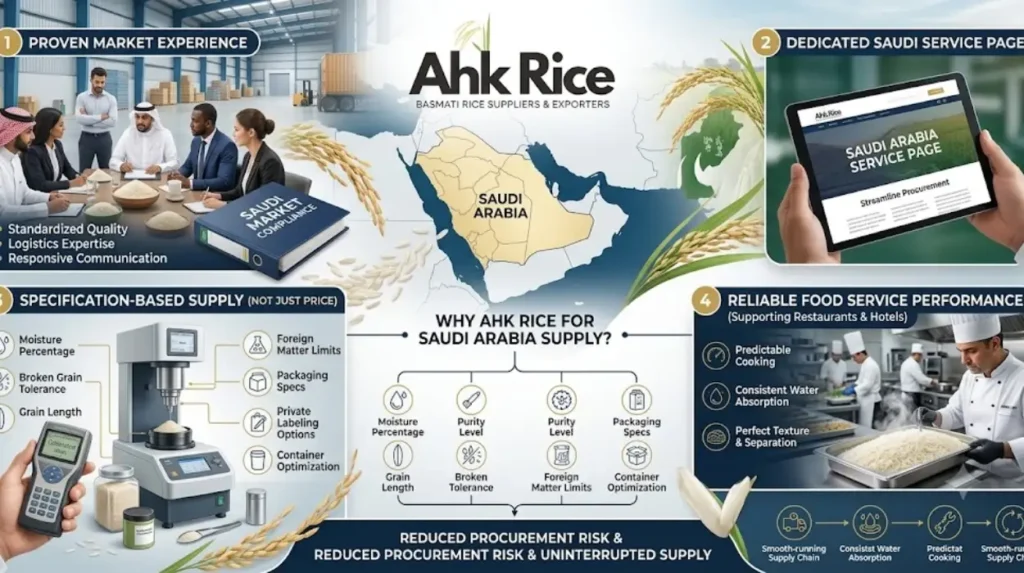
Choosing an exporter with proven Saudi market experience provides buyers with standardized quality, export compliance, responsive communication, documented certifications, reliable production capacity, and logistics expertise. These capabilities reduce procurement risks while supporting uninterrupted supply for restaurants, hotels, catering companies, and institutional kitchens throughout Saudi Arabia.
Saudi Arabia remains one of the largest destinations for Pakistani Basmati rice. Importers expect suppliers to understand Saudi regulatory requirements, commercial documentation, labeling standards, and shipment procedures.
AHK Rice offers dedicated export services for Saudi buyers through its Saudi Arabia service page, helping importers streamline procurement while maintaining consistent product specifications throughout long-term supply agreements.
Unlike suppliers that focus only on price, AHK Rice emphasizes specification-based supply. Every order is prepared according to agreed commercial requirements including:
- Moisture percentage
- Broken grain tolerance
- Grain length
- Purity level
- Foreign matter limits
- Packaging specifications
- Private labeling options
- Container optimization
This specification-driven approach enables buyers to receive products matching operational requirements instead of accepting generalized quality descriptions.
Food service companies frequently require predictable cooking performance across thousands of meals daily. Maintaining certified moisture helps improve water absorption consistency, grain separation, texture, and presentation after cooking.
What results can Saudi food service companies expect from moisture-certified Pakistan Basmati rice?
Commercial buyers typically experience greater cooking consistency, longer storage stability, fewer quality complaints, stronger inventory management, improved customer satisfaction, and reduced commercial risk because moisture-certified rice performs more predictably during transportation, warehousing, and large-scale food preparation across demanding hospitality environments.
Operational consistency matters more than simply purchasing rice at the lowest available price.
For example, a hotel group operating multiple banquet halls requires identical rice quality across every kitchen. When moisture varies significantly between shipments, chefs often need to adjust cooking time and water ratios. This creates inconsistency that affects service quality.
Similarly, airline catering companies prepare thousands of meals under strict production schedules. Consistent moisture levels help standardize cooking procedures, reducing production variability.
Institutional kitchens supplying hospitals or universities also benefit from stable cooking performance because recipes remain consistent throughout procurement cycles.
AHK Rice supports these operational requirements through controlled production and documented quality assurance rather than relying on subjective visual inspection.
Export shipments also undergo multiple quality verification stages before loading. These inspections reduce the possibility of specification deviations reaching the destination market.
Typical commercial documentation includes:
- Commercial Invoice
- Packing List
- Certificate of Origin
- Phytosanitary Certificate
- Fumigation Certificate
- Moisture Certificate
- Quality Inspection Report
- Bill of Lading
- Additional certificates where contractually required
These documents help facilitate smoother customs procedures while supporting importer quality verification.
What factors affect pricing for bulk Pakistan Basmati rice with moisture certification?
Bulk pricing depends on rice variety, processing method, crop quality, packaging requirements, order volume, freight rates, certification requests, seasonal availability, and destination logistics. Buyers evaluating complete landed cost obtain more accurate procurement decisions than comparing FOB prices alone across suppliers.
Rice pricing changes throughout the marketing year based on supply and demand.
Primary pricing factors include:
| Factor | Commercial Impact |
|---|---|
| Rice variety | Premium varieties command higher prices |
| Crop season | New crop and carryover inventory influence pricing |
| Processing type | Steam, White, and Sella differ in cost |
| Packaging | Retail bags cost more than bulk sacks |
| Container quantity | Larger orders improve economies of scale |
| Freight rates | Shipping markets fluctuate regularly |
| Certification requirements | Additional inspections increase service costs |
| Currency exchange | International trade pricing adjusts accordingly |
Saudi buyers should evaluate suppliers using total procurement value instead of unit price alone.
A lower-priced shipment that produces inconsistent cooking performance or requires quality claims may ultimately cost more than purchasing certified products from an experienced exporter.
AHK Rice works with buyers to identify specifications aligned with operational requirements rather than promoting unnecessary premium grades.
How long does shipping take from Pakistan to Saudi Arabia?
Shipping schedules depend on the Saudi destination port, vessel availability, documentation completion, container booking, and customs processing. Working with experienced exporters helps buyers plan inventory more accurately while reducing delays caused by incomplete export documentation or logistical coordination issues.
Typical shipping transit estimates during 2026 include:
| Saudi Destination | Average Sea Transit |
|---|---|
| Jeddah Islamic Port | 10–14 days |
| Dammam | 12–16 days |
| King Abdullah Port | 10–15 days |
| Jubail | 13–17 days |
Production time generally requires approximately 7–15 working days after confirming specifications and receiving agreed commercial arrangements.
Seasonal demand, vessel schedules, weather conditions, customs clearance, and port congestion may influence total delivery timelines.
AHK Rice coordinates production planning with shipping schedules to help commercial buyers maintain consistent inventory availability.
What is the sample process and what does it cost?
Professional exporters provide structured sampling procedures so buyers can evaluate grain quality, moisture levels, cooking performance, aroma, and specifications before confirming commercial orders. Sampling reduces purchasing uncertainty while strengthening confidence before container production begins for international shipments.
A typical commercial sampling process follows several stages.
First, the buyer identifies preferred rice varieties and required specifications.
Second, AHK Rice prepares representative samples matching requested commercial grades.
Third, laboratory moisture testing is completed where requested.
Fourth, samples are securely packaged for international dispatch.
Fifth, buyers conduct cooking evaluations, laboratory verification if required, and internal procurement approval.
Typical sample costs during 2026 include:
| Sample Type | Typical Cost |
|---|---|
| Product sample | Usually provided free |
| Courier charges | Paid by buyer depending on destination |
| Laboratory testing | Additional if specifically requested |
| Customized packaging sample | Additional according to design requirements |
Many commercial buyers order multiple varieties simultaneously to compare cooking performance before finalizing annual procurement contracts.
This process significantly reduces purchasing uncertainty before committing to full container orders.
How do Saudi food service companies get started?
The purchasing process begins by defining technical specifications, reviewing available rice grades, requesting representative samples, confirming certifications, approving commercial quotations, and placing production orders with an experienced exporter capable of delivering consistent long-term supply according to agreed contractual requirements.
An efficient procurement process generally follows these steps:
- Define required rice variety and specifications.
- Share monthly or annual volume requirements.
- Request product samples.
- Review moisture certification and quality documents.
- Approve quotation.
- Confirm packaging requirements.
- Finalize commercial agreement.
- Begin production.
- Complete quality inspection.
- Arrange shipment.
Throughout this process, AHK Rice maintains communication with procurement teams, ensuring documentation, production updates, and shipment information remain transparent.
For buyers planning annual supply contracts, early specification planning helps secure production capacity and improve shipment scheduling throughout the year.
Saudi food service businesses increasingly value dependable suppliers capable of maintaining consistent quality over multiple shipments instead of focusing solely on initial purchase price.
When moisture certification, processing standards, export documentation, and logistics coordination work together, buyers gain greater confidence in every shipment arriving from Pakistan.
AHK Rice combines export experience, laboratory-tested quality assurance, specification-driven production, and customer-focused service to help Saudi food service companies source Pakistan Basmati rice with confidence.
Frequently Asked Questions
How does moisture certification benefit Saudi food service companies?
Moisture certification verifies that the rice meets the agreed moisture level before shipment. It helps improve storage stability, ensures consistent cooking results, reduces quality risks during transit, and supports smoother import inspections.
Why is Pakistan Basmati rice preferred by Saudi food service businesses?
Pakistan Basmati rice is valued for its extra-long grains, natural aroma, excellent grain elongation after cooking, and suitability for traditional Saudi dishes served in hotels, restaurants, catering companies, and institutional kitchens.
What moisture level is generally recommended for export-quality Basmati rice?
Export-quality Pakistan Basmati rice is commonly supplied with moisture levels around 12% to 14%, depending on the buyer’s specifications, processing method, and destination market requirements.
How long does it take to ship bulk Basmati rice from Pakistan to Saudi Arabia?
Sea freight typically takes around 10–17 days, depending on the destination port, vessel schedule, customs clearance, and shipping line availability.
Can Saudi buyers request customized packaging for bulk rice orders?
Yes. Most exporters, including AHK Rice, offer customized packaging options such as private labels, retail bags, PP woven bags, BOPP bags, and bulk packaging to match commercial requirements.
What documents are provided with bulk rice shipments?
Commercial shipments usually include a Commercial Invoice, Packing List, Bill of Lading, Certificate of Origin, Phytosanitary Certificate, Fumigation Certificate, Moisture Certificate, and Quality Inspection Report.
Is it possible to receive rice samples before placing a bulk order?
Yes. Buyers can request product samples to evaluate grain quality, aroma, cooking performance, and moisture specifications before confirming container orders. Courier charges generally apply.
Which Pakistan Basmati rice varieties are commonly supplied to Saudi Arabia?
The most popular export varieties include 1121 Basmati Rice, Super Kernel Basmati Rice, 1509 Basmati Rice, Steam Rice, Sella Rice, and White Rice, depending on the buyer’s application and budget.
What factors affect the price of bulk Pakistan Basmati rice?
Pricing depends on the rice variety, processing type, crop season, order quantity, packaging requirements, certification needs, freight costs, and current international market conditions.
Why should Saudi food service companies choose AHK Rice?
AHK Rice provides moisture-certified Pakistan Basmati rice, strict quality control, export documentation, customized packaging, reliable shipping, and consistent supply tailored to the needs of Saudi food service companies.