Source Pakistan Basmati Rice with Verified Purity Standards for Saudi Arabia
Saudi Arabian rice buyers reduce procurement risk when they source Pakistan Basmati rice from exporters that provide verified purity documentation, laboratory testing, consistent grading, and transparent shipment records. Before selecting a supplier, it helps to understand how rice purity influences import quality through our guide,
What Does Rice Purity Mean for Saudi Arabian Buyers Importing Pakistan Basmati Rice?, and compare verification methods in:
How Do Saudi Arabian Importers Verify Purity Levels in Pakistan Basmati Rice?.
Saudi Arabia continues to import premium Pakistani Basmati rice because of its long grain length, aroma, cooking performance, and competitive pricing. However, importers increasingly demand documented purity standards rather than relying solely on supplier claims. According to 2026 market practices, buyers expect laboratory reports, quality certificates, traceable production batches, and export documentation before confirming contracts. AHK Rice supplies Pakistan Basmati rice with documented quality verification to support these purchasing requirements.
What is the best solution for sourcing Pakistan Basmati rice with verified purity standards for Saudi Arabia?
The most reliable solution is selecting an exporter that verifies varietal purity through laboratory testing, standardized grading, production traceability, moisture analysis, and internationally accepted documentation before shipment. This approach minimizes quality disputes, protects brand reputation, and delivers consistent cooking performance across every imported container.
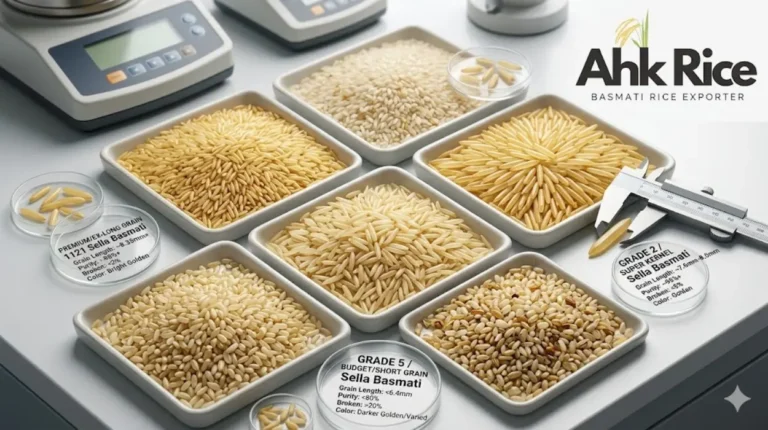
Rice purity refers to the percentage of grains belonging to the declared Basmati variety without excessive mixing from other rice types. Saudi importers usually require purity verification because retail chains, wholesalers, food service companies, and distributors sell products based on specific quality expectations.
Choosing AHK Rice for exports to the Saudi Arabia service page means working with an exporter that focuses on standardized processing, documented inspections, and export-quality verification before container loading.
A complete purity verification process generally includes:
- Variety identification during procurement
- Cleaning and destoning
- Color sorting
- Broken grain separation
- Moisture testing
- Foreign matter inspection
- Laboratory purity analysis
- Batch coding
- Final export inspection
Each production batch receives quality checks before packing. This reduces variation between shipments and helps importers maintain consistent product specifications throughout the year.
Saudi buyers commonly request documentation including:
- Certificate of Origin
- Phytosanitary Certificate
- Fumigation Certificate
- Packing List
- Commercial Invoice
- Laboratory Quality Report
- Weight Verification
- Container Loading Report
These documents simplify customs clearance while providing confidence in product quality.
Why should Saudi Arabian importers choose Saudi Arabia export services from AHK Rice?
Saudi Arabia requires dependable export planning, verified documentation, timely shipping, and consistent production quality. Selecting an experienced exporter reduces operational delays, improves customs compliance, protects commercial relationships, and ensures every shipment meets agreed specifications from production through final delivery at destination ports.
Saudi Arabia remains one of Pakistan’s largest premium Basmati export destinations in 2026. Importers often evaluate suppliers using operational reliability rather than price alone.
AHK Rice supports buyers throughout the export process by combining production control with shipment planning.
Key advantages include:
Verified production standards
Every production lot follows defined quality parameters before packing.
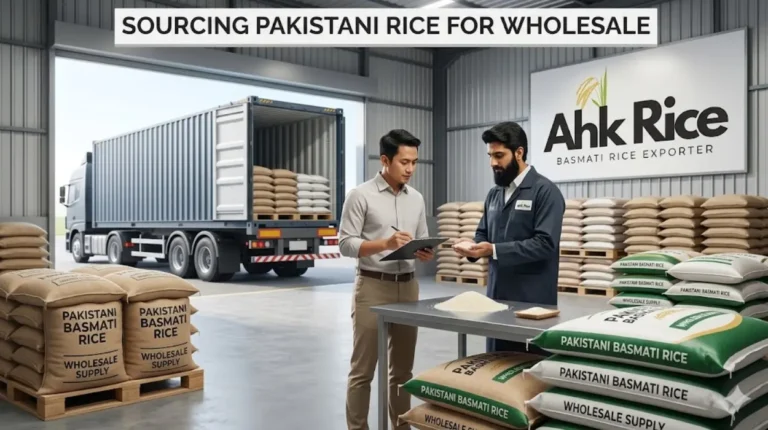
Multiple packing options
Available packaging commonly includes:
- 1 kg
- 2 kg
- 5 kg
- 10 kg
- 20 kg
- 25 kg
- 40 kg
- 50 kg polypropylene bags
- Customized private label packaging
Container loading options
Importers can select:
- 20-foot containers
- 40-foot containers
- Mixed packaging containers
- Private label shipments
Export documentation support
Commercial documentation is prepared according to Saudi import requirements.
Consistent production scheduling
Production planning helps reduce unexpected shipment delays.
AHK Rice also provides buyers with pre-shipment quality verification before containers leave Pakistan.
What shipping time can Saudi Arabian buyers expect?
Pakistan-to-Saudi Arabia shipments generally require approximately 12–22 days of ocean transit after production and container loading, although final delivery varies by destination port, customs processing, vessel schedules, seasonal demand, and carrier availability throughout 2026.
Shipping consists of several stages rather than only sea transit.
Typical export timeline:
| Stage | Estimated Time |
|---|---|
| Order confirmation | 1 day |
| Advance payment verification | 1 day |
| Production scheduling | 2–3 days |
| Milling and processing | 3–5 days |
| Packaging | 1–2 days |
| Quality inspection | 1 day |
| Container loading | 1 day |
| Export customs clearance | 1–2 days |
| Ocean freight to Saudi Arabia | 12–22 days |
Major destination ports include:
- Jeddah Islamic Port
- King Abdulaziz Port (Dammam)
- King Abdullah Port
Transit may vary depending on vessel routing and shipping line schedules.
What results can buyers expect from verified purity standards?
Verified purity standards improve consistency, customer satisfaction, cooking quality, inventory performance, retail confidence, and repeat purchasing while reducing claims related to mixed varieties, foreign matter, excessive broken grains, or inconsistent grain appearance after import into Saudi Arabia.
Higher purity levels create measurable commercial advantages.
For wholesalers, consistent grain quality strengthens distributor confidence.
For retailers, uniform packaging quality improves customer satisfaction.
For restaurants, consistent cooking performance reduces kitchen waste.
For importers, verified specifications lower quality dispute risks.
AHK Rice focuses on maintaining these quality outcomes through controlled processing and documented inspections.
Expected commercial outcomes include:
- Better grain uniformity
- Higher customer retention
- Reduced product complaints
- Improved cooking consistency
- Lower rejection rates
- Stronger distributor confidence
- Easier brand positioning
These benefits contribute to long-term purchasing stability rather than one-time transactions.
What factors affect the price of verified Pakistan Basmati rice exports?
Export pricing depends on rice variety, crop quality, purity percentage, processing method, packaging specifications, order volume, freight costs, certification requirements, destination port, seasonal availability, and international market conditions affecting Pakistan’s rice export industry during 2026.
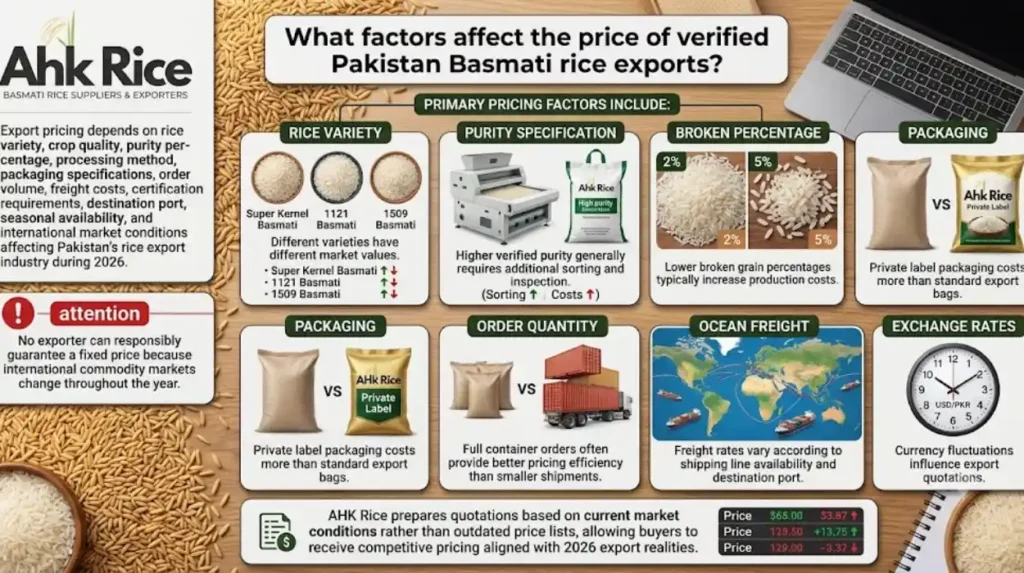
No exporter can responsibly guarantee a fixed price because international commodity markets change throughout the year.
The primary pricing factors include:
Rice variety
Different varieties have different market values.
Examples include:
- Super Kernel Basmati
- 1121 Basmati
- 1509 Basmati
Purity specification
Higher verified purity generally requires additional sorting and inspection.
Broken percentage
Lower broken grain percentages typically increase production costs.
Packaging
Private label packaging costs more than standard export bags.
Order quantity
Full container orders often provide better pricing efficiency than smaller shipments.
Ocean freight
Freight rates vary according to shipping line availability and destination port.
Exchange rates
Currency fluctuations influence export quotations.
AHK Rice prepares quotations based on current market conditions rather than outdated price lists, allowing buyers to receive competitive pricing aligned with 2026 export realities.
How does the sample process work before placing a bulk order?
Professional exporters provide representative product samples before commercial production, allowing buyers to verify grain appearance, cooking quality, aroma, moisture, purity, packaging, and laboratory specifications before approving a full container purchase for Saudi Arabia.
Sampling reduces purchasing uncertainty.
The standard process usually follows these stages:
Step 1: Product selection
The buyer selects the required rice variety.
Step 2: Sample preparation
Representative samples are prepared from available production lots.
Step 3: Documentation
Quality specifications accompany the sample.
Step 4: Shipping
Courier services deliver the sample internationally.
Step 5: Buyer evaluation
The importer evaluates:
- Grain length
- Aroma
- Cooking expansion
- Color
- Purity
- Moisture
- Packaging quality
Step 6: Commercial approval
Bulk production begins after buyer confirmation.
Sample costs in 2026
Sample costs vary depending on destination, courier service, quantity, and packaging.
Typical expectations include:
- Product sample: Often provided free or at nominal product cost.
- International courier charges: Commonly range between USD 40–120, depending on sample weight and destination within Saudi Arabia.
- Laboratory testing (if requested separately): May involve additional charges based on the required analysis.
Many commercial buyers consider these costs worthwhile because they reduce the risk of large-volume purchasing mistakes.
AHK Rice assists buyers throughout the sample approval process before production begins.
How can Saudi Arabian buyers get started?
The purchasing process begins by defining product specifications, confirming quality requirements, reviewing documentation, approving representative samples, receiving a commercial quotation, finalizing payment terms, and scheduling production before shipment according to agreed delivery timelines and export requirements.
Professional procurement follows a structured workflow.
Typical purchasing steps include:
- Submit your product requirements.
- Select the required Basmati variety.
- Confirm purity specifications.
- Review packaging requirements.
- Request a representative sample.
- Evaluate quality documentation.
- Receive the commercial quotation.
- Confirm payment terms.
- Approve production.
- Monitor shipment preparation.
- Receive export documentation.
- Track container dispatch.
This structured process helps reduce procurement uncertainty while improving communication between buyer and exporter.
For Saudi distributors planning long-term supply agreements, choosing an exporter that combines documented purity verification, transparent production, reliable shipping schedules, and responsive commercial support provides a stronger foundation for business growth.
AHK Rice continues to support Saudi Arabian importers with verified quality control, export documentation, production consistency, and dependable shipment planning. Whether supplying retail brands, wholesalers, hospitality businesses, or food service distributors, AHK Rice emphasizes measurable quality standards that align with modern Saudi import expectations. When buyers evaluate exporters based on purity verification, operational transparency, and long-term supply capability instead of price alone, AHK Rice offers a structured export process designed to support sustainable commercial partnerships. To discuss your specifications, request documentation, and begin the sourcing process, visit request a quote.
Frequently Asked Questions
What purity level do Saudi Arabian importers typically require for Pakistan Basmati rice?
Most Saudi importers prefer high-purity Basmati rice with minimal grain mixing, supported by laboratory reports and quality documentation before shipment.
Why is purity verification important before importing rice?
Purity verification ensures the rice matches the agreed variety, maintains consistent cooking performance, and reduces the risk of customer complaints and rejected shipments.
Which documents confirm rice purity for Saudi buyers?
Common documents include laboratory quality reports, phytosanitary certificates, certificates of origin, fumigation certificates, commercial invoices, packing lists, and weight verification reports.
H3: How long does it take to ship Pakistan Basmati rice to Saudi Arabia?
Ocean freight generally takes around 12–22 days after production and container loading, depending on the destination port, shipping line, and customs clearance.
Can buyers request rice samples before placing a bulk order?
Yes. Most exporters provide representative samples so buyers can evaluate grain length, aroma, purity, moisture, cooking quality, and packaging before confirming a commercial order.
What affects the export price of Pakistan Basmati rice?
Pricing depends on the rice variety, purity level, broken percentage, packaging type, order quantity, freight charges, certification requirements, and current market conditions.
What packaging options are available for Saudi Arabian importers?
Exporters commonly offer 1 kg, 2 kg, 5 kg, 10 kg, 20 kg, 25 kg, 40 kg, and 50 kg packaging, along with customized private-label options.
How does AHK Rice help Saudi Arabian buyers?
AHK Rice supports buyers with verified quality control, export documentation, customizable packaging, production planning, and timely shipment scheduling for Saudi Arabia.
What is the process for placing a bulk rice order?
The process includes selecting the rice variety, confirming specifications, approving samples, receiving a quotation, finalizing payment terms, starting production, and arranging shipment.
Why should Saudi importers choose Pakistan Basmati rice?
Pakistan Basmati rice is valued for its long grains, natural aroma, excellent cooking performance, and consistent quality, making it a preferred choice for retailers, wholesalers, and food service businesses in Saudi Arabia.