What Happens After Advance Payment for Basmati Rice Orders?
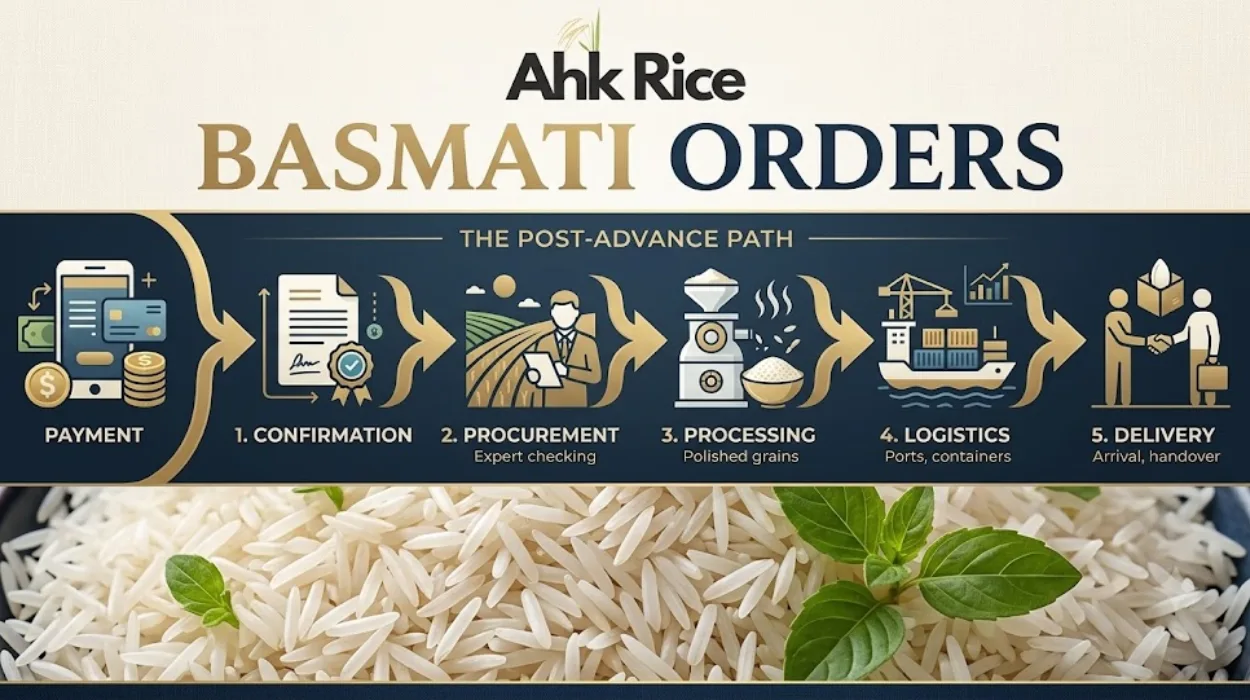
After advance payment is received for a Basmati rice export order, the shipment enters a controlled export workflow. The exporter confirms funds, allocates stock, processes the rice, prepares export documents, books shipping space, and releases the cargo after final payment or agreed payment terms are met.
For buyers, the advance payment is the trigger point that converts a quotation or proforma invoice into an active export order. For exporters such as AHK Rice, it starts the production, packaging, quality control, and logistics coordination needed to prepare rice for shipment.
Why does the export process begin only after advance payment?
Advance payment confirms buyer commitment, secures production scheduling, and allows the exporter to allocate rice stock, packaging material, labor, transport, and shipping arrangements for the specific Basmati rice order.
In Basmati rice exports, advance payment is commonly used to reduce commercial risk and begin order fulfillment. The payment percentage depends on the contract, buyer relationship, market conditions, and payment method.
Typical advance payment structures in 2026 include:
- 20% to 30% advance payment for standard export orders.
- 50% advance payment for customized packaging, private labeling, or urgent shipments.
- 100% advance payment for small trial orders, first-time buyers, or high-risk destinations.
Once the exporter receives the agreed amount, the order is treated as confirmed. Production planning, quality control, packaging procurement, and shipping coordination begin according to the agreed shipment schedule.
How is the advance payment verified and recorded?
The exporter verifies the incoming payment through bank confirmation, records it against the proforma invoice, confirms receipt with the buyer, and activates the internal export order file.
Payment verification is the first operational step after the buyer transfers funds. Exporters check that the payment amount, sender details, invoice reference, and currency match the agreed order terms.
The verification process includes:
- Confirming receipt through the bank statement or SWIFT message.
- Matching the payment against the proforma invoice number.
- Recording the payment in export accounting and order management systems.
- Issuing payment confirmation to the buyer.
- Opening the production and export documentation file.
This stage usually takes 1 to 2 working days, depending on banking channels and international transfer clearance.
What order confirmation steps follow the payment?
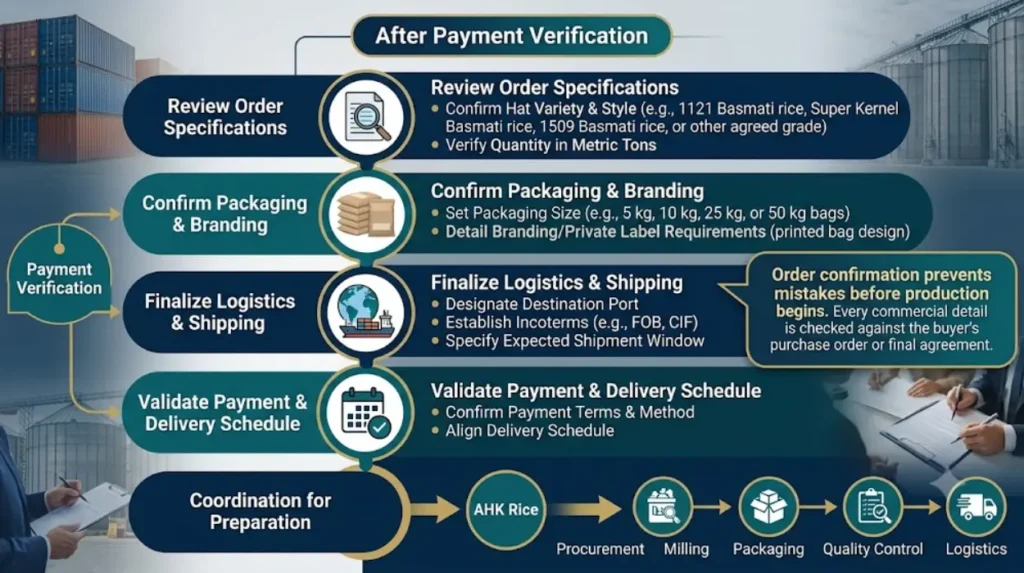
After payment verification, the exporter confirms the order specifications, shipment quantity, rice variety, packaging requirements, destination country, payment terms, and delivery schedule with the buyer.
Order confirmation prevents mistakes before production begins. Every commercial detail is checked against the buyer’s purchase order or final agreement.
Key details confirmed include:
- Rice variety: 1121 Basmati rice, Super Kernel Basmati rice, 1509 Basmati rice, or another agreed grade.
- Quantity in metric tons.
- Packaging size, such as 5 kg, 10 kg, 25 kg, or 50 kg bags.
- Branding, private label, or printed bag requirements.
- Destination port and Incoterms, such as FOB or CIF.
- Expected shipment window.
At this stage, exporters such as AHK Rice coordinate with procurement, milling, packaging, quality control, and logistics teams to prepare the order according to the confirmed specifications.
How is rice stock allocated after payment?
The exporter allocates available rice stock or schedules milling production, ensuring that the ordered Basmati rice variety, quantity, and grade are reserved for the buyer’s shipment.
Stock allocation is critical because Basmati rice export orders often involve specific grades and moisture standards. The exporter checks inventory, milling schedules, and aging requirements before reserving stock.
For example:
- 1121 Basmati rice is commonly selected for extra-long grain export markets.
- Super Kernel Basmati rice is often supplied to premium Middle Eastern and European buyers.
- 1509 Basmati rice is used in markets requiring good grain length and competitive pricing.
If ready stock is available, allocation can occur within 1 to 3 days. If milling or aging is required, the exporter schedules production according to the shipment deadline.
What processing steps prepare the rice for export?
Basmati rice is processed through cleaning, dehusking, milling, polishing, grading, sorting, and quality inspection to ensure export-grade rice that meets buyer and destination-country standards.
Rice processing converts paddy or raw rice into finished export-grade Basmati rice. Each stage affects grain quality, appearance, purity, and shelf life.
Cleaning and dehusking
Raw paddy is cleaned to remove stones, dust, straw, and other foreign matter. The husk is removed to produce brown rice.
Milling and polishing
The rice is milled to remove bran layers and polished according to the buyer’s required finish, such as white rice, steam rice, or parboiled rice.
Grading and sorting
Grains are separated by length, broken percentage, and quality. Color sorters remove discolored grains and impurities.
Quality inspection
The processed rice is checked for moisture, broken grains, chalkiness, foreign matter, and grain length before packaging approval.
This processing stage usually takes 5 to 10 days, depending on order size, rice variety, and mill capacity.
How is quality control handled after processing?
Quality control checks confirm that the rice meets contractual specifications for moisture, broken grains, grain length, purity, and overall export quality before packaging and shipment.
Quality control protects both the buyer and exporter. Exporters test representative samples from processed rice batches and compare the results with agreed specifications.
Common quality parameters checked in 2026 include:
| Parameter | Typical export standard |
|---|---|
| Moisture | 12% to 14% |
| Broken grains | According to grade specification |
| Foreign matter | Minimal or nil as agreed |
| Grain length | Variety-specific standard |
| Purity | High varietal purity |
If the buyer requires third-party inspection, an independent inspection agency can verify the rice quality before shipment approval.
What packaging work begins after quality approval?
After quality approval, the rice is packed into the agreed bag sizes, sealed, labeled, palletized when required, and prepared for container loading according to buyer and market requirements.
Packaging protects rice during storage, inland transport, sea freight, and distribution in the destination market. The packaging format depends on the buyer’s sales channel.
Common export packaging options include:
- 5 kg bags for retail distribution.
- 10 kg bags for supermarkets and wholesalers.
- 25 kg bags for foodservice and institutional buyers.
- 50 kg bags for bulk importers and distributors.
Packaging materials can include woven polypropylene bags, BOPP laminated bags, jute bags, or custom printed private-label bags. Packaging preparation generally takes 2 to 5 days.
Which export documents are prepared after payment?
The exporter prepares commercial, customs, shipping, quality, and regulatory documents required for Basmati rice export clearance and import clearance in the destination country.
Documentation is a major part of the post-payment process. Missing or incorrect documents can delay customs clearance and shipment release.
Key export documents include:
- Commercial invoice showing buyer, seller, quantity, value, and payment terms.
- Packing list detailing bag sizes, weights, and package counts.
- Certificate of origin confirming the rice originates from Pakistan.
- Phytosanitary certificate confirming the rice meets plant health requirements.
- Fumigation certificate when required by the importing country.
- Bill of lading issued after container loading and vessel departure.
- Quality certificate if required by the buyer or destination regulations.
Document preparation usually runs parallel with packaging and container booking, taking 2 to 4 days.
How is shipping space booked and cargo loaded?
The exporter books container space with a shipping line, arranges inland transport to the port, loads the rice into containers, seals the containers, and completes customs export clearance.
Shipping coordination starts after the order is packaged and documents are in progress. Exporters work with freight forwarders, transporters, customs agents, and shipping lines to secure vessel space.
The shipping process includes:
- Booking container space for the required shipment volume.
- Arranging trucks from the mill or warehouse to the export port.
- Loading rice bags into containers according to weight and stacking standards.
- Sealing containers and recording seal numbers.
- Submitting export documents for customs clearance.
- Obtaining shipping instructions and bill of lading details.
Container booking and loading generally take 3 to 7 days, depending on vessel schedules and port conditions.
What is the typical timeline from payment to shipment?
A standard Basmati rice export order is usually ready for shipment within 15 to 25 days after advance payment, depending on stock availability, processing requirements, packaging, documentation, and vessel booking.
The exact timeline varies by order size, rice variety, destination, and payment terms. A practical 2026 export timeline is:
| Stage | Typical time |
|---|---|
| Payment verification | 1–2 days |
| Order confirmation | 1–2 days |
| Stock allocation | 1–3 days |
| Rice processing | 5–10 days |
| Quality control | 1–2 days |
| Packaging | 2–5 days |
| Documentation | 2–4 days |
| Container booking and loading | 3–7 days |
| Total export preparation | 15–25 days |
Sea transit time is additional and depends on the destination port.
When is the remaining payment usually collected?
The remaining payment is collected according to the agreed payment terms, commonly before shipment, against shipping documents, through a letter of credit, or against bill of lading copies.
Payment collection timing depends on the contract. Common payment structures in Basmati rice exports include:
- Advance payment plus balance before shipment for many standard export orders.
- Advance payment plus balance against documents after shipment documents are issued.
- Letter of credit payment according to LC terms and bank document compliance.
- Cash against documents for buyers with established trade relationships.
The exporter releases original shipping documents only after the agreed payment condition is satisfied.
What updates should buyers expect after paying?
Buyers should expect payment confirmation, production updates, quality reports, packaging progress, container booking details, shipment dates, bill of lading information, and copies of export documents.
Regular communication helps buyers plan customs clearance, inventory, and distribution in the destination market. Professional exporters provide milestone updates throughout the order cycle.
Typical buyer updates include:
- Payment receipt confirmation.
- Order confirmation and production schedule.
- Quality inspection results.
- Packaging completion notice.
- Container booking and vessel details.
- Container loading confirmation.
- Bill of lading copy and shipment documents.
What problems can occur after advance payment?
Common post-payment issues include production delays, packaging shortages, quality mismatches, document errors, container shortages, port congestion, and delayed buyer approvals.
These issues can extend the shipment timeline if they are not managed early. Exporters reduce risk through production planning, quality checks, document review, and advance shipping coordination.
Common issues and controls include:
| Issue | Control measure |
|---|---|
| Production delay | Reserve stock and confirm milling schedule early. |
| Quality mismatch | Conduct pre-shipment inspection and sample approval. |
| Packaging shortage | Procure packaging material before processing starts. |
| Document error | Cross-check invoice, packing list, and certificates before submission. |
| Container shortage | Book vessel space in advance with freight forwarders. |
| Port congestion | Allow buffer time in the shipment schedule. |
What certifications and compliance checks apply?
Basmati rice export orders are checked against quality, food safety, phytosanitary, fumigation, origin, and destination-country import compliance requirements before shipment.
The exact certifications depend on the importing country and buyer requirements. Common export compliance documents include:
- Phytosanitary certificate.
- Fumigation certificate, when required.
- Certificate of origin.
- Quality certificate.
- Food safety management certification, such as HACCP or ISO 22000, when applicable.
- Halal certification for markets requiring halal-compliant food products.
These certifications support customs clearance and buyer confidence in regulated export markets.
How does AHK Rice handle the post-payment export process?
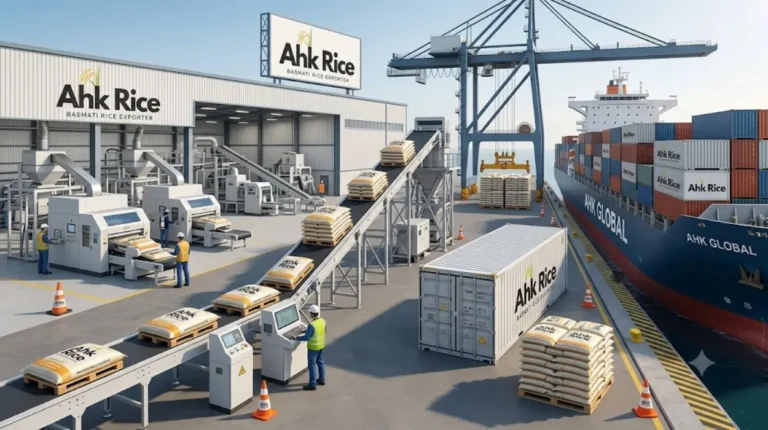
AHK Rice coordinates payment confirmation, stock allocation, processing, quality control, packaging, export documentation, container booking, and shipment tracking through an end-to-end export workflow.
As a Pakistani Basmati rice exporter based in Punjab, AHK Rice supplies 1121 Basmati rice, Super Kernel Basmati rice, and 1509 Basmati rice to more than 15 countries. Its workflow covers processing, custom packaging, export documentation, and shipment coordination.
This end-to-end approach helps buyers receive consistent updates and traceability from payment confirmation to vessel departure.
What should buyers check after making advance payment?
Buyers should confirm payment receipt, final specifications, production timeline, quality standards, packaging details, shipping schedule, required documents, and payment balance terms immediately after transfer.
A written confirmation from the exporter reduces misunderstandings later in the process. Buyers should keep copies of the proforma invoice, payment proof, order confirmation, and agreed specifications.
A practical buyer checklist includes:
- Payment receipt confirmation.
- Final rice variety and grade confirmation.
- Quantity and packaging confirmation.
- Expected shipment date.
- Required export documents list.
- Remaining payment condition.
- Contact person for shipment updates.
What is the overall outcome after advance payment?
Advance payment activates the full Basmati rice export cycle, moving the order from commercial agreement to production, quality control, packaging, documentation, container loading, shipment, and final delivery preparation.
The process is structured and time-bound. Buyers who understand each stage can track their order more effectively and prepare for customs clearance, inventory planning, and market distribution.
For a detailed breakdown of processing, packaging, and export preparation stages, readers can refer to:
Rice Processing, Packaging and Export Preparation Timeline Explained
Frequently Asked Questions
What does an advance payment mean in a Basmati rice export order?
An advance payment is the initial amount paid by the buyer to confirm the order. It allows the exporter to reserve rice stock, schedule processing, procure packaging materials, and begin export preparation.
How long does it take to prepare a Basmati rice order after advance payment?
Most Basmati rice export orders are prepared within 15–25 days after advance payment, depending on stock availability, processing requirements, packaging customization, documentation, and vessel schedules.
What happens immediately after the exporter receives the advance payment?
The exporter verifies the payment through the bank, confirms the order details, allocates inventory, opens the production schedule, and begins processing the rice according to the agreed specifications.
Which documents are prepared after advance payment?
The exporter prepares the commercial invoice, packing list, certificate of origin, phytosanitary certificate, fumigation certificate (if required), quality certificate, and bill of lading for the shipment.
Can buyers track the progress of their order after payment?
Yes. Professional exporters provide regular updates, including payment confirmation, production status, quality inspection results, packaging progress, container booking details, and shipment information.
What quality checks are performed before shipment?
The rice is tested for moisture content, grain length, broken percentage, purity, foreign matter, and overall quality to ensure it meets the agreed export specifications.
When is the remaining payment usually made?
The balance payment depends on the agreed contract terms. It is commonly paid before shipment, against shipping documents, or through a Letter of Credit (LC).
What packaging options are available for Basmati rice exports?
Common export packaging includes 5 kg, 10 kg, 25 kg, and 50 kg bags. Buyers can also request private-label packaging and custom-printed bags based on their market requirements.
What factors can delay a Basmati rice shipment after advance payment?
Delays can result from customized packaging production, additional quality inspections, incomplete documentation, shipping line schedule changes, container shortages, or port congestion.
Why is advance payment important in international rice trade?
Advance payment secures the order, reduces commercial risk, enables production planning, reserves export-grade rice, and allows the exporter to begin the complete processing and export workflow immediately.