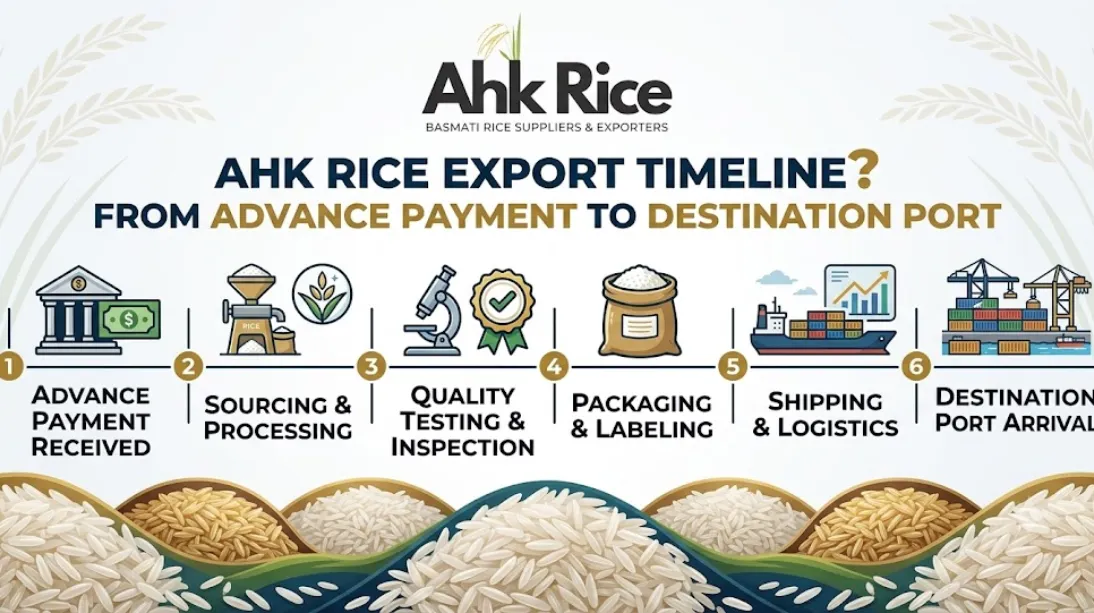
What is AHK Rice Export Timeline from Advance Payment to Destination Port
Importers who understand the complete export timeline make better purchasing decisions, reduce supply chain risks, and avoid costly inventory shortages. If you are planning your next shipment, it helps to first understand how Basmati rice transit time is calculated between Pakistan and the UAE through our guide on:
What Determines Basmati Rice Transit Time Between Pakistan and UAE? Once you know the shipping variables, the next step is selecting an exporter that can consistently deliver within committed schedules.
International rice trade depends on predictable execution rather than promises. Delays during production, packaging, documentation, container booking, customs clearance, or ocean freight can affect inventory planning and retail commitments. AHK Rice has developed a structured export workflow that minimizes these risks by following documented production schedules, quality inspections, and shipping procedures aligned with current 2026 export practices.
Businesses importing rice into the UAE often compare suppliers based on lead time, shipment visibility, export documentation, production capacity, and delivery reliability. This guide explains how AHK Rice manages every stage from advance payment to arrival at the destination port and what buyers should expect throughout the process.
What is the best solution for managing the rice export timeline?
The best solution is working with an exporter that follows a documented production schedule, provides shipment updates, completes quality inspections before dispatch, secures vessel bookings early, and delivers complete export documentation so your shipment reaches the UAE within the committed timeframe with minimal operational risk.
Many importers focus only on freight transit days. In reality, the total export timeline begins immediately after the advance payment is received.
A structured exporter reduces delays by planning every activity in sequence instead of handling them independently. AHK Rice follows an organized workflow that allows buyers to monitor progress throughout production and shipping.
A typical export timeline in 2026 includes:
| Stage | Typical Timeline |
|---|---|
| Advance payment confirmation | Same day |
| Production scheduling | 1 day |
| Rice processing and grading | 2–4 days |
| Laboratory quality inspection | 1 day |
| Packaging and pallet preparation | 1–2 days |
| Export documentation | 1–2 days |
| Container loading | 1 day |
| Pakistan customs clearance | 1–2 days |
| Port handling and vessel departure | 2–5 days |
| Ocean freight to UAE | 8–14 days |
| UAE port arrival | According to vessel schedule |
The complete workflow behind production, loading, and freight scheduling is explained in our:
Rice Production, Container Loading and Ocean Freight Timeline Guide, helping buyers compare different export stages before selecting a supplier.
Following this sequence helps importers forecast warehouse inventory more accurately and coordinate distribution with retailers across the UAE.
The first commercial step is selecting a supplier with reliable export operations, such as our UAE rice export service, which is designed for buyers seeking consistent supply schedules and professional shipment management.
Why should UAE importers choose AHK Rice?
Importers should choose AHK Rice because the company combines production planning, export documentation, quality inspection, container management, and shipment tracking into one coordinated export process that reduces uncertainty, supports timely delivery, and improves purchasing confidence for wholesale rice buyers.
Consistency matters more than isolated fast shipments.
AHK Rice supplies buyers using standardized production procedures that reduce unexpected delays.
The company manages:
- Production planning
- Quality grading
- Moisture verification
- Packaging
- Container loading
- Export documentation
- Shipping coordination
Instead of outsourcing multiple export activities, AHK Rice coordinates every stage under one export process.
For UAE importers this provides several operational advantages.
Production starts according to confirmed purchase orders.
Quality inspection is completed before shipment.
Packaging specifications match buyer requirements.
Shipping documents are prepared before vessel departure.
Container booking is planned in advance to reduce waiting time during peak export seasons.
Because AHK Rice exports regularly, buyers receive shipment progress updates that improve purchasing transparency.
This structured workflow is particularly valuable for wholesalers, supermarket distributors, hospitality suppliers, and food manufacturers operating on fixed inventory schedules.
What export timeline results can buyers expect?
Most UAE buyers can expect production completion within one week after scheduling, container loading shortly afterward, ocean transit averaging approximately 8–14 days depending on vessel schedules, and continuous shipment visibility throughout the export process when documentation is completed correctly.
Although every shipment differs slightly, experienced exporters maintain predictable timelines by controlling production instead of reacting to delays.
A practical example illustrates the process.
An importer confirms a 2×40HQ order.
Advance payment is received.
AHK Rice immediately allocates production capacity.
Rice is processed.
Quality testing confirms specifications.
Packaging is completed.
Containers are loaded.
Export documents are finalized.
The shipment is cleared by Pakistan Customs.
The vessel departs according to the booked sailing schedule.
Ocean freight reaches the UAE within the estimated transit period, subject to shipping line operations and port conditions.
Typical shipment expectations include:
| Destination | Estimated Ocean Transit (2026) |
|---|---|
| Jebel Ali | 8–10 days |
| Abu Dhabi | 9–12 days |
| Sharjah | 9–12 days |
| Fujairah | 10–14 days |
Transit times may vary due to vessel routing, weather, customs inspections, or port congestion.
Because AHK Rice provides shipment documentation promptly, buyers can begin import clearance preparations before cargo arrival, reducing unnecessary storage delays.
How does the sample approval process work and what does it cost?
Professional sample approval allows buyers to verify grain quality, milling standards, moisture levels, packaging specifications, and cooking performance before committing to large commercial orders, reducing procurement risks while supporting long-term supplier relationships.
Commercial rice purchases usually begin with sampling.
The process is straightforward.
The buyer submits the required specifications.
These may include:
- Rice variety
- Grain length
- Broken percentage
- Moisture level
- Packaging design
- Private label requirements
AHK Rice prepares representative samples matching the requested specification.
Typical sample quantities include:
- 500 g laboratory sample
- 1 kg evaluation sample
- 5 kg cooking trial sample
Courier dispatch normally takes one business day.
International delivery commonly requires 3–6 working days depending on destination.
Typical sample-related costs in 2026 include:
| Item | Typical Cost Range |
|---|---|
| Sample preparation | Usually complimentary |
| Courier charges | USD 40–120 |
| Customized packaging sample | May incur additional design costs |
| Laboratory certificate | Depends on requested analysis |
Many commercial orders credit the sample cost against the confirmed purchase, depending on contract terms.
After approval, production begins according to the agreed specifications.
This reduces misunderstandings during bulk manufacturing and improves consistency across future shipments.
What factors affect export pricing?
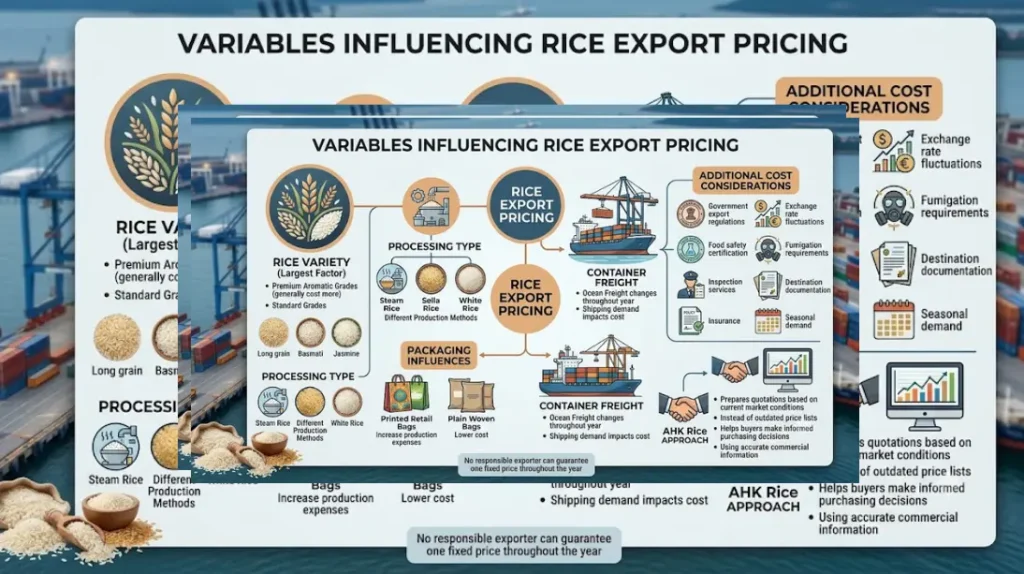
Rice export pricing depends on product specification, processing method, packaging requirements, shipping costs, currency movements, seasonal harvest conditions, container availability, certification needs, and destination logistics rather than a single fixed market price.
No responsible exporter can guarantee one fixed price throughout the year.
Several variables influence quotations.
The largest factor is the rice variety.
Premium aromatic grades generally cost more than standard grades.
Processing type also affects pricing.
Steam rice.
Sella rice.
White rice.
Each requires different production methods.
Packaging influences cost as well.
Printed retail bags increase production expenses compared with plain woven bags.
Container freight remains another major pricing factor.
Ocean freight changes throughout the year according to shipping demand.
Additional cost considerations include:
- Government export regulations
- Exchange rate fluctuations
- Food safety certification
- Fumigation requirements
- Inspection services
- Destination documentation
- Insurance
- Seasonal demand
AHK Rice prepares quotations based on current market conditions instead of outdated price lists.
This helps buyers make informed purchasing decisions using accurate commercial information.
How can buyers get started with AHK Rice?
Getting started involves confirming your product requirements, approving representative samples, receiving a formal quotation, completing advance payment, finalizing packaging details, monitoring production updates, reviewing export documentation, and tracking shipment progress until arrival at the UAE destination port.
Beginning the procurement process is simple when expectations are clearly defined.
The first step is sharing your requirements.
Include:
- Rice variety
- Quantity
- Packaging
- Destination port
- Required certifications
- Delivery schedule
AHK Rice reviews the request and prepares a commercial quotation.
If required, product samples are dispatched for evaluation.
Once the buyer approves the sample, both parties confirm technical specifications.
Advance payment is received according to the agreed payment terms.
Production scheduling begins immediately.
Throughout manufacturing, AHK Rice performs quality inspections to verify compliance with contractual specifications.
Packaging follows the approved artwork and labeling requirements.
Containers are loaded after final inspection.
Export documentation is completed before shipment.
The buyer receives the shipping documents required for import clearance.
During ocean transit, shipment updates allow buyers to coordinate warehouse operations and delivery planning before vessel arrival.
A structured procurement process reduces uncertainty, minimizes delays, and improves supply chain planning for UAE importers purchasing Pakistani Basmati rice.
When selecting an exporter, buyers should evaluate operational consistency, documentation accuracy, production capability, shipment visibility, and delivery performance rather than focusing only on price. AHK Rice supports importers with organized export management, transparent communication, and documented production workflows designed to meet current international trade expectations in 2026. To begin your order discussion, submit your requirements through the request a quote page.
Frequently Asked Questions
How long does the complete export process take from advance payment to UAE port arrival?
The complete timeline generally ranges from 18 to 30 days in 2026. This includes production, quality inspection, packaging, documentation, customs clearance, container loading, and ocean freight to the UAE, depending on vessel schedules and port operations.
When does AHK Rice begin production after receiving advance payment?
Production scheduling typically starts within one business day after advance payment confirmation. Raw material allocation, processing, and quality inspections are then carried out according to the agreed shipment schedule.
Can buyers track their shipment during the export process?
Yes. Buyers receive regular updates throughout production, container loading, vessel departure, and ocean transit, allowing them to prepare customs clearance and warehouse operations before the shipment arrives.
How many days does ocean freight from Pakistan to the UAE usually take?
Ocean freight usually takes 8 to 14 days, depending on the destination port, shipping line, vessel route, and weather or port congestion.
Is a product sample available before placing a bulk order?
Yes. Buyers can request representative rice samples to evaluate grain quality, moisture level, cooking performance, and packaging before confirming a commercial order.
What does the sample process cost?
Sample preparation is often complimentary, while international courier charges generally range between USD 40 and USD 120 depending on the destination and sample size. Additional laboratory testing may involve separate charges.
Which factors affect the final export price?
Pricing depends on the rice variety, processing type, packaging requirements, order quantity, freight rates, exchange rates, certification requirements, and seasonal market conditions.
What documents are provided with an export shipment?
A standard export shipment typically includes the Commercial Invoice, Packing List, Bill of Lading, Certificate of Origin, Phytosanitary Certificate, and any additional documents required by the buyer or UAE authorities.
What information should buyers provide to receive a quotation?
Buyers should specify the rice variety, quantity, packaging requirements, destination port, preferred shipment schedule, and any certification or labeling requirements to receive an accurate quotation.
Why is a structured export timeline important for importers?
A structured export timeline helps importers plan inventory, avoid stock shortages, coordinate customs clearance efficiently, and ensure timely distribution to wholesalers, retailers, and food service customers.