How Do Exporters Verify Moisture Compliance Before Shipment?
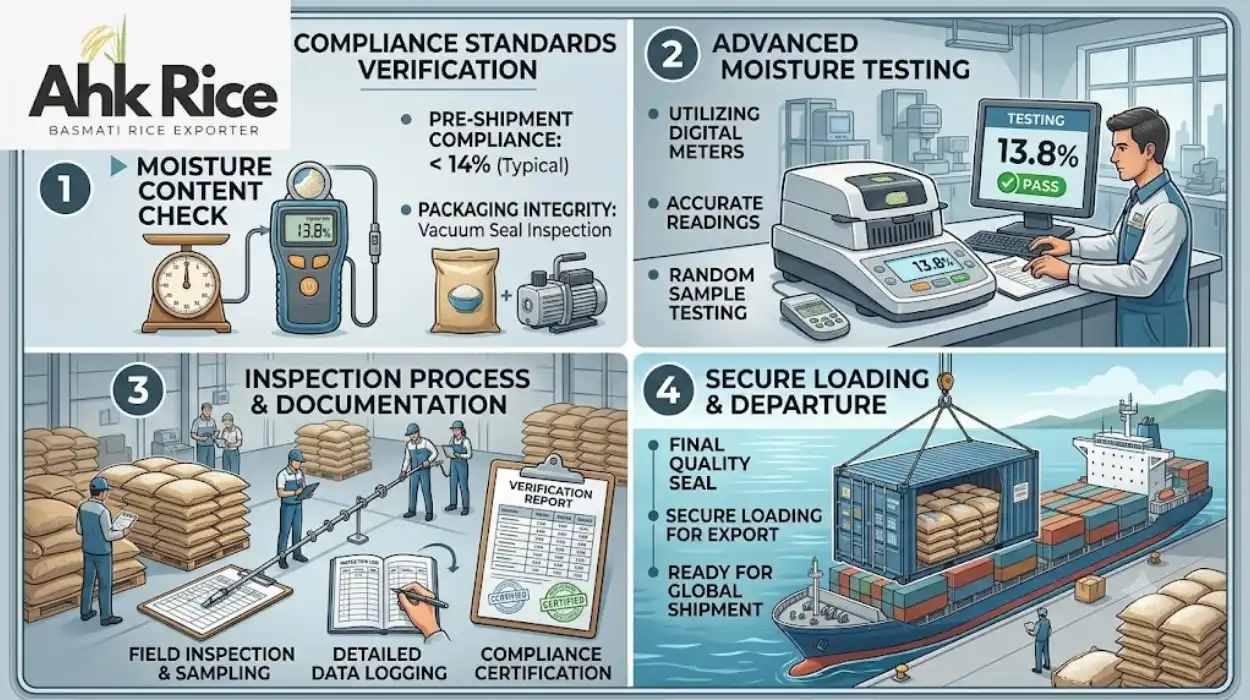
Exporters verify moisture compliance through calibrated moisture meters, laboratory testing, pre-shipment inspections, and documented quality control systems. Here is why: moisture directly affects shelf life, container safety, grain quality, import acceptance, and buyer claims. Rice shipped above the agreed moisture limit faces mould growth, weight disputes, and customs rejection. Moisture verification protects both exporters and importers by ensuring every shipment meets contract specifications before loading.
Moisture compliance has become a critical requirement in global Basmati rice trade. Buyers across the Gulf, Europe, North America, and Africa specify moisture limits within purchase contracts. Importers increasingly request laboratory reports alongside quality certificates. Understanding moisture standards helps buyers evaluate suppliers more effectively. Readers seeking a broader understanding of rice quality specifications can also explore the guide on understanding key quality indicators in export-grade Basmati rice.
AHK Rice is a trusted Pakistani Basmati rice exporter based in Punjab, supplying 1121, Super Kernel, and 1509 varieties to more than 15 countries. The company’s quality-controlled export programme includes moisture verification before every shipment, ensuring buyers receive rice within agreed specifications.
What Is Moisture Compliance in Rice Exports?
Moisture compliance means maintaining grain moisture within contract specifications, typically between 12% and 14%, before shipment.
Moisture content measures the amount of water present inside rice grains. Export contracts define acceptable moisture ranges because excessive moisture shortens storage life and increases spoilage risks.
Rice naturally absorbs and releases moisture depending on storage conditions. Exporters must test moisture repeatedly during processing, storage, and loading.
Most importing countries accept moisture levels between 12% and 14%. Premium Basmati shipments often target 13% maximum moisture for longer storage stability.
Moisture compliance affects several commercial factors:
- Grain stability
- Shelf life
- Weight consistency
- Container safety
- Buyer acceptance
- Import clearance
A shipment meeting moisture requirements reduces quality disputes and ensures predictable product performance during distribution.
With moisture compliance defined, the next question is how exporters actually verify these specifications.
What Solutions Are Available for Moisture Verification?
Digital moisture meters, laboratory testing, third-party inspections, and integrated quality management systems represent the primary verification solutions.
Exporters use several methods to measure moisture content. Each method offers different accuracy levels, costs, and operational benefits.
Digital Moisture Meters
Digital moisture meters provide rapid readings during processing and storage.
Operators collect grain samples and test them within seconds. Results help quality teams make immediate decisions about drying or storage adjustments.
Digital meters are commonly used because they provide:
- Fast results
- Portable operation
- Low testing costs
- Frequent monitoring capability
Modern meters typically deliver accuracy within ±0.2% to ±0.5% moisture.
Laboratory Oven Testing
Laboratory oven testing serves as the reference method.
Technicians weigh rice samples, dry them under controlled temperatures, and calculate moisture loss.
Laboratory testing provides:
- High precision
- Standardised procedures
- Verifiable documentation
- Audit compliance
Most export contracts recognise laboratory reports as the final verification method.
Third-Party Inspection Agencies
Independent inspectors verify shipment specifications before loading.
Inspection companies test representative samples and issue certificates accepted by international buyers.
Common inspection activities include:
- Sampling
- Testing
- Verification
- Certification
Third-party verification increases buyer confidence and reduces commercial disputes.
Integrated Quality Control Systems
Advanced exporters combine multiple verification methods.
Quality teams inspect moisture at every stage:
- Receive paddy
- Dry grain
- Mill rice
- Grade product
- Store inventory
- Test warehouse lots
- Verify packed bags
- Inspect containers
- Confirm loading samples
Integrated systems create complete traceability from processing to shipment.
With available solutions established, the next step is comparing their effectiveness.
How Do Different Moisture Verification Methods Compare?
Laboratory testing offers the highest accuracy, while digital meters provide the fastest operational control.
Moisture Verification Comparison Table
| Attribute | Digital Meter | Laboratory Testing | Third-Party Inspection |
|---|---|---|---|
| Accuracy | ±0.2%–0.5% | ±0.1% | ±0.1%–0.2% |
| Testing Speed | Seconds | Several hours | 1–2 days |
| Cost Per Test | Low | Medium | High |
| Portability | High | None | Limited |
| Operational Control | Excellent | Moderate | Low |
| Contract Acceptance | Moderate | High | Very High |
| Documentation Strength | Moderate | High | Very High |
Digital meters support daily quality control.
Laboratory testing supports specification verification.
Third-party inspection supports commercial assurance.
A strong export programme combines all three approaches instead of relying on a single method.
With method comparisons completed, the next consideration is regional buyer preferences.
Which Moisture Standards Do Different Markets Prefer?
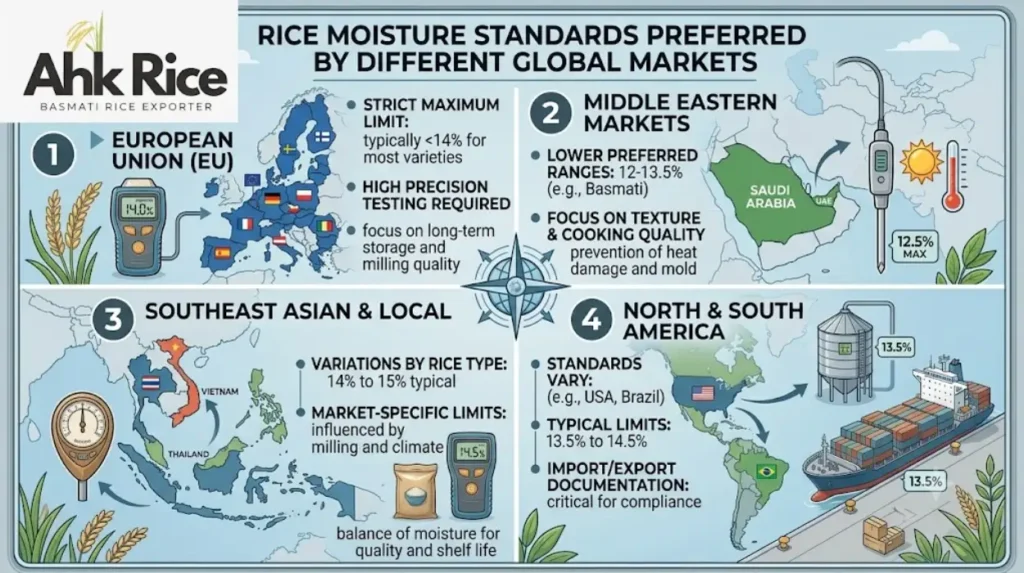
Gulf buyers commonly accept 13–14% moisture, while European buyers frequently require 12–13% moisture for extended storage.
Import requirements vary according to climate conditions, distribution networks, and storage practices.
Gulf Cooperation Council (GCC) Markets
Countries including Saudi Arabia, UAE, Qatar, Kuwait, Bahrain, and Oman import large volumes of Basmati rice.
Preferred grades include:
- 1121 Steam Basmati
- 1121 Golden Sella
- Super Kernel Basmati
Typical moisture preference ranges from 13% to 14%.
Higher turnover rates allow slightly higher moisture specifications while maintaining quality.
European Markets
European importers prioritise long storage periods and strict quality controls.
Preferred grades include:
- 1121 Steam Basmati
- Super Kernel White Basmati
- Premium A-grade Basmati
Typical moisture preference ranges from 12% to 13%.
Lower moisture improves warehouse stability and reduces spoilage risks during extended storage.
Regional Preference Comparison
| Market Region | Preferred Moisture | Common Grades |
|---|---|---|
| GCC | 13–14% | 1121 Steam, 1121 Golden Sella |
| Europe | 12–13% | 1121 Steam, Super Kernel White |
European buyers generally prioritise storage stability.
Gulf buyers often prioritise cooking performance and supply continuity.
With regional requirements covered, buyers should also understand pricing implications.
How Does Moisture Compliance Affect Price Per Metric Ton?
Lower moisture generally increases processing costs but improves market value and buyer acceptance.
Moisture management requires drying equipment, testing systems, skilled operators, and quality documentation.
Moisture Level vs Export Value
| Moisture Level | Typical Market Position | Price Impact Per MT |
|---|---|---|
| 14% | Standard Export Grade | Baseline |
| 13% | Premium Export Grade | +£8–£15 |
| 12% | High-Specification Grade | +£15–£30 |
Lower moisture specifications require additional drying and monitoring.
European importers frequently pay premiums for tighter moisture tolerances because long-term storage performance improves.
Premium rice contracts often reward verified moisture compliance through higher contract values.
With pricing implications explained, shelf life becomes the next logical factor.
How Does Moisture Compliance Influence Shelf Life?
Lower moisture significantly extends storage stability and reduces spoilage risks.
Moisture content directly affects microbial activity.
Higher moisture accelerates deterioration.
Lower moisture preserves grain quality.
Shelf Life Comparison
| Moisture Level | Estimated Shelf Life |
|---|---|
| 14% | 12–18 Months |
| 13% | 18–24 Months |
| 12% | 24+ Months |
A UAE distributor storing rice at high temperatures benefits from 13% moisture rice.
A European wholesaler storing inventory for extended periods benefits from 12% moisture rice.
A retailer managing seasonal demand benefits from lower moisture because stock remains stable longer.
Shelf life considerations naturally lead buyers toward selecting the most appropriate verification strategy.
Which Moisture Verification Method Works Best for Different Cases?
The best method depends on shipment value, destination market, and buyer requirements.
Decision Framework for Buyers
| Situation | Recommended Method | Reason |
|---|---|---|
| Daily production control | Digital meter | Fast monitoring |
| Premium export contract | Laboratory testing | High accuracy |
| New buyer relationship | Third-party inspection | Independent verification |
| EU market shipment | Lab + Third-party | Strict compliance |
| Large-volume GCC shipment | Digital + Lab | Efficient control |
Different situations require different verification approaches.
Combining methods creates stronger quality assurance than using any single method alone.
With suitability established, buyers should evaluate strengths and weaknesses.
What Are the Pros and Cons of Each Verification Method?
Every verification approach offers advantages and limitations that affect operational decisions.
Digital Moisture Meters
Advantages
- Fast testing
- Low operating cost
- Frequent monitoring
- Easy deployment
Limitations
- Calibration requirements
- Slight accuracy variations
- Operator dependence
Laboratory Testing
Advantages
- High precision
- Industry acceptance
- Detailed reporting
- Strong traceability
Limitations
- Longer turnaround
- Higher testing costs
- Limited operational speed
Third-Party Verification
Advantages
- Independent validation
- Buyer confidence
- Reduced disputes
- Global acceptance
Limitations
- Additional cost
- Scheduling requirements
- Longer certification process
Most professional exporters combine all three approaches to maximise reliability.
With advantages and limitations understood, the final consideration involves selecting suppliers.
What Decision Factors Should Buyers Evaluate?
Testing frequency, certification systems, traceability, calibration procedures, and reporting quality determine supplier reliability.
Buyers should evaluate exporters using measurable criteria.
Supplier Assessment Checklist
- Moisture testing frequency
- Laboratory capabilities
- Calibration records
- Inspection procedures
- Shipment documentation
Exporters providing documented moisture verification create greater confidence for importers.
Buyers should request recent moisture reports before placing large orders.
Verification systems matter more than verbal quality claims.
Strong moisture management protects product quality throughout processing, storage, loading, shipping, and delivery.
With supplier evaluation completed, buyers can make informed sourcing decisions based on measurable quality controls rather than assumptions.
Frequently Asked Questions
Why is moisture compliance important in rice exports?
Moisture compliance prevents mould growth, quality deterioration, weight disputes, and shipment rejection. It improves storage stability and buyer satisfaction.
What is the ideal moisture level for Basmati rice exports?
Most export contracts specify 12% to 14% moisture, with premium buyers often requesting 13% or lower.
How do exporters test rice moisture?
Exporters use digital moisture meters, laboratory oven testing, and third-party inspection services to verify compliance.
Which moisture testing method is most accurate?
Laboratory oven testing provides the highest accuracy and serves as the industry reference method.
Do different countries require different moisture levels?
Yes. European markets often require 12–13% moisture, while GCC markets generally accept 13–14% moisture.
Can moisture levels affect rice pricing?
Yes. Lower moisture specifications often increase processing costs and can command higher export prices.
How often should moisture be tested before shipment?
Professional exporters test moisture during processing, storage, packing, and pre-shipment inspection stages.