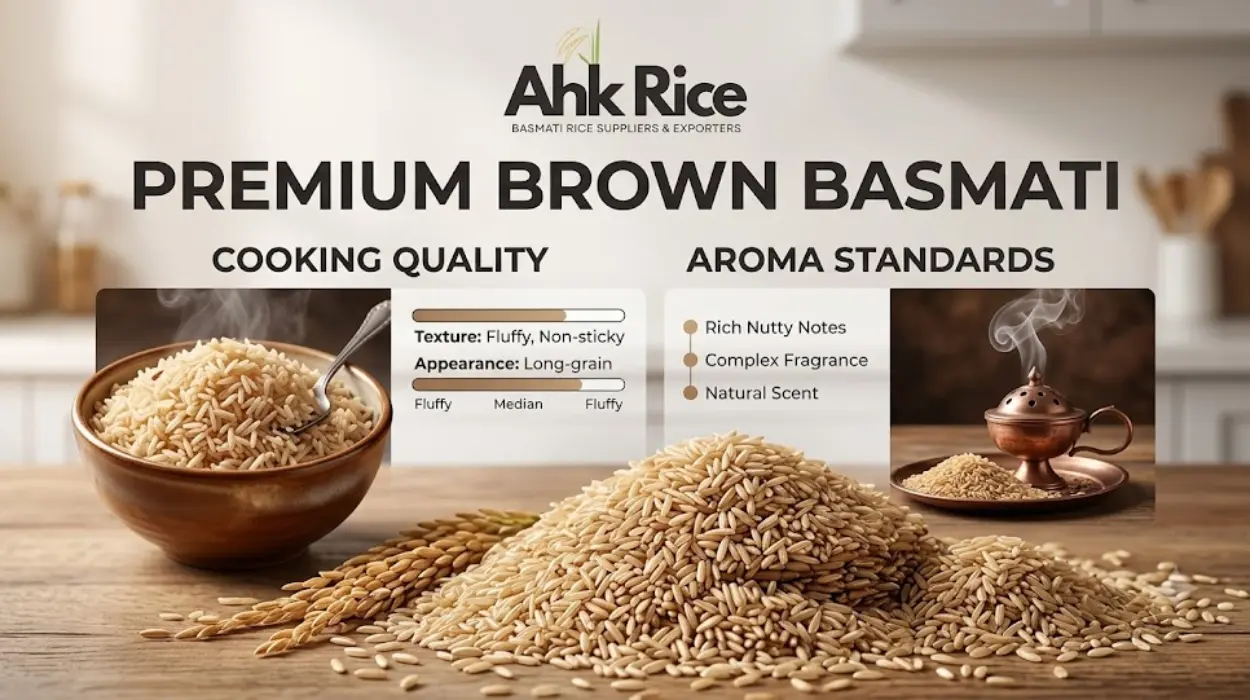
Cooking Quality and Aroma Standards for Premium Brown Basmati
Premium brown basmati is best evaluated by grain integrity, aroma retention, bran-layer condition, moisture control, cooking texture, and consistency after cooking, not by grain length alone. For health-focused retail markets, 1121 Brown Basmati offers the strongest combination of extra-long grain appearance, natural aroma, chewy texture, and whole-grain positioning.
Brown basmati differs from white basmati because the hull is removed while the bran layer remains. USDA defines brown rice as rice with the hull removed, while the bran is the outer layer containing the pericarp, aleurone layer, and part of the germ. This retained layer changes cooking time, mouthfeel, storage behavior, and aroma perception. For background on why American consumers increasingly evaluate 1121 Brown Basmati as a whole-grain option, see the educational guide on:
Why health-conscious Americans prefer 1121 Brown Basmati Rice.
What are the available solutions for premium brown basmati cooking quality?
Premium brown basmati quality can be achieved through raw-grain selection, controlled dehusking, precise cleaning and grading, moisture management, aroma preservation, and standardized cooking tests. The strongest solution combines all six controls because cooking performance depends on grain structure and processing consistency.
The first solution is raw-material selection. 1121 Basmati is particularly suitable for premium brown rice because of its long slender kernel and aromatic character. Current AHK Rice specifications for 1121 Brown Basmati list an average grain length of 8.2–8.3 mm, maximum moisture of 12%, broken grains of 1–2%, and an unpolished whole-grain finish.
The second solution is controlled dehusking. Dehusking removes the inedible outer hull without removing the bran layer. This produces brown rice rather than white rice. The processing distinction matters because further whitening would remove the bran and change the product category.
The third solution is mechanical and optical grading. Grading removes unsuitable kernels, foreign material, excessive broken grains, and visually inconsistent pieces. A premium retail product benefits from uniform grain size because consumers associate consistent appearance with consistent cooking performance.
The fourth solution is moisture control. A 12% maximum moisture specification is used for AHK Rice 1121 Brown Basmati. Moisture affects storage stability, microbial risk, grain condition, and cooking behavior. A consistent moisture profile also makes cooking tests more repeatable from one lot to another.
The fifth solution is aroma preservation. Basmati aroma is closely associated with volatile compounds, including 2-acetyl-1-pyrroline. Excessive heat exposure, prolonged cooking, poor storage, or stale raw material can reduce the perceived aromatic intensity. The objective is therefore not simply to produce fragrant raw rice but to retain recognizable basmati aroma after cooking.
The sixth solution is standardized cooking evaluation. A buyer should test the same rice-to-water ratio, soaking period, cooking temperature, cooking time, resting period, and serving condition for every supplier sample. This converts subjective claims such as “premium aroma” into comparable performance data.
How do different approaches compare for cooking quality and aroma?
Natural brown 1121, brown parboiled rice, white 1121, and lower-grade brown basmati serve different cooking objectives. Natural brown 1121 delivers the strongest whole-grain positioning, while parboiled and white alternatives offer different advantages in firmness, speed, appearance, and consumer familiarity.
| Attribute | 1121 Brown Basmati | Brown Parboiled Basmati | 1121 White Basmati | 1509 Brown Basmati |
|---|---|---|---|---|
| Grain structure | Bran retained | Bran retained with parboiling | Bran removed | Bran retained |
| Typical grain length | 8.2–8.3 mm | Long grain | 8.3–8.4 mm | Long grain |
| Aroma profile | Nutty, aromatic | Nutty, more process-stable | Strong basmati aroma | Aromatic, generally lighter |
| Cooking texture | Firm and chewy | Firmer and more separate | Fluffy and non-sticky | Firm and chewy |
| Cooking demand | Longer cooking | Longer than white, more forgiving | Faster | Longer cooking |
| Whole-grain positioning | Strongest | Strong | Limited | Strong |
| Premium retail fit | Health-focused retail | Health + convenience | Mainstream premium | Value-conscious premium |
The comparison shows why a buyer should not treat all “brown basmati” products as interchangeable. Brown 1121 retains the bran while preserving the naturally long basmati kernel. Brown parboiled rice adds a thermal processing step that changes texture and cooking stability. White 1121 removes the bran and prioritizes fluffy appearance and familiar cooking behavior. AHK Rice identifies both 1121 Brown Basmati and multiple other 1121 processing grades for international buyers.
For aroma, natural brown 1121 has an important advantage because the product retains its characteristic basmati grain structure without the whitening stage. However, the bran layer also creates a stronger whole-grain mouthfeel. The buyer therefore needs to evaluate aroma together with texture rather than treating aroma as the only quality indicator.
For cooking quality, soaking becomes more important. Brown rice generally requires more time for water penetration because the bran layer remains intact. A standardized test should therefore evaluate both soaked and unsoaked cooking performance before a retail specification is finalized.
Which method works best for different market regions?
For United States health-focused retail, natural 1121 Brown Basmati is the strongest fit because it combines whole-grain positioning with extra-long basmati identity. For Gulf premium retail, brown basmati works best when aroma, grain appearance, and firm cooking texture are prioritized alongside familiar basmati culinary applications.
Which grade fits United States retailers?
United States retailers targeting health-conscious consumers should prioritize 1121 Brown Basmati with 8.2–8.3 mm raw grain length, maximum 12% moisture, 1–2% broken grains, and a clean unpolished appearance. These parameters create a clear product story: extra-long basmati, retained bran, natural aroma, and premium whole-grain texture.
The U.S. market also requires food importers to address FDA requirements. Imported food must be safe, sanitary, truthfully labeled in English, and compliant with applicable U.S. requirements. Facilities handling food for the U.S. market are subject to FDA registration requirements, while importers must meet applicable prior-notice and Foreign Supplier Verification Program obligations.
The 2026 U.S. rice market also makes supply consistency more important. USDA’s July 2026 outlook lowered projected U.S. 2026/27 rice production and raised the projected all-rice season-average farm price to $14.90 per hundredweight. USDA also projects record U.S. long-grain rice imports at 49.8 million hundredweight. This supports the importance of dependable imported long-grain supply for retailers rather than evaluating products only on the initial purchase price.
Which grade fits Gulf premium retail?
For UAE and Saudi Arabian premium retail, brown 1121 fits consumers seeking healthier rice alternatives without abandoning the aromatic identity of basmati. The specification should emphasize 12% maximum moisture, 1–2% broken grains, low chalkiness, clean brown appearance, and strong cooked aroma. AHK Rice lists these parameters for its 1121 Brown Basmati export specification.
The key difference is merchandising. U.S. retail can lead with whole-grain and health positioning, while Gulf retail can lead with aroma, long-grain appearance, premium origin, and compatibility with biryani, pilaf, and rice-based meals.
How do 2026 price levels compare between the regions?
Price should be compared on an FOB Karachi basis first, then adjusted for freight, insurance, destination charges, customs, packaging, and retailer requirements. AHK Rice currently publishes a starting benchmark of $1,100 per metric ton FOB Karachi for its broader 1121 Basmati offering, while the dedicated 1121 Brown Basmati page uses quotation-based pricing rather than publishing a fixed $/MT figure.
| Market region | 1121 Brown Basmati price basis | Procurement interpretation |
| United States | Quote-based; compare against $1,100/MT published 1121 FOB benchmark | Higher logistics and compliance costs make specification consistency important |
| UAE/Saudi Gulf | Quote-based; compare against the same origin benchmark | Shorter regional logistics can improve landed-cost economics |
A fixed brown-basmati price would be misleading because crop year, order quantity, packaging, inspection, Incoterm, freight, and destination port change the final value. For procurement, the correct comparison is USD/MT + specification + landed cost + shelf-life performance, not headline FOB price alone.
How does shelf life compare?
Brown basmati generally requires tighter inventory management than white rice because the retained bran and germ contain more lipids that can oxidize during extended storage. White rice has greater storage stability after polishing because much of the bran layer has been removed. This makes brown basmati more dependent on moisture control, packaging quality, warehouse conditions, and stock rotation.
For both U.S. and Gulf markets, a premium brown-rice specification should therefore include moisture verification, packaging integrity, lot traceability, and storage recommendations. The longer the distribution chain, the more important these controls become.
What are the pros and cons of each approach?
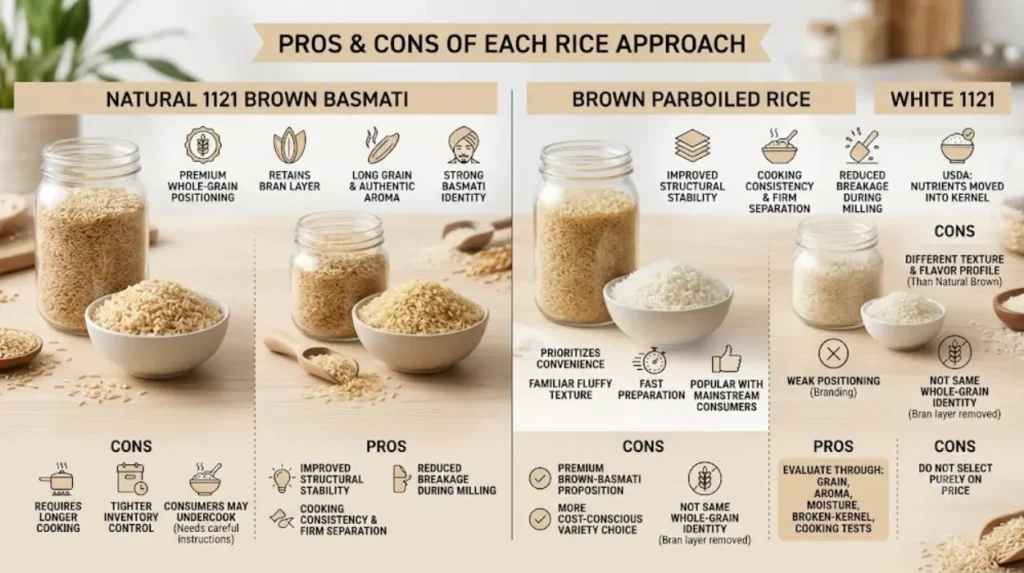
Natural 1121 Brown Basmati provides the strongest combination of whole-grain positioning, long grain, and authentic basmati aroma, but it requires longer cooking and tighter inventory control. Parboiled brown rice improves structural stability, while white 1121 prioritizes convenience and familiar fluffy texture.
Natural brown 1121 is strongest for a retailer selling premium whole-grain rice. The retained bran provides a recognizable brown-rice appearance, while the 1121 kernel adds premium basmati identity. The disadvantage is cooking time. Consumers expecting white-basmati cooking behavior may undercook the grain if the package instructions are inadequate.
Brown parboiled rice is stronger when cooking consistency and firm grain separation are more important. Parboiling changes the grain structure and can reduce breakage during milling. USDA notes that parboiling makes rice less likely to break during milling and can move nutrients from the bran into the kernel. The trade-off is that its texture and flavor profile differ from natural brown rice.
White 1121 is strongest for mainstream consumers who prioritize fluffy texture, fast preparation, and a familiar appearance. Its weakness is positioning. It does not provide the same whole-grain product identity because the bran layer has been removed.
1509 Brown Basmati is useful where a buyer wants a premium brown-basmati proposition with a more cost-conscious variety choice. It should be evaluated through the same grain, aroma, moisture, broken-kernel, and cooking tests as 1121 rather than selected purely on price.
What decision factors should buyers use before selecting premium brown basmati?
The best buying decision combines cooking performance, aroma retention, grain specifications, moisture, market positioning, shelf-life requirements, and landed cost. Buyers should approve a lot only after the physical specification and cooked sample both meet the intended retail positioning.
| Decision factor | What to verify | Why it matters |
| Grain length | 8.2–8.3 mm for 1121 Brown Basmati | Supports premium visual positioning |
| Moisture | Maximum 12% in the target specification | Supports storage stability and consistent cooking |
| Broken grains | 1–2% maximum | Improves appearance and cooked-grain uniformity |
| Aroma | Raw and cooked aroma test | Confirms basmati identity after preparation |
| Texture | Firmness, chewiness, separation | Determines consumer acceptance |
| Processing | Controlled dehusking without polishing | Protects brown-rice identity |
| Food compliance | U.S. import, labeling, and supplier controls | Reduces regulatory risk |
| Packaging | Barrier protection and appropriate pack size | Helps preserve quality during distribution |
| Price | FOB plus landed-cost calculation | Prevents misleading price comparisons |
| Sample consistency | Repeat cooking test across lots | Measures supply reliability |
The most useful sample protocol is simple. Inspect the raw grain first. Record length, broken percentage, color, foreign material, and moisture. Then rinse the sample consistently, apply the agreed soaking procedure, cook using the same water ratio and heat profile, and evaluate the cooked grains for aroma, elongation, firmness, chewiness, separation, and residual hardness.
The aroma test should occur immediately after cooking and again after a short resting period. A premium sample should provide a recognizable basmati fragrance without stale, musty, sour, chemical, or rancid notes. Texture should remain firm enough to distinguish individual grains without producing excessive hardness from the retained bran.
The final procurement decision should also separate product quality from supplier capability. A supplier can provide a good sample but fail to reproduce it at container scale. Buyers should therefore request a written specification, lot-based quality documentation, moisture results, packaging details, inspection terms, and a clear tolerance for broken grains and foreign material.
AHK Rice operates from Punjab and provides end-to-end processing covering paddy sourcing, cleaning, dehusking, grading, sorting, packaging, and export documentation. Its current product portfolio includes 1121 Brown Basmati alongside 1121 white, steam, and parboiled grades, allowing buyers to compare processing types against the same base variety.
For U.S. buyers, the final selection should prioritize 1121 Brown Basmati when the retail proposition centers on whole-grain consumption, long-grain appearance, natural aroma, and premium Pakistani origin. For Gulf buyers, the same grade works when aroma and traditional culinary performance are central to the product proposition. White 1121 remains stronger for convenience-focused consumers, while brown parboiled rice suits buyers who want a compromise between whole-grain positioning and structural cooking stability.
The strongest 2026 evaluation standard is therefore not simply “premium brown basmati.” It is a measurable combination of 8.2–8.3 mm grain length, maximum 12% moisture, 1–2% broken grains, controlled dehusking, consistent aroma, firm cooked texture, documented food compliance, suitable packaging, and repeatable lot performance.
For readers ready to move from evaluation to supplier selection, the next commercial step is to review:
Source 1121 Brown Basmati Rice from Pakistan for USA retailers before requesting samples or comparing supplier quotations.
Frequently Asked Questions
What is premium brown basmati rice?
Premium brown basmati rice is long-grain basmati rice with the inedible husk removed while the bran layer remains intact. This creates a firmer, chewier texture and a stronger whole-grain positioning than polished white basmati.
What makes 1121 Brown Basmati suitable for premium retail?
1121 Brown Basmati combines an extra-long, slender grain with natural basmati aroma and retained bran. A premium specification can include approximately 8.2–8.3 mm grain length, maximum 12% moisture, and 1–2% broken grains.
How does brown basmati differ from white basmati?
Brown basmati retains the bran layer, while white basmati undergoes additional milling that removes the bran. Brown basmati therefore has a firmer texture and longer cooking requirement, while white basmati cooks faster and produces a softer, fluffier result.
Why does brown basmati require longer cooking?
The retained bran layer creates an additional barrier to water penetration. Soaking before cooking helps water reach the kernel and improves texture, tenderness, and cooking consistency.
What gives premium brown basmati its aroma?
Basmati aroma comes from naturally occurring volatile compounds, especially 2-acetyl-1-pyrroline. Proper grain selection, controlled processing, suitable storage, and careful cooking help preserve the characteristic fragrance.
What moisture level is suitable for 1121 Brown Basmati?
A maximum moisture specification of around 12% is used for AHK Rice 1121 Brown Basmati. Consistent moisture supports storage stability and predictable cooking performance.
Which market is best suited to 1121 Brown Basmati?
1121 Brown Basmati is particularly suitable for U.S. health-focused retail because it combines whole-grain positioning with the premium appearance and aroma associated with basmati. It can also serve premium retail segments in the UAE and Saudi Arabia.
Is brown basmati suitable for U.S. retailers?
Yes. Brown basmati can serve U.S. retailers targeting consumers seeking whole-grain rice, premium imported rice, and naturally aromatic alternatives. Importers must still ensure compliance with applicable U.S. food safety, labeling, and import requirements.
What grain length should premium 1121 Brown Basmati have?
A premium 1121 Brown Basmati specification can target approximately 8.2–8.3 mm average grain length. Grain length should be evaluated together with broken percentage, moisture, cleanliness, aroma, and cooking performance.
How does brown basmati compare with brown parboiled rice?
Natural brown basmati retains its original grain structure and bran layer, while brown parboiled rice undergoes thermal treatment before milling. Parboiling can improve structural stability and reduce milling breakage, but it produces a different texture and cooking profile.
Does brown basmati have a longer shelf life than white basmati?
Brown basmati generally requires tighter storage and inventory management than white basmati because the retained bran contains more lipids that can oxidize. Packaging, moisture control, warehouse conditions, and stock rotation therefore have greater importance.
What should buyers test before importing brown basmati?
Buyers should test grain length, moisture, broken grains, foreign material, aroma, cooking time, grain separation, firmness, chewiness, and post-cooking aroma. The same cooking protocol should be applied to every supplier sample.
What is the ideal cooking test for premium brown basmati?
A consistent test should use the same rice-to-water ratio, soaking time, cooking temperature, cooking duration, and resting period for every sample. Buyers should then compare aroma, grain expansion, firmness, separation, tenderness, and residual hardness.
What certifications and compliance documents should U.S. buyers check?
U.S. importers should verify applicable FDA requirements, food facility registration, prior notice requirements, Foreign Supplier Verification Program obligations, labeling compliance, lot traceability, and relevant supplier quality documentation before commercial importation.
How should buyers compare brown basmati prices per metric ton?
Buyers should compare the FOB price per metric ton first and then calculate the complete landed cost. Freight, insurance, packaging, inspection, customs, destination charges, and order volume can materially change the final cost.
Which brown basmati grade is best for premium retailers?
1121 Brown Basmati is a strong choice when the retail proposition emphasizes extra-long grain appearance, natural aroma, whole-grain positioning, and premium Pakistani basmati origin. The final selection should still depend on sample testing and the retailer’s target consumer.
What are the main advantages of 1121 Brown Basmati?
The main advantages are extra-long grain appearance, retained bran, natural basmati aroma, firm cooked texture, whole-grain positioning, and suitability for premium retail packaging. It offers a distinct alternative to conventional polished white rice.
What are the disadvantages of brown basmati rice?
Brown basmati generally requires longer cooking, has a firmer and chewier texture, and needs tighter storage management than polished white rice. These characteristics can be advantages or disadvantages depending on the consumer and retail positioning.
How can importers maintain consistent brown basmati quality?
Importers should use a written product specification covering grain length, moisture, broken grains, processing method, aroma, packaging, and cooking performance. Samples should be tested before purchase and compared against subsequent commercial lots.
Why is cooking quality important when buying premium brown basmati?
Cooking quality converts laboratory and physical specifications into actual consumer performance. A rice sample can meet grain-length and moisture targets but still fail if it produces excessive hardness, weak aroma, poor separation, or inconsistent texture after cooking.