AHK Rice Pakistan 1121 White Basmati Supply for Indonesian Grocery Distributors
For Indonesian grocery distributors, Pakistan 1121 White Basmati is a strong premium sourcing choice when long grain appearance, clean milling, consistent cooking performance, and controlled export logistics matter more than buying the lowest-cost rice available. The right supplier should provide a defined specification, representative samples, appropriate documentation, flexible packing, and a shipment plan matched to the destination port.
Indonesian buyers evaluating Pakistan 1121 White Basmati should first understand the product characteristics and buying logic explained in the guide to what makes Pakistan 1121 White Basmati attractive for Indonesian grocery buyers. The commercial decision then becomes straightforward: match grain specifications and processing quality with your retail segment, order volume, packaging requirement, and landed-cost target.
What is the best solution for Indonesian grocery distributors?
The best solution is export-grade Pakistan 1121 White Basmati supplied against an agreed specification, tested before shipment, packed for the Indonesian retail channel, and supported by documentation that reduces quality, customs, and delivery uncertainty.
1121 White Basmati is particularly suitable when the distributor wants a visible premium product. The long, slender grain gives the rice strong shelf appeal. White processing produces a bright appearance, while controlled grading helps maintain uniformity across the shipment.
For a grocery distributor, consistency is more important than simply receiving a low quotation. A cheaper lot with excessive broken grains, inconsistent moisture, mixed grain sizes, or unsuitable packaging can create higher costs after arrival. Retail complaints, repacking, slow sales, and rejected lots can quickly outweigh an apparently lower purchase price.
AHK Rice supplies Pakistani Basmati varieties from Punjab and supports processing, grading, sorting, packaging, and export coordination. Its 1121 range includes White, Steam, Golden Sella, Creamy Sella, and Brown formats. This gives Indonesian buyers the ability to select the processing type according to the intended consumer segment.
For 1121 White Basmati, the core commercial checks should include average grain length, broken percentage, moisture, foreign matter, milling quality, polish, aroma, crop year, ageing status, packaging, and inspection requirements. A written specification should be agreed before commercial production begins.
Why choose AHK Rice for 1121 White Basmati supply?
AHK Rice is suitable for distributors that need one coordinated export source covering Pakistani-origin rice, processing, grading, customized packaging, documentation, sampling, and shipment preparation instead of managing several suppliers independently.
The first advantage is supply-chain coordination. AHK Rice handles the product from processing through export preparation. That reduces the number of separate parties involved between the buyer’s purchase order and the loaded container.
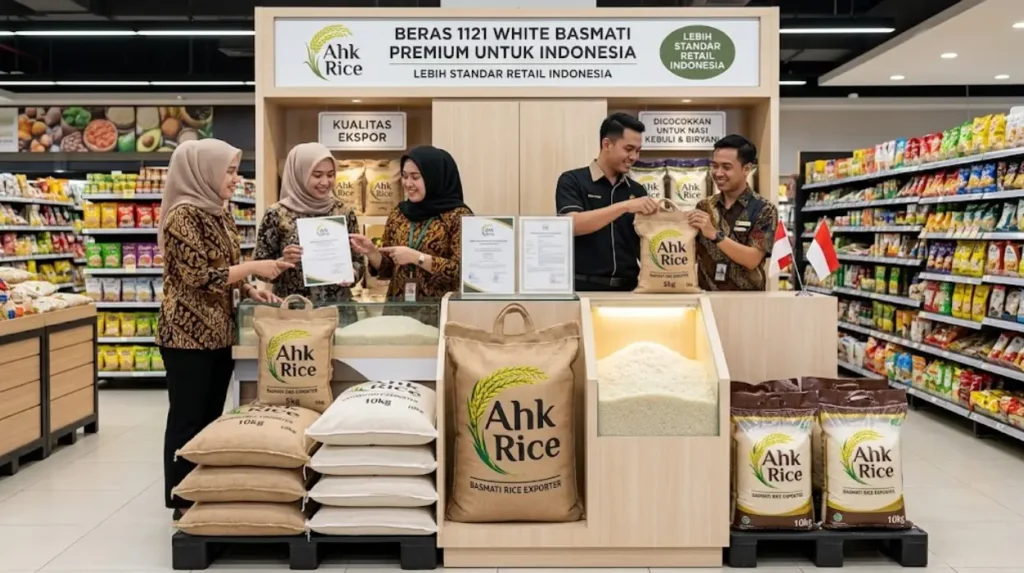
The second advantage is product flexibility. A distributor may require 5 kg, 10 kg, 20 kg, or larger wholesale packaging depending on its retail and distribution model. AHK Rice can work with different packing formats and private-label requirements according to the confirmed order specification.
The third advantage is specification control. Buyers should not approve a supplier based only on photographs or a general product description. The commercial sample should represent the actual specification that will be shipped. AHK Rice’s export process allows buyers to assess the rice before moving into bulk production.
The fourth advantage is destination planning. Indonesia requires the shipment to be prepared around the selected port, documentation, packing, import requirements, and shipping schedule. AHK Rice already lists Indonesia among its export destinations and provides an Indonesia-specific 1121 Basmati supply channel.
For buyers who want to review the available service and product options before requesting a quotation, the Pakistan 1121 White Basmati export service provides the appropriate starting point.
What specifications should distributors approve before ordering?
Distributors should approve grain length, broken percentage, moisture, foreign matter, milling quality, crop or ageing status, packaging, and documentation before placing a bulk order because these variables directly affect retail appearance, cooking results, storage, and landed cost.
A practical purchase specification can be structured as follows:
| Specification | Buyer decision point |
|---|---|
| Variety | Pakistan 1121 Basmati |
| Processing | White, non-steam |
| Grain length | Confirm agreed average specification |
| Broken grains | Confirm contract tolerance |
| Moisture | Confirm shipment specification |
| Foreign matter | Confirm contractual limit |
| Packing | Retail or wholesale format |
| Inspection | Pre-shipment quality verification |
The exact tolerance should always be written into the sales contract rather than assumed from a generic product name. This protects both the importer and exporter.
Indonesian distributors should also compare 1121 White with other Pakistani grades before committing. A useful comparison should consider not only grain length but also aroma, processing method, cooking behaviour, price position, and target consumer. The comparison of Pakistan 1121 White rice grades for Indonesian grocery buyers helps frame that decision.
What does the sample process look like and what does it cost?
A commercial sample should move from specification confirmation to physical sample approval, laboratory or quality checks where required, packing confirmation, and courier dispatch; sample rice may be free while courier and certification costs are normally buyer-paid.
The first step is specification confirmation. The distributor provides the required variety, grade, broken percentage, moisture target, packing preference, quantity, destination port, and intended retail use.
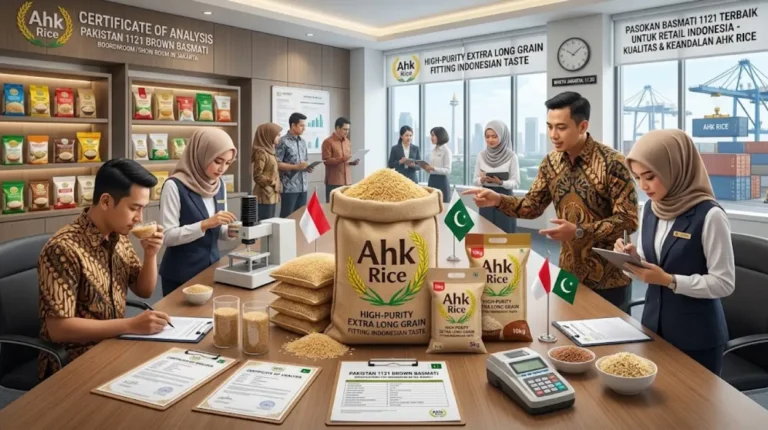
The second step is sample preparation. AHK Rice states that up to 20 kg of Basmati 1121 can be provided for sampling, while the client covers courier and phytosanitary certificate costs. If the order proceeds, those sample-related charges may be waived in the final quotation.
The third step is physical evaluation. The buyer should inspect colour, grain uniformity, aroma, broken grains, foreign matter, cooking expansion, texture, and general appearance. For grocery distribution, the rice should also be assessed after cooking because shelf appearance alone does not prove performance.
The fourth step is commercial approval. Once the sample matches the agreed specification, the buyer confirms quantity, packaging, Incoterm, payment terms, destination port, and documentation.
Sample costs vary because courier charges, destination, sample weight, certification requirements, and delivery speed differ. Therefore, a fixed universal sample cost would be misleading. AHK Rice’s published Indonesia information specifically separates the free sample quantity from courier and phytosanitary expenses.
How long does shipping to Indonesia take?
For Indonesia, buyers should allow roughly four to six weeks from purchase-order confirmation to completed shipment, including production, documentation and port clearance, and approximately 14–21 days of sea transit depending on routing and destination.
The published Indonesia supply information gives a planning model of 7–10 days for production, about one week for documentation and port clearance, and 14–21 days for sea transit.
This means a distributor planning a retail promotion should not calculate delivery only from the sailing date. Production and export preparation must be included in the procurement calendar.
For Jakarta and other Indonesian destinations, actual transit time can change according to vessel availability, transshipment, port congestion, customs processing, weather, and the selected shipping line. The final schedule should therefore be confirmed against the specific purchase order and destination port.
A practical procurement schedule is:
| Stage | Indicative timing |
|---|---|
| Specification and quotation | 1–3 days |
| Sample approval | Depends on courier |
| Production | 7–10 days |
| Documentation and port clearance | About 7 days |
| Sea transit | 14–21 days |
| Total planning window | About 4–6 weeks |
The safest approach is to build several days of contingency into promotional inventory planning.
What affects the price of 1121 White Basmati?
The final price depends on rice specification, order volume, crop and ageing status, packaging, quality requirements, Incoterm, destination, freight conditions, inspection, certification, and the season in which the order is placed.
A published AHK Rice Indonesia page gives an indicative starting price of $1,100 per metric tonne FOB Karachi, while noting that pricing changes with volume, packing, and season. This figure should be treated as an indicative reference rather than a guaranteed current quotation.
FOB pricing covers the agreed export-side cost up to the specified loading point. CIF pricing adds ocean freight and insurance where applicable. For an Indonesian distributor, comparing only FOB prices can therefore produce the wrong purchasing decision.
The buyer should request a quotation using the same specification for every supplier. Otherwise, a lower price may simply represent lower quality, different packaging, a different broken percentage, or different commercial terms.
Volume also matters. A full-container order can produce a different unit economics profile from a small trial shipment. Packaging materials, printing, private-label artwork, and special inspection requirements can also change the final price.
What results can Indonesian distributors expect?
A properly specified 1121 White Basmati program can give Indonesian distributors more predictable product quality, stronger retail presentation, clearer procurement costs, and a repeatable ordering process from sample approval through container shipment.
The strongest result is consistency. Once a buyer approves a detailed specification, future orders can be evaluated against the same commercial benchmark.
The second result is better inventory planning. A four-to-six-week planning window allows distributors to schedule replenishment before existing stock becomes critically low. This is particularly important for grocery products with recurring weekly demand.
The third result is clearer pricing. When the buyer defines quantity, packing, destination, and Incoterm, the quotation becomes much more useful for calculating landed cost and retail margins.
The fourth result is product positioning. 1121 White Basmati gives distributors a premium long-grain product that can sit above standard non-Basmati rice and compete within the premium imported rice segment.
How can an Indonesian grocery distributor get started?
Start by sending the required specification, quantity, destination port, packaging format, and target Incoterm; review the quotation, approve a representative sample, confirm commercial terms, and release the purchase order only after specifications are documented.
A buyer should begin with five decisions. First, define whether the product will be sold under an existing brand or private label. Second, confirm the preferred retail pack size. Third, define the required quality specification. Fourth, provide the Indonesian destination port. Fifth, establish the target purchase quantity.
After that, request the commercial quotation and sample. The sample should be tested using the same cooking method and inspection criteria that will be applied to the eventual shipment.
Once approved, the buyer should confirm the purchase order, payment structure, packaging artwork if applicable, inspection requirements, and shipping schedule.
AHK Rice’s published Indonesia terms indicate 30% advance payment with the remaining 70% against scanned shipment documents, although final payment terms should always be confirmed in the commercial contract.
For a distributor making its first purchase, the safest decision is not necessarily the cheapest quotation. It is the quotation that provides a clearly defined product, transparent commercial terms, credible sample approval, appropriate documentation, and a shipment schedule that fits the distributor’s inventory cycle.
AHK Rice can therefore be considered when the procurement requirement is Pakistan-origin 1121 White Basmati with coordinated processing, packaging, sampling, and export logistics for the Indonesian grocery market.
For a specification-based price, sample request, and shipment plan, request a customized export quotation.
FAQs
Is 1121 White Basmati suitable for Indonesian grocery distributors?
Yes, 1121 White Basmati suits distributors targeting premium imported rice buyers.
Its long, slender grain creates strong retail shelf appeal.
White processing provides a clean and polished appearance.
The product can be supplied in retail or wholesale packing formats.
The final specification should be agreed before bulk production.
How much sample rice can AHK Rice provide?
AHK Rice states that up to 20 kg can be provided for sampling.
The rice sample itself can be supplied without a product charge.
Courier and phytosanitary certificate costs are normally paid by the client.
Those sample-related charges may be waived after an order is confirmed.
The exact arrangement should be confirmed before dispatch.
How long does shipping from Pakistan to Indonesia take?
The published planning window is approximately four to six weeks overall.
Production generally takes around 7–10 days after order confirmation.
Documentation and port clearance are estimated at about one week.
Sea transit to Indonesia is approximately 14–21 days.
Actual timing depends on vessel schedules, routing, ports, and clearance.
What determines the price per metric tonne?
Price depends on specification, quantity, packing, season, and crop or ageing status.
Freight and insurance affect CIF pricing separately from FOB pricing.
Inspection, certification, and private-label requirements can add costs.
AHK Rice publishes an indicative FOB reference but not a fixed universal price.
A shipment-specific quotation is therefore required for an accurate buying decision.
What should buyers check before approving the shipment?
Buyers should verify grain length and broken-grain percentage first.
Moisture, foreign matter, milling quality, and appearance should also be checked.
Packaging must match the intended Indonesian retail or wholesale channel.
The commercial sample should represent the agreed bulk specification.
Documentation, Incoterm, payment terms, and shipment schedule should be recorded in the contract.