Super Kernel Rice Grain Length Standards Retail Buyers Expect
For retail buyers, Super Kernel Basmati with a consistent 7.0–7.5 mm raw grain, low broken percentage, controlled moisture, and strong cooking elongation provides the best balance between shelf appeal, traditional consumer expectations, and procurement cost. The specification must remain consistent across every shipment.
Retail buyers do not evaluate grain length alone. They compare raw kernel size, cooked elongation, broken grains, moisture, purity, polish, aroma, packaging, and price. A product that looks long in a supplier photograph can still perform poorly if grain distribution varies between lots.
Super Kernel Basmati is a Pakistani aromatic long-grain rice variety associated with Punjab’s rice-growing belt. It sits below extra-long 1121 Basmati in raw grain length while retaining the aroma, fluffy texture, and elongation expected from Basmati rice.
Retail demand has expanded through South Asian grocery stores because consumers recognize Super Kernel as a traditional household rice rather than simply an inexpensive long-grain product. Buyers evaluating this category can also understand the wider market development through:
How Super Kernel Rice built demand across American ethnic stores.
What are the available Super Kernel rice solutions for retail buyers?
Retail buyers can choose between Super Kernel White, Super Kernel Steam, and parboiled formats, while adjusting grain length, broken percentage, moisture, polish, packaging, and purity to match the intended shelf position and consumer cooking expectations. Each configuration creates a different cost and performance profile.
Super Kernel White Rice
Super Kernel White is the most direct option for ethnic grocery shelves. The rice is milled and polished after de-husking, producing a white appearance, natural Basmati aroma, and soft cooked texture.
Current supplier specifications place Super Kernel White around 7.0–7.5 mm average raw grain length, with commercial specifications commonly targeting broken grains around 2–3% or lower for premium retail grades.
This format works well for retail packs because consumers can immediately see the slender grain shape through transparent windows or clear packaging. It suits biryani, pulao, pilaf, and everyday household cooking.
Super Kernel Steam Rice
Steam processing uses controlled steaming before milling. It produces firmer cooked grains and improves resistance to breakage during cooking.
For retailers, Steam becomes useful when the target customer expects separate grains and stronger texture. It is also suitable for restaurants purchasing through retail distributors.
Super Kernel Parboiled Rice
Parboiled Super Kernel receives a more intensive heat treatment before milling. This changes the texture, color, and cooking behavior.
The main advantage is grain integrity. Parboiled rice remains firmer and more separate after cooking, which makes it useful for foodservice-oriented distribution. It is less suitable when a retail brand depends on the bright-white appearance and softer texture associated with conventional Super Kernel White.
What grain length should buyers specify?
Retail buyers should specify average raw grain length plus an acceptable tolerance, rather than simply writing “long grain” into a purchase contract.
A practical premium specification is 7.0–7.5 mm average raw grain length, with the exact tolerance established through the approved pre-shipment sample. One Pakistani supplier currently lists Super Kernel at 7.2 mm average raw length and 16 mm+ cooked length.
The cooked result matters because Basmati is valued for elongation. Pakistan’s official Basmati specification identifies a minimum cooked-to-precooked length ratio of 1.70, alongside a minimum average cooked rice length of 12 mm.
How do different Super Kernel approaches compare?
Super Kernel White delivers the strongest retail appearance, Steam offers firmer cooking performance, and parboiled rice provides maximum grain stability; 1121 remains the premium alternative when buyers need greater raw grain length and stronger visual differentiation. The correct choice depends on shelf positioning.
| Attribute | Super Kernel White | Super Kernel Steam | Super Kernel Parboiled | 1121 White |
|---|---|---|---|---|
| Average raw grain length | 7.0–7.5 mm | 7.0–7.4 mm | 7.0–7.2 mm | 8.0–8.4 mm |
| Cooked appearance | Soft, fluffy, separate | Firmer, separate | Firm, highly separate | Very long, fluffy |
| Broken-grain target | ≤2–3% premium grade | ≤2–3% premium grade | ≤2–3% premium grade | ≤2% premium grade |
| Moisture target | Around 12–13.5% | Around 12–13.5% | ≤12.5% | Around 12–13.5% |
| Aroma | Strong Basmati aroma | Strong Basmati aroma | Strong Basmati aroma | Stronger premium aroma |
| Retail positioning | Traditional premium/value | Premium traditional | Specialty/foodservice | Premium/extralong |
| Cost position | Moderate | Moderate-plus | Moderate-plus | Higher |
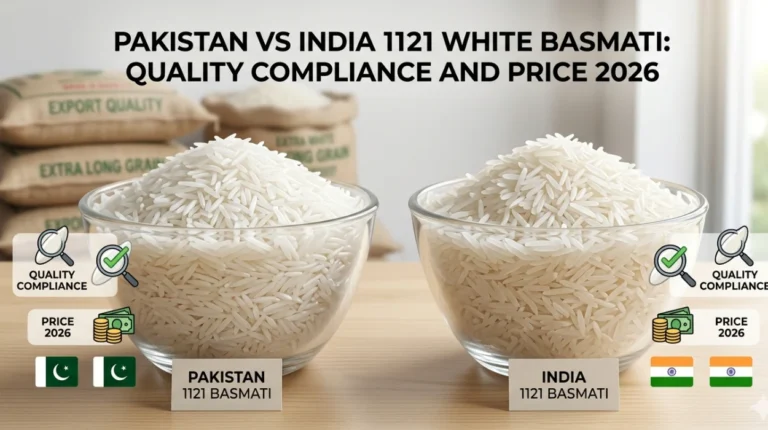
These figures should be treated as procurement targets rather than universal legal limits. Commercial rice specifications vary by mill, crop, processing method, contract, and buyer tolerance. Current supplier data confirms Super Kernel around 7.2 mm, while 1121 commonly reaches approximately 8.3 mm.
The difference is visible on the retail shelf. A 1121 kernel creates a more dramatic extra-long appearance, while Super Kernel offers a more familiar balance between grain size, aroma, cooking texture, and price.
For buyers who want a premium ethnic-store product without moving completely into the highest-priced extra-long segment, Super Kernel remains commercially relevant.
What does the 2026 price comparison show?
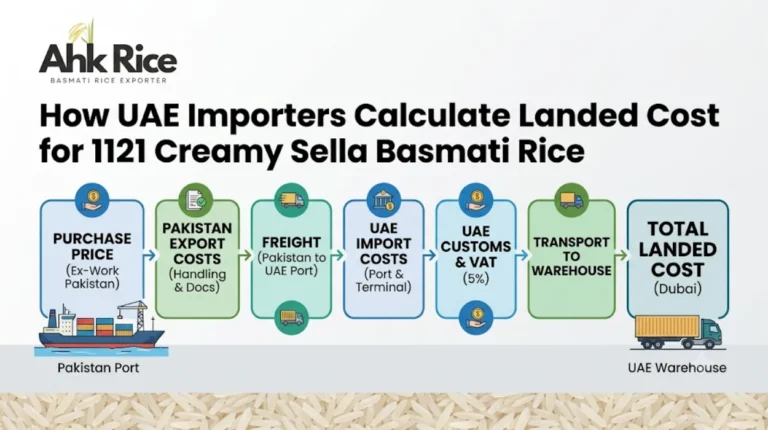
Current indicative FOB Karachi pricing for premium Super Kernel White is approximately $1,165–$1,205 per metric ton. This is a supplier-indicated 2026 range and excludes ocean freight, insurance, duties, customs clearance, inland transport, and U.S. distribution costs.
A buyer should therefore avoid comparing a Pakistani FOB quote directly against a U.S. warehouse price. The commercial comparison must use landed cost per metric ton.
The price gap between Super Kernel and 1121 also depends on broken percentage, grain selection, processing, packaging, crop, order volume, and shipment terms. Longer grain does not automatically produce a fixed premium across every transaction.
Which Super Kernel method works best for different market cases?
Super Kernel White works best for traditional U.S. ethnic retail shelves, Steam suits buyers needing firmer cooking performance, and parboiled grades fit foodservice-heavy distribution; Gulf buyers generally place greater emphasis on firm, separate grains for biryani, mandi, and large-volume catering. Market segmentation determines the right grade.
Which grade does the U.S. market prefer?
The United States is the stronger market for consumer-facing Super Kernel White when the target channel is South Asian ethnic grocery retail.
Retail buyers serving Pakistani, Indian, Bangladeshi, and broader South Asian communities need a familiar grain profile. Packaging, aroma, grain uniformity, cooking results, and consumer recognition influence repeat purchases.
For this segment, Super Kernel White in 5 kg and 10 kg retail packs provides a practical configuration. Premium brands can use tighter broken-grain specifications and stronger sorting, while value-oriented brands can adjust the grade without changing the underlying variety.
FDA requirements also matter. Imported food entering U.S. commerce must meet U.S. safety and labeling requirements, while food facilities subject to registration must register with FDA and imported food shipments require Prior Notice.
Which grade does the Gulf market prefer?
The Gulf region, particularly Saudi Arabia and the UAE, has stronger demand for rice used in biryani, mandi, kabsa, catering, and restaurant operations.
Gulf buyers often prioritize firm cooked grains, separation, visual length, and consistency after cooking. Super Kernel Steam and parboiled specifications therefore become more relevant for foodservice distribution.
The 2026 market environment also requires attention to shipping conditions. Disruption around the Strait of Hormuz has affected Gulf rice trade flows and increased logistics uncertainty for regional buyers.
How do price and shelf-life expectations compare?
| Market region | Preferred Super Kernel grade | Indicative FOB Karachi price* | Practical commercial shelf-life target |
|---|---|---|---|
| United States | White, premium retail grade | $1,165–$1,205/MT | 12–24 months |
| Gulf | Steam/parboiled and White | $1,135–$1,205/MT | 12–24 months |
*Indicative 2026 FOB ranges are not landed prices. Final commercial quotations depend on crop, grade, quantity, packaging, inspection, and Incoterms. Current supplier data places Super Kernel White around $1,165–$1,205/MT.
Shelf life is strongly affected by packaging and storage. Standard PP/BOPP packaging is commonly specified around 12–18 months, while vacuum packaging can extend commercial shelf-life claims to approximately 24–36 months when storage conditions remain controlled.
For retail procurement, the buyer should therefore specify the required shelf-life claim in the contract instead of assuming every Super Kernel shipment has the same shelf-life period.
What are the pros and cons of each Super Kernel approach?
White Super Kernel provides the strongest retail presentation and familiar household cooking profile, Steam improves firmness, and parboiled rice increases grain stability; however, each additional processing requirement can change cost, color, texture, and consumer positioning. Buyers should match processing to the selling environment.
What are the advantages of Super Kernel White?
Super Kernel White has a strong visual advantage. The bright polished grain is easy to present in consumer packaging.
It also maintains the familiar soft and fluffy Basmati cooking profile. That makes it suitable for households that use rice for both everyday meals and traditional dishes.
The limitation is cooking sensitivity. Overcooking can soften the grain more quickly than parboiled rice.
What are the advantages of Super Kernel Steam?
Steam rice provides firmer grains and better separation after cooking.
For retailers, this reduces the risk of consumers associating the product with sticky or broken cooked rice. It also works well when the product serves both retail and restaurant customers.
The limitation is that the processing stage adds production requirements and can alter the final grain appearance.
What are the advantages of parboiled Super Kernel?
Parboiled rice provides excellent grain integrity and consistent cooking performance.
It works well for large-volume foodservice because cooked rice remains firm for longer holding periods.
The disadvantage is market positioning. Some consumers expect traditional white Basmati and may perceive the parboiled color and texture as a different product category.
What decision factors should retail buyers use before ordering?
Retail buyers should evaluate grain length, broken percentage, cooked elongation, moisture, market preference, landed cost, packaging, shelf life, and supplier consistency as one specification system; choosing grain length alone creates procurement risk because appearance does not guarantee repeatable cooking performance. The strongest buying decision balances all variables.
What should the five-step decision framework include?
| Decision factor | Buyer question | Preferred approach |
|---|---|---|
| Grain length | Does the sample consistently meet the contracted length? | Specify 7.0–7.5 mm for Super Kernel |
| Broken percentage | Does the retail grade maintain visual uniformity? | Target ≤2–3% for premium retail |
| Cooking performance | Does the grain elongate and remain separate? | Conduct a standardized cooking test |
| Landed economics | Does FOB price remain competitive after freight and duties? | Compare complete landed cost |
| Market fit | Does the grade match the customer and channel? | White for traditional retail; Steam/parboiled for firmer cooking |
Retail buyers should approve a physical sample before finalizing bulk production. The sample should be measured for raw grain length, cooked elongation, broken percentage, aroma, color, moisture, and texture.
The same test should be repeated against the pre-shipment lot. This creates a measurable connection between the commercial sample and the delivered container.
AHK Rice operates from Punjab and supplies 1121, Super Kernel, and 1509 varieties through an integrated processing and export operation. Its processing workflow includes paddy sourcing, cleaning, de-husking, polishing, grading, length sorting, and export preparation.
For buyers evaluating suppliers, this type of integrated process matters because grain length is established through both variety selection and processing control. A long-grain variety cannot compensate for inconsistent grading or excessive broken kernels.
The final purchasing specification should therefore state the variety, average grain length, tolerance, broken percentage, moisture level, purity requirement, processing type, packaging, shelf-life requirement, inspection procedure, and destination-market compliance.
For U.S. distributors moving from evaluation to procurement, the next step is comparing commercial requirements for:
Importing Super Kernel White Rice from Pakistan to USA distributors.
What should buyers verify before approving a Super Kernel shipment?
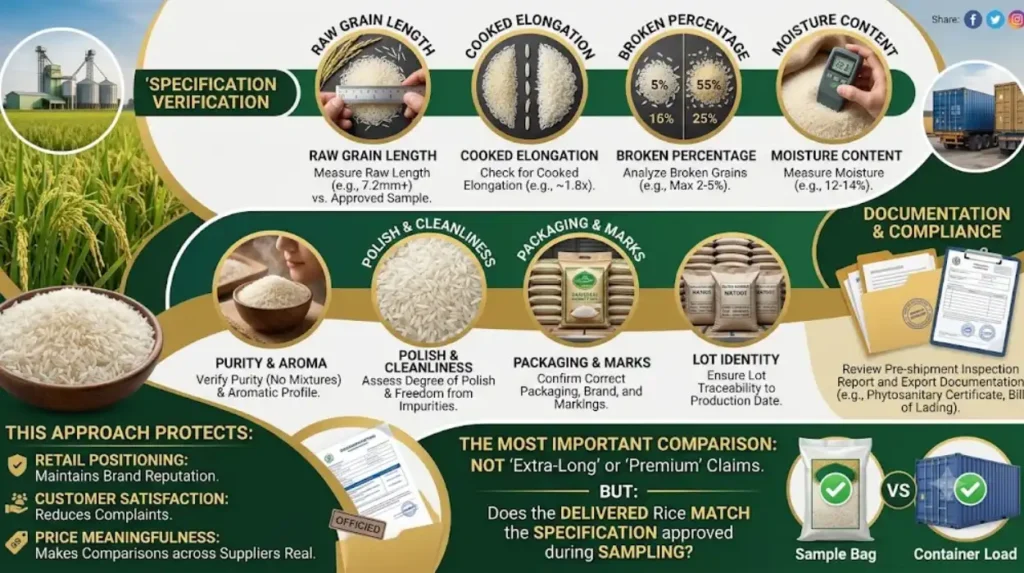
Buyers should verify the raw grain length, cooked elongation, broken percentage, moisture, purity, aroma, polish, packaging, lot identity, inspection report, and export documentation before approving container loading.
The most important comparison is not whether a supplier claims “extra-long” or “premium.” It is whether the delivered rice repeatedly matches the measurable specification approved during sampling.
That approach protects retail positioning, controls customer complaints, and makes price comparisons more meaningful across Pakistani rice suppliers.
Frequently Asked Questions
What is the standard grain length of Super Kernel rice?
Super Kernel rice typically has an average raw grain length of around 7.0–7.5 mm. Premium specifications should define the acceptable length tolerance in the purchase contract.
What grain length do U.S. retail buyers expect from Super Kernel rice?
U.S. ethnic retail buyers generally expect 7.0–7.5 mm raw grains, consistent kernel appearance, low broken percentage, and good cooked elongation.
Is Super Kernel rice longer than 1121 Basmati rice?
No. 1121 Basmati is longer, commonly measuring around 8.0–8.4 mm raw. Super Kernel generally measures around 7.0–7.5 mm while offering a different balance of aroma, cooking performance, and price.
What is the ideal broken percentage for premium Super Kernel rice?
A premium retail specification commonly targets 2–3% broken grains or lower. Buyers should establish the exact tolerance before production and verify it through pre-shipment inspection.
How much does Super Kernel rice cost per metric ton in 2026?
Indicative 2026 FOB Karachi pricing for premium Super Kernel White is approximately $1,165–$1,205 per metric ton. Final pricing depends on grade, crop, quantity, packaging, inspection, and shipping terms.
Which Super Kernel grade is best for U.S. ethnic stores?
Super Kernel White is generally the strongest choice for traditional U.S. ethnic retail because of its white appearance, Basmati aroma, familiar texture, and suitability for household cooking.
Is Super Kernel Steam better for retail buyers?
Super Kernel Steam is better when buyers prioritize firmer, more separate cooked grains. It is particularly useful for customers who prepare biryani, pulao, and other rice dishes where grain integrity matters.
What is the difference between Super Kernel White and Super Kernel Steam?
Super Kernel White is milled without the same steaming treatment and produces a softer, traditional cooked texture. Super Kernel Steam provides firmer grains and improved separation after cooking.
What shelf life does Super Kernel rice have?
Super Kernel rice commonly has a commercial shelf-life target of 12–24 months, depending on processing, packaging, moisture, and storage conditions. The exact shelf-life claim should be specified by the buyer.
What should retail buyers check before importing Super Kernel rice?
Buyers should check grain length, broken percentage, cooked elongation, moisture, purity, aroma, polish, packaging, shelf life, inspection reports, and export documentation before approving a shipment.
Does grain length determine Super Kernel rice quality?
No. Grain length is only one quality indicator. Retail buyers should also evaluate uniformity, broken grains, moisture, cooking performance, aroma, purity, and processing consistency.
Which markets prefer Super Kernel Steam or parboiled rice?
Super Kernel Steam and parboiled formats are particularly suitable for Gulf markets and foodservice channels where buyers often prioritize firm, separate grains and cooking stability for biryani, mandi, kabsa, and catering.
How should buyers test Super Kernel rice before bulk ordering?
Buyers should approve a representative sample and test raw grain length, cooked elongation, broken percentage, moisture, aroma, appearance, and texture. The approved sample should then be compared with the pre-shipment lot.