How Do Specialty Distributors Select Premium Imported Rice Products?
Specialty distributors select premium imported rice by balancing grain specification, cooking performance, origin, processing grade, landed cost, shelf life, compliance, and replenishment reliability, rather than choosing the lowest FOB price. For Maine and wider New England markets, 1121 Basmati, Super Kernel, and 1509 Basmati serve different retail and foodservice positions.
The starting point is understanding why premium rice performs differently in specialty channels. Maine specialty food stores often depend on differentiated products, recognizable origin, reliable packaging, and consistent cooking results. Buyers evaluating this category can first review:
Why premium Basmati rice is growing in Maine specialty food stores to understand the consumer and retail context.
For distributors, the procurement decision becomes more technical after the market opportunity is established. A distributor must convert the word “premium” into measurable specifications. These include variety, processing method, grain length, broken percentage, moisture, purity, packaging, shelf life, certifications, and documentation.
What are the available solutions for specialty rice distributors?
Specialty distributors have three practical sourcing solutions: buy established imported brands, source bulk rice for their own packing, or establish a specification-controlled supply program with a Pakistani exporter. Each model differs in control, investment, margin potential, documentation responsibility, and replenishment reliability.
Established imported brands
Buying an existing imported brand is the simplest approach. The distributor receives finished consumer packaging, established labeling, and a product that already has market recognition.
The disadvantage is limited control over specifications and packaging. The distributor also accepts the supplier’s existing product architecture, price structure, and available pack sizes.
This approach works when the distributor wants fast category expansion without developing a private-label program.
Bulk imported rice
Bulk importing gives distributors more control over pack formats and downstream distribution. Rice arrives in larger commercial bags and can be repacked domestically where the distributor has the required facilities and compliance controls.
This model can improve packaging flexibility. It also adds domestic handling, inventory, labor, and quality-control responsibilities.
Origin-controlled private-label supply
A specification-controlled supply program connects the distributor directly with a rice exporter or processor. The buyer approves the rice specification before commercial production and defines packaging, quantity, inspection, and documentation requirements.
AHK Rice operates this type of origin-side model from Punjab, supplying 1121, Super Kernel, and 1509 Basmati while providing processing, grading, sorting, custom packaging, inspection coordination, documentation, and container loading. Its USA rice export service is structured for U.S. importers purchasing Pakistani rice.
This approach provides greater control over the finished specification than buying an anonymous commodity shipment. It also requires stronger procurement planning.
How do premium imported rice specifications compare?
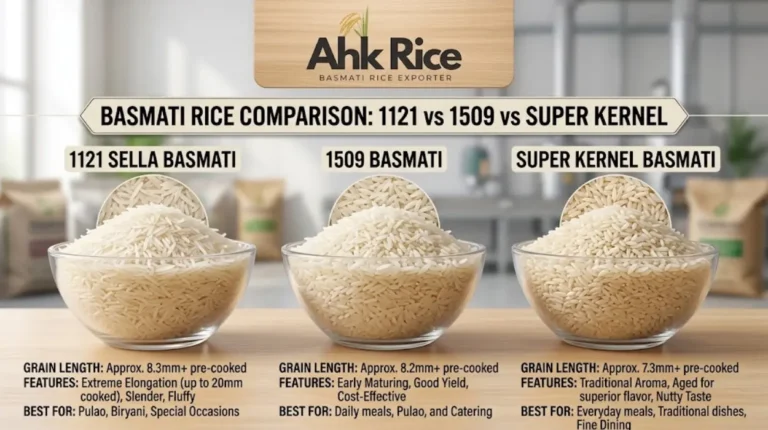
The strongest comparison starts with physical and commercial specifications because variety, processing, grain length, broken percentage, moisture, cooking behavior, shelf life, and price determine whether a rice product fits premium retail or foodservice distribution.
| Attribute | 1121 White / Steam | Super Kernel | 1509 White / Sella |
|---|---|---|---|
| Variety | Extra-long Basmati | Long-grain Basmati | Long-grain Basmati |
| Typical positioning | Premium retail and specialty cuisine | Premium traditional Basmati segment | Value-premium retail and foodservice |
| Grain characteristic | Extra-long, strong visual elongation | Long, aromatic, balanced texture | Long, efficient cooking performance |
| Processing options | White, Steam, Sella | White, Sella and other specifications | White, Creamy Sella, Steam |
| Cooking profile | Fluffy, aromatic, separate grains | Soft, aromatic, separate grains | Strong grain structure, especially in Sella |
| Indicative 2026 Pakistan export benchmark | $1,175/MT White/Sella; $1,225/MT Steam | $1,050/MT Super Basmati White/Sella benchmark | $1,100/MT White/Sella; $1,150/MT Steam |
| Commercial shelf-life target | Commonly up to 24 months when properly packed and stored | Commonly 18–24 months | Commonly 18–24 months |
Pakistan Customs’ 2026 Valuation Ruling No. 1/2026 lists minimum export values of $1,175/MT for 1121 White/Sella, $1,225/MT for 1121 Steam, $1,050/MT for Super Basmati White/Sella, $1,100/MT for 1509 White/Sella, and $1,150/MT for 1509 Steam. These are customs valuation benchmarks, not delivered Maine prices or guaranteed supplier quotations.
An August 2026 commercial FOB reference also places 1121 Basmati White around $1,165–$1,205/MT, showing why distributors should compare actual supplier quotations against specification rather than using one universal market price.
Shelf life must also be evaluated against the finished package and storage conditions. USDA FSIS identifies approximately two years for rice and dried pasta under shelf-stable storage guidance, while commercial Basmati specifications commonly state 18–24 months.
The important distinction is that shelf life is not simply a variety characteristic. Packaging material, moisture control, warehouse conditions, sealing quality, and storage temperature affect commercial quality.
Which rice grades fit Maine and wider New England markets?
Maine specialty distributors generally need a premium visual product for specialty retail while wider New England distribution requires a broader price ladder that can serve independent groceries, South Asian stores, restaurants, caterers, and foodservice operators.
Maine specialty retail
Maine is suited to a differentiated premium-rice strategy. Specialty retailers can use 1121 Basmati as a flagship product because its extra-long grain creates an obvious visual distinction on the shelf and after cooking.
Super Kernel fits buyers seeking traditional Basmati aroma and familiar South Asian cooking performance at a lower benchmark than 1121 Steam.
1509 can occupy the value-premium position. It provides a Basmati proposition while controlling procurement cost more effectively than the highest-priced 1121 Steam specification.
Maine also has established specialty-food distribution infrastructure. Regional distributors serve independent food businesses, while specialty food brokers cover Maine and other New England states.
Wider New England
The wider New England market requires a more segmented portfolio. A distributor serving Massachusetts, New Hampshire, Vermont, Connecticut, and Rhode Island can support multiple customer types.
Premium independent groceries can carry 1121 White or Steam. South Asian retailers can require several Basmati grades. Restaurants and caterers can favor Sella or 1509 where grain strength and repeatable cooking performance are more important than maximum grain length.
A practical regional portfolio therefore uses different grades instead of forcing one product across every channel.
| Market region | Preferred grades | 2026 benchmark range | Shelf-life planning | Best commercial use |
| Maine specialty retail | 1121 White/Steam, Super Kernel | $1,050–$1,225/MT | 18–24 months | Premium retail, specialty grocery |
| Wider New England | 1121, Super Kernel, 1509 | $1,050–$1,225/MT | 18–24 months | Retail, wholesale, restaurants, foodservice |
These benchmark ranges represent Pakistan-side export valuation references. Freight, insurance, customs, port handling, inland delivery, packaging, tariffs where applicable, financing, and distributor margins must be added before calculating landed cost.
How do different sourcing approaches compare?
Direct origin sourcing provides the highest specification control, established brands provide the fastest market entry, and domestic bulk repacking provides packaging flexibility; specialty distributors should select the model according to volume, margin objectives, compliance capability, and desired control.
| Sourcing model | Main advantage | Main limitation | Best fit |
| Established imported brand | Fast launch | Limited control | New category entry |
| Domestic bulk repacking | Flexible packaging | More domestic handling | Established distributors |
| Direct exporter program | Origin and specification control | Requires stronger planning | Repeat commercial supply |
Direct exporter sourcing is particularly useful when the distributor wants the same rice specification across repeated shipments.
The buyer can establish a product specification before production. The exporter can then process, grade, sort, pack, inspect, and document the shipment against that specification.
This reduces the risk of buying based only on a product name. “1121 Basmati,” for example, should be connected to grain specification, processing type, broken percentage, moisture, packaging, and inspection requirements.
What are the pros and cons of each premium rice strategy?
Every sourcing strategy creates a different balance between control and convenience; distributors should accept higher operational responsibility only when the expected margin, volume, private-label opportunity, or customer differentiation justifies that additional procurement work.
Established brands have the strongest advantage in speed. A distributor can add an existing SKU without developing packaging artwork or building consumer recognition from zero.
The disadvantage is weaker differentiation. Competing distributors may carry the same brand, making price competition more direct.
Bulk sourcing creates stronger control over packaging and inventory architecture. A distributor can develop several pack sizes from one commercial rice specification.
The disadvantage is additional handling. Repacking requires appropriate facilities, controls, labeling, traceability, and inventory management.
Direct origin sourcing creates the strongest specification relationship. The distributor can approve samples, establish acceptable limits, select packaging, and plan repeat shipments.
The disadvantage is procurement complexity. The distributor must evaluate the exporter, verify documents, understand U.S. import responsibilities, and plan inventory far enough ahead to accommodate ocean logistics.
For U.S. imports, FDA states that imported food must meet the same legal requirements as domestically produced food. Importers also have responsibilities involving food facility registration, Prior Notice, labeling, and applicable FSVP obligations.
That means a premium rice decision is not complete when the buyer approves the grain. The compliance file must also be acceptable.
What decision framework should specialty distributors use?
Specialty distributors should score each supplier against product specification, landed economics, compliance, supply continuity, and market fit before approval; the lowest FOB quotation should not win when it creates higher quality variation, inventory risk, or documentation costs.
| Decision factor | What to evaluate | Practical distributor question |
| Product specification | Variety, grain length, broken %, moisture, purity | Does the sample match the intended SKU? |
| Landed cost | FOB, freight, insurance, port, inland and handling costs | What is the true cost per MT delivered? |
| Compliance | FDA, labeling, facility, Prior Notice, FSVP documentation | Can the shipment enter and be distributed compliantly? |
| Supply continuity | Production capacity, lead time, repeatability | Can the supplier support the next three orders? |
| Market fit | Retail price, cooking performance, pack size, positioning | Will the grade earn repeat purchases in the target channel? |
The first decision factor is specification control. Distributors should create a written product sheet before comparing supplier prices.
The second is landed economics. A $1,100/MT rice quotation is not equivalent to another $1,100/MT quotation if one shipment has different packaging, inspection, freight, or handling costs.
The third is compliance. FDA places responsibility on U.S. importers for ensuring imported food is safe, sanitary, and properly labeled. Covered FSVP importers must maintain supplier-verification procedures.
The fourth is continuity. A distributor selling a premium SKU needs repeatable specifications, not only a successful first shipment.
The fifth is market fit. Maine specialty stores may justify a higher retail position for 1121 Basmati, while restaurants or value-oriented grocery channels may gain better economics from Super Kernel or 1509.
What does the best specialty distributor sourcing strategy look like?

The best strategy is a segmented portfolio built around approved rice specifications, tested samples, clear landed-cost targets, compliant import documentation, suitable packaging, and scheduled replenishment, allowing distributors to match premium grades with different Maine and New England customer requirements.
A distributor should begin with customer demand rather than supplier availability. Identify whether the primary buyer is a specialty grocery, South Asian retailer, restaurant, caterer, foodservice operator, or private-label brand.
Next, define the rice specification. The specification should include variety, processing grade, grain characteristics, broken percentage, moisture, packaging, quantity, inspection requirements, and shelf-life requirement.
The next step is sampling. The distributor should evaluate the physical rice before approving commercial production. Cooking tests should measure aroma, elongation, separation, texture, appearance, and consistency.
The commercial quotation should then be evaluated on an FOB and landed-cost basis. Pakistan’s 2026 export valuation data provides a useful benchmark, but the distributor still needs a complete delivered-cost model.
Finally, the distributor should connect approved specifications with shipment planning. A repeat program should maintain the same product definition from sample to production to container loading.
For a Maine distributor moving from evaluation toward commercial supply, the next decision is to assess whether the exporter can provide the required variety, specification, packaging, documentation, inspection, and shipment coordination as one repeatable program. The
Maine specialty food market supply option from AHK Rice can be positioned at this decision stage.
Frequently Asked Questions
How do specialty distributors select premium imported rice?
Specialty distributors compare rice varieties, grain length, processing method, broken percentage, moisture, purity, cooking performance, price, packaging, shelf life, compliance, and supply reliability before selecting a product.
Which Basmati rice varieties are suitable for specialty distribution?
Common premium choices include 1121 Basmati, Super Kernel Basmati, and 1509 Basmati. Each variety serves different price points, cooking requirements, retail positions, and foodservice applications.
Why is 1121 Basmati considered a premium rice?
1121 Basmati is valued for its extra-long grain, aromatic profile, visual elongation after cooking, and separate-grain cooking performance. These characteristics make it suitable for premium retail and specialty food channels.
What is the difference between 1121, Super Kernel, and 1509 Basmati?
1121 is positioned toward the premium end because of its extra-long grain. Super Kernel provides traditional Basmati characteristics at a different price level. 1509 offers a value-premium option with strong cooking performance and multiple processing formats.
How much does premium Pakistani rice cost per metric ton in 2026?
Pakistan’s 2026 customs valuation benchmarks include approximately $1,225/MT for 1121 Steam, $1,175/MT for 1121 White/Sella, $1,050/MT for Super Basmati White/Sella, $1,100/MT for 1509 White/Sella, and $1,150/MT for 1509 Steam. These are valuation benchmarks rather than final landed prices.