Why Do Saudi Arabian Food Service Buyers Check Rice Purity Before Purchasing Pakistan Basmati Rice?
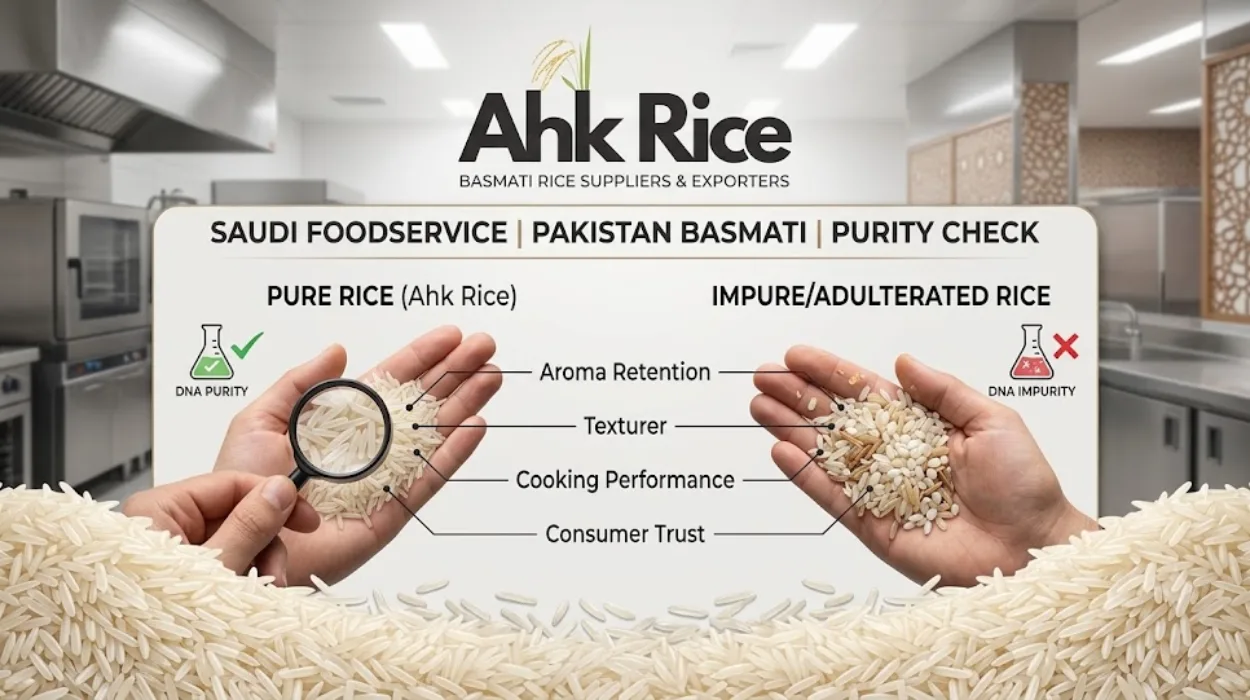
Saudi Arabian food service buyers check rice purity because purity determines whether a shipment matches its declared rice identity, meets Saudi food requirements, cooks consistently, and avoids contamination risks. For Pakistan Basmati rice, purity inspection covers grain identity, foreign matter, damaged kernels, broken grains, appearance, and laboratory safety parameters.
The Saudi Food and Drug Authority (SFDA) regulates imported food entering Saudi Arabia. Its controls include document verification, shipment inspection, physical examination, sampling, and laboratory analysis when required. Saudi requirements also require imported food to comply with applicable technical regulations and standards.
For rice, the key GCC technical regulation is GSO 1003:2022, Rice Kernels. The current edition was approved on October 19, 2022, and replaced GSO 1003:2012. It covers husked, milled, enriched, and parboiled rice intended for direct human consumption.
What Is Rice Purity and Why Does It Matter to Saudi Food Service Buyers?
Rice purity is the measured consistency of rice grains with their declared identity and specification, including acceptable grain characteristics and freedom from foreign matter, harmful seeds, contaminants, damaged kernels, and other defects that affect food safety and cooking performance.
Rice purity has a broader meaning than visual cleanliness. It includes the physical identity of the grain and its food safety condition.
GSO 1003:2022 defines rice as whole and broken kernels obtained from Oryza sativa L. It separately defines Basmati rice according to characteristics such as length, aroma, taste, fluffy texture, and separate cooked grains.
The regulation identifies foreign matter as materials other than rice kernels. Examples include foreign seeds, husk, straw, paper, wood, thread, stones, sand, plastic, glass, and metals. Animal-origin impurities include dead insects and parts of insects, rodents, birds, and mites’ excreta.
Purity also concerns damaged and defective grains. GSO 1003:2022 defines heat-damaged kernels, damaged kernels, chalky kernels, red kernels, red-streaked kernels, pecks, and immature kernels. These categories provide a technical vocabulary for evaluating rice lots.
For a restaurant, hotel, catering company, or institutional kitchen, this distinction matters because rice is purchased in large quantities and prepared repeatedly. A mixed or contaminated lot creates quality-control problems across multiple meals.
How Is Rice Purity Checked Before Pakistan Basmati Rice Reaches Saudi Arabia?
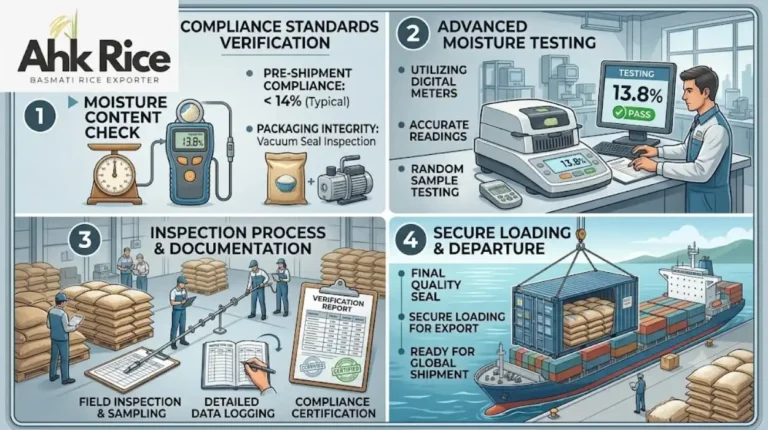
Rice purity is checked through a sequence of documentation review, representative sampling, physical inspection, laboratory testing, and cooking assessment, allowing buyers and regulators to compare the shipment with its declared variety, grain characteristics, safety requirements, and applicable Saudi or GCC specifications.
The process begins before the container reaches Saudi Arabia. The importer confirms the product identity, documentation, packaging information, and applicable requirements.
SFDA states that imported food is subject to inspection at Saudi entry points. Its control process includes document review, consignment inspection, physical examination, sampling, and laboratory referral where required. A shipment can be rejected when it fails applicable requirements.
1. Document verification
The buyer checks documents against the physical product. Important records include the commercial invoice, certificate of origin, product description, crop information where applicable, and analysis or conformity documentation required for the specific shipment.
Saudi food import requirements require the importer to register food products and ensure that imported food complies with Saudi regulations, technical regulations, and standards.
2. Representative sampling
A rice sample must represent the lot being evaluated. GSO 1003:2022 references GSO ISO 950 for cereal sampling and GSO 1307 for methods of testing milled rice.
3. Physical examination
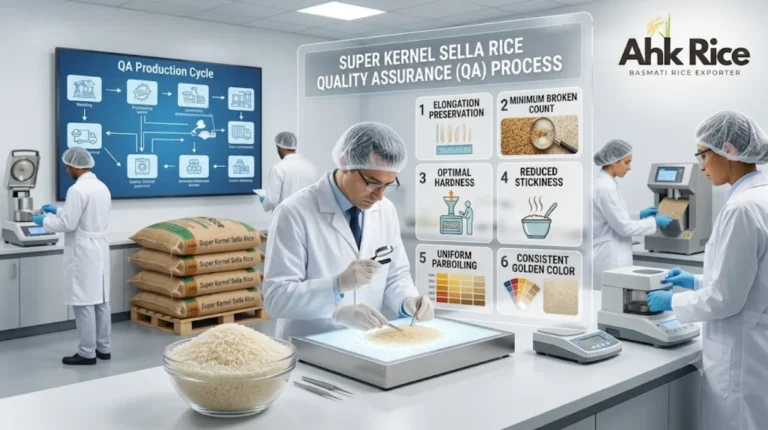
Inspectors evaluate visible characteristics such as purity, grain color, grain length, abnormal odor, and physical defects. SFDA has specifically described rice examination as covering purity, poisonous and harmful seeds, abnormal odor, color, grain length, and cooking characteristics.
4. Laboratory analysis
Laboratory analysis addresses safety parameters that cannot be confirmed through visual inspection alone. These include pesticide residues, contaminants, and microbiological hazards. GSO 1003:2022 references GSO 382 for pesticide residue limits, GSO 193 for contaminants and toxins, and GSO 1016 for microbiological criteria.
5. Cooking evaluation
Cooking assessment connects laboratory and physical specifications with actual food service performance. Buyers can evaluate grain separation, appearance, texture, aroma, and cooking behavior.
This is particularly important for long-grain aromatic rice because the commercial value depends on both raw-grain identity and cooked-rice characteristics.
What Are the Key Components of Pakistan Basmati Rice Purity?
The main purity components are varietal identity, grain length, broken-kernel percentage, foreign matter, defective kernels, color, odor, moisture-related damage, pesticide residues, contaminants, and microbiological safety, with each parameter addressing a different quality or food-safety risk during commercial rice use.
Varietal identity
Varietal identity establishes whether the rice corresponds to the product declared in the specification. Pakistan supplies several commercially traded Basmati and aromatic rice types, including 1121, Super Kernel, and 1509.
The distinction between a variety and a processing form is important. Steam and Sella describe processing methods. They do not automatically create separate botanical varieties.
Grain length
Grain length is a major physical characteristic of Basmati rice. GSO 1003:2022 recognizes grain-length classification and requires rice identity and physical characteristics to correspond with the applicable standard.
Long-grain rice is important in food service because grain appearance directly affects plated dishes such as biryani, pulao, kabsa, mandi, and other rice-based meals.
Broken kernels
A broken kernel is a rice grain that has lost part of its original structure. GSO 1003:2022 classifies rice according to broken parts, including whole kernels, head rice, and broken-kernel categories.
A buyer therefore does not evaluate purity only by asking whether rice looks clean. Broken percentage also forms part of commercial specification control.
Foreign matter
Foreign matter includes materials that are not rice kernels. Examples include stones, sand, plastic, glass, metal, foreign seeds, husk, straw, and animal-origin impurities.
This component directly connects rice purity with food safety.
Defective grains
Defects include heat-damaged, damaged, chalky, red, red-streaked, pecked, and immature kernels. Each defect affects the visual consistency of a rice lot.
Chemical and microbiological safety
Purity inspection also connects with pesticide residues, contaminants, toxins, and microbiological hazards. GSO 1003:2022 specifically references separate GCC standards covering these areas.
What Are the Benefits of Checking Rice Purity for Saudi Food Service Operations?
Purity testing helps Saudi food service operators control food safety, cooking consistency, portion quality, procurement specifications, regulatory compliance, and customer expectations while reducing the operational risk created by foreign matter, excessive defects, incorrect product identity, or unsafe chemical and microbiological conditions.
The first benefit is food safety control. Foreign matter and harmful substances require control before rice enters commercial kitchens.
The second benefit is consistent cooking. A uniform rice lot produces more predictable results when kitchens use fixed recipes and cooking procedures.
The third benefit is portion consistency. Restaurants and catering operations depend on repeatable cooked yields. Grain variation changes appearance and can affect serving standards.
The fourth benefit is procurement accuracy. A written purity specification gives buyers measurable criteria instead of relying on general descriptions such as premium or high quality.
The fifth benefit is regulatory compliance. Saudi Arabia requires imported food to comply with applicable regulations, technical regulations, and standards. SFDA also performs physical and laboratory controls on imported food.
The sixth benefit is traceability. A documented rice specification connects the product identity with the shipment, supplier documentation, testing records, and production information.
Where Do Saudi Arabian Food Service Buyers Use Purity Checks?
Saudi food service buyers use rice purity checks across restaurants, hotels, catering companies, institutional kitchens, central kitchens, food manufacturers, wholesalers, and distributors where large-volume rice consumption requires consistent identity, safe raw material, predictable cooking performance, and documented procurement specifications.
Restaurants
Restaurants use purity specifications to maintain consistent dishes. Examples include biryani, kabsa, mandi, pulao, and rice-based combination meals.
Hotels
Hotels purchase rice for restaurants, buffets, banquets, room service, and large events. A consistent rice specification helps kitchens maintain the same cooking method across multiple service periods.
Catering companies
Catering operations handle large batches. A difference in grain quality or broken percentage becomes more visible when hundreds or thousands of portions are prepared.
Central kitchens
Central kitchens prepare food for multiple branches. They require standardized raw materials because one rice specification must work across several production locations.
Institutional food service
Hospitals, universities, schools, military facilities, and workplace catering operations also use bulk rice. Their procurement systems depend on measurable specifications and documented compliance.
For buyers comparing different Pakistan rice grades, the next level of evaluation is the relationship between grain purity, variety, and processing type. This is where:
How purity standards apply to Pakistan 1121 Steam and Golden Sella rice becomes relevant.
Which Pakistan Rice Grades Require Careful Purity Evaluation?
Pakistan rice is sold in multiple commercial forms and grades, including 1121, Super Kernel, and 1509, with white, steam, and parboiled or Sella processing forms; purity evaluation confirms that the delivered product matches the declared specification rather than simply relying on its commercial name.
1121 Basmati
1121 is a widely traded extra-long aromatic rice type from Pakistan. Its evaluation focuses on declared grain characteristics, purity, broken percentage, appearance, and cooking performance.
Super Kernel
Super Kernel is associated with Pakistan’s long-grain aromatic rice trade. Its commercial identity requires separation from other rice types during procurement and processing.
1509
1509 is an early-maturing aromatic rice type cultivated in Pakistan. It is commercially available in processing forms such as white, steam, and Sella.
White rice
White rice is milled rice. GSO 1003:2022 defines milled rice as husked rice from which all or part of the bran and germ have been removed through milling.
Steam rice
Steam processing uses heat during rice processing. The process affects the physical and cooking properties of the grain but does not by itself establish varietal identity.
Sella or parboiled rice
Parboiled rice is produced by soaking paddy or husked rice in water, applying heat so starch gelatinizes, and then drying the rice. GSO 1003:2022 includes parboiled rice within its scope.
An important regulatory point is that GSO 1003:2022 explicitly defines Basmati and lists 9 approved varieties: Basmati 370, Basmati 386-India, Basmati 217, Type 3, Kernel, Taraori, Ranbir Basmati, Pusa Basmati-1, and Super Basmati, along with provision for future approved varieties.
This means buyers should distinguish between commercial trade names and the exact regulatory identity used in a Saudi shipment specification.
What Certifications and Standards Apply to Rice Purity in Saudi Arabia?
Rice purity itself is established primarily through applicable technical standards, inspection, sampling, and testing; certifications and supporting documents provide additional evidence of compliance, origin, food safety systems, or specific claims rather than replacing product-level purity analysis.
The most important technical reference for rice is GSO 1003:2022. It establishes the scope, definitions, classifications, requirements, sampling references, testing methods, packaging, transportation, storage, and labeling framework for rice kernels.
Saudi food import controls also refer to GSO 9 for prepackaged food labeling. Product labeling must accurately communicate the food identity and other required information.
Other relevant technical references include GSO 382 for pesticide residue limits, GSO 193 for contaminants and toxins, and GSO 1016 for microbiological criteria.
A Certificate of Origin establishes the declared country of origin. SFDA lists it among documents that can be required according to the food product.
A Certificate of Analysis (COA) records laboratory results for specified parameters. SFDA states that clearance requirements depend on product classification and the applicable requirements.
A Certificate of Conformity provides evidence that a product complies with applicable Saudi standards when such certification is required. SFDA states that a conformity certificate is issued by an accredited certification company in the country of origin and confirms compliance with Saudi standards.
Food safety management certifications such as ISO 22000, ISO 9001, GMP, and HACCP can demonstrate structured quality and food safety controls at an establishment, but they do not replace product-specific rice testing. SFDA references these systems in its foreign-establishment requirements for certain food sectors.
What Common Misconceptions Exist About Pakistan Basmati Rice Purity?
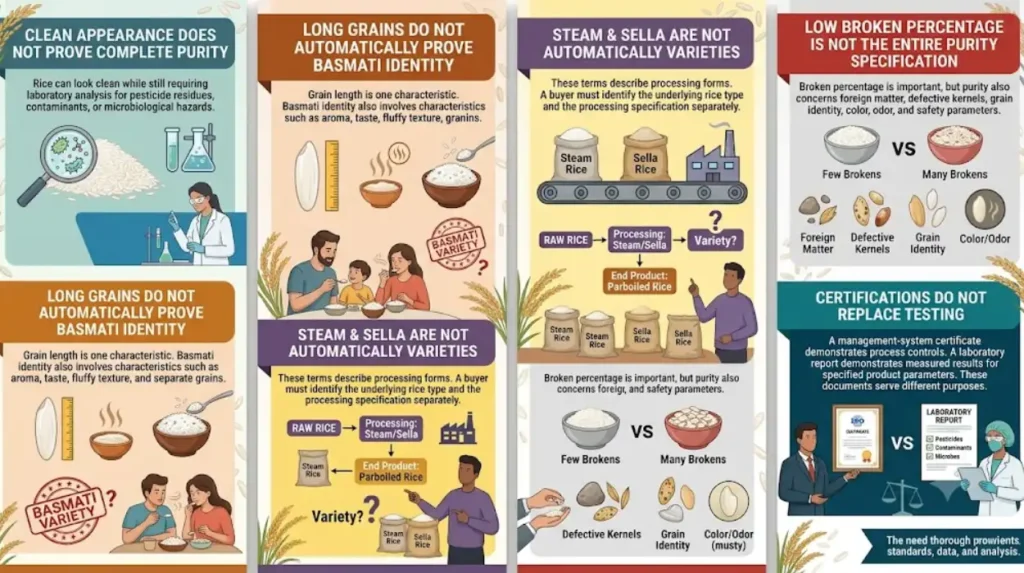
The main misconception is that clean-looking rice automatically proves purity; visual appearance alone cannot establish varietal identity, pesticide compliance, contaminant limits, or microbiological safety, because these properties require documented specifications, representative sampling, physical inspection, and laboratory analysis.
Clean appearance does not prove complete purity
Rice can look clean while still requiring laboratory analysis for pesticide residues, contaminants, or microbiological hazards.
Long grains do not automatically prove Basmati identity
Grain length is one characteristic. Basmati identity also involves characteristics such as aroma, taste, fluffy texture, and separate grains.
Steam and Sella are not automatically varieties
These terms describe processing forms. A buyer must identify the underlying rice type and the processing specification separately.
Low broken percentage is not the entire purity specification
Broken percentage is important, but purity also concerns foreign matter, defective kernels, grain identity, color, odor, and safety parameters.
Certifications do not replace testing
A management-system certificate demonstrates process controls. A laboratory report demonstrates measured results for specified product parameters. These documents serve different purposes.
Why Does Purity Become Especially Important for High-Volume Saudi Food Service Buyers?
High-volume food service operations need rice that behaves consistently across repeated cooking cycles, because variation in grain identity, broken percentage, contamination, defects, or safety parameters affects food quality, production control, procurement accuracy, and compliance across thousands of servings.
Saudi Arabia’s food import system places responsibility on importers to ensure that imported food meets applicable requirements. SFDA also maintains controls over imported food through inspection and laboratory procedures.
For a food service buyer, purity therefore functions as a procurement control. It connects the raw agricultural product with the final cooked dish.
Pakistan’s Punjab region has a strong rice research and cultivation base. The Punjab Agriculture Department’s Rice Research Institute at Kala Shah Kaku has developed numerous aromatic and Basmati varieties, while its research program covers breeding, agronomy, rice technology, and quality-related areas.
The supply chain then converts harvested paddy into commercial rice through drying, cleaning, husking, milling or parboiling, grading, sorting, packaging, storage, and export preparation. Each stage affects the final physical quality of the grain.
Purity checks give the Saudi buyer a measurable way to verify the result.
For this reason, purity is not simply an appearance test. It is a structured assessment connecting variety, processing, grain characteristics, defects, foreign matter, chemical safety, microbiological safety, documentation, and regulatory compliance.
Frequently Asked Questions
Why do Saudi Arabian food service buyers check Pakistan Basmati rice purity?
Saudi Arabian food service buyers check rice purity to verify grain identity, foreign matter limits, defective kernels, broken percentage, food safety, and consistent cooking performance before purchasing Pakistan Basmati rice.
What does rice purity mean for Pakistan Basmati rice?
Rice purity refers to the consistency of a rice lot with its declared identity and specification. It includes grain characteristics, foreign matter, defective kernels, broken grains, appearance, and applicable food safety parameters.
How is Pakistan Basmati rice purity tested?
Purity is evaluated through documentation review, representative sampling, physical inspection, and laboratory testing. Checks can cover grain length, foreign matter, defects, pesticide residues, contaminants, and microbiological safety.
What foreign matter is checked in Pakistan Basmati rice?
Foreign matter includes materials other than rice kernels. Examples include stones, sand, plastic, glass, metal, foreign seeds, husk, straw, paper, wood, and animal-origin impurities.
Does grain length prove Basmati rice purity?
No. Grain length is only one quality characteristic. Basmati evaluation also considers identity, aroma, taste, cooked texture, grain separation, defects, foreign matter, and applicable safety requirements.
What Pakistan Basmati rice grades are commonly evaluated by Saudi buyers?
Saudi buyers can evaluate commercial types such as 1121, Super Kernel, and 1509, including processing forms such as white, steam, and Sella or parboiled rice. The exact specification should identify the variety and processing form separately.
Why do broken grains matter to Saudi food service buyers?
Broken grains affect the visual appearance, cooking behavior, yield, and commercial specification of rice. Food service buyers therefore establish a defined broken-kernel percentage for consistent bulk procurement.
What standards apply to rice imported into Saudi Arabia?
GSO 1003:2022 is the GCC technical regulation covering rice kernels. Other applicable requirements address labeling, pesticide residues, contaminants, toxins, microbiological criteria, packaging, and food import controls.
Does a Certificate of Analysis prove rice purity?
A Certificate of Analysis records laboratory results for specified parameters, but it does not replace every physical, documentary, or regulatory check. Buyers use COAs together with product specifications and applicable import requirements.
Do ISO 22000 and HACCP certifications prove rice purity?
No. ISO 22000 and HACCP demonstrate structured food safety controls within a food operation. Product-specific purity and safety still require appropriate specifications, sampling, inspection, and laboratory testing.
Why is rice purity important for Saudi restaurants?
Rice purity helps restaurants maintain consistent grain appearance, cooking performance, food safety, portion quality, and dish presentation across repeated production cycles.
What happens when imported rice fails Saudi food requirements?
SFDA controls imported food through documentation review, inspection, sampling, and laboratory procedures. A shipment that fails applicable requirements can face regulatory action, including rejection according to the relevant import-control process.