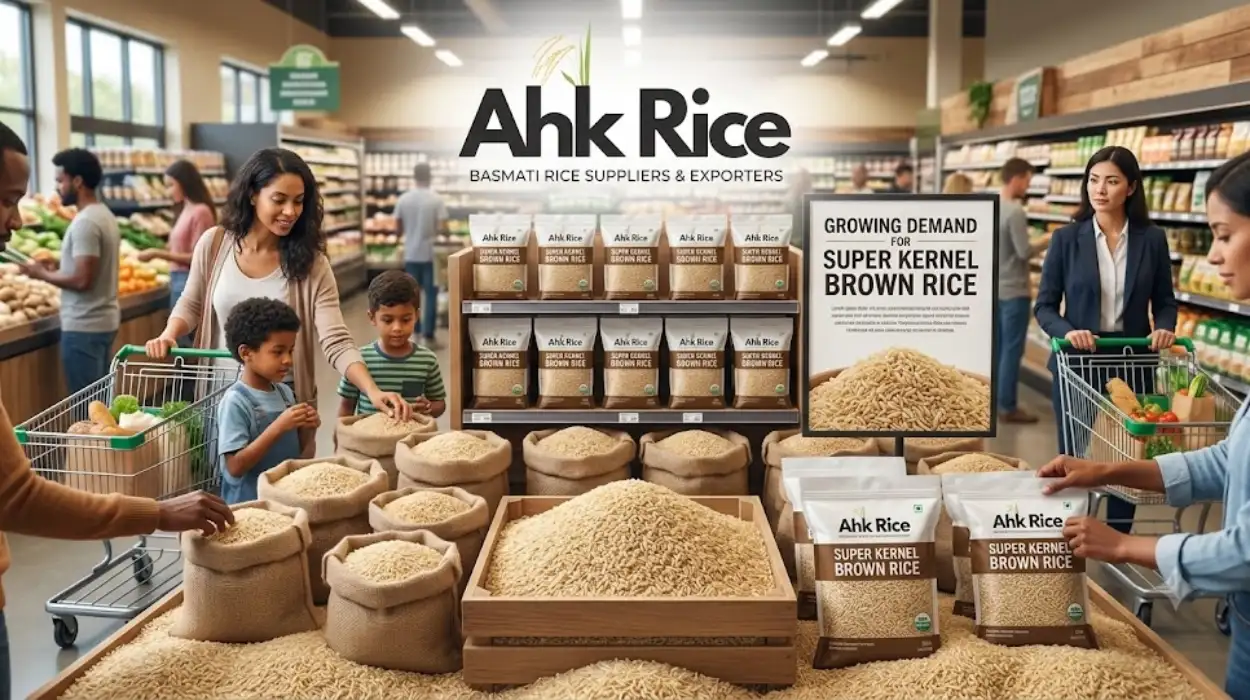
Growing Demand for Super Kernel Brown Rice in American Stores
Super Kernel Brown Rice is a whole-grain form of Pakistan’s Super Kernel Basmati rice. It retains the bran layer after the husk is removed, giving it a brown appearance, firmer cooked texture, longer cooking time, and a distinct aromatic profile. Its position in American stores connects Pakistani Basmati production with the U.S. preference for whole-grain foods and diverse rice varieties.
The U.S. market entered 2026 with strong structural demand for imported long-grain rice. USDA reported that U.S. 2026/27 rice imports are projected at a record 49.8 million hundredweight, with imports consisting of long-grain rice. The current Dietary Guidelines for Americans 2025–2030 also prioritize whole, healthy, and nutritious foods while limiting highly processed foods and refined carbohydrates. These conditions support retail interest in brown rice products, including imported aromatic varieties.
What is Super Kernel Brown Rice?
Super Kernel Brown Rice is a long-grain aromatic rice produced from Super Kernel Basmati paddy and milled only enough to remove the inedible husk while retaining the bran and germ layers. It combines Basmati aroma with whole-grain characteristics for retail and food applications.
Super Kernel is a Pakistani Basmati rice variety associated with the Punjab rice-growing region. Punjab provides the primary agricultural environment for Pakistani Basmati production, with fertile soils, irrigation systems, warm growing conditions, and seasonal temperature changes supporting aromatic long-grain rice cultivation.
Brown rice describes the milling condition rather than a separate botanical species. When rice paddy is harvested, the outer husk is removed during dehusking. The remaining kernel still contains the bran layers and germ. That kernel is brown rice.
White rice receives additional milling that removes these outer layers. Brown rice therefore retains more of the original grain structure. This distinction affects cooking time, texture, storage behavior, and nutritional composition.
Super Kernel Brown Rice is especially relevant to American retail because brown rice qualifies as a whole grain when it retains the complete grain structure. USDA guidance specifically recognizes regular, quick, instant, and fully cooked brown rice as whole-grain foods when the applicable composition requirements are met.
The product should not be confused with ordinary brown long-grain rice. Super Kernel Brown Rice combines the brown-rice milling condition with the aromatic characteristics of Pakistani Basmati.
Where is Super Kernel Brown Rice grown?
Super Kernel Brown Rice originates from Super Kernel Basmati paddy cultivated primarily in Punjab, Pakistan, where the crop develops its long grain, aroma, and cooking characteristics before milling, sorting, grading, packing, and export to international markets.
The production chain begins in rice-growing districts of Punjab. Farmers cultivate Basmati paddy through the crop cycle, then harvest mature plants and move the paddy into post-harvest handling.
The geographical origin matters because variety identity starts at cultivation. Milling cannot turn ordinary rice into Super Kernel Basmati. The grain must originate from the appropriate seed and crop system before processing begins.
Pakistan remains a major participant in global rice trade. USDA’s 2025/26 Rice Explorer places Pakistan among the world’s leading rice exporters, with an estimated 5.2 million metric tons of rice exports in 2025.
Pakistan’s rice export system also includes Basmati alongside non-Basmati varieties. USDA reported approximately 661,907 tons of Basmati exports during the 2024/25 marketing year.
How is Super Kernel Brown Rice processed?
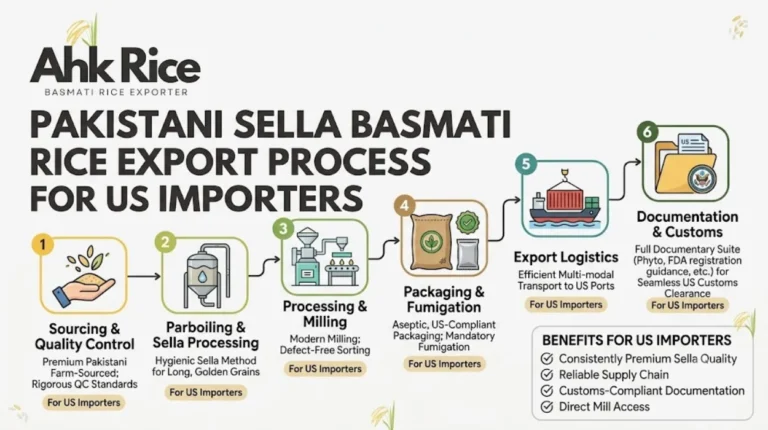
Super Kernel Brown Rice passes through harvesting, drying, cleaning, dehusking, separation, grading, sorting, quality inspection, and packaging, while avoiding the intensive polishing stage that removes the bran layer and converts brown rice into white rice.
1. Harvesting
Mature Super Kernel paddy is harvested after the rice plant reaches the appropriate crop stage. Harvesting removes the grain-bearing panicles from the field.
The harvested material is still paddy. It contains the rice kernel inside an outer husk and includes field material that must be removed during subsequent cleaning.
2. Drying
Freshly harvested paddy contains more moisture than finished brown rice requires. Controlled drying reduces moisture to a level suitable for milling and storage.
Moisture management affects kernel integrity. Excessive drying creates brittle kernels, while insufficient drying increases storage and processing risks.
3. Cleaning
Cleaning removes foreign material from the paddy. Examples include stones, dust, straw, plant fragments, and other non-rice particles.
Modern rice mills use mechanical cleaning and separation equipment to improve raw-material consistency before dehusking.
4. Dehusking
Rubber-roll huskers remove the outer husk from the paddy. The exposed kernel becomes brown rice because the bran layers remain attached.
This stage defines the primary difference between brown and white rice processing.
5. Paddy separation
The milling line separates remaining paddy from brown rice. Unhusked grains return to the husking stage so the finished batch maintains consistent processing.
6. Grading
Brown rice is classified according to commercial specifications. These include grain length, broken-grain percentage, foreign matter, immature grains, damaged kernels, moisture, and purity.
The exact specification depends on the buyer and destination market.
7. Optical sorting
Optical sorting equipment identifies visual defects and removes kernels that fail the specified quality parameters. Examples include discolored grains, damaged kernels, chalky grains, and foreign particles.
This stage helps create a more uniform retail product.
8. Final inspection and packing
The finished brown rice is inspected against the agreed specification before packaging. Packaging can use retail bags, food-service sacks, or bulk formats.
For U.S. distribution, packaging and labeling must also comply with applicable FDA requirements. Imported foods must be safe, produced under sanitary conditions, and carry informative and truthful labeling in English.
What are the key components of Super Kernel Brown Rice quality?
The key quality components are variety identity, grain length, broken percentage, moisture, purity, kernel appearance, aroma, cooking behavior, packaging integrity, and food-safety documentation because each factor affects retail acceptance and consumer performance.
Grain length
Long, slender kernels are an important visual characteristic of Super Kernel Basmati. Buyers evaluate grain dimensions before purchasing because appearance influences shelf presentation and consumer expectations.
Broken percentage
Broken grains are kernels that do not remain whole after milling and handling. A lower broken percentage produces a more uniform retail appearance.
Moisture
Moisture affects storage stability and grain condition. Export specifications normally establish a defined moisture limit rather than relying on an undefined description such as “dry.”
Purity
Purity measures how closely the shipment matches the declared rice variety and specification. It also involves the absence of unwanted material and unacceptable admixture.
Aroma
Aromatic quality distinguishes Basmati from many conventional long-grain rice products. The aroma becomes more noticeable during cooking.
Cooking behavior
Brown rice retains the bran layer, so it generally requires more water and a longer cooking period than polished white rice. The intact outer layers also produce a firmer bite.
Packaging
Packaging protects the grain from moisture, contamination, physical damage, and handling exposure. Retail packaging also communicates variety, origin, weight, cooking instructions, and other required information.
Why are American stores interested in Super Kernel Brown Rice?
American retail demand for Super Kernel Brown Rice connects three product attributes: whole-grain positioning, long-grain Basmati aroma, and international food preferences. U.S. nutrition guidance currently emphasizes whole, healthy foods, while rice imports remain essential to domestic supply.
Whole-grain positioning is important in the U.S. food environment. The 2025–2030 Dietary Guidelines for Americans emphasize whole and nutritious foods and recommend limiting refined carbohydrates.
Brown rice fits this category because the bran and germ remain attached to the grain. USDA food-program guidance recognizes brown rice as a whole-grain option under applicable requirements.
The product also addresses demand for aromatic rice. Basmati has a different sensory profile from standard American long-grain rice, particularly in aroma, grain shape, and cooked texture.
U.S. supply conditions reinforce the importance of imported long-grain rice. USDA’s July 2026 rice outlook projects U.S. 2026/27 imports at a record 49.8 million hundredweight, driven by reduced domestic availability and higher import requirements.
The strongest retail opportunities therefore occur where consumers already understand brown rice, Basmati, ethnic foods, natural foods, and international cuisines.
What are the main grades of Super Kernel Brown Rice?
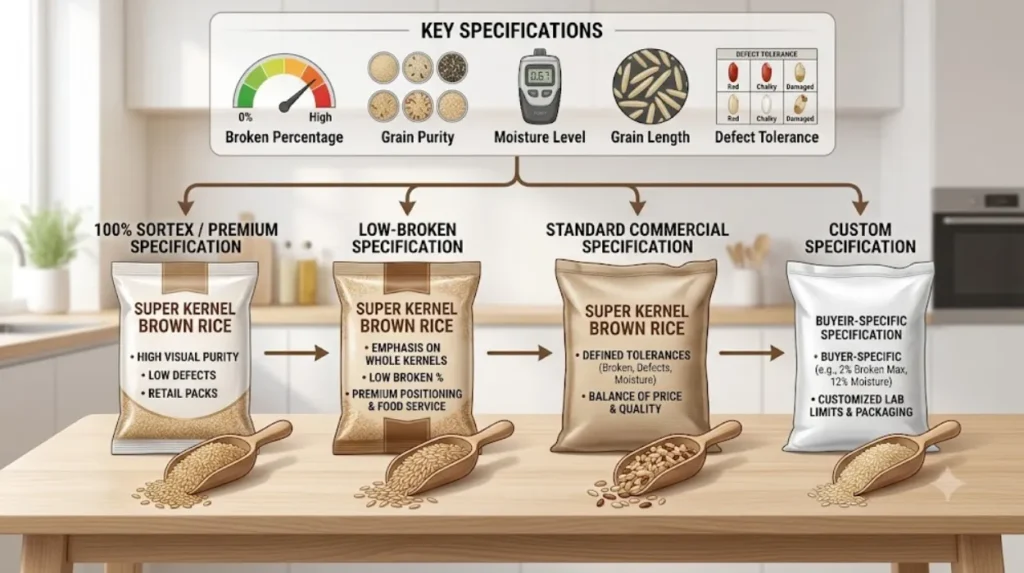
Super Kernel Brown Rice does not have one universal retail grading system that applies to every export market; commercial grades are established through measurable specifications such as broken percentage, grain purity, moisture, grain length, and defect tolerance.
A buyer can therefore encounter different commercial grades from different suppliers. The grade name alone does not provide enough information.
100% sortex or premium specification
This specification normally targets high visual purity and low defect levels. It suits retail packs where appearance is a major purchasing factor.
Low-broken specification
This grade emphasizes whole kernels and a low percentage of broken grains. It fits premium retail positioning and food-service applications that require consistent presentation.
Standard commercial specification
Standard grades use defined tolerances for broken kernels, defects, moisture, and foreign matter. They provide a balance between price and physical quality.
Custom specification
Importers can establish a buyer-specific specification using measurable limits. Examples include moisture maximum, broken percentage, grain length, damaged-kernel tolerance, packaging size, and laboratory testing requirements.
A useful comparison therefore focuses on the actual specification sheet rather than treating words such as “premium,” “super,” or “extra” as legally standardized grades.
Which markets import Super Kernel Brown Rice?
Super Kernel Brown Rice serves markets where consumers recognize Basmati, brown rice, whole grains, and South Asian cuisine, with the United States representing a significant destination because its retail sector combines imported long-grain rice demand with established whole-grain consumption.
The United States is the central market for this topic. American stores include mainstream supermarkets, natural-food retailers, South Asian grocery stores, Middle Eastern grocery stores, specialty food stores, and online grocery channels.
Other international markets also purchase Pakistani brown and Basmati rice. Examples include the United Kingdom, Canada, Gulf markets, European markets, and other countries with established South Asian food consumption.
Market suitability depends on the buyer’s specification rather than geography alone. Retailers serving consumers who recognize Basmati aroma and brown-rice cooking characteristics have a clear product-use context.
For U.S. imports, regulatory compliance remains essential. Imported food is subject to FDA requirements, including prior notice, applicable facility registration, food safety requirements, and truthful English-language labeling.
Which certifications and documents apply to Super Kernel Brown Rice?
Super Kernel Brown Rice exports use regulatory documents and voluntary certifications according to the destination, product claim, buyer specification, and supply chain; FDA compliance, phytosanitary documentation, food-safety systems, and organic certification serve different purposes.
A phytosanitary certificate confirms compliance with plant-health requirements established by the importing country. Pakistan’s Department of Plant Protection describes inspection, sampling, treatment where required, and phytosanitary certification under ISPM 12 as part of export procedures.
FDA food facility registration applies to facilities that manufacture, process, pack, or hold food for U.S. consumption, subject to applicable exemptions. The current FDA framework also requires periodic registration renewal.
FSMA compliance relates to the U.S. food-safety framework. U.S. food importers also have responsibilities under the Foreign Supplier Verification Program for covered imported foods.
HACCP and ISO 22000 are food-safety management approaches or certifications used by businesses to demonstrate controlled food-safety systems. They are not substitutes for FDA import compliance.
USDA Organic certification applies when a product is marketed in the United States as organic under the applicable organic regulations. Conventional brown rice cannot be marketed as organic simply because it is minimally milled.
Laboratory analysis can also support buyer requirements. Tests can cover moisture, broken percentage, purity, pesticide residues, heavy metals, microbiological parameters, and other specifications established by the buyer or regulation.
One important distinction concerns arsenic. FDA has established a 100 ppb action level for inorganic arsenic in infant rice cereals, including brown and white rice cereals. This is an infant-cereal action level, not a general maximum limit for all retail bags of brown rice.
How is Super Kernel Brown Rice used in American stores?
American stores use Super Kernel Brown Rice for household meals, South Asian recipes, health-oriented whole-grain meals, grain bowls, meal preparation, food-service applications, and specialty retail packs where aroma and long-grain appearance distinguish it from conventional brown rice.
Households use it as a side dish with vegetables, meat, seafood, lentils, and sauces. The bran layer produces a firmer texture than polished Basmati.
South Asian retailers use it for traditional rice dishes where Basmati aroma remains important. Examples include pulao, biryani-style preparations, rice bowls, and everyday steamed rice.
Health-oriented retailers position brown rice around whole-grain consumption. This positioning aligns with current U.S. dietary guidance that emphasizes whole and nutritious foods.
Food-service businesses use bulk formats when the same cooking characteristics are required across repeated meals. Restaurants can also use brown Basmati as an alternative to white Basmati on menus.
What are the common problems and misconceptions about Super Kernel Brown Rice?
The most common misconceptions concern the meaning of brown rice, the Super Kernel name, cooking time, grading terminology, certification status, and health claims; buyers should evaluate variety, milling condition, specification, documentation, and preparation requirements separately.
One misconception is that brown rice is a separate variety. Brown describes the milling condition. Super Kernel identifies the rice variety or commercial variety designation.
Another misconception is that all brown rice cooks identically. Grain variety, age, moisture, milling condition, soaking, water ratio, and cooking equipment affect the final result.
A third misconception is that “Super Kernel” automatically means one universal export grade. Commercial specifications differ by supplier and contract. The buyer should review measurable limits for broken grains, moisture, purity, defects, and grain characteristics.
A fourth misconception is that brown rice always requires identical cooking instructions. Brown rice generally takes longer to cook because the bran layer remains intact.
A fifth misconception is that brown rice is automatically healthier without considering the complete diet. Brown rice is a whole-grain food, but food safety and dietary quality still depend on the overall consumption pattern.
Arsenic also requires accurate communication. Rice absorbs arsenic more readily than many other crops, and FDA advises consumers to include a variety of grains in the diet. FDA research also shows that cooking rice in excess water and draining it can reduce inorganic arsenic by 40% to 60%, depending on the rice type, although this method also reduces some nutrients.
The final misconception is that a certification replaces product testing. Certification, regulatory documentation, laboratory analysis, and commercial specifications address different parts of quality assurance.
Super Kernel Brown Rice therefore represents more than a brown-colored rice product. It is the combination of a Pakistani aromatic rice variety, a specific milling condition, measurable commercial specifications, controlled processing, and a U.S. retail environment where whole-grain foods and imported long-grain rice have established relevance.
For readers comparing the sensory side of brown Basmati products, the most relevant next topic is:
How aroma and cooking quality differ among brown Basmati varieties.
Frequently Asked Questions
What is Super Kernel Brown Rice?
Super Kernel Brown Rice is a long-grain aromatic rice from Pakistan that retains its bran and germ layers after the outer husk is removed. It combines Basmati aroma with the whole-grain characteristics of brown rice.
Where is Super Kernel Brown Rice grown?
Super Kernel Brown Rice is produced from Super Kernel Basmati paddy primarily grown in Punjab, Pakistan. The region supports Basmati cultivation through suitable soil, irrigation, climate, and seasonal growing conditions.
How is Super Kernel Brown Rice processed?
The process includes harvesting, drying, cleaning, dehusking, paddy separation, grading, optical sorting, quality inspection, and packaging. Unlike white rice, the bran layer remains on the kernel.
What makes Super Kernel Brown Rice different from white Basmati rice?
Super Kernel Brown Rice retains the bran and germ layers, creating a firmer texture and longer cooking time. White Basmati undergoes additional milling that removes these layers and produces a lighter-colored grain.
Why is Super Kernel Brown Rice becoming popular in American stores?
Its popularity connects the demand for whole-grain foods with consumer interest in aromatic Basmati rice. It also serves South Asian, Middle Eastern, health-oriented, and specialty grocery markets across the United States.
What grades of Super Kernel Brown Rice are available?
Commercial grades are based on specifications such as broken percentage, grain length, moisture, purity, defects, and appearance. Common specifications include premium, low-broken, standard commercial, and customized buyer specifications.
Which countries import Super Kernel Brown Rice?
The United States is an important market for imported brown and Basmati rice. Other destinations include the United Kingdom, Canada, Gulf countries, European markets, and regions with established demand for South Asian rice.
What certifications apply to Super Kernel Brown Rice exports?
Depending on the destination and buyer requirements, documentation can include phytosanitary certification, FDA-related compliance for U.S. imports, food-safety system certifications, organic certification where applicable, and laboratory analysis reports.
How long does Super Kernel Brown Rice take to cook?
Brown rice generally requires more cooking time than polished white rice because its bran layer remains intact. Cooking time also depends on soaking, water ratio, grain condition, and cooking equipment.
Is Super Kernel Brown Rice a variety or a milling type?
Super Kernel identifies the rice variety or commercial variety designation, while brown rice describes the milling condition. Therefore, Super Kernel Brown Rice combines a specific rice type with brown-rice processing.
How is Super Kernel Brown Rice used in American stores?
It is used for household meals, rice bowls, South Asian dishes, meal preparation, food-service applications, and specialty retail products. Common preparations include pulao, biryani-style dishes, steamed rice, and side dishes.
What should American importers check before buying Super Kernel Brown Rice?
Importers should check variety identity, grain length, broken percentage, moisture, purity, defects, packaging, laboratory analysis, food-safety documentation, labeling requirements, and applicable U.S. import regulations.