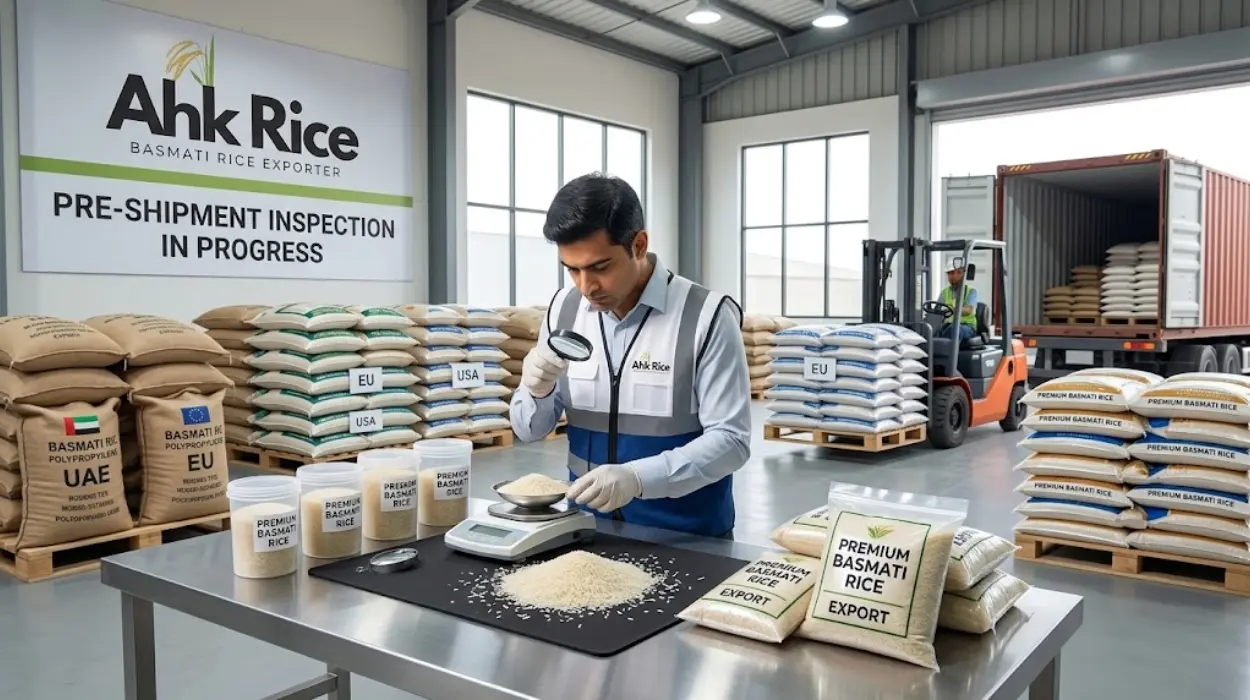
What Is Pre-Shipment Inspection for Basmati Rice Exports?
Pre-shipment inspection for Basmati rice exports is a quality verification process completed before a shipment leaves the exporting country. It checks grain specifications, moisture, broken rice percentage, packaging, labeling, quantity, and compliance documents against the buyer’s purchase order. The inspection confirms whether the prepared consignment meets the agreed export requirements.
Pakistani Basmati rice exporters use pre-shipment inspection to verify varieties such as 1121, Super Kernel, and 1509 Basmati rice before container loading or shipment release. The process connects the buyer’s specification sheet with the physical rice being shipped. It also creates inspection records that support quality approval, customs documentation, and dispute resolution.
The inspection scope depends on the destination, contract, product grade, and buyer requirements. UAE importers, for example, need clear specifications for grain length, broken percentage, moisture, labeling, and applicable food safety requirements. Independent inspection companies such as SGS, Bureau Veritas, and Intertek provide different testing and verification services. The buyer and exporter must agree on the required checks before inspection begins.
What Does Pre-Shipment Inspection Mean in Basmati Rice Exports?
Pre-shipment inspection is a documented examination of export rice before dispatch. It verifies product identity, physical quality, quantity, packaging, and contractual compliance. The inspection establishes whether the consignment matches agreed specifications before the buyer accepts shipment release.
Basmati rice is a long-grain aromatic rice traditionally cultivated in Pakistan and India. Pakistani Basmati production is concentrated in Punjab, including districts such as Hafizabad, Gujranwala, Sheikhupura, Narowal, and Sialkot. Its characteristic aroma, slender grains, and cooked elongation make consistent grading important for international trade.
Exporters supply several commercial varieties:
- 1121 Basmati: A premium long-grain variety used in retail packs, restaurants, and premium foodservice.
- Super Kernel Basmati: An aromatic Pakistani variety commonly supplied to ethnic grocery retailers and wholesale distributors.
- 1509 Basmati: A shorter-maturity variety used in price-sensitive retail, wholesale, and institutional markets.
Pre-shipment inspection does not automatically certify every aspect of food safety. Its scope depends on the inspection agreement, sampling method, laboratory tests, and destination requirements.
How Does Pre-Shipment Inspection Work Step by Step?
Pre-shipment inspection follows a defined sequence: specification review, lot identification, representative sampling, physical examination, laboratory testing when required, packaging verification, and report issuance. The buyer compares the findings with contractual limits before authorizing shipment according to agreed procedures.
1. Review the purchase order
The exporter and buyer confirm the variety, grade, grain length, broken percentage, moisture limit, foreign matter tolerance, quantity, packaging, and destination. These details form the inspection criteria.
2. Identify the export lot
The inspector identifies the rice lot, production batch, warehouse, or packed consignment. The lot reference connects the physical product to its inspection report and export documents.
3. Collect representative samples
The inspector collects samples from selected bags, bulk material, or multiple points in the lot. A representative sample reduces the risk of judging a shipment from a small, unrepresentative portion.
4. Examine grain quality
The sample undergoes checks for grain appearance, broken kernels, foreign matter, discoloration, damaged grains, and other agreed parameters. Grain length is measured using the specified method and sampling basis.
5. Conduct laboratory tests
Laboratory testing follows the contract and destination requirements. Tests include moisture measurement, pesticide residue analysis, mycotoxin screening, and other chemical or microbiological checks when applicable.
6. Verify packaging and loading
The inspector checks bag weight, packaging condition, labels, lot identification, and shipping marks. If loading supervision is included, the inspector also records container condition, loading progress, and seal details.
7. Issue the inspection report
The final report records the scope, sampling details, results, and identified deviations. The buyer uses this evidence to approve the shipment, request corrective action, or hold release under the agreed contract.
What Are the Key Components of Basmati Rice Inspection?
Basmati rice inspection evaluates measurable product attributes and shipment conditions. The main components are variety identity, grain length, broken percentage, moisture, purity, food safety, packaging, quantity, and container condition, with acceptance limits established in the purchase contract.
| Inspection component | What the inspector checks |
|---|---|
| Variety and grade | 1121, Super Kernel, or 1509 identity and agreed processing grade |
| Grain length | Average length or specified measurement for raw rice |
| Broken percentage | Proportion of broken kernels under the agreed grading method |
| Moisture | Moisture percentage against the contractual limit |
| Purity | Foreign matter, admixture, and off-type grains |
| Appearance | Color, uniformity, damaged grains, and visible defects |
| Food safety | Required pesticide residues, mycotoxins, and other regulated contaminants |
| Packaging | Bag material, net weight, labeling, stitching, and markings |
| Quantity | Number of bags, total net weight, and shipping quantity |
| Container condition | Cleanliness, dryness, odor, structural condition, and loading records |
A specification sheet makes these checks measurable. For example, a buyer can specify a maximum moisture level of 13% and a maximum broken percentage of 2%, provided those limits match the product, contract, and destination requirements. The inspector then reports results against the agreed criteria rather than applying one universal standard to every shipment.
Grain length also requires precise terminology. Raw grain length and cooked grain elongation are different measurements. A claim that a variety reaches a particular raw length does not establish its cooked elongation ratio.
What Are the Benefits of Pre-Shipment Inspection?
Pre-shipment inspection gives importers documented evidence of product quality before dispatch. It reduces uncertainty about contractual compliance, identifies defects earlier, improves traceability, supports payment and claims procedures, and helps buyers assess whether the shipment meets their purchasing specifications.
The principal benefits relate to quality control and commercial risk.
- Fewer specification disputes: Recorded measurements help resolve disagreements about broken percentage, moisture, and appearance.
- Better batch traceability: Lot numbers and sampling records connect test results with the inspected consignment.
- Improved shipment planning: Early detection of defects allows corrective sorting, drying, repacking, or replacement before dispatch.
- Clearer commercial decisions: Buyers can compare the report with contractual acceptance criteria before shipment approval.
- Stronger documentation: Inspection reports support internal quality assurance and contractual claims when the inspection agreement provides relevant evidence.
Inspection does not eliminate every risk. A sample represents the inspected lot only to the extent supported by the sampling plan. Incorrect sampling, unrecorded lot changes, or damage during transport can affect the relationship between inspection results and the rice ultimately received.
When Do Importers Require Pre-Shipment Inspection?
Importers request pre-shipment inspection when contracts require independent verification, product specifications are strict, shipments involve substantial commercial value, or destination procedures demand specific evidence. The inspection scope varies by market, buyer policy, commodity grade, and applicable regulations.
UAE rice imports
UAE importers commonly focus on product specifications, compliant labeling, food safety documentation, and shipment traceability. Dubai wholesalers, supermarket suppliers, and foodservice distributors use different packaging formats and quality requirements.
An importer purchasing 1121 Basmati for premium retail can specify grain length, broken percentage, aroma, and pack size. A distributor purchasing 1509 for bulk trade can prioritize price, moisture, uniformity, and consistent bag weights.
European and North American imports
Importers serving the UK, European Union, and United States need to account for the applicable food safety and import rules. Pesticide residue limits, contaminant controls, traceability, and labeling requirements depend on the destination jurisdiction and product category.
A pre-shipment inspection report supports quality verification but does not replace mandatory import controls, official sampling, or regulatory certificates.
Wholesale and private-label contracts
Private-label buyers often require precise packaging specifications, barcode details, lot coding, and artwork approval. Wholesale buyers frequently prioritize consistent grade, net weight, and shipment quantity.
These requirements belong in the purchase order before production and inspection begin.
Which Certifications and Documents Apply to Rice Inspection?
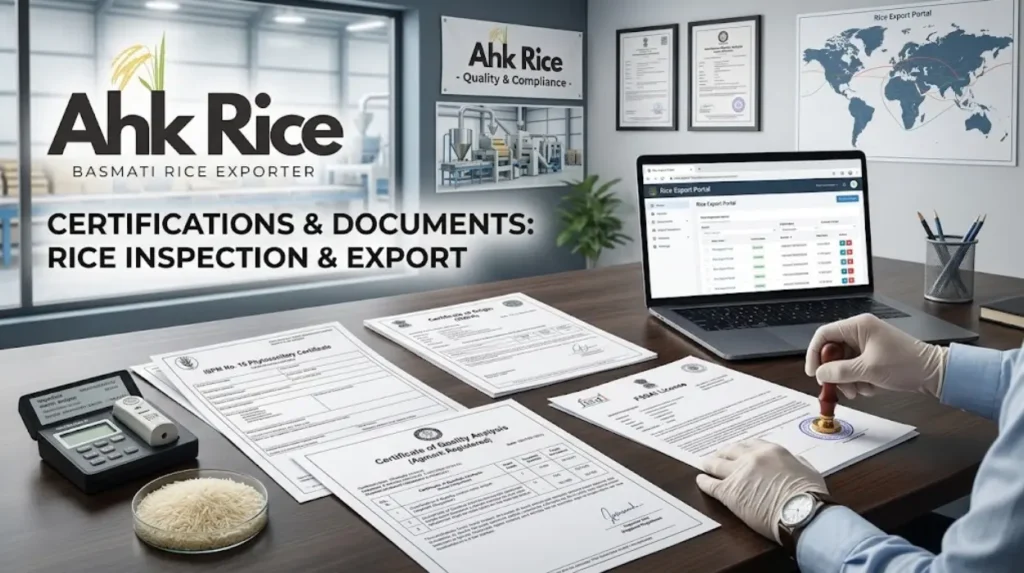
The required documents depend on the destination country, product, and contract. Inspection reports, laboratory certificates, phytosanitary certificates, certificates of origin, and food safety records serve different purposes. No single document automatically satisfies every import requirement.
Common export documents include:
- Inspection report: Records the inspection scope, findings, and compliance against agreed specifications.
- Certificate of Analysis (COA): Presents laboratory results for specified parameters, such as moisture, pesticide residues, or contaminants.
- Phytosanitary certificate: Confirms plant-health requirements under the relevant authority’s procedures when required.
- Certificate of origin: Identifies the country of origin under the applicable issuing process.
- Commercial invoice and packing list: Record transaction details, product descriptions, package counts, and shipment quantities.
- Bill of lading: Records shipment details and serves as a transport document.
- Other required certificates: Depend on destination regulations, product claims, and buyer requirements.
Halal certification, organic certification, and food safety management certifications apply only when relevant to the product, market, buyer, or legal requirement. They do not replace product-specific inspection or laboratory analysis.
What Are the Common Problems and Misconceptions?
The most common inspection problems involve unclear specifications, nonrepresentative samples, mismatched documents, inconsistent lot identification, and confusion between inspection and certification. Buyers and exporters prevent these problems by agreeing on methods, limits, responsibilities, and acceptance procedures before production.
Treating inspection as a guarantee of every quality attribute
An inspector verifies only the parameters included in the agreed scope. A visual examination does not establish pesticide residue compliance, and a moisture test does not prove microbiological safety.
Sampling too few bags
A sample taken from only one or two bags can miss variation across a large consignment. The sampling plan must reflect lot size, packaging format, risk, and the agreed inspection method.
Using unclear acceptance limits
Terms such as “premium quality,” “long grain,” and “low broken” lack precision without measurable definitions. Contracts should specify the measurement method, maximum or minimum values, and treatment of results outside the limits.
Assuming every inspection company provides identical services
SGS, Bureau Veritas, and Intertek offer inspection and testing services, but the exact scope depends on the service order, laboratory capability, destination, and contract. Importers should confirm the specific tests and report format before appointing an agency.
Confusing inspection approval with import clearance
An accepted inspection report does not guarantee customs release. Authorities retain the power to inspect consignments, request documents, sample products, or reject goods that fail applicable requirements.
How Should Buyers Prepare for a Reliable Inspection?
Buyers should finalize a written specification, identify the inspection lot, select suitable sampling and testing methods, and agree on acceptance criteria before dispatch. Clear responsibilities for fees, corrective action, report approval, and shipment release prevent avoidable commercial disputes.
The buyer and exporter should confirm these points before inspection:
- Exact rice variety, processing type, and grade.
- Grain length, broken percentage, moisture, and purity limits.
- Required food safety tests and applicable regulatory limits.
- Sampling method, inspection date, location, and lot size.
- Bag weight, packaging material, labels, and shipping marks.
- Whether container loading supervision and seal recording are required.
- Report delivery deadlines and procedures for failed results.
For UAE shipments, buyers comparing independent inspection providers should understand the scope of each service before selecting an agency. The related guide on SGS, Bureau Veritas and Intertek rice inspection for UAE importers explains which inspection and testing requirements importers should request and compare.
Pre-shipment inspection works best when it is part of the purchasing process rather than a final check added after production. A precise specification, representative sampling, appropriate testing, and traceable records create a clearer basis for accepting Basmati rice shipments.
SEO keywords and metadata
Primary keyword: pre-shipment inspection for Basmati rice exports
Secondary keywords:
- Basmati rice export inspection
- rice pre-shipment inspection process
- Basmati rice quality inspection
- rice inspection certificate
- rice export quality standards
- SGS rice inspection
- Bureau Veritas rice inspection
- Intertek rice testing
- rice export quality control
- Basmati rice Certificate of Analysis
Meta title (under 60 characters):
Pre-Shipment Inspection for Basmati Rice Exports
Meta description (over 60 characters):
Learn how pre-shipment inspection verifies Basmati rice quality, grain length, moisture, broken percentage, packaging, and export compliance before shipment.
Frequently asked questions
What is pre-shipment inspection for Basmati rice?
Pre-shipment inspection verifies rice quality, quantity, packaging, and agreed specifications before export dispatch. The inspection report records the findings for buyer review.
What parameters are checked during rice inspection?
Common parameters include grain length, broken percentage, moisture, purity, appearance, packaging, net weight, and applicable food safety tests.
Is a pre-shipment inspection certificate mandatory for every rice export?
No. Requirements depend on the destination’s regulations, buyer’s contract, and shipment conditions. Importers must verify the documents required for their specific transaction.
What is the difference between a COA and an inspection report?
A Certificate of Analysis presents results for specified laboratory tests. An inspection report can cover broader checks, including physical quality, packaging, quantity, and loading, depending on its scope.
Do SGS, Bureau Veritas, and Intertek inspect Basmati rice?
These companies provide inspection and testing services. Buyers should confirm availability, laboratory scope, sampling procedures, accreditation where relevant, and destination-specific requirements before booking.