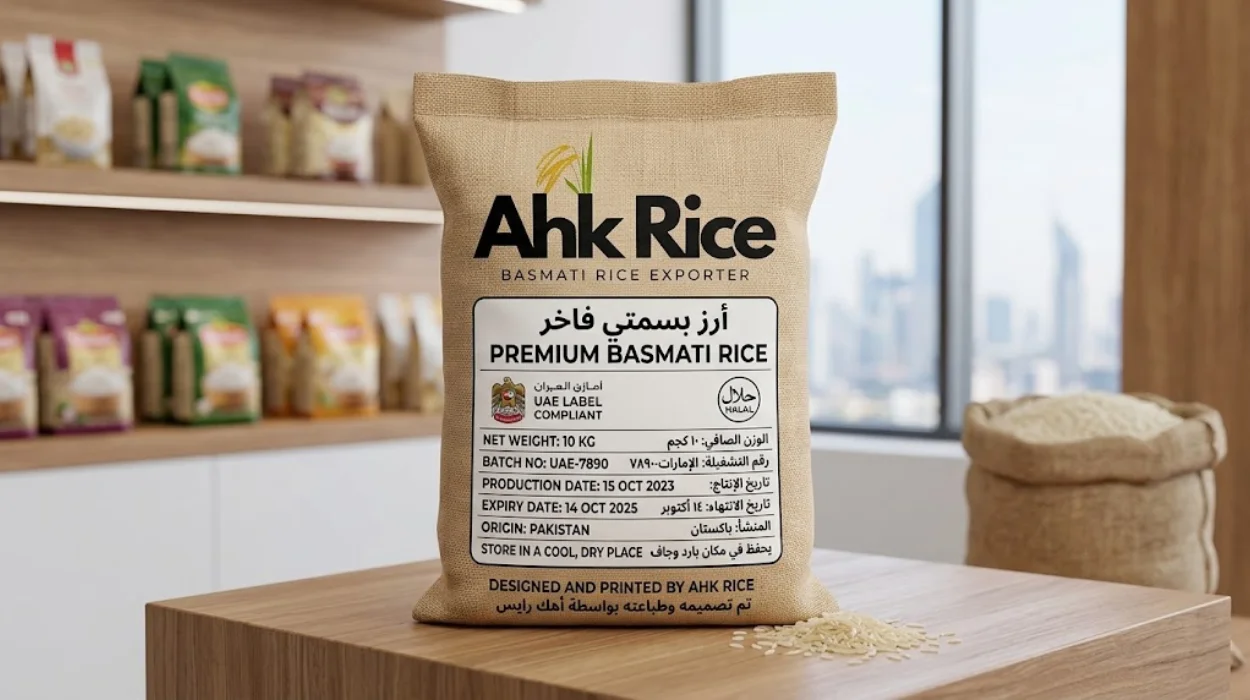
Get UAE Label-Compliant Basmati Rice Packaging Designed and Printed by AHK Rice
UAE-compliant Basmati rice packaging requires accurate product information, Arabic labelling, correct date declarations, country of origin, net weight and packaging specifications that meet applicable requirements. Importers should approve the final artwork before printing to reduce relabelling costs, customs delays and rejected retail stock.
For a practical introduction, read [What Labelling Rules Apply to Rice Sold in the UAE?] before finalising your packaging brief. This educational guide helps buyers identify the information that must be checked before artwork approval.
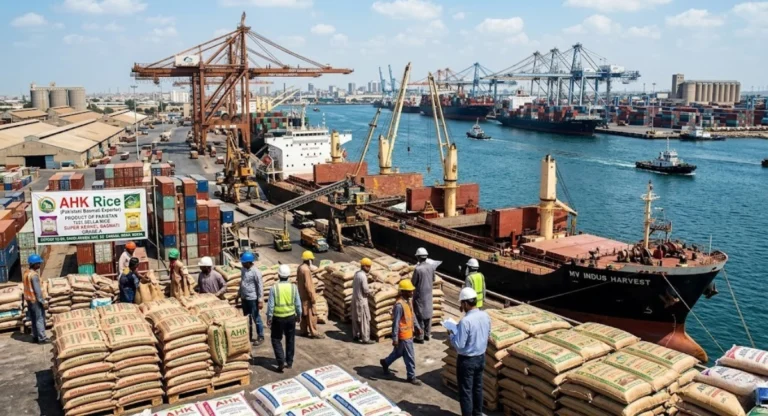
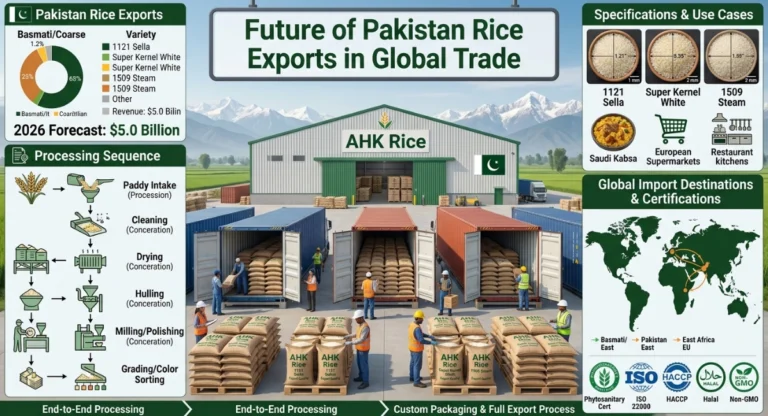
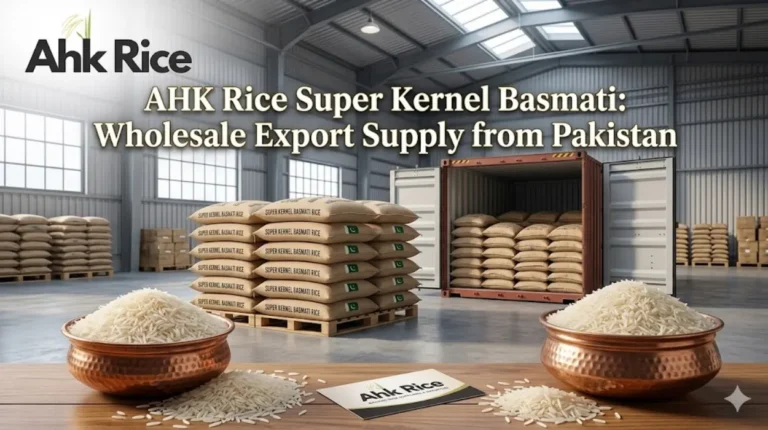
AHK Rice is a Pakistani Basmati rice exporter based in Punjab, supplying 1121, Super Kernel and 1509 varieties to international buyers. Through its Basmati rice supply and export service, AHK Rice supports buyers coordinating rice specifications, packaging requirements and export preparation.
The objective is to align the rice grade, printed bag design, label information and shipment documents before production begins. Buyers should confirm the applicable UAE and emirate-level requirements with their importer, food registration team or regulatory adviser before approving the final artwork.
What Is the Best Solution for UAE Rice Packaging Compliance?
The best solution is to combine buyer-approved packaging artwork with verified product specifications and a pre-print label review. This approach allows importers to check Arabic text, dates, origin, net weight and product identity before committing to a commercial packaging run.
A compliant packaging project begins with the intended sales channel. A distributor supplying bulk foodservice customers may need different bag sizes and presentation from a retailer selling branded rice in supermarkets. Both must ensure that mandatory information is accurate and legible.
The packaging brief should identify the following:
- Product identity: Specify whether the bag contains 1121, Super Kernel or 1509 Basmati rice.
- Processing type: State whether the product is white, steam, parboiled or another accurately described variety.
- Arabic information: Prepare the required Arabic text and check that its meaning matches the approved product information.
- Country of origin: Declare Pakistan accurately where applicable.
- Net weight: Confirm the declared quantity against the actual pack size.
- Date information: Verify the applicable production, expiry or best-before declarations and their required format.
- Storage instructions: Include suitable storage guidance where required.
- Importer details: Confirm the responsible importer and other required particulars for the destination market.
The exact legal declarations depend on the product, applicable standards and current UAE requirements. A checklist is a useful control, but it does not replace regulatory verification.
For example, an importer ordering 5 kg retail bags of 1121 Steam Basmati should approve the product name, Arabic translation, origin statement, weight declaration and date-printing area together. Approving each element separately increases the risk of inconsistent information appearing on the finished bag.
Why Should UAE Importers Choose AHK Rice?
UAE importers should choose a supplier that coordinates rice specifications, packaging requirements and export preparation within one purchasing workflow. AHK Rice helps buyers align the selected Basmati variety, bag format, artwork approval and shipment requirements before confirming a commercial order.
AHK Rice supplies Pakistani Basmati varieties for wholesale distribution, retail packaging and foodservice applications. Its role is to coordinate the rice order and the agreed packaging specifications with the buyer, rather than treating the printed bag as an isolated design task.
The process begins by identifying the product and commercial requirements. Buyers confirm the rice variety, processing type, grain specifications, broken percentage, moisture limits, quantity and intended bag size. They then provide their brand artwork or request a packaging design brief.
AHK Rice can coordinate the agreed packaging details, subject to confirmation of the order, available materials, printing arrangements and production requirements. Buyers should confirm which design, printing and packaging services are included in their quotation before placing the order.
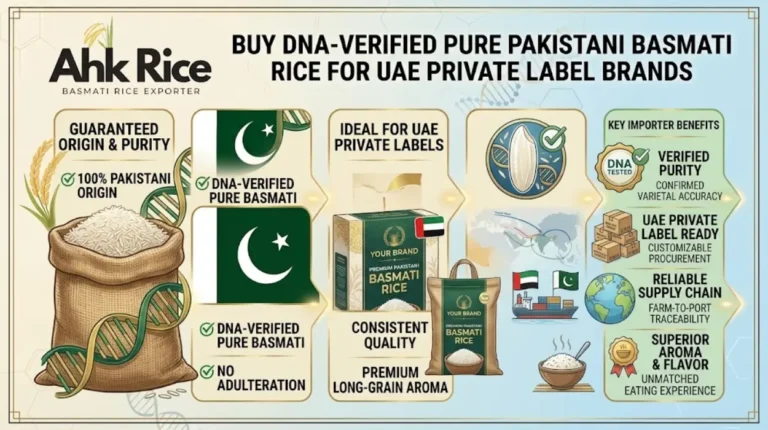
This coordination is particularly useful for private-label importers. A distributor launching a new retail brand needs the bag to communicate the correct product identity while supporting its own branding and market positioning. A foodservice buyer may prioritise durable bags, clear identification and practical storage information.
AHK Rice also helps buyers connect the packaging brief to the wider export order. This reduces the risk of approving artwork for one rice grade while purchasing another grade with different specifications.
Before printing, the importer should approve a final proof containing the complete text, translated declarations, artwork dimensions, colours, bag material and printing positions. The buyer should retain the approved version as the reference for production and subsequent orders.
Which UAE Labelling Requirements Must Be Checked Before Printing?
Before printing, importers must verify the applicable UAE food-labelling rules and relevant GSO requirements for the specific rice product. Arabic declarations, product identity, country of origin, net weight, date information and responsible business details should be checked against current regulatory and importer requirements.
The General Standard for the Labelling of Prepackaged Foods, commonly associated with Codex CXS 1, provides an important international reference. Relevant Gulf standards and UAE rules may establish additional or more specific requirements. Importers should confirm which provisions apply to their product and sales channel.
The main checks include:
Arabic text and translation: Mandatory information should be provided in the format and language required by the applicable rules. Translation must accurately represent the approved product information. Arabic text should remain readable after printing and should not be obscured by logos or decorative elements.
Product name and description: The label must identify the product accurately. A bag marketed as 1121 Basmati rice should not carry misleading variety or processing claims. Steam and parboiled descriptions should match the actual product.
Country of origin: The origin declaration must be accurate and consistent with the product and supporting documents. For Pakistani rice, the wording should clearly identify Pakistan where required.
Net weight: The declared quantity must match the product packed and comply with applicable measurement and presentation requirements. Buyers should verify that the printed unit and numeral are clear.
Production and expiry information: Confirm the applicable date declarations, date format, printing location and legibility requirements before approving the bag. Do not assume one date format is automatically acceptable for every product or registration.
Importer and regulatory details: Check which importer identification, manufacturer or packer details, registration information and other declarations apply to the specific product.
Storage and claims: Storage instructions and any nutrition, health, quality or origin-related claims must be accurate and supported where required.
Buyers should also review whether the packaging requires prior product registration, label approval or other clearance before import. Final acceptance depends on the applicable rules and the relevant authorities, not solely on the printer or exporter.
For a more detailed comparison of these requirements, use [GSO and UAE Food Label Requirements: Arabic Text, Dates, Origin and Net Weight on Rice Bags] as the supporting MOFU article. It should be reviewed alongside the buyer’s product registration and artwork checklist before production approval.
What Results Can Buyers Expect From a Proper Packaging Workflow?
A controlled packaging workflow improves label consistency, reduces avoidable artwork corrections and gives importers a documented basis for approving production. It also helps align the printed bag with the ordered rice specification, intended retail presentation and export documentation.
The results depend on the quality of the initial brief and the checks completed before printing. A complete brief reduces unanswered questions about bag dimensions, mandatory text, branding, product descriptions and date-printing space.
Consider a UAE distributor launching 10 kg private-label bags of Super Kernel Basmati. The distributor submits its logo and preferred design, confirms the product specification and provides the required importer information. The label is reviewed, the Arabic text is verified, and a final proof is approved before printing.
This workflow creates a clear record of what was authorised. It also allows the buyer to check that the packaging reflects the agreed product rather than relying on a general design preview.
AHK Rice can coordinate the agreed rice and packaging requirements, but buyers should not treat artwork approval as a guarantee of regulatory acceptance. UAE compliance remains dependent on current regulations, the specific product, required registrations and the decisions of the competent authorities.
For repeat orders, buyers should retain the approved artwork, specification sheet and relevant batch documentation. Any change to the product, pack size, origin declaration, importer details or regulatory requirements should trigger a review before the next print run.
How Much Does UAE-Compliant Rice Packaging Cost?
Packaging costs depend on bag material, pack size, printing method, order quantity, artwork complexity and any registration or testing requirements. Importers should request an itemised quotation covering packaging, printing and rice supply instead of relying on a single generic price.
AHK Rice should confirm the final price against the buyer’s product specification and order volume. The following factors commonly influence the total cost:
| Cost factor | What buyers should confirm |
|---|---|
| Bag material | Material type, thickness, durability and food-contact suitability |
| Pack size | Required formats, such as 1 kg, 5 kg, 10 kg, 20 kg or 25 kg |
| Printing | Number of colours, artwork complexity and printing method |
| Order quantity | Minimum production quantity and cost per bag |
| Artwork | New design, existing artwork adaptation and revision charges |
| Label compliance | Translation, regulatory review and any required registration support |
| Packaging format | Standard bags, woven bags, laminated bags or other agreed formats |
| Export logistics | Carton or pallet arrangements where applicable, loading and freight terms |
These are quotation factors, not fixed AHK Rice prices. The buyer should request confirmation of minimum order quantities, printing setup fees, sample charges, payment terms and the treatment of unused packaging.
The commercial comparison should also separate the rice price from packaging and freight. An apparently cheaper bag may have a different material specification or printing quality, while an incomplete quotation may exclude artwork changes or additional compliance work.
Buyers should confirm the quotation currency, Incoterm, shipment quantity and destination charges before comparing suppliers.
What Is the Sample, Artwork and Approval Process?
The sample process should verify the rice quality and packaging presentation before the buyer commits to the full order. Importers should approve the commercial rice sample, final label proof, packaging specifications and production terms in writing, with all sample and courier costs confirmed in advance.
AHK Rice buyers can organise the process around five practical stages.
Stage 1: Submit the buying brief. Specify the rice variety, processing type, quantity, destination, bag sizes, branding requirements and preferred delivery terms. Provide existing artwork if available and identify the applicable UAE labelling requirements.
Stage 2: Confirm sample availability and cost. AHK Rice has offered up to 20 kg of Super Kernel Basmati for sampling under specified arrangements. The buyer covers courier shipping and applicable phytosanitary charges. Confirm current eligibility, availability and all charges before dispatch. Other varieties, courier options or special requests may have different terms.
Stage 3: Evaluate the rice sample. Check grain appearance, aroma, cooking performance and the agreed commercial specifications. If the purchase requires limits for moisture, broken grains or grain length, record those requirements in the order specification. Approve the commercial sample before finalising the bulk order.
Stage 4: Approve packaging artwork. Submit the logo, brand colours, product information, Arabic declarations, origin statement, net weight, required dates and importer details. Review a final proof and confirm the bag dimensions, material and printing specifications in writing. Clarify whether a physical printed sample is available and whether it incurs an additional charge.
Stage 5: Confirm production and shipment. Approve the quotation, payment terms, order specification, packaging proof and agreed inspection arrangements. Production should proceed only after the required approvals are complete.
Sample costs are not necessarily the same as bulk-order costs. The rice sample may be supplied under a specific offer, but courier charges, phytosanitary costs, physical packaging samples, artwork services and independent testing may be chargeable. Obtain written confirmation rather than assuming these services are free.
How Long Does Shipping Take From Pakistan to the UAE?
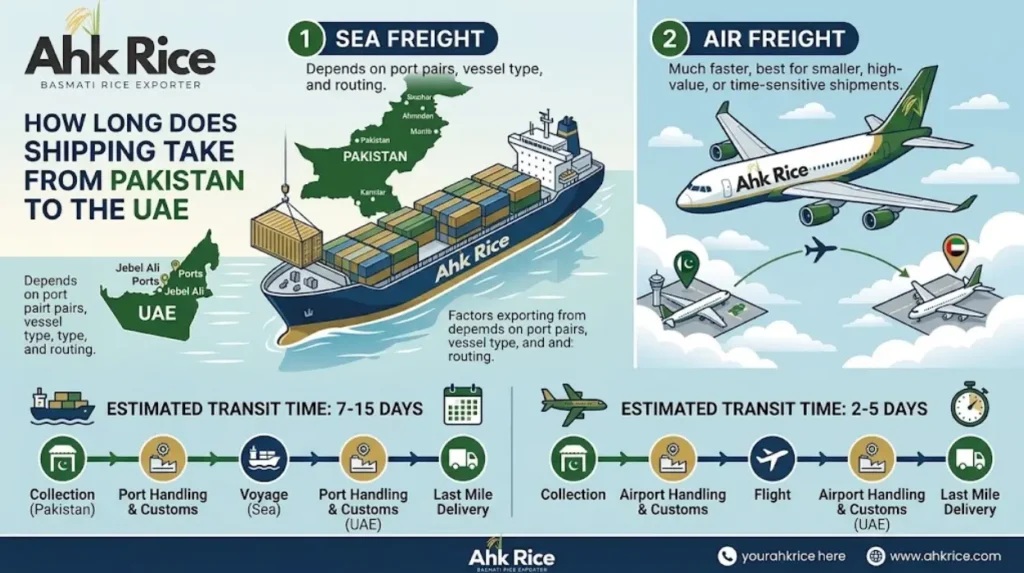
Shipping time depends on vessel schedules, port availability, booking confirmation, customs clearance and the final delivery location. Buyers should distinguish transit time from total order lead time because rice preparation, packaging production, documentation and port handling also require time.
For planning purposes, sea freight from Karachi to UAE ports is often budgeted at approximately 3–10 days of port-to-port transit, depending on the destination port, service and schedule. This is an indicative planning range, not a guaranteed transit commitment.
The full timeline can be longer because the order must be processed before the container is ready. Rice preparation, bag printing, filling, quality checks, container loading and export documentation each affect dispatch readiness. Port congestion, transshipment and customs clearance may add further time.
Before confirming a retail launch or warehouse replenishment, ask AHK Rice for a shipment-specific estimate covering production readiness, vessel departure, expected arrival and destination clearance. Confirm the port, Incoterm and whether the quoted schedule includes only ocean transit or the full delivery process.
Importers should also confirm that the product and label have completed the necessary UAE approvals before shipment. A fast vessel schedule does not resolve an outstanding registration or labelling issue.
How Can You Start an Order With AHK Rice?
Start by submitting a complete product and packaging brief, then approve the rice specification, sample, artwork and commercial quotation before production. This gives both parties a documented reference for product quality, label content, packaging costs and shipment expectations.
Prepare the following information before requesting a quotation:
- Rice variety and processing type.
- Required quantity and bag sizes.
- Retail brand or private-label artwork.
- Arabic and English label content, where applicable.
- Importer details and destination port.
- Required product specifications and inspection arrangements.
- Target shipment date and preferred Incoterm.
AHK Rice can then assess the order requirements and confirm the available rice options, packaging arrangements, sample conditions, estimated lead time and commercial terms. Buyers should request written confirmation of any design or printing services included in the offer.
The most reliable purchasing decision comes from treating rice quality, packaging and regulatory review as connected stages. Approving them together reduces avoidable revisions and provides a clearer route from sample evaluation to a container-ready shipment.
To discuss UAE-compliant Basmati rice packaging, private-label requirements and your export order, request a quote from AHK Rice.
Frequently Asked Questions
What information must appear on UAE Basmati rice packaging?
UAE rice labels must meet the requirements applicable to the specific product.
Mandatory information can include product identity, Arabic text, country of origin and net weight.
Production and expiry or best-before declarations must follow applicable rules.
Importer details and other declarations should be verified before printing.
Confirm the final artwork against current UAE requirements before approving production.
Can AHK Rice provide private-label Basmati rice packaging?
AHK Rice supplies Pakistani Basmati varieties for international buyers.
Private-label requirements should be confirmed when discussing the commercial order.
Buyers should provide their logo, preferred bag sizes and packaging specifications.
Arabic text and mandatory label information require review before printing.
Confirm design, printing availability, minimum quantities and costs in writing.
How much does UAE-compliant rice packaging cost?
The price depends on bag material, size, printing method and order quantity.
Artwork preparation, revisions and additional compliance services may incur separate charges.
Rice supply, packaging and freight should be itemised wherever possible.
Physical samples, courier charges and testing may also affect the total cost.
Request a written quotation based on your exact specifications and destination.
Can I receive a rice sample before placing a bulk order?
AHK Rice has offered up to 20 kg of Super Kernel Basmati for sampling under specified conditions.
The buyer covers courier shipping and applicable phytosanitary charges.
Availability and current offer conditions should be confirmed before dispatch.
Evaluate the sample against the agreed quality and cooking requirements.
Approve the commercial sample and written specifications before confirming the bulk order.
How long does shipping rice from Pakistan to the UAE take?
Sea freight transit depends on the UAE destination port and vessel schedule.
An indicative planning range is approximately 3–10 days port to port.
Packaging production, rice preparation and export documentation add to the total lead time.
Customs clearance and destination delivery can extend the schedule.
Request a shipment-specific estimate before committing to a delivery date.