Why Do Premium UAE Rice Brands Demand Low Foreign Matter Levels in Pakistan Basmati Rice?
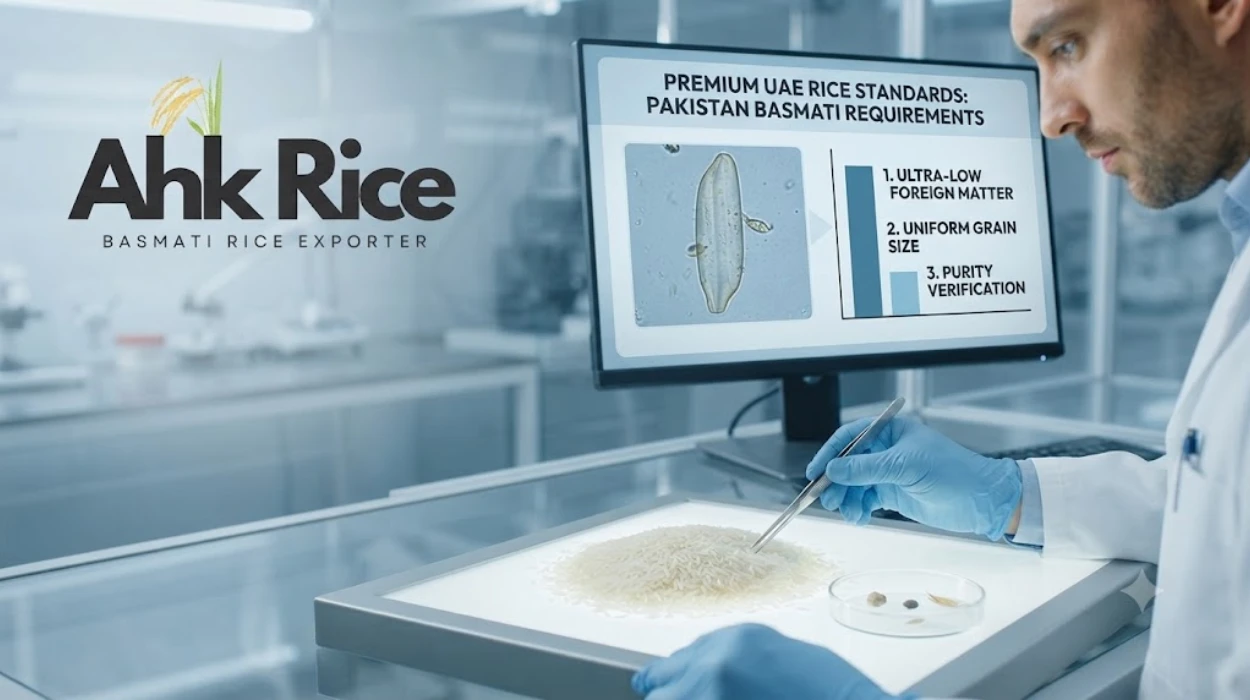
Premium UAE rice brands demand Pakistan Basmati Rice with extremely low foreign matter because cleaner rice reduces customer complaints, improves processing efficiency, satisfies UAE import inspections, protects brand reputation, and increases repeat sales. Here is why buyers increasingly select exporters that provide verified laboratory reports and documented quality control before shipment.
UAE consumers expect premium Basmati Rice to arrive clean, aromatic, uniform, and ready for retail packing. Foreign matter directly affects these expectations. Stones, paddy grains, husk particles, straw, dust, immature kernels, and other impurities reduce product value and increase processing costs after arrival.
Buyers who understand foreign matter specifications also understand the commercial risks of purchasing rice without laboratory verification. Before comparing exporters, many importers first learn how professional inspection methods work. Our guide on foreign matter testing methods used for Pakistan Basmati Rice exported to the UAE explains the inspection process and helps buyers understand the quality parameters before making purchasing decisions. (Internal Link – TOFU)
When sourcing premium Pakistan Basmati Rice, AHK Rice provides documented inspection, laboratory verification, modern processing, and export support for UAE importers seeking consistent quality.
What Is the Best Solution for Importing Premium Pakistan Basmati Rice with Low Foreign Matter?
The best solution is selecting an exporter that verifies every shipment through laboratory analysis, modern optical sorting, multiple cleaning stages, documented inspection reports, export certifications, and transparent quality specifications before container loading.
Foreign matter is more than a quality issue. It directly influences import approval, customer satisfaction, packaging efficiency, retail presentation, and warehouse handling.
Premium UAE brands compete on reputation rather than price alone. Every retail bag reflects the supplier’s quality standards. Even a small percentage of contamination can create negative customer reviews and additional processing expenses.
Professional exporters reduce these risks by integrating quality control throughout production instead of relying only on final inspection.
Why Low Foreign Matter Matters
Low foreign matter provides measurable commercial advantages.
- Higher consumer confidence
- Better retail appearance
- Reduced sorting costs
- Faster warehouse processing
- Lower rejection rates
- Improved cooking consistency
- Stronger brand reputation
These benefits improve profitability throughout the supply chain instead of only improving inspection results.
How Professional Processing Reduces Foreign Matter
Modern exporters follow multiple processing stages before shipment.
- Clean harvested paddy.
- Remove stones using destoners.
- De-husk the grain.
- Polish the rice.
- Grade by grain size.
- Sort using optical color sorters.
- Remove damaged kernels.
- Inspect every batch.
- Verify laboratory specifications.
Each processing stage removes a different type of impurity. Multiple inspections produce significantly cleaner export-quality rice.
Why UAE Buyers Prefer Documented Quality
Professional purchasing departments rarely rely on visual inspection alone.
They request laboratory reports showing measurable specifications before approving shipment.
Typical specifications include:
| Quality Parameter | Commercial Importance |
|---|---|
| Foreign Matter | Determines cleanliness |
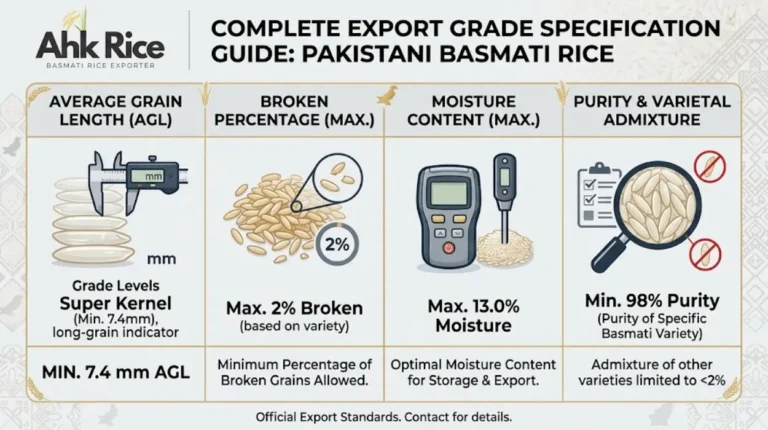
| Moisture | Supports shelf life |
| Broken Rice | Affects grade |
| Grain Length | Confirms specification |
| Chalkiness | Improves appearance |
| Damaged Kernels | Maintains quality |
| Color Uniformity | Supports retail branding |
These measurable values reduce purchasing uncertainty.
Rather than accepting supplier claims, experienced buyers compare verified laboratory reports before awarding contracts.
This quality verification naturally leads buyers to compare exporters with stronger inspection systems.
Why Choose AHK Rice for Premium UAE Basmati Rice?
AHK Rice combines modern milling, advanced sorting technology, laboratory verification, export documentation, shipment support, and consistent quality control to supply Pakistan Basmati Rice that meets demanding UAE commercial requirements.
Selecting an exporter is a long-term business decision rather than a single purchase.
Premium UAE brands require consistent quality across every shipment because retail customers expect the same cooking performance every time.
AHK Rice follows systematic processing instead of depending on visual inspection alone.
Complete Processing Workflow
AHK Rice performs every major processing stage before export.
- Paddy cleaning
- Stone separation
- De-husking
- Whitening
- Polishing
- Length grading
- Optical color sorting
- Metal detection
- Final inspection
Each operation removes specific impurities while maintaining grain integrity.
This structured approach produces export-ready rice suitable for premium UAE brands.
Quality Verification
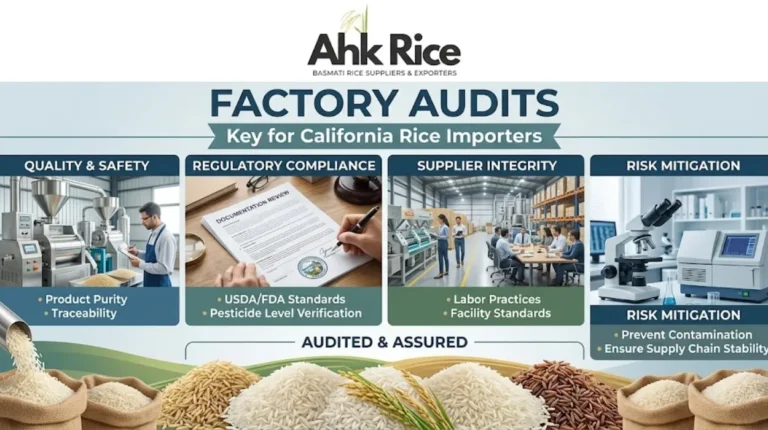
AHK Rice verifies export quality through documented inspection.
Inspection includes:
- Foreign matter analysis
- Moisture testing
- Broken percentage
- Grain length verification
- Damaged kernel inspection
- Packaging inspection
- Container loading inspection
Each report provides measurable quality data before shipment.
Certifications Supporting Export
Professional UAE buyers frequently request export documentation.
Typical documentation includes:
- Phytosanitary Certificate
- Certificate of Origin
- Fumigation Certificate
- Packing List
- Commercial Invoice
- Bill of Lading
- Quality Inspection Report
Complete documentation accelerates customs clearance and minimizes shipment delays.
Commercial Reliability
Reliable exporters offer more than quality rice.
AHK Rice supports buyers through:
- Production updates
- Container loading photographs
- Sample approval
- Packaging customization
- Export documentation
- Shipment tracking
- After-sales communication
These services reduce purchasing uncertainty for first-time and repeat importers.
Many buyers compare suppliers based on verified inspection systems before placing bulk orders. Our article about importing Pakistan Basmati Rice with verified foreign matter analysis into the UAE explains those comparison factors in greater detail.
What Results Can Be Expected from Low Foreign Matter Pakistan Basmati Rice?
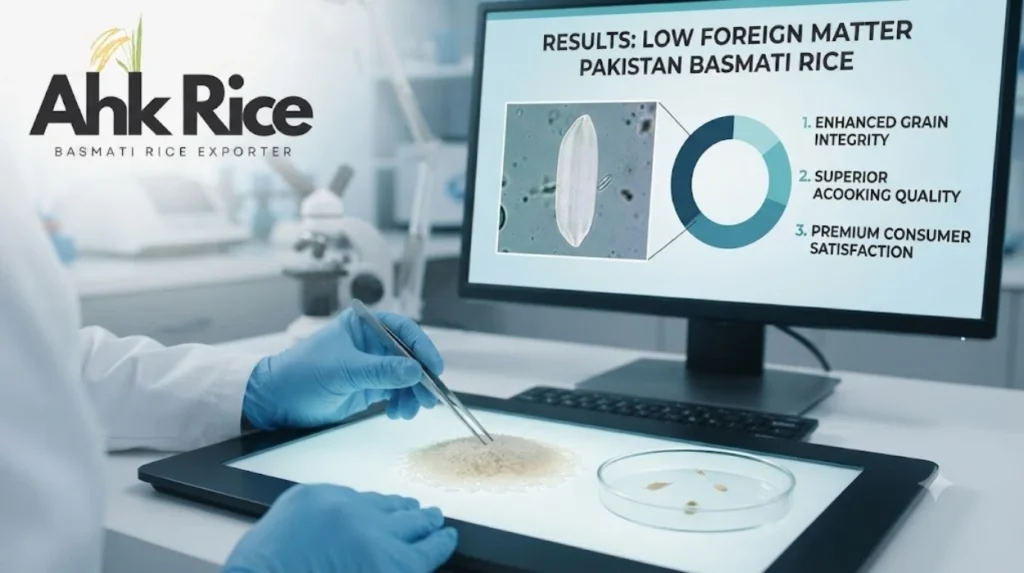
Buyers can expect fewer shipment disputes, smoother UAE customs clearance, stronger retail acceptance, reduced processing costs, higher customer satisfaction, longer business relationships, and improved brand reputation when Pakistan Basmati Rice consistently meets verified low foreign matter specifications.
Low foreign matter delivers measurable business benefits throughout the supply chain. Every stakeholder benefits, from the importer and distributor to the retailer and the end consumer. Premium UAE brands invest in cleaner rice because quality directly influences repeat purchases and long-term profitability.
Improved Consumer Satisfaction
Consumers judge premium Basmati Rice before cooking it.
Clean grains with uniform appearance immediately create confidence. Customers notice the absence of stones, husk particles, dust, and immature kernels when opening the package. This visual quality strengthens trust in the retail brand.
Uniform rice also cooks more consistently. Every grain absorbs water evenly, producing the long, separate grains expected from premium Pakistan Basmati Rice.
Satisfied consumers are more likely to purchase the same brand again.
Reduced Processing Costs for Importers
Importers sometimes re-clean rice after arrival when foreign matter exceeds acceptable limits.
Additional cleaning requires:
- Extra labor
- Sorting equipment
- Production downtime
- Higher operational costs
- Delayed retail distribution
Verified low foreign matter eliminates these unnecessary expenses. Retail packing can begin immediately after customs clearance, improving operational efficiency.
Better Retail Brand Reputation
Retail shelves in the UAE are highly competitive.
Consumers compare brands based on quality, appearance, aroma, and consistency. Even one shipment with excessive contamination can damage years of brand development.
Low foreign matter helps premium brands maintain consistent product quality across every batch. Consistency strengthens customer loyalty and supports long-term market growth.
Lower Risk of Shipment Disputes
Commercial disagreements often arise when delivered quality differs from contractual specifications.
Professional exporters minimize this risk by providing pre-shipment laboratory reports that verify agreed specifications before container loading.
Both buyer and supplier work from the same documented quality standards, reducing misunderstandings and protecting long-term business relationships.
Stronger Long-Term Supply Partnerships
Large supermarket chains, foodservice distributors, and hospitality suppliers rarely change exporters after finding a dependable partner.
Consistent quality creates confidence. Confidence leads to repeat contracts. Repeat contracts provide stable supply planning for both exporter and importer.
For this reason, many UAE buyers evaluate suppliers based on documented quality systems rather than simply selecting the lowest quotation.
What Factors Affect the Cost of Premium Pakistan Basmati Rice?
Rice pricing depends on variety, processing grade, foreign matter specification, packaging, order quantity, certifications, freight charges, destination port, and seasonal crop availability rather than a single fixed export price.
Many first-time buyers expect one standard export price. In reality, premium Pakistan Basmati Rice is priced according to the exact commercial specification requested by the importer.
### Major Pricing Factors
| Pricing Factor | Commercial Impact |
|---|---|
| Rice variety | Premium varieties command higher prices. |
| Foreign matter specification | Lower tolerance requires additional cleaning and sorting. |
| Broken percentage | Lower broken levels increase value. |
| Packaging type | Customized retail bags cost more than bulk PP bags. |
| Order volume | Larger orders improve pricing efficiency. |
| Certifications | Additional testing and documentation increase processing costs. |
| Freight rates | Ocean freight varies by destination and season. |
Each factor contributes to the final export quotation.
Why Lower Foreign Matter Costs More
Producing cleaner rice requires additional processing.
Exporters invest in:
- Advanced optical sorting
- Multiple grading stages
- Repeated inspection
- Laboratory analysis
- Skilled quality control staff
These investments improve product consistency but also increase production costs. Premium UAE brands accept these costs because cleaner rice generates higher customer satisfaction and fewer quality complaints.
Packaging Requirements
Packaging also influences pricing.
Common export options include:
- 1 kg retail bags
- 2 kg retail bags
- 5 kg branded bags
- 10 kg consumer packs
- 20 kg woven bags
- 25 kg PP bags
- 40 kg PP bags
- 50 kg PP bags
Custom printing, multilingual labels, barcode integration, and private-label branding increase packaging costs but strengthen retail positioning.
Estimated Shipping Transit Times
Shipping schedules vary according to destination port, carrier availability, and customs procedures.
| Market | Typical Transit Time |
|---|---|
| UAE (Jebel Ali) | 8–12 days |
| Saudi Arabia | 12–18 days |
| Oman | 8–12 days |
| Qatar | 10–14 days |
| Kuwait | 12–16 days |
| Bahrain | 12–16 days |
Actual delivery schedules depend on vessel availability, documentation completion, and port congestion.
Sample Approval Process and Estimated Costs
Professional buyers usually approve samples before confirming a bulk order.
A typical process includes:
- Submit the required rice specification.
- Receive a quotation.
- Prepare representative samples.
- Dispatch samples through an international courier.
- Review laboratory reports and physical samples.
- Approve the specification.
- Confirm the commercial contract.
- Begin production for export.
Estimated sample costs may include:
| Item | Typical Cost |
|---|---|
| Product sample | Often complimentary or nominal |
| Laboratory testing | Depends on requested analyses |
| Courier charges | Based on destination and package weight |
| Customized packaging sample | Quoted separately |
Many exporters adjust or reimburse sample-related expenses after confirmation of a commercial bulk order, depending on the agreed contract terms.
How Can You Get Started with a Reliable Pakistan Basmati Rice Exporter?
Start by defining your product specifications, requesting verified laboratory reports, approving representative samples, confirming commercial terms, and selecting an exporter that provides transparent communication throughout production, inspection, shipping, and post-delivery support.
Selecting an export partner should focus on consistency rather than a single shipment. Premium UAE rice brands protect their reputation by working with suppliers that deliver the same quality across every container. A structured procurement process reduces commercial risk and creates a dependable supply chain.
Step 1: Define Your Product Specification
Begin with a clear purchase specification.
Include every important quality requirement before requesting a quotation.
Typical specifications include:
- Rice variety
- Grain length
- Broken percentage
- Foreign matter limit
- Moisture level
- Crop year
- Packaging type
- Container quantity
- Destination port
Providing complete specifications allows the exporter to prepare an accurate quotation and recommend the appropriate processing grade.
Step 2: Review Laboratory Reports
Professional exporters should provide quality reports before shipment.
Review measurable specifications instead of relying only on photographs.
Important laboratory values include:
- Foreign Matter
- Moisture Content
- Broken Percentage
- Damaged Kernels
- Chalky Grains
- Grain Length
- Purity Level
Verified reports create confidence before production begins and help avoid quality disputes after arrival.
Step 3: Approve Representative Samples
Physical samples remain an important part of commercial purchasing.
Evaluate the sample for:
- Aroma
- Grain appearance
- Uniformity
- Cooking performance
- Cleanliness
- Packaging quality
Sample approval establishes the quality benchmark for the commercial shipment.
Step 4: Confirm Production and Shipment
Once the specification is approved, production can begin.
Professional exporters normally provide updates during:
- Milling
- Grading
- Laboratory inspection
- Packaging
- Container loading
- Dispatch
This transparency allows buyers to monitor progress before the vessel departs.
Step 5: Receive Complete Export Documentation
Documentation is essential for smooth customs clearance.
A complete shipment generally includes:
- Commercial Invoice
- Packing List
- Bill of Lading
- Certificate of Origin
- Phytosanitary Certificate
- Fumigation Certificate
- Quality Inspection Report
Accurate documentation reduces clearance delays and supports efficient delivery.
Why Premium UAE Brands Continue Choosing AHK Rice
AHK Rice understands that premium buyers evaluate suppliers on consistency, documentation, and communication as much as price.
AHK Rice supports importers with:
- Modern milling technology
- Multi-stage cleaning and grading
- Optical color sorting
- Verified laboratory analysis
- Export documentation
- Flexible packaging solutions
- Timely shipment coordination
- Responsive customer support
These capabilities help UAE importers source Pakistan Basmati Rice with confidence while protecting their own retail reputation.
Premium brands also value long-term supplier relationships. AHK Rice focuses on maintaining consistent quality across every shipment rather than treating each order as a standalone transaction. This approach supports repeat business and stable procurement planning.
Premium UAE rice brands demand low foreign matter levels because product cleanliness directly influences customer satisfaction, operational efficiency, regulatory compliance, and brand reputation. Verified quality specifications reduce commercial risk while ensuring every shipment meets agreed standards.
AHK Rice delivers this confidence through advanced processing, documented laboratory verification, comprehensive export documentation, and transparent communication throughout the export process. Buyers receive consistent Pakistan Basmati Rice that aligns with premium retail and foodservice requirements in the UAE and other international markets.
Ready to source premium Pakistan Basmati Rice with verified low foreign matter specifications? Contact AHK Rice today to discuss your requirements and request a customized export quotation .
Frequently Asked Questions
Why is low foreign matter important for premium UAE rice brands?
Low foreign matter improves the appearance, safety, and consistency of Pakistan Basmati Rice. It reduces the need for additional cleaning after import and helps retailers maintain customer confidence. Premium brands also benefit from fewer complaints and smoother quality inspections. Consistent cleanliness strengthens brand reputation and encourages repeat purchases.
What types of foreign matter are removed during rice processing?
Professional rice processing removes stones, paddy grains, husk particles, straw, dust, metal fragments, immature kernels, and other unwanted materials. Modern exporters use multiple cleaning stages and optical color sorters to achieve export-grade quality. Each stage targets a different impurity to produce cleaner and more uniform rice for international markets.
How does AHK Rice verify the quality of Pakistan Basmati Rice?
AHK Rice verifies quality through multi-stage inspection and laboratory testing. Every shipment is checked for foreign matter, moisture, broken percentage, grain length, and overall purity. The company also performs final packaging and container inspections before dispatch. This documented verification helps buyers purchase with confidence.
How long does it take to ship Pakistan Basmati Rice to the UAE?
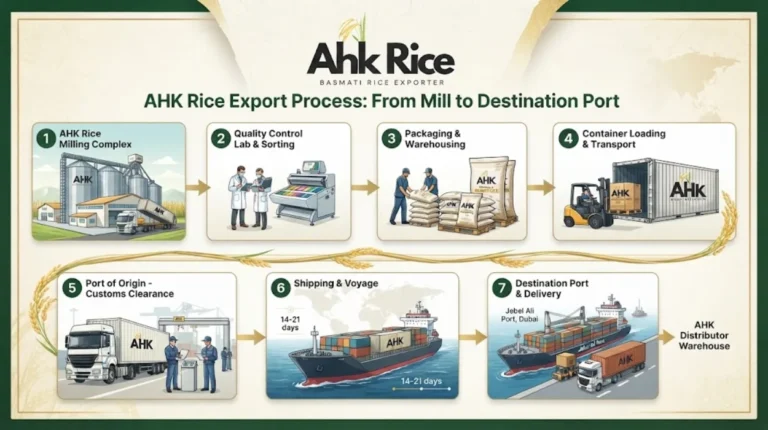
Typical sea freight from Pakistan to Jebel Ali in the UAE takes approximately 8–12 days, depending on vessel schedules, customs processing, and port operations. Complete documentation and timely production help avoid unnecessary delays. Transit times for other Gulf countries may vary slightly based on destination ports.
What should buyers check before placing a bulk rice order?
Buyers should confirm the rice variety, foreign matter specification, moisture content, broken percentage, packaging requirements, certifications, laboratory reports, shipping schedule, and payment terms before finalizing a contract. Reviewing representative samples and export documents also helps ensure the shipment meets commercial expectations and reduces purchasing risk.