Comparing Aroma and Cooking Quality of Brown Basmati Varieties
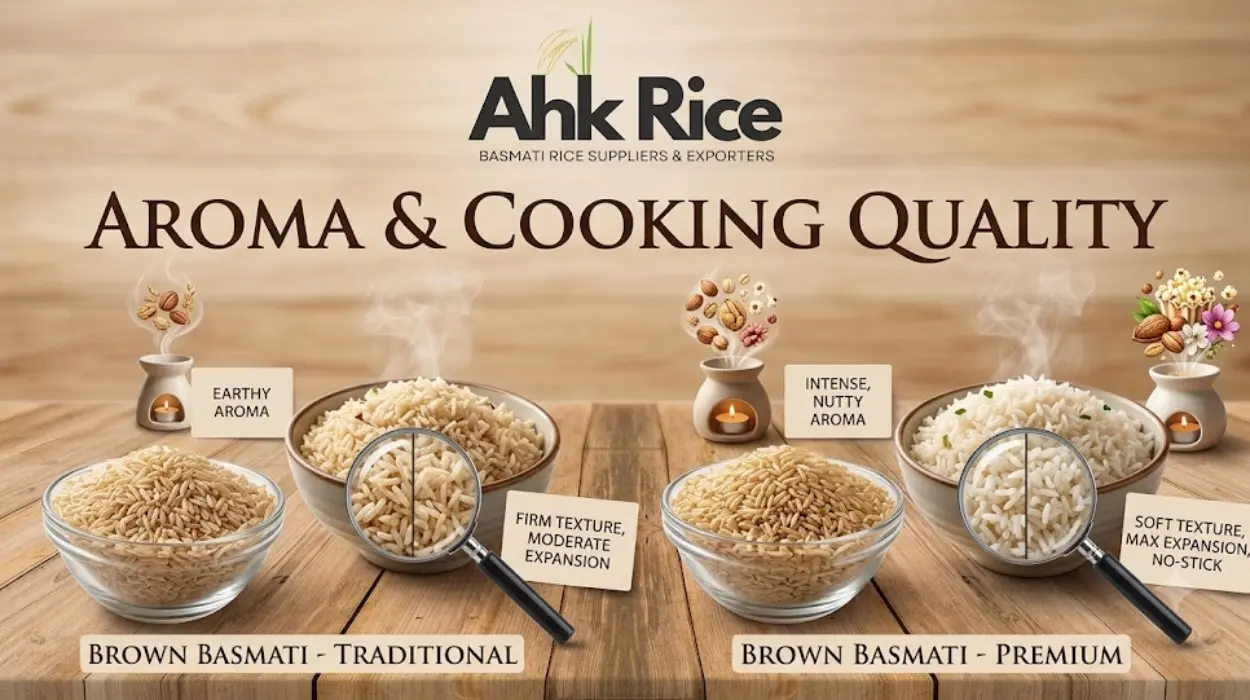
For aroma and cooking quality, Super Kernel Brown Basmati offers the strongest balance of traditional fragrance, firm texture, and commercial value, while 1121 Brown Basmati prioritizes longer cooked grains and 1509 Brown Basmati provides a practical middle position for buyers comparing appearance, cooking performance, and price.
Brown Basmati is rice that has had the outer husk removed while retaining the bran and germ layers. This creates a different cooking profile from polished white Basmati. The bran layer contributes a nuttier taste, firmer bite, darker appearance, and shorter storage window.
The comparison matters for importers because aroma alone does not determine product value. Grain length, broken percentage, moisture, milling consistency, cooking time, elongation, texture, and storage conditions affect the final retail and food-service result.
For buyers studying the market before selecting a variety, the:
Growing demand for Super Kernel Brown Rice in American stores provides useful context on why brown Pakistani rice is receiving attention in retail channels.
What are the available solutions for brown Basmati buyers?
Brown Basmati buyers can compare Super Kernel, 1121, and 1509 according to aroma intensity, grain length, cooking texture, elongation, broken percentage, price position, and storage requirements. The right choice depends on whether the buyer prioritizes fragrance, visual length, cooking consistency, or commercial value.
Super Kernel Brown Basmati
Super Kernel is a traditional Pakistani Basmati variety associated with strong aroma and a balanced grain profile. Current 2026 market references place Super Kernel raw grain length around 7.20 mm, with premium white Super Kernel commonly offered at 0–2% broken.
In brown form, the bran remains intact, so the cooked grain has a firmer bite than polished white rice. Its aroma remains a major selling attribute. The result suits retailers that want recognizable Basmati fragrance without positioning the product at the highest extra-long-grain tier.
1121 Brown Basmati
1121 is an extra-long-grain Basmati variety. It is selected when cooked grain length and visual presentation are major purchase criteria. Its cooked appearance can create a stronger premium effect in dishes such as biryani, pulao, and rice bowls.
The brown version retains the bran layer, so the cooking texture is firmer than 1121 White. Buyers should therefore judge 1121 Brown using both raw grain appearance and cooked-grain performance rather than assuming that extra-long raw grain automatically produces the softest eating texture.
1509 Brown Basmati
1509 is another Pakistani Basmati variety used for long-grain applications. It provides a useful alternative for buyers who want Basmati aroma and long-grain appearance while managing the price position of the product.
The brown form keeps the bran layer and therefore needs more controlled cooking than polished white rice. Its commercial value depends on grain uniformity, broken percentage, moisture, crop condition, and the consistency of the milling process.
How do different brown Basmati approaches compare?
Super Kernel performs strongest for traditional aroma and balanced texture, 1121 leads for cooked grain length and premium visual presentation, while 1509 provides a practical middle option. Brown processing makes all three firmer than white rice and increases the importance of soaking, moisture, and cooking control.
| Attribute | Super Kernel Brown | 1121 Brown | 1509 Brown |
|---|---|---|---|
| Raw grain profile | Long, traditional Basmati | Extra-long Basmati | Long-grain Basmati |
| Aroma | Strong traditional fragrance | Fragrant, refined profile | Fragrant, balanced profile |
| Cooked appearance | Long and distinct | Strongest visual elongation | Long and presentable |
| Texture | Firm and slightly chewy | Firm with defined grains | Firm and moderately tender |
| Cooking requirement | Soaking improves consistency | Longer preparation benefits texture | Controlled soaking improves tenderness |
| Commercial positioning | Premium-value | Premium visual tier | Value-to-premium middle tier |
| Best purchase criterion | Aroma and balanced eating quality | Grain length and presentation | Balanced cost and performance |
The most important difference is not simply grain length. Brown rice retains the bran layer, which changes water absorption and tenderness. This means a 7.20 mm Super Kernel Brown grain can deliver a more satisfying eating experience for a buyer who values aroma and firmness than a longer variety that has not been properly processed or cooked.
A current 2026 reference places premium Super Kernel Basmati at approximately $1,165–$1,205 per metric ton FOB Karachi, with 0–2% broken in the cited premium specification. This is a useful origin-market benchmark, not a fixed international brown-rice quotation. Brown specifications, packaging, crop, certification, freight, and destination costs must be quoted separately.
Which method works best for different market regions?
U.S. retailers generally benefit from Super Kernel Brown or 1121 Brown when aroma, premium positioning, and authentic Pakistani Basmati identity matter, while Gulf buyers can favor Super Kernel Brown and 1509 Brown where traditional fragrance, food-service performance, and controlled purchase cost carry greater weight.
United States retail market
The United States is particularly relevant for brown-rice products because retailers can position brown Basmati around whole-grain consumption, South Asian cuisine, premium imported rice, and ethnic grocery demand.
For U.S. retail, 1121 Brown fits premium shelves where cooked grain length is highly visible. Super Kernel Brown fits stores where aroma and traditional Basmati identity are stronger purchase drivers. 1509 Brown works when the retailer needs a more cost-controlled long-grain option.
The U.S. market also adds regulatory requirements. Imported food must meet U.S. requirements for safety and labeling. Foreign facilities that manufacture, process, pack, or hold food for the U.S. market generally require FDA registration, and importers must comply with Prior Notice requirements. Covered U.S. importers also have Foreign Supplier Verification Program obligations.
Gulf market: Saudi Arabia and UAE
Saudi Arabia and the UAE are established Basmati markets where fragrance, grain appearance, cooking behavior, and consistency remain important purchasing factors. Gulf demand also includes retail, restaurants, catering companies, distributors, and institutional food-service buyers.
Super Kernel Brown fits traditional Basmati positioning because aroma and recognizable grain character remain central product attributes. 1509 Brown can serve buyers seeking long-grain appearance at a more controlled commercial position. 1121 Brown is suited to premium retail or specialty channels where extra-long cooked grains justify a higher price position.
The Gulf market also requires closer logistics planning in 2026. Shipping disruptions and higher insurance and freight costs have affected Basmati movements through the region, especially around the Red Sea and Strait of Hormuz routes. These costs can influence the landed price even when the origin FOB price remains unchanged.
Price and shelf-life comparison
| Market region | Preferred brown grades | 2026 origin-price reference | Shelf-life planning |
| United States | Super Kernel Brown, 1121 Brown | Super Kernel benchmark: about $1,165–$1,205/MT FOB Karachi | Use controlled storage and shorter inventory cycles |
| Saudi Arabia/UAE | Super Kernel Brown, 1509 Brown, premium 1121 Brown | Same origin benchmark; landed cost changes with freight and insurance | Prioritize cool, dry storage and controlled turnover |
Brown rice has a shorter storage window than polished white rice because the retained bran contains natural oils that can deteriorate during storage. USDA procurement specifications have historically used a three-month shelf-life benchmark for brown rice at 50–70°F and six months at 30–40°F.
For commercial inventory, this means shelf life should not be treated as a single universal number. Temperature, humidity, packaging barrier, oxygen exposure, crop age, and warehouse management affect quality retention. Brown Basmati should therefore move through the supply chain with tighter stock rotation than white Basmati.
What are the pros and cons of each brown Basmati option?
Super Kernel provides the best aroma-to-texture balance, 1121 creates the strongest premium visual effect, and 1509 offers a practical value position. Their disadvantages are equally important: brown rice cooks more slowly, remains firmer, and requires tighter storage control than polished white Basmati.
Super Kernel Brown
The main advantage is aromatic identity. Super Kernel has a traditional Basmati profile and a firm cooked texture that works well in pilaf, biryani, and grain-based meals. Its approximately 7.20 mm raw grain provides a strong long-grain appearance without relying entirely on extra-long grain positioning.
The limitation is that buyers seeking extremely long cooked grains may prefer 1121. Brown processing also requires more attention to soaking and cooking than white Super Kernel.
1121 Brown
The main advantage is visual presentation. Extra-long grain characteristics can create a premium appearance in retail packs and prepared dishes. It works well when consumers judge quality partly through cooked grain length.
The limitation is cost positioning. Current premium 1121 Basmati benchmarks are above Super Kernel in some 2026 Pakistan export quotations, with 1121 White listed around $1,165–$1,205/MT FOB Karachi and 1121 Steam around $1,160–$1,200/MT.
1509 Brown
The main advantage is commercial flexibility. It provides long-grain Basmati characteristics while allowing buyers to build a product tier below their highest-priced 1121 offering.
The limitation is market recognition. Buyers who specifically seek the strongest aroma or most dramatic grain elongation may favor Super Kernel or 1121 instead.
What decision factors should buyers use before selecting a variety?
The strongest decision framework evaluates aroma, cooked grain appearance, texture, price, and inventory life together. A variety becomes commercially suitable only when its sensory performance matches the target consumer, while its processing specification and storage requirements fit the importer’s supply-chain capacity.
| Decision factor | What to evaluate | Best fit |
| Aroma | Fragrance after cooking and during serving | Super Kernel |
| Grain appearance | Raw length and cooked elongation | 1121 |
| Texture | Firmness, separation, and tenderness | Super Kernel or 1509 |
| Price position | Origin cost against target retail tier | 1509 or Super Kernel |
| Inventory life | Storage temperature, packaging, and turnover | Shorter controlled cycles for all brown grades |
A professional buyer should request a representative pre-shipment sample rather than judging a brown Basmati variety from raw grain appearance alone. The sample should be cooked using a defined water ratio and soaking period. The evaluator should record aroma, cooked length, separation, tenderness, chewiness, broken grains, and appearance after cooling.
The same evaluation should be applied to every candidate variety. This creates a controlled comparison between Super Kernel Brown, 1121 Brown, and 1509 Brown instead of relying on subjective descriptions such as “premium,” “long grain,” or “high aroma.”
What is the best solution for buyers comparing aroma and cooking quality?
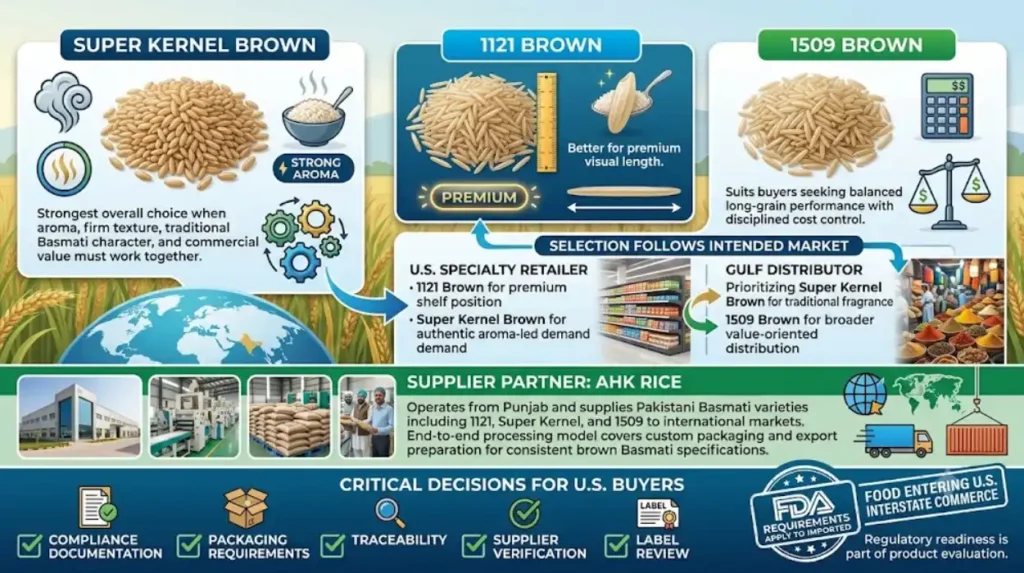
Super Kernel Brown is the strongest overall choice when aroma, firm texture, traditional Basmati character, and commercial value must work together. 1121 Brown is better for premium visual length, while 1509 Brown suits buyers seeking balanced long-grain performance with disciplined cost control.
The selection should therefore follow the intended market rather than a universal ranking. A U.S. specialty retailer can use 1121 Brown to build a premium shelf position and Super Kernel Brown for authentic aroma-led demand. A Gulf distributor can prioritize Super Kernel Brown for traditional fragrance and 1509 Brown for broader value-oriented distribution.
AHK Rice operates from Punjab and supplies Pakistani Basmati varieties including 1121, Super Kernel, and 1509 to international markets. Its end-to-end processing model also covers custom packaging and export preparation, which are relevant when brown Basmati specifications need to remain consistent from milling through shipment.
For U.S. buyers, the product decision should also include compliance documentation, packaging requirements, traceability, supplier verification, and label review. FDA requirements apply to imported food entering U.S. interstate commerce, making regulatory readiness part of product evaluation rather than a separate post-purchase issue.
Moving from comparison to procurement, the decision-focused:
Import Super Kernel Brown Rice from Pakistan into USA Retail
Frequently Asked Questions
What is Brown Basmati rice?
Brown Basmati rice is Basmati rice with the outer husk removed while retaining the bran and germ layers. This gives it a nuttier flavor, firmer texture, darker color, and different cooking behavior than polished white Basmati rice.
Which Brown Basmati variety has the strongest aroma?
Super Kernel Brown Basmati is a strong choice for buyers prioritizing traditional Basmati fragrance. Its aroma becomes more noticeable during cooking and serving, making it suitable for aroma-focused retail and food-service applications.
How does 1121 Brown Basmati compare with Super Kernel Brown Rice?
1121 Brown Basmati is primarily valued for its extra-long grain characteristics and cooked-grain presentation. Super Kernel Brown Rice offers a stronger balance of traditional aroma, firm texture, and commercial value.
Is 1509 Brown Basmati a good alternative to 1121?
Yes. 1509 Brown Basmati provides long-grain characteristics and Basmati aroma while offering another price and positioning option. It is suitable for buyers seeking a balance between cooking performance and cost.
Does Brown Basmati rice take longer to cook?
Yes. The retained bran layer makes Brown Basmati firmer and slower to soften than polished white rice. Soaking before cooking can improve water absorption, tenderness, and consistency.
Which Brown Basmati is best for U.S. retail stores?
Super Kernel Brown and 1121 Brown are strong options for U.S. retail. Super Kernel suits aroma-focused positioning, while 1121 is better suited to premium products where extra-long cooked grains support visual differentiation.
Which Brown Basmati varieties are suitable for Saudi Arabia and the UAE?
Super Kernel Brown, 1509 Brown, and premium 1121 Brown can serve Saudi Arabian and UAE markets. Super Kernel fits traditional aroma preferences, while 1509 provides a value-oriented long-grain option.
Does Brown Basmati rice have a shorter shelf life than White Basmati?
Yes. Brown rice generally has a shorter storage life because the retained bran contains natural oils that can deteriorate during storage. Cool, dry conditions, suitable packaging, and controlled inventory rotation help maintain quality.
What factors affect the price of Brown Basmati rice?
Price depends on variety, grain length, broken percentage, crop quality, moisture, milling specifications, packaging, certification, order volume, freight, insurance, and destination-market requirements. FOB Pakistan pricing and landed cost are different measures.
How should importers compare Brown Basmati cooking quality?
Importers should test representative samples using consistent soaking time, water ratio, cooking time, and cooling conditions. The evaluation should measure aroma, grain elongation, separation, tenderness, firmness, broken grains, and appearance.
Is Super Kernel Brown Basmati suitable for premium positioning?
Yes. Its traditional aroma, long-grain appearance, and firm cooked texture can support premium positioning, particularly when supported by consistent milling, suitable packaging, traceability, and controlled storage.
What should buyers check before importing Brown Basmati from Pakistan?
Buyers should check variety, grain specifications, broken percentage, moisture, crop year, milling quality, packaging, certifications, sample performance, export documentation, destination regulations, storage requirements, and supplier consistency.