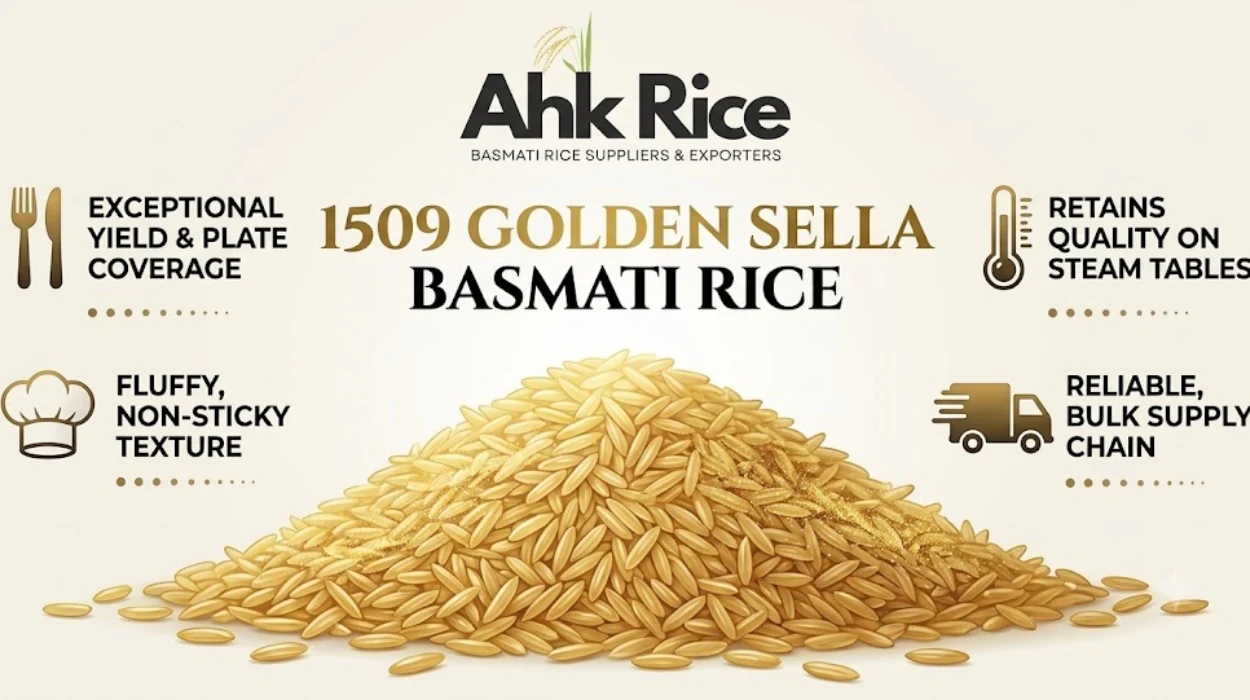
Why Foodservice Distributors Choose 1509 Golden Sella Basmati Rice
Foodservice distributors choose 1509 Golden Sella Basmati Rice because it combines extra-long grains, high cooking yield, consistent texture, low grain breakage, and efficient processing. It supports large-scale commercial kitchens that require reliable quality, stable supply chains, and predictable cooking performance throughout 2026.
Restaurants, catering companies, institutional kitchens, hotel chains, airline caterers, and wholesale food distributors purchase rice based on measurable performance rather than appearance alone. They evaluate grain length, moisture percentage, cooking expansion, broken grain ratio, aging, and export compliance before placing bulk orders.
Pakistan remains one of the leading producers of premium Basmati rice. Punjab contributes the largest share of export-quality 1509 Golden Sella Basmati Rice because of fertile alluvial soil, irrigation networks, and favorable seasonal temperatures. The variety has become an important choice for commercial buyers across the Middle East, Europe, North America, Africa, and Asia due to its combination of quality and affordability.
Readers interested in understanding the commercial cooking specifications behind this variety can continue with our guide explaining:
Professional cooking quality requirements for bulk Golden Sella rice procurement.
What Is 1509 Golden Sella Basmati Rice?
1509 Golden Sella Basmati Rice is an extra-long grain parboiled Basmati variety developed for high productivity, consistent cooking performance, and commercial foodservice applications. The grains remain separate after cooking, absorb flavors efficiently, and retain their structure during large-volume meal preparation for restaurants, hotels, catering businesses, and institutional kitchens.
1509 refers to a modern Basmati variety developed through agricultural breeding programs to improve productivity while preserving traditional Basmati characteristics.
Golden Sella describes the processing method instead of the variety itself.
The term “Sella” means parboiled rice.
During parboiling, paddy rice undergoes soaking, steaming, and drying before milling. This process transfers nutrients from the bran layer into the grain while improving structural strength.
The word “Golden” comes from the natural golden color that develops during controlled steaming before milling.
Commercial buyers prefer this processing because it improves grain durability during transportation, storage, packaging, and industrial cooking.
Compared with ordinary white rice, Golden Sella offers stronger grain integrity and lower breakage during processing.
How Does 1509 Golden Sella Basmati Rice Work Through the Production Process?
1509 Golden Sella Basmati Rice follows a controlled production sequence that begins with cultivation and ends with export packaging. Every stage influences grain length, moisture content, appearance, cooking consistency, food safety, and international trade compliance required by professional foodservice distributors worldwide.
Production starts with certified seed selection.
Farmers prepare fields before sowing to create uniform crop establishment.
Plants receive irrigation throughout their growth cycle.
Harvest begins after the grains reach physiological maturity.
Fresh paddy then enters the parboiling facility.
The production process follows these steps:
Paddy Cleaning
Raw paddy passes through pre-cleaners that remove straw, stones, dust, immature grains, and foreign material.
This improves processing efficiency.
Soaking
The cleaned paddy remains in warm water tanks for controlled hydration.
Uniform water absorption prepares the grains for steaming.
Steaming
Steam gelatinizes the starch inside each grain.
This strengthens the kernel structure and produces the characteristic golden appearance.
Drying
Mechanical dryers reduce moisture to safe storage levels.
Controlled drying prevents stress cracks inside the grains.
Dehusking
The outer husk separates from the rice kernel without damaging grain shape.
Whitening and Polishing
Specialized milling machines remove bran layers while preserving maximum grain length.
Grading
Optical sorters classify grains according to size, color, and defects.
Grades include export premium, standard export grade, and customer-specific commercial grades.
Quality Inspection
Laboratories verify moisture, broken percentage, damaged kernels, chalkiness, purity, grain dimensions, and food safety standards.
Packaging
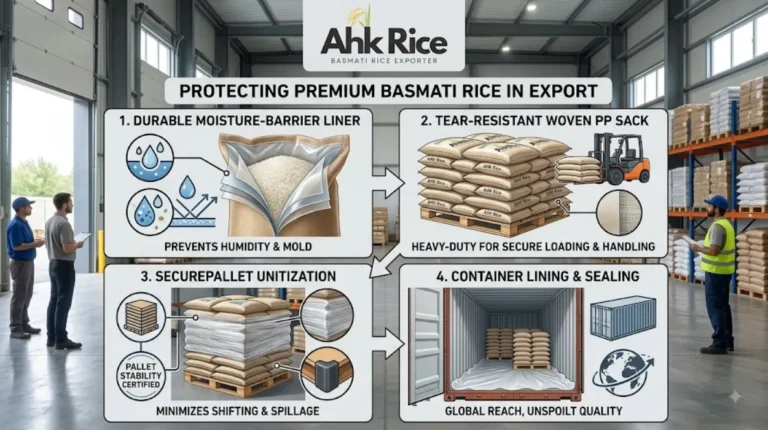
Rice is packed into commercial sizes such as 5 kg, 10 kg, 20 kg, 25 kg, and 50 kg bags depending on export requirements.
What Components Define the Quality of 1509 Golden Sella Basmati Rice?
Several measurable quality components determine whether 1509 Golden Sella Basmati Rice satisfies commercial purchasing standards. Foodservice distributors evaluate physical specifications, cooking behavior, processing consistency, food safety, and export documentation before approving suppliers for long-term procurement programs.
Quality begins with grain length.
Export buyers generally prefer extra-long kernels with uniform dimensions.
Consistency matters more than isolated exceptional grains.
Moisture content remains another important specification.
Controlled moisture improves shelf stability while reducing storage risks.
Broken grain percentage directly affects market value.
Lower broken percentages increase presentation quality and cooking consistency.
Purity determines whether the shipment contains the declared variety only.
Mixed varieties reduce consistency during cooking.
Color uniformity indicates proper parboiling and milling control.
Commercial laboratories also evaluate damaged kernels, immature grains, foreign matter, and chalky kernels.
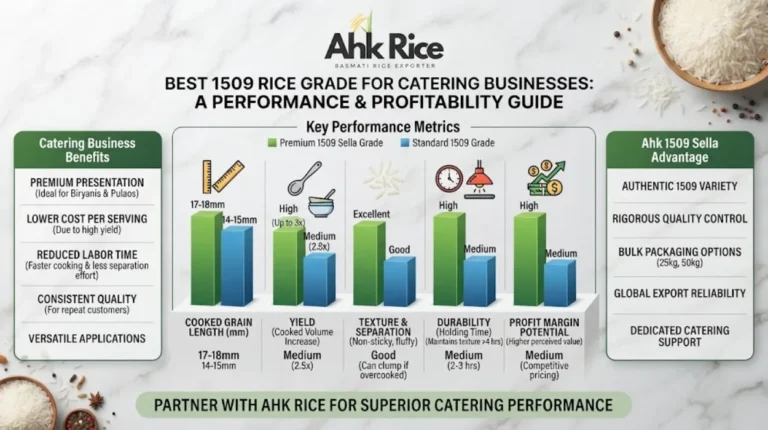
Foodservice distributors examine cooking expansion because volume affects food cost calculations.
Higher expansion improves serving efficiency.
Aroma also receives attention.
Although 1509 has a lighter aroma than traditional aged Basmati varieties such as 1121 or Super Kernel, it still provides recognizable Basmati fragrance suitable for commercial applications.
What Benefits Make Foodservice Distributors Choose This Rice?
Foodservice distributors select 1509 Golden Sella Basmati Rice because it delivers consistent cooking yield, excellent grain separation, efficient inventory management, reliable transportation performance, competitive pricing, and stable quality across repeated commercial shipments supplied to international hospitality and catering industries.
Commercial kitchens prepare hundreds or thousands of meals every day.
Consistency reduces operational variability.
The grains remain separate after cooking.
Restaurants serving biryani, pulao, mandi, kabsa, and buffet rice require this characteristic.
Parboiling improves grain strength.
This reduces breakage during mechanical handling and packaging.
Cooking yield supports foodservice economics.
Rice expands significantly after cooking, increasing serving portions from each kilogram of raw product.
Storage performance also benefits distributors.
The strengthened grain structure tolerates transportation better than many non-parboiled alternatives.
Inventory losses remain lower when packaging experiences normal handling during logistics.
Uniform grain appearance improves presentation in hotel buffets and restaurant service.
Commercial buyers also appreciate processing consistency because standardized quality simplifies procurement planning.
Where Is 1509 Golden Sella Basmati Rice Used Around the World?
1509 Golden Sella Basmati Rice serves diverse commercial markets because it adapts well to multiple cuisines and industrial food production systems. Restaurants, wholesalers, institutional kitchens, retailers, airlines, and catering companies use this variety in high-volume meal preparation across numerous international regions.
The Middle East remains one of the largest importing regions.
Examples include Saudi Arabia, the United Arab Emirates, Qatar, Oman, Kuwait, and Bahrain.
Restaurants frequently prepare mandi, kabsa, and mixed rice dishes.
African importers also purchase substantial volumes.
Examples include South Africa, Kenya, Tanzania, and Nigeria.
European markets supply ethnic supermarkets, restaurant wholesalers, and food distributors.
Examples include the United Kingdom, Germany, Italy, France, and the Netherlands.
North American buyers include foodservice distributors supplying restaurants specializing in South Asian, Middle Eastern, and fusion cuisine.
Examples include the United States and Canada.
Asian markets also import selected quantities depending on regional demand.
Examples include Malaysia, Singapore, and Indonesia.
Institutional buyers include hospitals, universities, military kitchens, correctional facilities, and corporate cafeterias.
These organizations prioritize consistent cooking performance across large production batches.
Which Grades and Certifications Apply to 1509 Golden Sella Basmati Rice?
Commercial exports of 1509 Golden Sella Basmati Rice follow standardized grading systems and internationally recognized food safety certifications. These requirements verify product identity, processing quality, traceability, hygiene practices, and regulatory compliance throughout the export supply chain during 2026.
Export grades differ according to customer specifications.
Common commercial grades include:
Premium Export Grade
Features maximum grain uniformity, very low broken percentage, and high purity.
Standard Export Grade
Balances quality with commercial pricing for large-volume procurement.
Customer Specification Grade
Produced according to contract requirements covering grain length, broken percentage, packaging, and inspection criteria.
International buyers commonly request certification demonstrating food safety management and regulatory compliance.
Examples include:
ISO 22000
Food safety management system certification.
HACCP
Hazard Analysis and Critical Control Points for food safety control.
FSSC 22000
Advanced food safety certification recognized by many international buyers.
Phytosanitary Certificate
Confirms compliance with plant health regulations before export.
Certificate of Origin
Verifies the country where the rice was produced.
Laboratory Quality Reports
These reports document moisture percentage, broken grains, purity, grain dimensions, and other technical specifications requested by importers.
What Misconceptions Exist About 1509 Golden Sella Basmati Rice?
Several misconceptions create confusion about 1509 Golden Sella Basmati Rice. Understanding the difference between variety, processing method, cooking behavior, and commercial grading helps buyers evaluate the product accurately using objective quality standards instead of assumptions.
Some buyers believe Golden Sella represents a separate rice species.
It does not.
1509 identifies the variety.
Golden Sella identifies the processing method.
Another misconception states that parboiled rice contains artificial coloring.
The golden color develops naturally during steaming.
No coloring agents produce this appearance.
Some people assume all Basmati varieties perform identically.
Different varieties possess different grain lengths, aroma intensity, productivity, cooking expansion, and market pricing.
Another misunderstanding suggests that all export shipments follow identical specifications.
Commercial contracts define exact quality parameters.
Different distributors purchase different broken percentages, packaging formats, and inspection requirements depending on their market.
Some buyers also believe longer grains always indicate better quality.
Professional procurement evaluates multiple specifications simultaneously, including purity, moisture, cooking yield, grain integrity, certification, and consistency rather than a single measurement.
Why Does 1509 Golden Sella Basmati Rice Continue Growing in Commercial Demand?
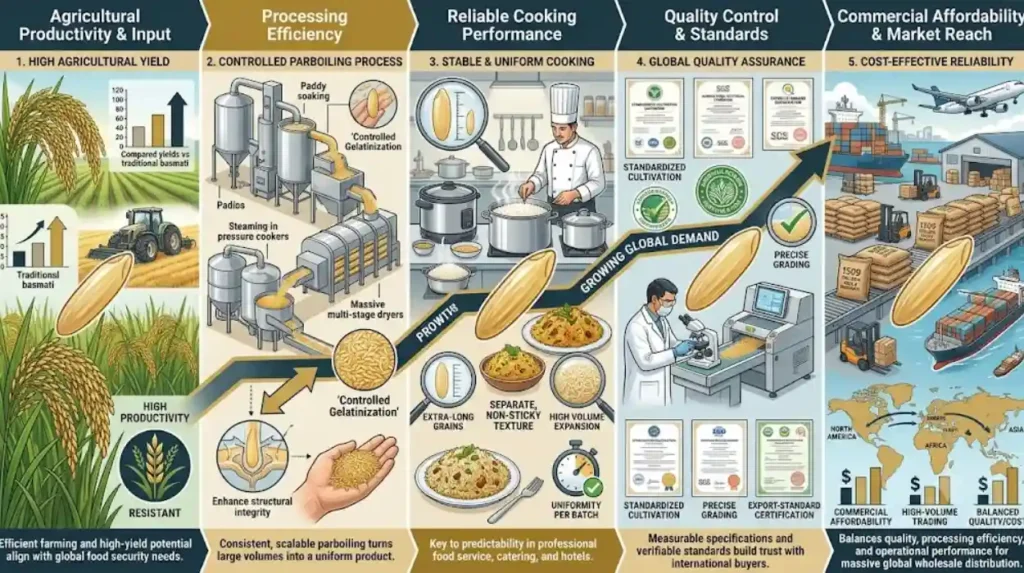
1509 Golden Sella Basmati Rice continues expanding across international foodservice markets because it combines agricultural productivity, efficient processing, reliable cooking performance, export-standard quality control, and commercial affordability. These characteristics align with the operational requirements of modern wholesale food distribution throughout global markets in 2026.
Foodservice businesses depend on consistency.
Purchasing decisions rely on measurable specifications rather than marketing claims.
1509 Golden Sella satisfies these expectations through standardized cultivation, controlled parboiling, precise grading, laboratory testing, and internationally recognized certification systems.
Its extra-long grains, stable cooking performance, and strong structural integrity support restaurants, hotels, caterers, institutional kitchens, wholesalers, and distributors serving millions of meals every year.
As global demand for reliable commercial rice continues to increase, this variety remains an important component of professional food supply chains because it balances quality, processing efficiency, and operational performance across diverse international cuisines.
Frequently Asked Questions
What makes 1509 Golden Sella Basmati Rice suitable for foodservice distributors?
1509 Golden Sella Basmati Rice offers extra-long grains, high cooking yield, consistent grain separation, and excellent durability after parboiling. These qualities help restaurants, hotels, caterers, and institutional kitchens maintain consistent meal quality.
Is 1509 Golden Sella Basmati Rice different from regular white Basmati rice?
Yes. Golden Sella Basmati Rice is parboiled before milling, giving it a golden color, stronger grain structure, better cooking stability, and lower breakage compared to regular white Basmati rice.
Where is 1509 Golden Sella Basmati Rice mainly grown?
The variety is primarily cultivated in Pakistan’s Punjab region, where fertile alluvial soil, irrigation systems, and suitable climate conditions support the production of export-quality Basmati rice.
How is 1509 Golden Sella Basmati Rice processed?
The production process includes paddy cleaning, soaking, steaming, drying, dehusking, milling, polishing, grading, laboratory quality inspection, and packaging according to export specifications.
Which countries import 1509 Golden Sella Basmati Rice?
Major importing markets include Saudi Arabia, the UAE, Qatar, Oman, Kuwait, Bahrain, the United Kingdom, Germany, the United States, Canada, South Africa, Kenya, and several other international markets.
Which dishes are commonly prepared with 1509 Golden Sella Basmati Rice?
It is widely used for biryani, kabsa, mandi, pulao, steamed rice, buffet meals, airline catering, institutional food service, and large-scale commercial meal preparation.
What certifications are commonly required for exporting 1509 Golden Sella Basmati Rice?
Export shipments commonly include certifications such as ISO 22000, HACCP, FSSC 22000, Phytosanitary Certificate, Certificate of Origin, and laboratory quality reports based on buyer requirements.
Does Golden Sella Basmati Rice contain artificial coloring?
No. The golden color develops naturally during the controlled parboiling and steaming process. No artificial coloring agents are used to create its appearance.