Import Low Moisture Pakistani Basmati Rice for USA Retail Markets
Moisture control is one of the most important quality factors when importing Pakistani Basmati rice for USA retail markets. Retail buyers need rice that maintains aroma, grain integrity, shelf life, and packaging stability from Pakistan to American distribution centers. If you are evaluating suppliers, first understand why moisture content determines imported Basmati rice quality through our guide on:
Why Is Moisture Content Critical for Imported Basmati Rice Quality? Then compare storage performance in our article:
How Do Moisture Levels Affect Basmati Rice Storage and Shelf Life? before selecting your long-term export partner.
For importers seeking dependable supply, AHK Rice provides premium Pakistani Basmati rice for the USA market with controlled export moisture, internationally recognized quality certifications, private-label packaging, and complete documentation that supports smooth customs clearance and long-term retail distribution.
What is the best solution for importing low moisture Pakistani Basmati rice for USA retail markets?
The best solution is partnering with an exporter that controls moisture throughout procurement, milling, grading, packaging, storage, container loading, and ocean transportation while providing laboratory reports, export certifications, and consistent production standards that meet USA retail expectations for quality, shelf life, and food safety.
Many importers compare suppliers primarily by price. That approach often increases long-term costs because inconsistent moisture levels create quality problems after arrival.
Moisture directly affects grain stability during international transportation. Rice exported above recommended moisture levels becomes more vulnerable to mold development, discoloration, broken grains, unpleasant odor, insect activity, and reduced shelf life.
By 2026, premium Pakistani exporters generally target export moisture around 12.5%–13.5%, depending on customer specifications, packaging type, destination climate, and shipping duration. These levels help preserve aroma while minimizing storage risks during long-distance transportation.
AHK Rice follows moisture-controlled production from paddy selection until final container sealing. Every production stage is monitored to maintain consistency across export lots.
The process includes:
- Raw paddy inspection
- Moisture testing before milling
- Controlled milling operations
- Color sorting
- Length grading
- Laboratory verification
- Food-grade packaging
- Dry warehouse storage
- Container inspection before loading
- Final export quality verification
This systematic approach significantly reduces quality variation between shipments.
Why should USA retail importers choose AHK Rice?
USA retailers should choose AHK Rice because the company combines consistent moisture management, premium Pakistani sourcing, international certifications, flexible packaging, transparent documentation, predictable production schedules, and professional export support that reduces commercial risks throughout the importing process.
Retail markets require consistency more than occasional premium quality.
Consumers expect every bag purchased from a supermarket to cook the same way. Retail brands therefore need suppliers capable of producing identical quality over multiple shipments rather than only one successful order.
AHK Rice specializes in supplying:
- 1121 Steam Basmati Rice
- 1121 White Basmati Rice
- Super Kernel Basmati Rice
- 1509 Basmati Rice
- Golden Sella varieties
- Creamy Sella varieties
- Brown Basmati Rice
Each export order is produced according to customer specifications covering:
- Moisture percentage
- Grain length
- Broken percentage
- Chalky grains
- Damaged kernels
- Foreign matter
- Packaging
- Labeling
- Palletization
- Container configuration
This specification-driven production reduces disputes after delivery.
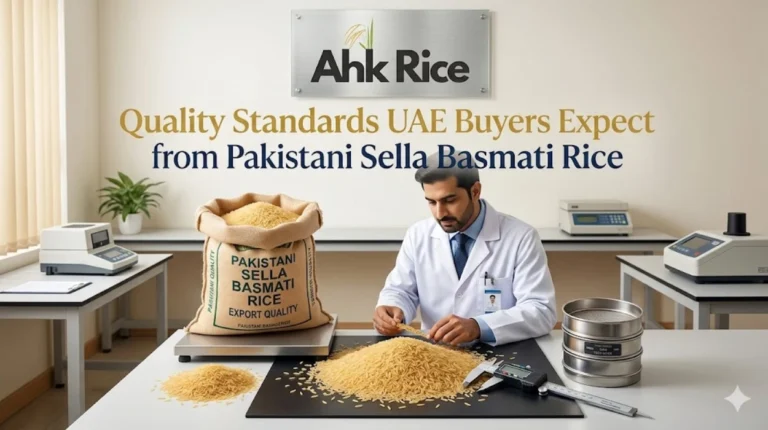
Unlike suppliers that rely only on visual inspection, AHK Rice verifies export quality through laboratory testing before shipment.
Typical export documentation includes:
- Commercial Invoice
- Packing List
- Certificate of Origin
- Phytosanitary Certificate
- Fumigation Certificate
- Quality Certificate
- Bill of Lading
- Inspection reports (when requested)
These documents simplify customs processing and retail compliance.
What results can USA retail buyers expect?
Importers can expect better shelf stability, stronger consumer satisfaction, lower complaint rates, improved cooking consistency, fewer damaged bags, better inventory management, and stronger retail brand reputation when sourcing moisture-controlled Pakistani Basmati rice from an experienced exporter.
Retail operations depend on inventory stability.
If moisture rises during transportation, product quality declines before reaching store shelves.
Low-moisture rice offers several commercial advantages.
It maintains:
- Natural aroma
- Long grain appearance
- Cooking elongation
- Texture consistency
- Package integrity
- Better warehouse performance
These benefits directly influence repeat purchases.
For example, consider two supermarket chains importing identical rice varieties.
One purchases based solely on the cheapest quotation.
The other purchases from AHK Rice, selecting moisture-controlled production with complete laboratory verification.
After six months of warehouse storage, the second retailer experiences fewer customer complaints, more consistent cooking results, stronger shelf presentation, and lower inventory losses.
Over multiple shipments, these differences become commercially significant.
Retail buyers also benefit from predictable product specifications that simplify purchasing decisions for future orders.
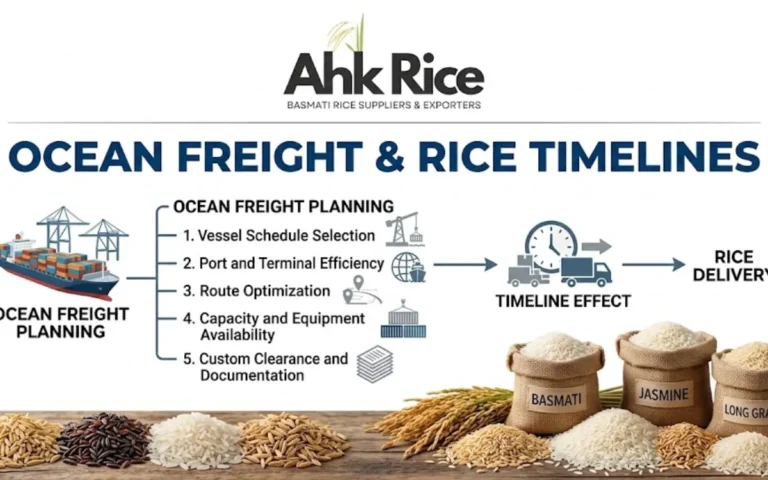
How many shipping days are required for USA retail imports?
Most USA shipments require approximately 28–40 days of ocean transit depending on destination port, vessel schedules, transshipment requirements, customs processing, weather conditions, and shipping line availability after container loading from Pakistan.
Production time should be considered separately from ocean transit.
Typical production timeline:
| Production Stage | Estimated Time |
|---|---|
| Contract confirmation | 1 day |
| Raw material allocation | 1–2 days |
| Milling and processing | 3–4 days |
| Quality inspection | 1 day |
| Packaging | 2 days |
| Container loading | 1 day |
| Export documentation | 1–2 days |
Average production before shipment generally requires 8–12 days depending on order volume.
Estimated ocean shipping times in 2026 include:
| USA Destination | Estimated Transit |
|---|---|
| New York | 30–35 days |
| New Jersey | 30–35 days |
| Savannah | 31–36 days |
| Houston | 32–38 days |
| Los Angeles | 28–33 days |
| Oakland | 29–34 days |
| Seattle | 30–36 days |
Final delivery depends on customs clearance and inland transportation.
AHK Rice coordinates production schedules with freight planning to minimize unnecessary delays.
How does the sample process work before placing a bulk order?
A structured sampling process allows importers to verify grain quality, moisture level, cooking performance, packaging standards, and laboratory specifications before committing to a commercial shipment, reducing purchasing risk and improving confidence in long-term supply agreements.
Professional exporters encourage product evaluation before bulk purchasing.
The standard process followed by AHK Rice includes:
Step 1: Requirement discussion
The buyer shares required specifications including:
- Rice variety
- Moisture requirement
- Grain length
- Broken percentage
- Packaging
- Quantity
- Destination
Step 2: Sample preparation
Samples are prepared from production lots matching requested specifications.
Step 3: Laboratory verification
Moisture and quality parameters are verified before dispatch.
Step 4: Sample shipment
Samples are dispatched using international courier services.
Typical sample quantities
- 500 grams
- 1 kilogram
- 2 kilograms
- 5 kilograms
Sample costs in 2026
| Item | Typical Cost |
|---|---|
| Product sample | Usually free |
| Courier charges | USD 45–120 depending on destination and weight |
| Laboratory report (optional) | USD 40–100 |
| Customized retail packaging sample | USD 80–250 depending on artwork and quantity |
Many commercial orders receive sample cost adjustments after confirmation, subject to agreed contract terms.
What factors affect pricing for imported Pakistani Basmati rice?
Pricing depends on rice variety, crop quality, moisture specification, grain length, broken percentage, packaging type, certification requirements, private labeling, freight costs, currency movements, and order volume rather than a single market price.
Import pricing changes throughout the export season.
The biggest pricing variables include:
Rice variety
Premium varieties command higher prices.
Moisture specification
Lower controlled moisture may require additional production management.
Packaging
Retail packaging increases production costs compared with bulk export bags.
Printing
Private-label packaging requires artwork approval, cylinder preparation, and printing.
Certifications
Additional testing requested by buyers increases inspection costs.
Freight
Ocean freight continues to fluctuate according to shipping demand and fuel costs.
Quantity
Larger container orders generally reduce per-unit production costs.
AHK Rice provides quotation breakdowns based on actual customer specifications rather than generic pricing.
This approach allows buyers to compare suppliers using identical commercial requirements.
How does AHK Rice ensure export quality?
AHK Rice maintains export quality through controlled sourcing, laboratory testing, automated processing, certified food safety procedures, experienced quality control teams, and documented inspection processes before every shipment leaves Pakistan for USA retail customers.
Quality assurance begins before milling.
Only selected raw material enters production.
Modern processing includes:
- Cleaning
- Destoning
- Husking
- Whitening
- Polishing
- Length grading
- Color sorting
- Metal detection
- Moisture verification
- Packaging inspection
Each stage minimizes quality variation.
Warehouse management also contributes to quality preservation.
Clean storage, controlled stacking practices, regular inspections, and moisture monitoring reduce storage-related risks before export.
This integrated quality system allows AHK Rice to maintain reliable specifications across repeat shipments.
How do I get started with importing from AHK Rice?
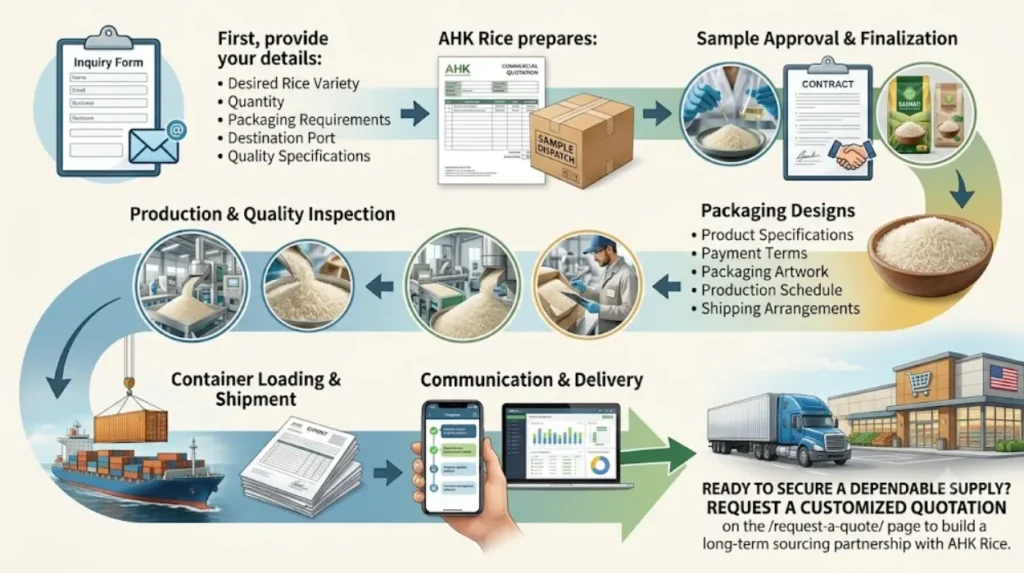
The import process starts with sharing your product specifications, reviewing samples, confirming pricing, approving packaging, finalizing documentation, and scheduling production before shipment, allowing buyers to establish a reliable long-term sourcing relationship with minimal commercial uncertainty.
The purchasing process is straightforward.
First, provide your desired rice variety, quantity, packaging requirements, destination port, and quality specifications.
Next, AHK Rice prepares a detailed commercial quotation and arranges sample dispatch for evaluation.
After sample approval, both parties finalize product specifications, payment terms, packaging artwork, production schedule, and shipping arrangements.
Production normally begins immediately after contract confirmation.
During manufacturing, quality inspections verify that the agreed specifications are maintained throughout processing.
After successful inspection, containers are loaded, export documentation is completed, and shipment is booked with the selected carrier.
Throughout the process, AHK Rice provides communication on production progress, documentation status, and shipment scheduling so buyers can plan inventory for USA retail distribution with confidence.
If you are ready to secure a dependable supply of low-moisture Pakistani Basmati rice for the USA retail market, request a customized quotation through the /request-a-quote/ page and begin building a long-term sourcing partnership with AHK Rice.
Frequently Asked Questions
How does low moisture improve the quality of imported Pakistani Basmati rice?
Low moisture levels help preserve the rice’s natural aroma, reduce the risk of mold and insect activity, minimize grain breakage, and extend shelf life during shipping and storage in USA retail warehouses.
What moisture level is recommended for Pakistani Basmati rice exports to the USA?
Most premium exporters target an export moisture range of approximately 12.5%–13.5%, depending on the rice variety, packaging type, shipping duration, and buyer specifications.
Why should USA retail buyers request a sample before placing a bulk order?
A sample allows buyers to evaluate grain length, cooking performance, aroma, moisture level, packaging quality, and overall product consistency before committing to a full container purchase.
How long does it take to ship Pakistani Basmati rice to the USA?
Production generally takes 8–12 days, while ocean transit typically ranges from 28–40 days, depending on the destination port, shipping line, and customs clearance.
What certifications should a Pakistani Basmati rice exporter provide?
Reliable exporters should provide documents such as a Phytosanitary Certificate, Certificate of Origin, Commercial Invoice, Packing List, Bill of Lading, Quality Certificate, and Fumigation Certificate when required.
Can AHK Rice supply private-label packaging for USA retailers?
Yes. AHK Rice offers custom private-label packaging with flexible bag sizes, retail-ready printing, branding support, and packaging tailored to USA supermarket and wholesale requirements.
Which Pakistani Basmati rice varieties are best for USA retail markets?
Popular choices include 1121 Steam Basmati Rice, 1121 White Basmati Rice, Super Kernel Basmati Rice, 1509 Basmati Rice, Golden Sella, and Creamy Sella, depending on customer preferences and target retail segments.
What factors influence the final import price of Pakistani Basmati rice?
Pricing depends on the rice variety, moisture specification, grain quality, broken percentage, packaging type, certification requirements, order quantity, private labeling, and international freight costs.