How Does Ocean Freight Planning Affect Rice Delivery Timelines?
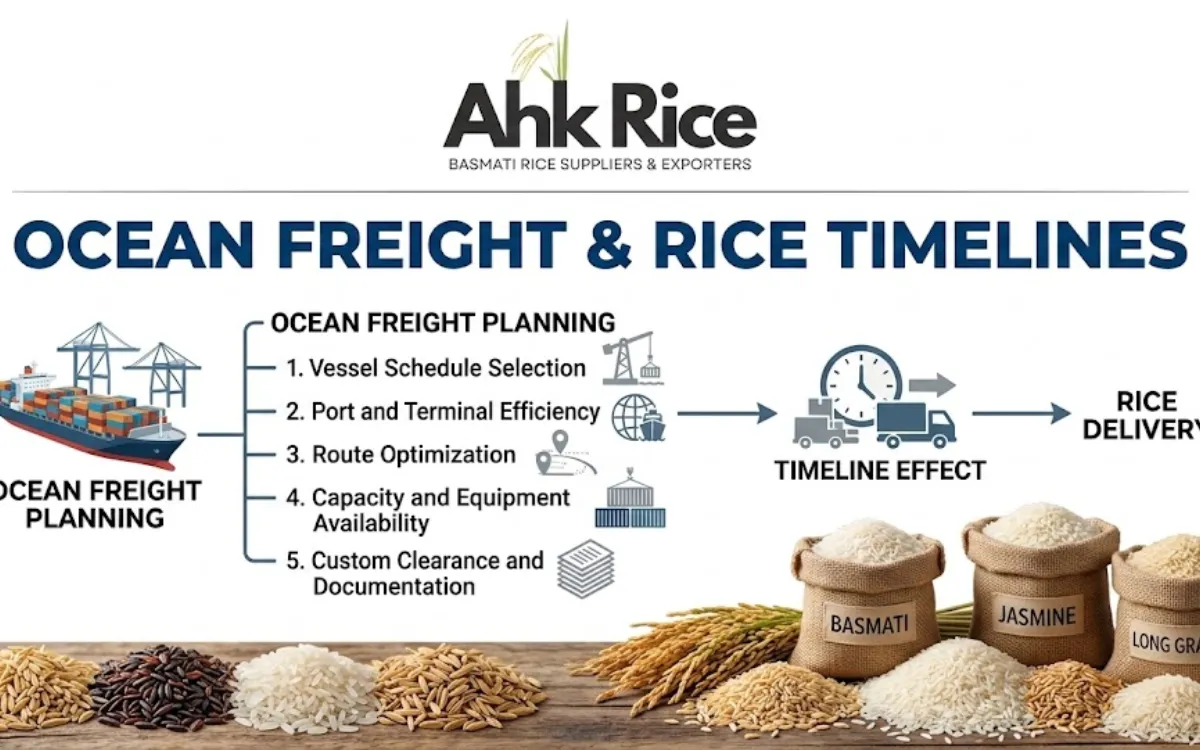
Ocean freight planning directly determines rice delivery reliability because vessel schedules, port selection, transshipment, container availability, documentation, and destination clearance all affect the final arrival date. For Pakistani Basmati rice, the strongest approach combines fixed shipment windows, early booking, correct grade selection, and coordinated export documentation.
For importers, understanding:
Why port logistics influence rice import performance provides the wider context before comparing ocean freight strategies. Port operations do not work separately from procurement. A container can leave the mill on schedule and still arrive late because of vessel rollover, transshipment delays, congestion, customs holds, or route disruption.
In 2026, this planning challenge has become more important. The Panama Canal Authority announced reduced daily transit capacity because of strengthening El Niño conditions. Daily transits are scheduled to fall to 34 from early September and 32 by mid-September. Lower water levels and higher demand are increasing route uncertainty and shipping costs.
For AHK Rice, the first product consideration is Pakistani Basmati rice, including 1121, Super Kernel, and 1509 varieties, supported by processing, grading, color sorting, custom packaging, container loading, and export documentation from Punjab.
What are the available solutions for planning ocean freight?
Rice importers have four practical freight-planning solutions: direct FCL shipping, transshipment-based FCL, flexible multi-port routing, and exporter-managed logistics. Each option balances transit time, freight cost, schedule frequency, documentation control, and destination delivery requirements differently.
Direct FCL shipping
Full Container Load, or FCL, dedicates the container to one shipment. This is the standard choice for commercial rice buyers purchasing enough volume to fill a container.
FCL reduces cargo handling compared with Less than Container Load, or LCL. It also gives the buyer stronger control over container condition, loading documentation, seal records, and shipment tracking.
For regular rice procurement, FCL creates a clearer planning cycle:
Production → packing → inspection → container loading → vessel departure → ocean transit → destination port → customs → warehouse.
This sequence is easier to forecast than fragmented cargo movement.
Transshipment-based FCL
A transshipment shipment changes vessels at an intermediate port. It expands carrier availability and creates access to destinations without a direct service.
The trade-off is an additional operational stage. A missed connection can extend the total delivery window.
For buyers serving Louisiana, current freight platforms show different Karachi or Port Qasim routing structures into New Orleans. One current Port Qasim option shows an estimated 32–38-day transit window, while a Karachi-to-New Orleans routing through Savannah shows 37–42 days.
Multi-port routing
Multi-port planning uses alternative U.S. gateways when the preferred destination becomes constrained. A Louisiana importer can evaluate New Orleans, Houston, Savannah, or another gateway based on vessel schedules, inland transport, port congestion, and warehouse location.
This strategy is valuable when the final delivery date matters more than using one fixed port.
Exporter-managed logistics
Exporter-managed logistics combines rice processing, packaging, documentation, container loading, freight coordination, and shipment tracking under one workflow.
This model reduces communication gaps between the mill, freight forwarder, inspection provider, shipping line, and importer. It also gives the buyer one operational contact for shipment milestones.
How do different ocean freight approaches compare?
Direct FCL provides the clearest shipment structure, transshipment expands route availability, multi-port planning improves flexibility, and exporter-managed logistics strengthens coordination. The best method depends on volume, destination, required delivery date, inventory buffer, product grade, and tolerance for freight volatility.
Specification comparison table
| Attribute | Direct FCL | Transshipment FCL | Multi-Port Routing | Exporter-Managed Logistics |
|---|---|---|---|---|
| Transit predictability | High on stable lanes | Medium | Medium-High | High when coordinated |
| Route flexibility | Medium | High | Very High | High |
| Handling stages | Low | Higher | Medium | Controlled |
| Freight-cost visibility | High | Medium | Medium | High with consolidated quote |
| Documentation coordination | Buyer/carrier dependent | More complex | More complex | Centralized |
| Best shipment size | Full-container volumes | Full-container volumes | Full-container volumes | Regular commercial orders |
| Main risk | Vessel rollover | Missed connection | Inland or port mismatch | Dependence on one coordinator |
The table shows why freight planning is not simply a choice between “cheap” and “fast.” A lower base freight rate does not guarantee the lowest landed cost.
A missed connection can create storage charges. A delayed container can disrupt retail replenishment. A documentation error can create a customs hold. A longer route can increase inventory carrying costs.
Therefore, importers need to evaluate the complete delivery chain.
Which method works best for Middle East and North American markets?
Middle East buyers generally benefit from short-sea FCL schedules and fast inventory replenishment, while North American buyers need longer planning windows, larger safety buffers, stronger documentation control, and alternative-port strategies because ocean transit from Pakistan takes substantially longer.
Middle East market
The Middle East is a natural market for Pakistani Basmati because buyers value aroma, grain elongation, cooking performance, and established Basmati varieties.
Jebel Ali is a major regional gateway. Current August 2026 lane data shows a median Karachi-to-Jebel Ali transit of about seven days, although actual service varies by carrier and transshipment structure.
Common grade preferences include:
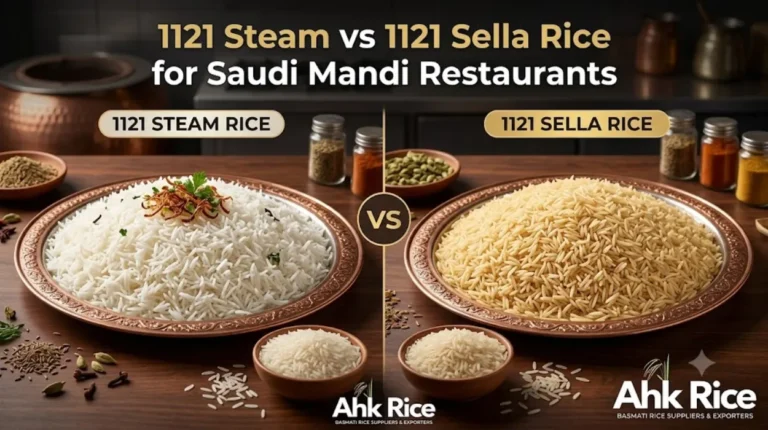
- 1121 Sella and Steam: Premium retail, restaurants, biryani, and foodservice.
- Super Kernel: Traditional aromatic positioning.
- 1509: Cost-conscious long-grain programs and volume buyers.
Current Pakistani Basmati FOB indications provide useful product benchmarks. Public August 2026 indications place 1121 White around $1,165–$1,205 per MT, 1121 Sella around $1,135–$1,175 per MT, and Super Kernel around $1,165–$1,205 per MT. These are market indicators, not fixed AHK Rice quotations.
North American market
North American buyers operate with a longer replenishment cycle. Louisiana is particularly relevant because New Orleans provides access to inland distribution networks serving the U.S. South and wider domestic markets.
Current freight data shows Port Qasim-to-New Orleans FCL transit at approximately 32–38 days for one current service option. Karachi-to-New Orleans routings through Savannah show approximately 37–42 days on another current option. Other routing databases show longer schedules, demonstrating why buyers need shipment-specific ETAs rather than one generic transit number.
Common grade preferences include:
- 1121 Basmati: Premium retail and private-label programs.
- Super Kernel: Ethnic retail and traditional South Asian distribution.
- 1509: Value-oriented retail and foodservice programs.
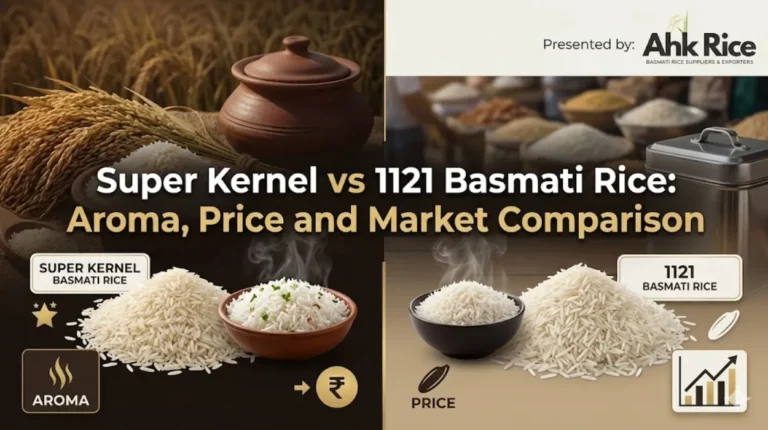
AHK Rice’s 2026 U.S. market comparison identifies 1121 as stronger for premium long-grain retail and Super Kernel as stronger for ethnic retail where aroma and familiarity carry greater weight.
For North American buyers, the product price alone is therefore insufficient. Freight, destination charges, inland transportation, customs processing, warehousing, and inventory carrying costs must enter the purchasing calculation.
How do price and shelf life affect freight planning?
Rice price and shelf life influence freight strategy because expensive premium grades increase inventory exposure, while longer storage stability creates greater scheduling flexibility. Buyers need to compare FOB product cost, freight, transit duration, storage conditions, and destination inventory requirements together.
| Market region | Common premium grades | Indicative FOB price/MT | Typical commercial shelf-life target | Freight-planning priority |
| Middle East | 1121 Sella/Steam, Super Kernel, 1509 | ~$1,135–$1,205 | 12–24 months* | Fast replenishment |
| North America | 1121, Super Kernel, 1509 | ~$1,135–$1,205 | 12–24 months* | Longer inventory planning |
*Shelf-life targets depend on processing, packaging, moisture, storage conditions, buyer specification, and product type. They are commercial planning ranges rather than universal expiry guarantees.
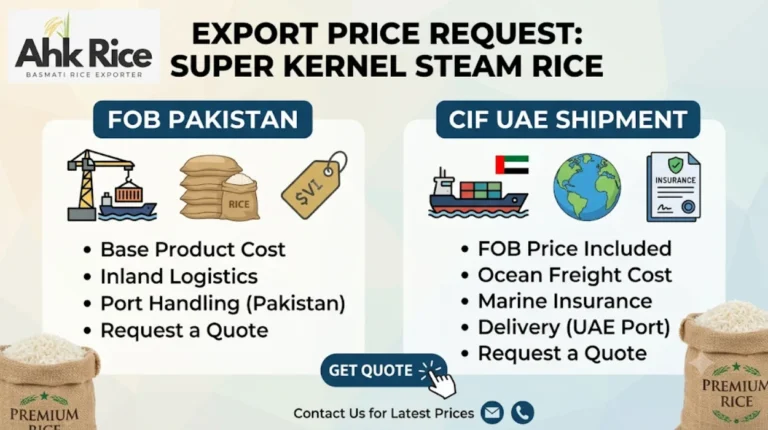
The price difference between the two regions is therefore not primarily a different rice FOB price. The same Pakistani grade can have a similar origin benchmark while the landed price changes because freight, insurance, destination charges, customs, inland transport, and distribution costs differ.
For example, an importer buying premium 1121 at approximately $1,165–$1,205 per MT must not compare that figure directly with another market’s warehouse price. The correct comparison is landed cost per MT.
Ocean freight planning also protects shelf life. A shipment spending additional weeks in transit, port storage, or customs does not automatically become unusable. It does, however, reduce the remaining commercial window and can affect inventory rotation.
What are the advantages and disadvantages of each approach?
Direct FCL offers simpler control but less routing flexibility; transshipment improves network access but introduces connection risk; multi-port planning protects against local disruption but adds inland complexity; exporter-managed logistics improves coordination but requires strong supplier execution.
Direct FCL
Advantages: fewer handling stages, clear container ownership, simpler tracking, and strong suitability for repeat orders.
Disadvantages: schedule disruption on one service can affect the whole shipment. Buyers also need sufficient volume to justify FCL economics.
Example: A Louisiana distributor ordering recurring containers for supermarket replenishment can use fixed FCL bookings and maintain a planned inventory buffer.
Transshipment FCL
Advantages: more carrier options and broader destination coverage.
Disadvantages: additional port handling and connection dependency.
Example: A buyer without a convenient direct service can accept transshipment to gain a better sailing frequency.
Multi-port routing
Advantages: protects procurement against congestion at one gateway and creates alternative delivery paths.
Disadvantages: inland freight can increase. Customs procedures and warehouse planning also become more complex.
Example: A Louisiana buyer can compare New Orleans against another Gulf gateway when the expected arrival window changes.
Exporter-managed logistics
Advantages: one workflow connects processing, inspection, documentation, container loading, and shipping coordination.
Disadvantages: the buyer becomes more dependent on the exporter’s operational discipline and communication.
Example: A buyer purchasing several Basmati grades can use one coordinated shipment plan rather than managing separate mill, inspection, and freight contacts.
Which method works best for different rice delivery cases?
The best method depends on the commercial objective rather than the destination alone. Stable recurring orders favour direct FCL, urgent replenishment favours faster available services, complex destinations favour multi-port planning, and buyers seeking one coordinated workflow favour exporter-managed logistics.
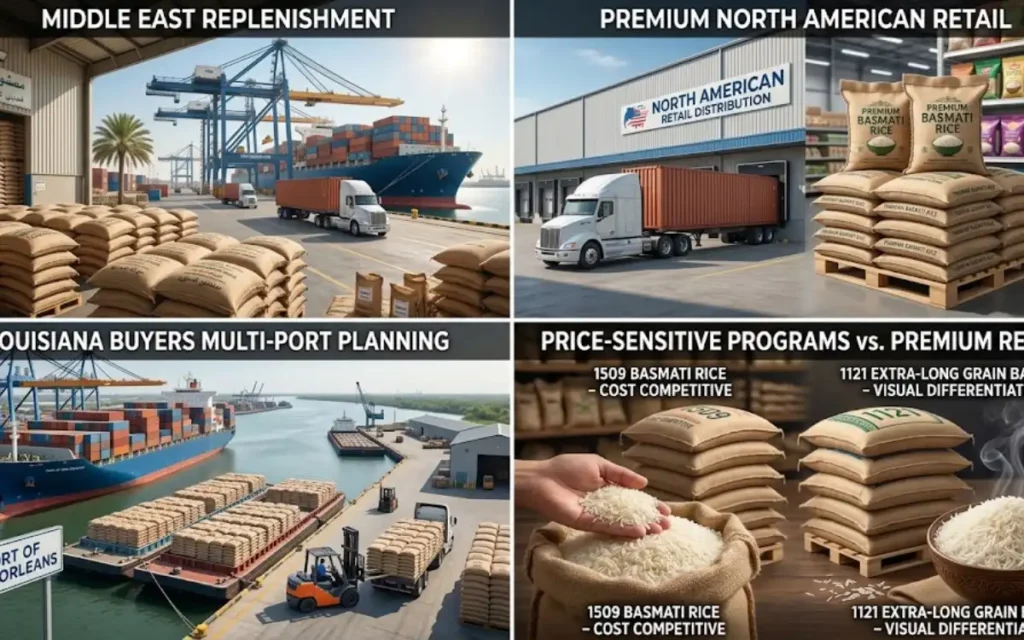
For routine Middle East replenishment, direct FCL is generally the strongest structure because short regional sailing windows support frequent inventory cycles.
For premium North American retail, direct FCL combined with a larger planning buffer provides stronger control. The buyer needs enough stock to absorb vessel delays without creating shelf shortages.
For Louisiana buyers, multi-port contingency planning has additional value because New Orleans delivery involves both ocean movement and inland distribution after discharge.
For buyers evaluating supplier-led logistics for Louisiana:
AHK Rice’s export logistics support for Louisiana buyers explains how origin processing, documentation, container coordination, and export planning connect with the destination delivery process.
For price-sensitive programs, 1509 can provide a more economical premium-grade position than 1121. AHK Rice describes 1509 as a cost-competitive Basmati option with strong cooking performance and long-grain characteristics.
For premium retail programs, 1121 offers stronger visual differentiation through extra-long grain characteristics. Super Kernel fits buyers prioritizing traditional aroma and established consumer familiarity.
What factors should buyers use to decide on an ocean freight plan?
Buyers need five decision factors: delivery deadline, shipment volume, route reliability, landed cost, and product stability. Scoring these factors before booking creates a measurable freight strategy and prevents purchasing decisions based only on the lowest quoted ocean rate.
Five-row decision framework
| Decision factor | Question to ask | Strong choice |
| Delivery deadline | How much schedule variation can inventory absorb? | Direct or high-frequency FCL |
| Shipment volume | Does the order fill a container efficiently? | FCL for full-container volume |
| Route reliability | How many connections and ports are involved? | Fewer-transshipment routing |
| Landed cost | What is the total cost per MT after freight and destination charges? | Lowest reliable landed cost |
| Product stability | How much storage and transit flexibility does the grade require? | Stable grade + suitable packaging |
This framework turns freight planning into a procurement decision rather than a shipping-only decision.
Buyers also need to review the booking cutoff, estimated time of departure, estimated time of arrival, transshipment ports, free-time allowance, container type, seal process, inspection status, phytosanitary documentation, certificate of origin, bill of lading, and destination customs requirements.
These details determine whether an advertised transit period becomes a realistic delivery plan.
How should rice exporters and importers plan delivery timelines in 2026?
A reliable 2026 rice delivery plan starts before cargo reaches the port. Buyers need production readiness, specification approval, documentation completion, container booking, vessel confirmation, tracking, destination clearance, and inventory buffers connected into one timeline from origin to warehouse.
The current shipping environment reinforces this requirement. Panama Canal restrictions announced for September 2026 demonstrate how climate conditions can change vessel capacity and route economics quickly.
The same principle applies to geopolitical disruption. Current 2026 shipping conditions have increased pressure on major maritime corridors and raised global freight volatility.
A rice importer therefore needs two timelines:
Operational timeline: production, packing, inspection, booking, loading, sailing, discharge, customs, and delivery.
Commercial timeline: purchase order, promotional launch, warehouse stock, retail replenishment, customer commitments, and next-order planning.
The two timelines must match.
If a Louisiana buyer needs rice in a warehouse by a fixed date, the shipment cannot be planned from the vessel ETA alone. The buyer needs a buffer for port discharge, customs, inland transportation, and operational exceptions.
This is why shipment planning starts with the required warehouse date and works backward to the booking date.
What is the practical takeaway for rice buyers?
Ocean freight planning affects rice delivery timelines through every stage between container booking and warehouse receipt. The strongest strategy combines grade selection, accurate transit estimates, early vessel booking, documentation control, alternative routing, and sufficient inventory buffer.
For Middle East buyers, short regional transit supports more frequent replenishment and leaner inventory planning. For North American buyers, longer ocean routes require greater schedule discipline and stronger contingency planning.
For Louisiana buyers specifically, current 2026 route data demonstrates that Karachi or Port Qasim to New Orleans can produce materially different transit windows depending on routing and service structure.
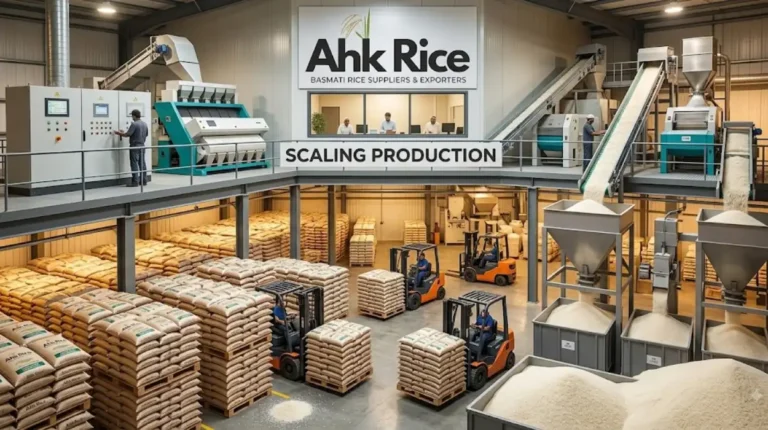
AHK Rice operates from Punjab and connects sourcing, processing, grading, sorting, custom packaging, container loading, and export documentation into its rice export workflow. Its export information states that shipments can be arranged through major carriers and that buyers can also use their own freight forwarder under FOB Karachi terms.
Frequently Asked Questions
What is ocean freight planning in rice exports?
Ocean freight planning is the process of coordinating vessel schedules, container bookings, ports, transit routes, documentation, customs, and delivery timelines to move rice from the exporting country to the buyer’s destination efficiently.
How long does Pakistani rice take to reach international markets?
Transit time depends on the destination, shipping line, routing, and transshipment requirements. Karachi or Port Qasim to Middle East destinations can take around one week on some services, while routes to North American destinations can take more than 30 days.
Which Pakistani Basmati rice grades are commonly exported?
Common Pakistani Basmati grades include 1121, Super Kernel, and 1509. Buyers select grades according to grain length, aroma, cooking performance, price positioning, and target-market preferences.
Why does port congestion affect rice delivery timelines?
Port congestion can delay vessel berthing, container handling, transshipment connections, customs processing, and inland movement. These delays extend the time between the planned shipment date and warehouse receipt.
Is direct FCL better than transshipment for rice shipments?
Direct FCL generally provides fewer handling stages and simpler scheduling. Transshipment provides more routing options but introduces additional connection and handling points. The better choice depends on destination, vessel availability, cost, and delivery requirements.
How does ocean freight affect the landed cost of rice?
Ocean freight affects landed cost through freight charges, destination fees, insurance, port handling, customs-related costs, and inland transportation. Buyers need to compare the complete landed cost per MT rather than the FOB rice price alone.