Why Do England Rice Importers Need Accurate Customs Declarations?
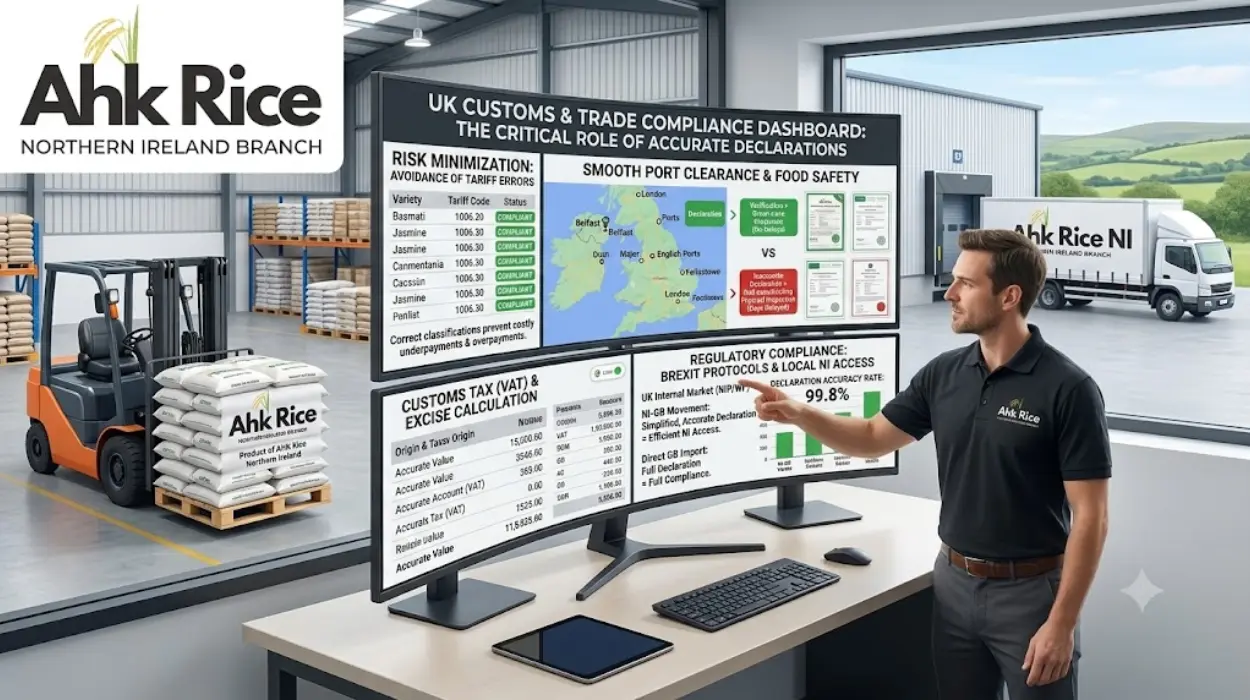
Accurate customs declarations prevent classification, valuation, documentation, and food-control errors during Pakistani rice imports into England. England follows Great Britain customs procedures, so importers use the UK Customs Declaration Service for commercial rice shipments.
Why Do England Rice Importers Need Accurate Customs Declarations?
Accurate customs declarations identify the rice, origin, value, quantity, packaging, and applicable controls correctly. England sits within Great Britain for customs purposes. Pakistani rice also faces food controls, so customs data must match food safety documents and shipment records.
A customs declaration is the formal information submitted to HM Revenue and Customs (HMRC) when goods enter Great Britain. The declaration identifies what enters the country and establishes the customs treatment.
England, Scotland, and Wales form Great Britain for customs purposes. Northern Ireland follows different arrangements for some movements. An England importer therefore needs the correct Great Britain import process for rice arriving from Pakistan.
Rice is classified under Chapter 10 of the UK tariff. Rice generally falls under heading 1006, with further classification depending on its physical state and processing. UK guidance distinguishes paddy, husked, semi-milled, wholly milled, parboiled, and broken rice.
This distinction matters because a commercial name does not automatically determine the customs code. Basmati describes a rice variety. Terms such as 1121, Super Kernel, and 1509 describe commercial varieties supplied from Pakistan.
How Do Customs Declarations Work for Pakistani Rice Imports?
Customs declarations move shipment information into HMRC’s Customs Declaration Service. The importer or agent submits commodity codes, values, weights, origins, procedures, and documents. HMRC assesses duty, VAT, controls, and release status from those declared details before border clearance begins immediately.
The process starts with importer identification. An England business normally needs a GB EORI number to import goods into Great Britain. The EORI identifies the economic operator in customs systems.
The importer then identifies the product and selects the appropriate commodity code. UK guidance specifically directs importers to use the UK Integrated Online Tariff when preparing a declaration.
The declaration records customs value, quantity, weight, origin, packaging, transport information, and the customs procedure. It also records certificates or licences where the commodity requires them.
A customs agent can submit the declaration on the importer’s behalf. The importer remains responsible for providing accurate commercial information and supporting records.
HMRC processes the declaration through the Customs Declaration Service. Accepted declarations establish the customs treatment and amounts due. Customs can request supporting evidence during checks.
The workflow connects the commercial invoice, rice specification, tariff classification, and border controls into one customs record.
With the declaration process established, the next question is which data fields require the closest attention.
What Are the Key Components of a Rice Customs Declaration?
Key components include the EORI number, commodity code, customs procedure, customs value, origin, quantity, weight, packaging, transport details, and supporting documents. Rice declarations also connect to food controls through IPAFFS and CHED-D requirements for covered Pakistani consignments during commercial import.
Which Product Details Must Match?
The product description should identify the rice clearly. A declaration for Pakistani Basmati rice should distinguish the rice type, processing state, packaging, quantity, and intended commercial description.
The commodity code requires particular attention. UK guidance lists rice in the following broad categories:
- Paddy rice: rice retaining its husk.
- Husked rice: brown rice with the husk removed.
- Semi-milled rice: rice receiving partial milling.
- Wholly milled rice: rice receiving complete milling.
- Broken rice: rice classified specifically as broken grain.
These categories connect the physical product with tariff classification. A shipment described simply as “rice” provides less classification information than a precise commercial description.
Why Does Origin Matter?
Country of origin identifies where the rice originates for customs purposes. Pakistani Basmati rice should therefore show Pakistan as its origin when the product qualifies as Pakistani-origin goods.
Origin also connects the shipment with country-specific import controls. Pakistan-origin rice currently appears on Great Britain’s list of foodstuffs subject to enhanced controls.
Why Do Weight and Value Matter?
Customs valuation determines the monetary basis used for customs treatment. Commercial invoices, packing lists, freight information, and declared values therefore need to remain consistent.
A mismatch between invoice value and declaration value creates an avoidable customs query. Incorrect quantities or weights also create inconsistencies between the declaration and physical shipment.
These fields form the core evidence trail for customs. The next question is why accuracy creates practical value for importers.
What Benefits Do Accurate Rice Customs Declarations Provide?
Accurate declarations reduce incorrect duty calculations, border queries, document mismatches, storage delays, and compliance exposure. They also create consistent records for customs audits. Correct commodity classification and valuation connect the physical rice shipment with the legal data submitted to HMRC.
How Does Accuracy Support Customs Compliance?
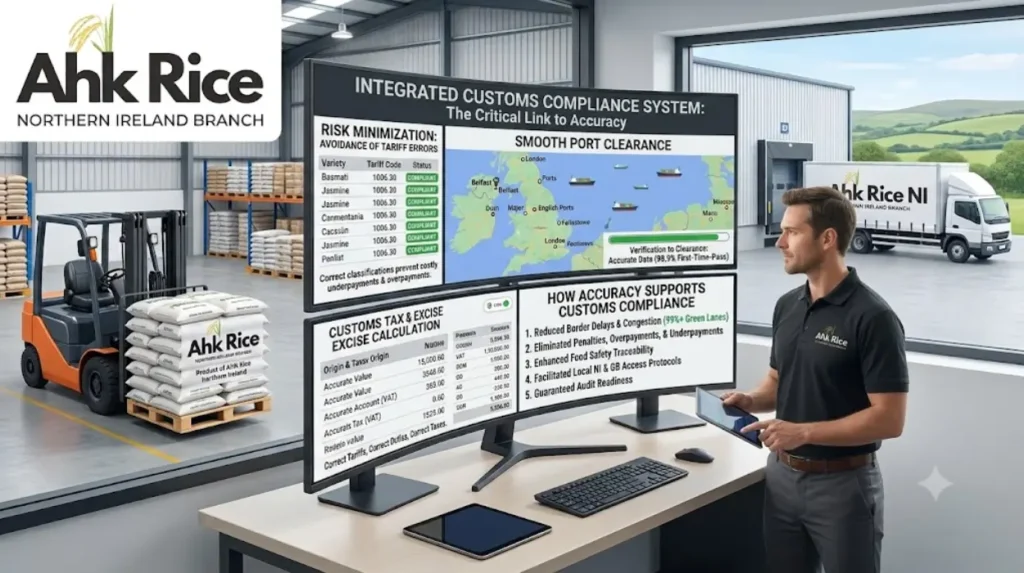
Correct classification establishes the correct tariff treatment for the imported rice. Correct valuation provides the appropriate financial information. Correct origin connects the goods with applicable country-specific measures.
HMRC guidance states that declarations contain commodity codes, procedures, values, transport details, and supporting information. Customs can request documents to verify a declaration during clearance.
How Does Accuracy Support Food Controls?
Customs accuracy also supports food-control processes. Pakistan-origin rice is currently controlled for pesticide residues, aflatoxins, and Ochratoxin A under Great Britain’s imported food controls.
Current guidance identifies rice from Pakistan under Annex I controls. Rice consignments covered by these controls require CHED-D processing and commercial documentation through the relevant import-control system.
The Food Standards Agency currently lists a 5% identity and physical check frequency for Pakistan-origin rice under these controls.
Accurate customs data therefore supports both customs compliance and food-control identification. The next question is how different rice products affect declaration details.
How Do Rice Grades and Processing States Affect Customs Classification?
Rice declarations depend on the product’s physical and commercial characteristics. White, brown, parboiled, broken, paddy, and milled rice fall under different tariff descriptions. Grain varieties such as 1121, Super Kernel, and 1509 describe commercial rice, not substitutes for tariff classification.
What Is 1121 Basmati Rice?
1121 Basmati is a long-grain Pakistani rice variety recognised commercially for its slender grain and cooking characteristics. Export specifications can distinguish white, Sella, Golden Sella, and other processing forms.
The customs declaration must focus on the physical processing state and applicable tariff description. The commercial grade alone does not replace tariff classification.
What Is Super Kernel Basmati Rice?
Super Kernel Basmati is a Pakistani Basmati variety used across retail, foodservice, and wholesale markets. Its commercial identity describes the grain variety.
The customs classification still depends on the product presented for import. Milled, husked, parboiled, or broken forms require classification according to the applicable tariff rules.
What Is 1509 Basmati Rice?
1509 Basmati is another Pakistani long-grain variety used in international rice trade. Exporters can process the variety into different commercial forms and packaging formats.
The declaration should describe the actual product state. The importer should not replace the tariff description with only the variety name.
UK customs guidance confirms that rice classification considers processing and grain characteristics.
Understanding the distinction between variety and tariff classification leads directly to the certificates and food documents connected with Pakistani rice imports.
Which Certifications and Food Documents Apply to Pakistani Rice Imports?
Pakistan-origin rice entering Great Britain is subject to enhanced food controls covering pesticides, aflatoxins, and Ochratoxin A. Covered rice requires CHED-D controls. Customs declarations remain separate from food certificates, but both records must identify the same product and consignment records.
What Is CHED-D?
CHED-D means Common Health Entry Document for food and feed of non-animal origin. It supports official controls for qualifying high-risk food imports entering Great Britain.
Current guidance lists Pakistan-origin rice under Annex I controls. The rice entry covers tariff heading 1006 and controls for aflatoxin, Ochratoxin A, and pesticides.
Are Health Certificates Always Required?
Health certification depends on the specific regulatory annex and product control. Pakistan-origin rice listed under the current Annex I controls is treated differently from Annex II products requiring health certificates and laboratory results.
The current Great Britain guidance identifies Pakistan rice under Annex I. Importers should therefore check the current control status before each shipment.
Is a Phytosanitary Certificate Required?
Rice is among certain grains that can enter Great Britain without a phytosanitary certificate under the relevant plant-health guidance. Food-control requirements remain separate from this plant-health rule.
This distinction prevents a common documentation mistake. Plant-health certification and food-safety certification address different regulatory purposes.
The certification framework shows why customs data must align with food-control information. The final issue is identifying the errors that cause avoidable problems.
What Common Problems Do England Rice Importers Face With Customs Declarations?
Common errors include using a generic rice description, selecting the wrong commodity code, misstating origin, copying invoice values incorrectly, and overlooking food-control requirements. Another misconception treats customs clearance as paperwork only, while classification, valuation, controls, and evidence determine compliance overall.
Is “Basmati Rice” Enough for Customs?
No. “Basmati rice” identifies a commercial variety but does not fully describe its customs classification.
The declaration needs the appropriate commodity code and relevant product details. UK tariff guidance specifically separates rice according to processing and physical characteristics.
Does the Customs Agent Remove the Importer’s Responsibility?
No. An agent can prepare and submit a declaration, but the importer must provide accurate commercial information.
The importer should therefore verify the invoice, packing list, origin, weights, product description, and tariff classification before submission.
Does Customs Classification Depend Only on the Rice Variety?
No. The processing state also matters. White, brown, parboiled, paddy, and broken rice have different tariff descriptions.
A Pakistani exporter can supply 1121 Basmati in different processing forms. The importer must classify the actual product entering Great Britain.
Can Customs and Food Documents Use Different Product Information?
The records should remain consistent. A customs declaration identifying one rice product while food-control documentation identifies another creates an avoidable discrepancy.
Consistent descriptions improve traceability across the invoice, packing list, customs declaration, CHED-D process, and shipment records.
Accurate declarations therefore depend on product knowledge, tariff classification, valuation, origin, and food-control awareness rather than paperwork alone.
Where Should England Rice Importers Insert the Related MOFU Article?
The best placement is in the “How Do Customs Declarations Work for Pakistani Rice Imports?” section, immediately after explaining the commodity-code and supporting-document steps.
Use a natural anchor such as “how customs declarations are prepared for Pakistani Basmati rice imports” rather than forcing the exact article title into the sentence.
Recommended contextual sentence:
Importers can also examine how customs declarations are prepared for Pakistani Basmati rice imports before submitting shipment information.
Place [Insert Link to MOFU Article] on that anchor text.