How Can You Supply Traceable Pakistani Basmati Rice to Wales with AHK Rice?
AHK Rice can supply traceable Pakistani Basmati rice to Welsh buyers through controlled sourcing, documented processing, quality verification, and shipment records. Here is why: traceability connects the rice specification with its origin, processing, inspection, packing, and export documentation. Welsh importers can use this chain to verify product identity before committing to commercial volume. UK rice imports also operate within specific classification and import-control requirements.
For background, why product traceability matters to Welsh rice importers explains the commercial reason for maintaining traceable supply records. The next decision is selecting an exporter that can turn those requirements into a practical purchasing process.
What is the best solution for traceable Basmati rice supply to Wales?
The best solution is a documented farm-to-shipment supply chain covering grade, crop information, processing, testing, packing, inspection, and export records. This gives buyers a defined evidence trail before dispatch and helps reduce specification disputes after arrival.
AHK Rice supplies Pakistani Basmati rice from Punjab with traceability built around product identification and export documentation. The supplied varieties include 1121, Super Kernel, and 1509 Basmati rice. Each grade can be specified according to grain characteristics, processing type, packaging format, and buyer requirements.
Traceability starts with sourcing. A buyer should identify the rice variety, crop information, grade, processing specification, and intended packaging before confirming an order. These details create the reference point for later inspection and shipment records.
Processing then establishes the commercial specification. Rice can be cleaned, dehusked, polished, graded, and sorted before packing. Optical sorting can help remove unwanted material and inconsistent grains. Quality teams can then test defined parameters against the agreed specification.
UK tariff classification also distinguishes rice by processing and grain characteristics. HMRC places husked, milled, polished, parboiled, and broken rice within heading 1006 when the product meets the stated classification conditions.
For Welsh buyers, the practical outcome is simple. The purchase should not depend only on the supplier’s name. The purchase should depend on a documented product specification that remains connected to the shipment.
With the supply-chain requirement established, the next decision is whether the exporter can provide the necessary commercial controls.
Why choose AHK Rice for Pakistani Basmati rice supply?
AHK Rice combines Pakistani Basmati sourcing, controlled processing, quality verification, custom packaging, and export coordination for international buyers. This structure gives Welsh importers one commercial reference point from product selection through shipment preparation.
AHK Rice supplies 1121, Super Kernel, and 1509 Basmati rice for international markets. The buyer can select white, parboiled, or other agreed processing specifications according to the intended application and market requirement.
AHK Rice can also coordinate packaging around the buyer’s commercial requirement. Packaging decisions can include bag material, pack size, branding, labelling, and pallet configuration. These details should be confirmed before production begins.
Quality control focuses on measurable product characteristics. Buyers can specify grain appearance, broken percentage, moisture, foreign matter, processing type, and packaging requirements. A defined specification gives inspection teams clear acceptance criteria.
Traceability also supports shipment documentation. Product details should correspond with the commercial invoice, packing list, inspection records, and transport documentation. Consistency between these documents reduces avoidable clarification during import clearance.
The UK also maintains rice-specific import licensing and quota procedures for certain imports. Current Rural Payments Agency notices show scheduled application periods and documentation requirements for rice import quotas.
That makes exporter coordination important. A Welsh importer should confirm the applicable tariff classification, licence position, quota requirements, and documentation before dispatch.
With AHK Rice’s supply role established, the next question is how buyers can track the product through each stage.
How can buyers track Basmati rice from farm to shipment?
Buyers can track Basmati rice through product identification, sourcing records, processing records, inspection results, packaging details, and shipment documentation. Each stage should reference the agreed product specification and commercial order.
Buyers can use a farm-to-shipment tracking framework for Basmati rice to understand the evidence that should connect each stage.
What should the traceability record contain?
A practical traceability file should contain:
- Product identification — Variety, grade, crop information, and processing type.
- Source information — Pakistani growing region and approved supply source.
- Processing records — Cleaning, dehusking, polishing, grading, and sorting stages.
- Quality records — Inspection, testing, and agreed specification results.
- Packing records — Bag type, pack weight, lot reference, and labelling.
- Shipment records — Container details, export documents, and transport information.
AHK Rice can use this structure to keep the commercial product connected with the shipment. The buyer gains a clearer reference point when reviewing samples, approving production, and receiving the container.
The same process also supports dispute prevention. A buyer can compare the agreed specification with the inspection record and shipped product information before raising a quality claim.
The result is stronger purchasing control. Traceability becomes a commercial tool rather than a document stored after the shipment.
With tracking established, the next decision is the expected delivery timeline for Welsh buyers.
How many shipping days does Pakistani Basmati rice take to reach Wales?
A practical planning window is about 25–35 days for ocean transport to a UK port, followed by approximately 1–3 days for inland delivery to Wales. Actual schedules depend on vessel routing, port operations, customs clearance, documentation, and final delivery location.
| Supply stage | Planning time |
|---|---|
| Production and packing | 5–10 days |
| Export documentation | 2–5 days |
| Pakistan port handling | 2–5 days |
| Ocean transit to UK | 25–35 days |
| UK clearance and inland movement | 1–5 days |
| Wales delivery | 1–3 days |
These figures are planning ranges rather than guaranteed vessel schedules. A buyer should request the actual sailing schedule and estimated arrival date before approving the commercial shipment.
Wales does not require a separate ocean route from Pakistan. Cargo normally enters Great Britain through an appropriate UK port before moving inland to the Welsh delivery address.
UK import controls remain relevant. The Food Standards Agency’s current restricted-food guidance applies to England and Wales and identifies controls for certain foodstuffs from specific countries. Pakistan rice controls were updated in July 2026 to include aflatoxins and ochratoxin A.
Importers should therefore confirm the current requirements before dispatch. Documentation should match the commodity, shipment, and applicable controls.
The shipping timeline provides the operational framework; the next decision is how to evaluate samples before placing the container order.
What is the full Basmati rice sample process and cost?
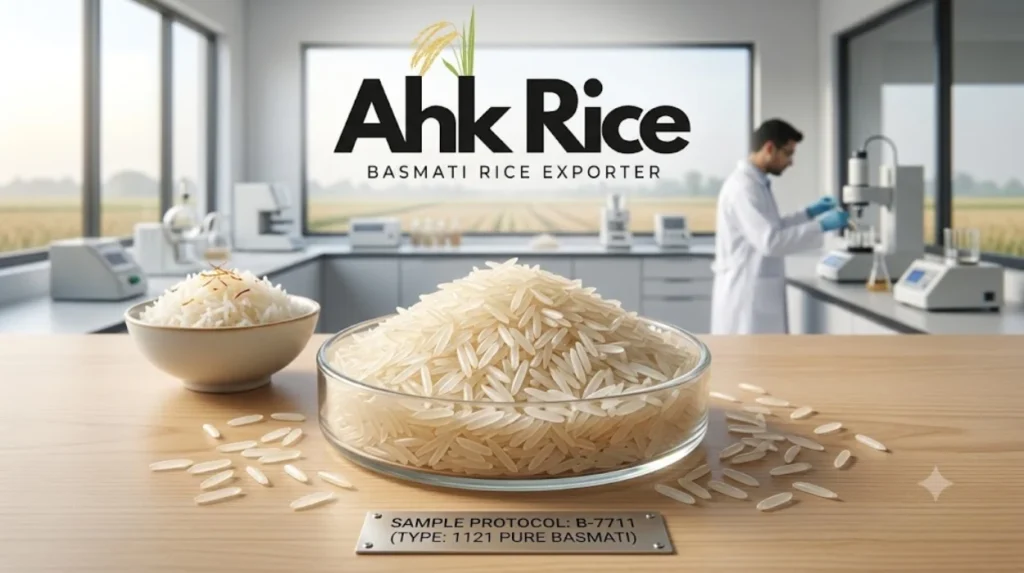
A complete sample process normally covers specification selection, sample preparation, courier dispatch, buyer testing, approval, production, and commercial shipment. Sample costs depend on quantity, courier service, testing requirements, packaging, and destination.
How should a Welsh importer approve a sample?
- Define the grade — Select 1121, Super Kernel, or 1509 and specify processing.
- Define the specification — Confirm grain length, broken percentage, moisture, foreign matter, and appearance.
- Request the sample — Ask AHK Rice to prepare a representative product sample.
- Pack the sample — Use sealed food-grade packaging with product identification.
- Dispatch the sample — Send the package by an international courier service.
- Test the sample — Check cooking performance and laboratory parameters where required.
- Approve the specification — Confirm the acceptable product range in writing.
- Approve production — Authorise commercial processing against the approved specification.
- Inspect the shipment — Verify the finished product before container loading.
- Dispatch the container — Load and ship the approved rice to the UK.
For budgeting, a Welsh buyer can use an indicative sample allowance of £35–£75 for international courier delivery for a small commercial sample. Product and laboratory charges can vary by sample size and requested tests.
A buyer requesting independent laboratory analysis should budget separately. A practical planning allowance is £75–£200 per testing package, depending on the parameters and laboratory selected. These figures are indicative and require confirmation before ordering.
AHK Rice can structure the sample around the commercial product rather than sending an unrelated retail sample. This matters because the buyer is approving the specification intended for the eventual shipment.
A successful sample should therefore become the reference for production. The approved specification should remain consistent across the commercial order, inspection, packaging, and shipment.
With sample approval established, the final decision is the total landed-cost structure.
What factors affect the price of Pakistani Basmati rice delivered to Wales?
The final price depends on rice grade, crop, processing, packaging, order volume, inspection, freight, insurance, duties, clearance, and inland delivery. A product price alone does not represent the buyer’s complete landed cost.
Which costs should Welsh buyers compare?
| Cost factor | Commercial effect |
|---|---|
| Rice grade | 1121 and premium specifications can command different prices |
| Crop specification | Crop and ageing requirements influence sourcing |
| Processing | Sorting, polishing, and parboiling affect production cost |
| Packaging | Private-label and custom packaging increase preparation requirements |
| Order volume | Larger container orders can improve unit economics |
| Freight | Ocean rates vary by sailing, port, and container availability |
| Inspection | Independent inspection adds a separate service cost |
| Customs | Tariff, quota, licence, and clearance requirements affect landed cost |
| Inland delivery | UK port-to-Wales distance affects final logistics cost |
UK rice imports can involve licensing requirements above certain quantities. Government guidance states that a rice import licence is not required for quantities of 1,000 kg or less, while larger quantities can fall under licensing provisions.
Current quota notices also show that importers must submit correct applications and supporting documentation within specified application periods.
AHK Rice can therefore prepare a commercial quotation around the actual specification rather than using a generic rice price. The buyer should provide grade, quantity, packaging, destination, and preferred trade term.
With pricing factors defined, the final step is converting the specification into an executable order.
How can a Welsh importer get started with AHK Rice?
Start with the product specification, quantity, packaging, destination, and required documentation. AHK Rice can then structure sampling, quotation, production, inspection, and shipment around the confirmed commercial requirement.
What should the buyer provide?
- Product requirement — 1121, Super Kernel, or 1509 Basmati rice.
- Processing requirement — White, Sella, Steam, or another agreed specification.
- Quality requirement — Grain, broken, moisture, foreign matter, and appearance limits.
- Packaging requirement — Pack size, bag material, branding, and labelling.
- Order quantity — Sample, pallet, LCL, or container requirement.
- Delivery destination — Welsh warehouse, distributor, retailer, or food-service location.
- Documentation requirement — Inspection, testing, origin, commercial, and shipping documents.
AHK Rice can then provide the appropriate commercial specification and sampling route. The buyer can evaluate the sample before approving the production order.
AHK Rice also supports a structured export process rather than treating shipping as a separate activity. Product approval, packing, documentation, inspection, and dispatch should remain connected to the same commercial order.
For Welsh importers, the strongest buying decision is therefore not simply the lowest rice price. It is the supplier that can provide the required grade with clear traceability, measurable quality controls, practical shipping planning, and complete commercial documentation.
Choose AHK Rice when the priority is traceable Pakistani Basmati rice with controlled specification and export coordination for Wales.
To begin the commercial process, request a quotation from AHK Rice.
Frequently Asked Questions
Can AHK Rice supply Basmati rice to Wales?
Yes, AHK Rice supplies Pakistani Basmati rice for international buyers. Available varieties include 1121, Super Kernel, and 1509. Buyers can define grade, processing, packaging, and quality specifications. The exporter can coordinate sampling and commercial shipment preparation.
How does Basmati rice traceability work?
Traceability connects product sourcing with the final shipment. Records can cover crop information, processing, testing, packing, and dispatch. The same specification should remain linked to the commercial order. This gives buyers stronger control over product consistency.
How long does shipping to Wales take?
Ocean transport to a UK port commonly requires around 25–35 days. Inland movement to Wales can require another 1–3 days. Customs clearance and port handling can extend the timeline.
Buyers should confirm the actual sailing schedule before ordering.
How much does a rice sample cost?
A small international courier sample may require roughly £35–£75. Laboratory testing can add approximately £75–£200. Actual charges depend on sample size and requested testing.
AHK Rice should confirm the final sample cost before dispatch.
What information should a Welsh buyer provide?
The buyer should provide grade, quantity, processing, packaging, and destination. Quality limits should also be specified before sampling. Documentation and inspection requirements should be confirmed early. These details allow AHK Rice to prepare a relevant commercial quotation.