How Do Importers Select Basmati Rice for Private Label Programs?
For private label Basmati programs, 1121 Basmati is usually the strongest premium retail choice, Super Kernel provides a lower-cost mainstream position, and 1509 gives importers a practical value-oriented option when grain length, cooking yield, and target shelf price must be balanced.
Private label rice is different from buying commodity rice. An importer is selecting a product specification that will appear repeatedly under one retail brand. Grain appearance, cooking behavior, packaging, documentation, price stability, and supply continuity therefore become connected purchasing decisions. This is why understanding the growth of:
Private label Basmati brands in the USA is an important first step before comparing suppliers and grades.
A private label program means a retailer, distributor, or importer sells rice under its own brand name while an external processor or exporter supplies the product. The buyer controls the brand positioning, package design, market price, and customer relationship. The supplier controls agricultural sourcing, milling, grading, processing, packing, inspection, and export preparation.
What are the available solutions for private label Basmati rice?
Importers have three practical sourcing solutions: direct exporter supply, trader-based procurement, or specification-led contract supply. Direct export programs provide stronger control, traders offer sourcing flexibility, and contract supply provides the best structure for repeat private label specifications and planned inventory.
The first solution is direct exporter sourcing. The importer purchases from a rice exporter that manages procurement, milling, grading, packing, documentation, and shipment. This model reduces the number of intermediaries between the rice mill and the private label buyer.
The second solution is trader or intermediary sourcing. A trader purchases rice from mills or exporters and resells it to the importer. This can provide access to multiple origins and grades, but the buyer has less visibility into processing controls and lot-to-lot specification management.
The third solution is contract-based specification sourcing. The importer defines the variety, grain length, broken percentage, moisture, milling grade, packaging, tolerance levels, and shipment schedule before procurement begins. The supplier then produces and ships against that specification.
For private labels, specification-led sourcing has a major advantage. The rice becomes a repeatable commercial product rather than an occasional purchase. The importer can approve a reference sample and use the agreed specification as the benchmark for future shipments.
AHK Rice represents the type of integrated exporter model in which procurement, processing, grading, custom packaging, and export preparation can be coordinated through one supply chain. The company is based in Punjab and supplies 1121, Super Kernel, and 1509 varieties to international markets.
How do 1121, Super Kernel, and 1509 compare for private labels?
1121 delivers the strongest premium positioning through extra-long grains and high shelf appeal; Super Kernel balances aroma, appearance, and procurement cost; 1509 provides an economical long-grain option for brands prioritizing price competitiveness and cooking yield over maximum grain length.
| Attribute | 1121 Basmati | Super Kernel Basmati | 1509 Basmati |
|---|---|---|---|
| Typical raw grain length | About 8.0–8.3 mm | About 7.0–7.5 mm | About 8.0 mm class |
| Brand positioning | Premium | Mainstream-premium | Value-premium |
| Cooking elongation | Very high | High | High |
| Aroma | Strong | Strong | Good |
| Visual shelf appeal | Excellent | Very good | Very good |
| Typical buyer priority | Premium retail | Volume retail and foodservice | Cost-conscious retail |
| Main advantage | Maximum grain presentation | Balance of quality and price | Competitive procurement economics |
The 1121 variety is widely used when grain length is central to brand positioning. Its long, slender appearance makes it suitable for premium rice shelves, biryani-focused products, and brands that want the package itself to communicate quality.
Super Kernel sits between premium presentation and procurement efficiency. Its grain is shorter than 1121 but remains long and aromatic. It works well when a private label needs strong cooking performance without paying exclusively for maximum grain length.
1509 gives importers another long-grain option. It is particularly relevant when the retail price must remain competitive while the product still needs Basmati characteristics such as aroma, slender grains, and cooking elongation.
The correct selection therefore depends on the brand promise, not simply the longest available grain. A premium supermarket brand can justify 1121. A high-volume ethnic grocery label can use Super Kernel. A value-oriented brand can evaluate 1509 against its target consumer price.
How do USA and UAE private label requirements differ?
USA private labels place greater emphasis on food-import compliance, retail packaging, documentation, and consistent specifications, while UAE programs emphasize fast replenishment, premium Basmati grades, Gulf consumer preferences, and efficient landed cost through nearby Jebel Ali distribution channels.
The USA market requires importers to manage FDA-related food requirements and the Foreign Supplier Verification Program where applicable. Private label buyers also need packaging and labeling that fit their intended retail channel. Because ocean transit from Pakistan is longer, inventory planning becomes a significant part of supplier selection.
The UAE market benefits from geographical proximity to Pakistan and established Jebel Ali distribution infrastructure. Current 2026 market information shows indicative FOB Karachi Basmati prices around $1,135–$1,205 per MT, depending on variety and processing grade.
For the USA, current July 2026 indicative FOB Karachi pricing is also approximately $1,135–$1,205 per MT, before destination freight and other landed costs. The quoted range covers several 1121 processing grades, with 1121 Steam listed around $1,160–$1,200 per MT.
The important difference is therefore not simply the FOB rice price. Landed economics change after ocean freight, insurance, customs costs, port charges, inspection, warehousing, and domestic distribution are included.
For example, a USA private label buyer may accept a higher total landed cost for 1121 because the product can support a higher retail price. A UAE importer may select a similar grade but prioritize rapid replenishment and regional distribution efficiency.
What price per MT should private label importers compare?
Importers should compare total landed cost rather than FOB price alone. July 2026 indicative Pakistani Basmati FOB pricing is approximately $1,135–$1,205 per MT, while final private label economics also include packaging, freight, compliance, inspection, customs, warehousing, and distribution.
FOB means Free on Board. Under FOB Karachi pricing, the exporter delivers the shipment on board the vessel at the agreed port, while the buyer normally manages the main ocean freight and subsequent destination costs.
A July 2026 Pakistani market listing places 1121 White around $1,165–$1,205 per MT, 1121 Sella around $1,135–$1,175, 1121 Golden Sella around $1,145–$1,185, and 1121 Steam around $1,160–$1,200 per MT FOB Karachi. These figures are indicative and require confirmation before contracting.
For private label buyers, a useful cost model is:
Landed cost = FOB rice + ocean freight + insurance + inspection + destination charges + customs-related costs + packaging allocation + inland distribution.
Packaging can materially affect the final economics. A 5 kg premium retail bag has a different packaging cost structure from a 20 kg or 40 kg wholesale format. Printed bags, laminated materials, zippers, handles, cartons, labels, and palletization should therefore be evaluated separately.
A private label buyer should also calculate cost per retail unit, not only cost per metric ton. A $1,180/MT rice specification may produce a better commercial result than a $1,140/MT alternative if the higher-grade product supports a stronger retail price and lower consumer complaints.
How does shelf life affect private label selection?
Shelf life depends on processing, moisture control, packaging, storage conditions, and inventory rotation rather than variety alone. Private label importers should establish a documented shelf-life specification and storage requirement before approving the commercial rice grade.
Shelf life is the period during which rice remains within agreed quality and safety specifications when stored under recommended conditions.
Milled Basmati rice is generally stable because it has low moisture and does not contain the high oil content found in the bran layer of brown rice. However, storage temperature, humidity, packaging integrity, pests, oxygen exposure, and warehouse conditions can affect quality over time.
Private label importers should therefore avoid selecting rice solely by a printed shelf-life number. They should establish:
- Maximum moisture specification
- Packaging material
- Seal integrity
- Storage temperature
- Warehouse humidity controls
- Pest-control procedures
- Lot identification
- Production and packing dates
- Recommended stock rotation
For the USA, longer ocean transit and larger retail distribution distances make inventory planning especially important. A supplier may quote a shipment window of several weeks from Pakistan to major American ports; one current 2026 market reference indicates approximately 24–40 days of sailing time from Karachi to New York or Los Angeles.
The UAE provides a different logistics profile. Current 2026 market information indicates approximately 4–10 days sailing from Karachi to Jebel Ali, making replenishment faster than the USA route.
Which Basmati approach works best for different private label cases?
Premium supermarket brands should prioritize 1121, high-volume mainstream labels should evaluate Super Kernel, and price-sensitive private labels should evaluate 1509. The best grade is the one that matches consumer positioning, retail price, cooking expectations, and replenishment requirements.
A premium USA supermarket brand can use 1121 Steam or White Basmati. The extra-long grain supports premium visual positioning, while the specification can emphasize grain uniformity, low broken percentage, aroma, and cooking elongation.
A mainstream ethnic grocery label can use Super Kernel. This grade provides a strong combination of aroma, appearance, cooking performance, and price control.
A value-oriented private label can evaluate 1509. The objective is to maintain recognizable Basmati characteristics while reducing the raw material cost relative to a top-tier 1121 specification.
A foodservice-oriented private label should focus more heavily on cooking yield, grain separation, breakage, and batch consistency. Appearance still matters, but repeatable kitchen performance often carries greater commercial weight than maximum raw grain length. For more insight read:
Launch USA Private Label Basmati Rice with AHK Rice
AHK Rice supplies these three core varieties and provides end-to-end processing and custom packaging, making the sourcing model relevant to importers comparing several grades under one private label strategy.
What are the pros and cons of each sourcing approach?
Direct exporter sourcing provides stronger specification control but requires careful supplier qualification; trader sourcing offers flexibility but can reduce traceability; contract specification sourcing creates repeatability but requires detailed technical standards, sample approval, and disciplined quality verification before every commercial shipment.
Direct exporter sourcing
The main advantage is visibility. The importer can evaluate the exporter’s milling, grading, packing, inspection, and documentation process.
The disadvantage is that the buyer must perform deeper supplier due diligence. A direct relationship does not automatically guarantee consistent specifications.
Trader sourcing
The main advantage is flexibility. Traders can compare multiple mills and grades and sometimes respond quickly to short-term procurement requirements.
The disadvantage is reduced production visibility. If the trader changes the underlying mill, the physical characteristics of the rice can change even when the commercial product name remains the same.
Contract specification sourcing
The major advantage is repeatability. The buyer defines the acceptable parameters before production.
The disadvantage is greater preparation. The importer needs a detailed product specification, approved reference sample, packaging artwork, inspection process, and tolerance limits.
For private label programs, the third model generally provides the strongest framework because the brand depends on maintaining a recognizable product from one shipment to the next.
What decision factors should importers use before selecting a grade?
Importers should score each Basmati option against five factors: consumer positioning, technical specification, landed cost, supply reliability, and regulatory readiness. A grade should only be approved when it satisfies all five commercial requirements simultaneously.
| Decision factor | What the importer should evaluate | Why it matters |
|---|---|---|
| Brand positioning | Premium, mainstream, or value | Determines acceptable grade and retail price |
| Technical specification | Length, broken %, moisture, purity, cooking behavior | Controls product consistency |
| Landed cost | FOB, freight, packaging, customs, distribution | Determines gross margin |
| Supply reliability | Capacity, lead time, crop availability, repeatability | Protects retail inventory |
| Compliance | Food documentation, labeling, inspection, certificates | Reduces import and clearance risk |
1. Brand positioning: Define the consumer first. A luxury Basmati label should not select a grade solely because it is the cheapest option.
2. Technical specification: Establish measurable limits. Grain length, broken percentage, moisture, foreign matter, purity, and cooking performance should appear in the purchase specification.
3. Landed cost: Compare the complete delivered economics. FOB price is only one part of private label profitability.
4. Supply reliability: Evaluate whether the exporter can reproduce the approved specification at commercial volume. Private labels cannot afford major differences between shipments.
5. Compliance: Confirm that the exporter can provide the documentation required for the destination market and the buyer’s import process.
What should importers verify before approving the private label supplier?
Before approval, importers should test a representative sample, verify laboratory or inspection specifications, review packaging capabilities, confirm export documentation, assess production capacity, and compare the approved sample against the first commercial lot before releasing the product to retail distribution.
The first step is a technical product brief. It should identify variety, processing type, grain length, broken percentage, moisture, purity, packaging size, bag material, printing requirements, destination port, annual volume, and shipment frequency.
The second step is sample evaluation. Buyers should cook the sample using a controlled method and record grain elongation, aroma, texture, separation, breakage, water absorption, and final appearance.
The third step is commercial validation. The approved specification should be compared against the supplier’s quotation and minimum order requirements.
The fourth step is packaging approval. Artwork should be checked for product description, net weight, origin information, importer details, nutrition information, and other market-specific labeling requirements.
The fifth step is pre-shipment verification. A representative lot should be inspected before loading. This creates a control point between the approved reference sample and the shipment entering the buyer’s inventory.
The sixth step is post-arrival evaluation. The importer should compare arrival quality with the approved sample and retain lot records for future procurement decisions.
This process transforms private label purchasing from a price-based transaction into a controlled product program.
Which sourcing strategy creates the strongest private label program?
The strongest private label strategy combines a clearly defined rice grade, measurable specifications, approved samples, destination-specific compliance, controlled packaging, predictable supply, and landed-cost analysis. Product selection should follow the brand strategy rather than price alone.
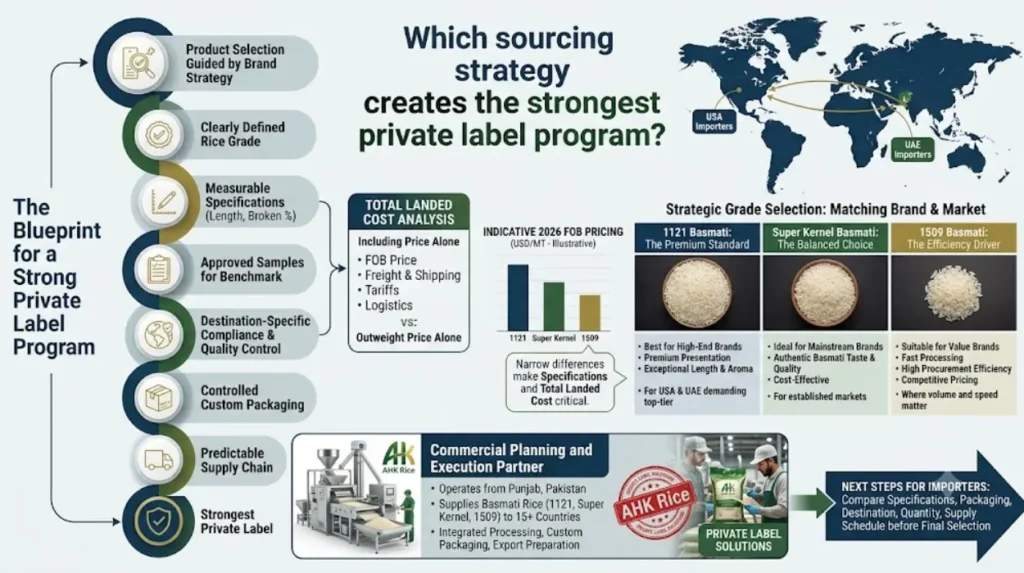
For USA importers, 1121 is the strongest choice when premium grain presentation is central to the brand. Super Kernel provides a balanced proposition for mainstream private labels. 1509 is useful where procurement efficiency and competitive retail pricing are more important.
For UAE importers, the same three-grade framework applies, but shorter shipping routes and rapid Jebel Ali replenishment can make inventory planning different. Current 2026 indicative FOB pricing demonstrates that grade differences can remain relatively narrow, making specifications and total landed cost more important than simply choosing the lowest quoted MT price.
AHK Rice operates from Punjab, Pakistan, and supplies Basmati rice to more than 15 countries. Its product range includes 1121, Super Kernel, and 1509, with processing, custom packaging, and export preparation handled within its supply model.
For importers moving from evaluation to commercial planning, the next logical step is to compare the required product specification, packaging format, destination, quantity, and supply schedule before selecting the final private label grade.
Frequently Asked Questions
What is private label Basmati rice?
Private label Basmati rice is rice supplied by an exporter or processor and sold under the importer’s or retailer’s own brand. The buyer controls the brand, packaging, positioning, and retail strategy while the supplier manages sourcing, processing, grading, packing, and export preparation.
Which Basmati rice is best for private label programs?
1121 Basmati is generally suited to premium private labels because of its extra-long grain and strong visual appeal. Super Kernel works well for mainstream-premium brands, while 1509 is suitable for value-focused programs that prioritize competitive pricing and cooking yield.
What is the difference between 1121, Super Kernel, and 1509 Basmati?
1121 is recognized for very long, slender grains and premium presentation. Super Kernel provides a balance between grain appearance, aroma, cooking performance, and cost. 1509 offers long-grain Basmati characteristics with a more value-oriented procurement position.
How much does Pakistani Basmati rice cost per metric ton in 2026?
Indicative July 2026 FOB Karachi prices for Pakistani Basmati are approximately $1,135–$1,205 per metric ton, depending on variety, processing grade, and specification. Importers should calculate landed cost rather than relying only on the FOB quotation.
Is 1121 Basmati suitable for USA private label brands?
Yes. 1121 Basmati is particularly suitable for USA private labels positioned as premium or extra-long-grain products. Its grain appearance, aroma, and cooking elongation support premium retail positioning when the specification is consistently maintained.
Which Basmati grade is suitable for UAE private label programs?
1121, Super Kernel, and 1509 can all serve UAE private label programs. 1121 suits premium retail, Super Kernel supports mainstream positioning, and 1509 can help brands maintain competitive pricing while offering long-grain Basmati characteristics.
How should importers compare Basmati rice suppliers?
Importers should compare suppliers using measurable specifications, sample consistency, processing capability, packaging options, documentation, production capacity, shipment schedules, inspection procedures, and total landed cost. Supplier selection should not be based on FOB price alone.
What specifications should private label rice buyers include?
A private label specification should define rice variety, grain length, broken percentage, moisture, purity, foreign matter limits, processing type, packaging material, package size, tolerance levels, inspection requirements, and shipment schedule.
How important is grain length for private label Basmati rice?
Grain length strongly influences visual positioning and consumer perception, particularly for premium Basmati products. However, importers should evaluate grain length together with purity, broken percentage, moisture, aroma, cooking elongation, and consistency.
What affects the shelf life of private label Basmati rice?
Shelf life is influenced by moisture level, milling quality, packaging integrity, storage temperature, humidity, pest control, oxygen exposure, and inventory rotation. Proper storage and sealed packaging help maintain rice quality throughout distribution.
Should private label importers buy directly from a rice exporter?
Direct exporter sourcing can provide greater visibility into processing, grading, packaging, documentation, and quality controls. It can be effective for private label programs when the exporter can consistently reproduce the approved product specification at commercial volumes.
Why is sample approval important for private label rice?
Sample approval establishes a physical quality benchmark before commercial production. Importers can evaluate grain appearance, aroma, cooking performance, texture, elongation, and breakage, then use the approved sample as a reference for subsequent shipments.
What packaging options are available for private label Basmati rice?
Private label Basmati can be packed in different retail and commercial formats, including small consumer bags and larger wholesale packs. Packaging can include custom printed bags, laminated materials, labels, handles, zippers, cartons, and palletized shipment formats.