What Purity Reports Do Saudi Arabian Rice Importers Request from Pakistan Exporters?
Saudi Arabian rice importers primarily request comprehensive purity analysis reports that verify varietal authenticity, physical purity, grain quality, contamination levels, pesticide residues, heavy metals, microbiological safety, and compliance with Saudi Food and Drug Authority (SFDA) regulations. Exporters providing internationally recognised laboratory reports, traceability documentation, and shipment-specific quality certificates consistently meet importer requirements and reduce customs clearance delays.
Saudi Arabia remains one of the largest importers of Pakistani Basmati rice in 2026. Importers no longer evaluate rice based only on appearance or aroma. They now require scientific purity verification before approving suppliers, issuing purchase contracts, and clearing shipments at Saudi ports.
Pakistani exporters have therefore strengthened laboratory testing procedures to align with international food safety standards. Companies such as AHK Rice, a trusted Pakistani Basmati rice exporter based in Punjab supplying 1121, Super Kernel, and 1509 varieties to more than 15 countries, provide documented quality assurance through complete export processing, traceability systems, and shipment-specific laboratory verification.
Importers seeking a better understanding of laboratory verification can first explore our guide explaining how laboratories verify Basmati rice quality before export in the article:
How Is Purity Tested in Pakistan Basmati Rice Before Export? before evaluating supplier documentation requirements.
Why do Saudi Arabian rice importers request purity reports?
Saudi importers request purity reports because laboratory verification reduces commercial risk, confirms product authenticity, protects consumers, satisfies SFDA food safety requirements, and ensures imported Basmati rice matches the agreed specification before shipment leaves Pakistan. These reports also simplify customs clearance, supplier evaluation, and long-term procurement decisions.
A purity report is a laboratory document that verifies whether exported rice matches the contractual specification.
It measures the physical and chemical characteristics of a rice lot before shipment.
For Saudi buyers, purity reports are part of supplier qualification rather than an optional quality document.
Importers use these reports to:
- Confirm the rice variety.
- Verify grain uniformity.
- Detect foreign materials.
- Ensure food safety compliance.
- Reduce import rejection risks.
- Support customs documentation.
- Maintain consistent retail quality.
Most large Saudi distributors also compare laboratory reports across multiple suppliers before awarding annual supply contracts.
What does a Pakistani Basmati rice purity report normally include?
Modern Pakistani export purity reports contain laboratory measurements covering physical purity, varietal composition, grain dimensions, broken percentage, damaged kernels, moisture content, foreign matter, pesticide residues, heavy metals, microbiological safety, packaging identification, and shipment traceability. Together, these parameters verify both product quality and regulatory compliance.
A professional export report contains considerably more information than a traditional quality certificate.
Typical laboratory sections include:
| Quality Attribute | Typical Information Included |
|---|---|
| Rice Variety | 1121, Super Kernel, 1509 or specified grade |
| Physical Purity | Percentage of pure rice kernels |
| Foreign Matter | Stones, husk, dust, plant material |
| Broken Grains | Percentage by weight |
| Damaged Kernels | Heat damaged, insect damaged or discoloured grains |
| Moisture | Moisture percentage for storage stability |
| Chalkiness | Percentage of chalky kernels |
| Grain Length | Average kernel size |
| Colour Consistency | Visual grading |
| Microbiological Analysis | Yeast, mould and pathogens where required |
| Heavy Metal Testing | Lead, arsenic, cadmium and mercury |
| Pesticide Residues | Compliance with maximum residue limits |
| Batch Identification | Lot number and traceability |
Saudi importers frequently request third-party laboratory verification instead of relying only on internal factory quality reports.
What solutions are available for verifying rice purity before export?
Pakistani exporters use several verification approaches ranging from internal quality inspections to internationally accredited laboratory testing, independent pre-shipment inspection agencies, digital traceability systems, and shipment-specific documentation packages. The most reliable solution combines all verification methods into one export quality process.
Exporters generally follow one of four approaches.
Internal factory quality inspection
Processing plants inspect incoming paddy, milling quality and finished rice.
This provides rapid quality control but offers limited credibility for overseas buyers without independent verification.
Accredited laboratory testing
Independent laboratories analyse rice samples using internationally recognised testing procedures.
These reports carry greater acceptance among Saudi importers.
Third-party inspection companies
Inspection organisations verify loading, sampling and shipment condition.
Their reports provide additional confidence for commercial buyers.
Integrated export documentation
Leading exporters combine:
- Laboratory reports
- Traceability records
- Quality certificates
- Packing lists
- Phytosanitary certificates
- Certificate of Origin
- Container inspection reports
This integrated documentation package reduces documentation gaps.
How do different purity verification approaches compare?
Independent accredited laboratory testing consistently provides the highest confidence because it combines scientific analysis with internationally recognised procedures. Internal inspections improve production quality, while third-party inspections strengthen shipment verification. Using all methods together creates the strongest supplier credibility.
Purity verification comparison
| Attribute | Internal Factory Testing | Accredited Laboratory | Third-Party Inspection | Integrated Documentation |
|---|---|---|---|---|
| Buyer Confidence | Medium | Very High | High | Very High |
| Scientific Analysis | Limited | Excellent | Moderate | Excellent |
| International Recognition | Limited | High | High | High |
| Regulatory Acceptance | Moderate | Excellent | High | Excellent |
| Traceability | Medium | High | High | Excellent |
| Commercial Value | Medium | Very High | High | Very High |
| Overall Import Risk Reduction | Moderate | Excellent | High | Excellent |
The comparison demonstrates why Saudi buyers increasingly request laboratory reports alongside complete shipment documentation.
Which purity specifications matter most to Saudi Arabian buyers?
Saudi importers place the highest importance on varietal purity, foreign matter limits, broken grain percentage, moisture levels, pesticide residue compliance, heavy metal analysis, and microbiological safety because these directly affect food quality, regulatory approval, and consumer confidence.
Importers generally evaluate multiple specifications simultaneously.
Varietal purity confirms that 1121 Basmati contains genuine 1121 kernels rather than mixed varieties.
Moisture affects shelf life and transportation stability.
Broken percentage influences retail presentation and cooking consistency.
Foreign matter directly affects food safety.
Residue analysis demonstrates compliance with food safety legislation.
Microbiological testing becomes especially important for retail brands supplying supermarkets throughout Saudi Arabia.
Which Basmati grades are preferred in different Saudi market segments?
Different Saudi market segments purchase different Basmati grades according to customer expectations, retail positioning, and food service requirements. Premium retailers favour higher purity grades, while institutional buyers often balance quality with commercial pricing.
Market preference comparison
| Market Region | Preferred Grade | Typical Buyer Priority |
|---|---|---|
| Riyadh & Central Region | Premium 1121 Steam and Sella | Premium retail quality |
| Jeddah & Western Region | 1121 Steam, Super Kernel | Hospitality and retail balance |
Premium supermarket chains generally prioritise longer grain length, higher purity percentages and consistent cooking performance.
Hotels and restaurants also value consistency because it directly affects customer satisfaction.
Wholesale distributors often purchase multiple grades depending on customer segments.
How do purity levels influence export pricing?
Higher purity levels generally increase export pricing because achieving superior varietal consistency requires stricter sorting, advanced optical colour sorting, additional quality inspections, and higher processing costs. Buyers typically accept higher prices when laboratory reports confirm measurable quality improvements.
Estimated 2026 comparison
| Specification | Premium Purity | Commercial Purity |
|---|---|---|
| Physical Purity | Higher | Standard |
| Processing Cost | Higher | Lower |
| Export Price (USD/MT) | Higher | More economical |
| Buyer Acceptance | Excellent | Moderate |
| Retail Positioning | Premium | Value segment |
| Import Risk | Lower | Moderate |
| Contract Stability | Higher | Moderate |
Although premium grades cost more per metric tonne, many Saudi buyers consider documented quality more valuable than short-term price savings because it reduces downstream commercial risk.
How does purity affect shelf life?
Proper purity management extends shelf life because cleaner rice contains fewer contaminants, lower moisture variation, and reduced biological activity. Scientific quality control therefore protects storage stability throughout international shipping, warehousing, wholesale distribution, and retail sales.
Shelf life comparison
| Condition | Expected Stability |
|---|---|
| Premium cleaned rice with controlled moisture | Longer storage stability |
| Standard commercial quality | Moderate stability |
| High moisture rice | Reduced stability |
| Mixed quality batches | Variable performance |
Storage conditions remain equally important.
Controlled humidity, sealed packaging and clean warehouses help preserve laboratory quality throughout the supply chain.
What are the advantages and disadvantages of different purity verification methods?
Each verification method serves a different purpose. Internal inspections improve manufacturing consistency, laboratories provide scientific evidence, inspection agencies validate shipment conditions, and integrated documentation strengthens commercial trust. Selecting the right combination depends on buyer expectations and regulatory requirements.
Internal factory inspection
Advantages
- Immediate quality monitoring
- Lower operational cost
- Continuous production control
Disadvantages
- Lower international credibility
- Limited independent verification
Example
A processor identifies broken grain levels before packaging and adjusts milling settings immediately.
Accredited laboratory testing
Advantages
- Scientific verification
- International recognition
- Greater buyer confidence
Disadvantages
- Additional testing cost
- Longer reporting time
Example
An exporter submits shipment samples for pesticide residue analysis before container loading.
Third-party inspection
Advantages
- Independent shipment verification
- Supports dispute resolution
Disadvantages
- Does not replace laboratory analysis
Example
An inspection agency supervises container loading and sample collection.
Integrated documentation
Advantages
- Complete buyer transparency
- Simplified customs processing
- Strong commercial credibility
Disadvantages
- Requires coordinated documentation management
Which purity verification strategy works best for different exporters?
The most effective strategy depends on export scale, customer expectations, destination regulations, and contract value. Small exporters often begin with accredited laboratory reports, while established suppliers serving premium Saudi buyers usually combine multiple verification systems into one documented quality programme.
Decision framework
| Business Situation | Recommended Solution | Reason |
|---|---|---|
| New exporter | Accredited laboratory testing | Builds buyer confidence |
| Premium retail contracts | Integrated documentation | Meets strict quality expectations |
| Hospitality supply | Laboratory plus third-party inspection | Supports consistent quality |
| Long-term supply agreements | Full traceability programme | Improves supplier credibility |
| Multi-country exports | Complete verification package | Simplifies international compliance |
The strongest approach is not selecting one method over another.
Instead, successful exporters integrate laboratory testing, processing controls, shipment inspection and documentation into one consistent quality assurance system.
What should Saudi buyers evaluate before accepting purity reports?
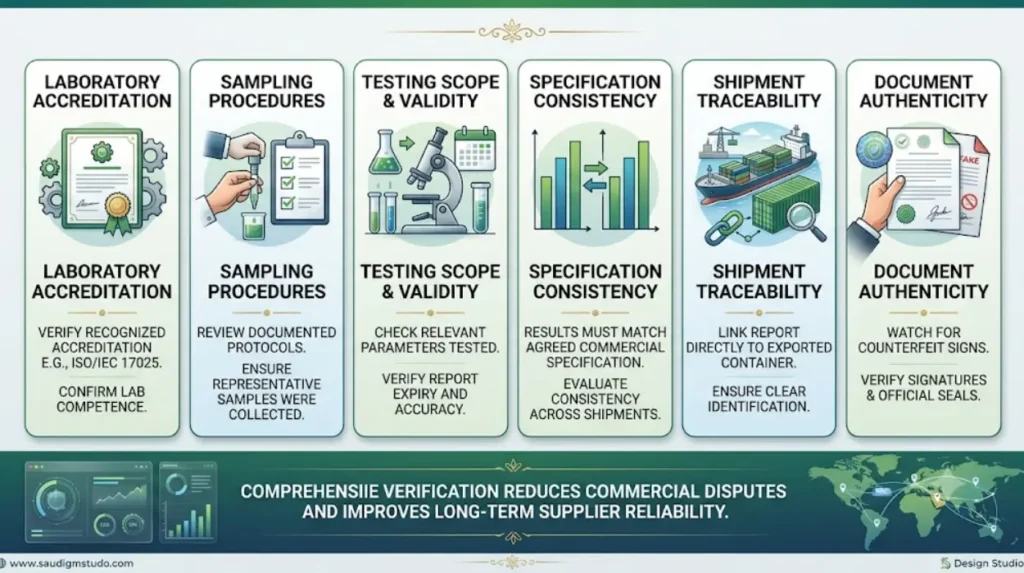
Importers should review laboratory accreditation, sampling procedures, report validity, shipment traceability, testing scope, specification consistency, and document authenticity before accepting purity reports. Comprehensive verification reduces commercial disputes and improves long-term supplier reliability.
A high-quality purity report should clearly identify the shipment.
The laboratory should be recognised.
Sampling procedures should be documented.
Results should match the agreed commercial specification.
Traceability should link the report directly to the exported container.
Consistency between multiple shipments also indicates a reliable exporter capable of maintaining quality over time.
Buyers evaluating exporters should also review supplier capabilities for providing shipment-specific documentation and laboratory evidence, as explained in our article on
Exporters that provide comprehensive purity analysis documentation for Saudi import requirements.
Saudi Arabian rice importers increasingly depend on laboratory-based purity reports because objective verification supports food safety, regulatory compliance, commercial consistency, and long-term procurement decisions. The strongest exporters combine accredited laboratory testing, traceability systems, shipment inspections, and complete export documentation into a unified quality assurance process. For buyers, evaluating the quality of the verification process is just as important as evaluating the rice itself, making documented purity analysis a critical component of international Basmati rice trade in 2026.
Frequently Asked Questions
What documents do Saudi Arabian rice importers require besides purity reports?
In addition to purity reports, Saudi importers commonly request a phytosanitary certificate, Certificate of Origin, commercial invoice, packing list, bill of lading, fumigation certificate (if applicable), and other shipment-specific export documents.
Are third-party laboratory purity reports better than internal quality reports?
Yes. Third-party laboratory reports provide independent verification of rice quality and purity, making them more credible and widely accepted by Saudi importers than internal factory quality reports.
What purity level do Saudi buyers expect for Pakistani Basmati rice?
Saudi buyers generally expect high varietal purity, minimal foreign matter, low broken grain percentages, compliant moisture levels, and laboratory confirmation that the rice meets agreed contract specifications.
Why are pesticide residue tests included in purity reports?
Pesticide residue testing confirms that the rice complies with international food safety standards and Saudi import regulations, helping buyers ensure consumer safety and avoid shipment rejections.
How do purity reports help reduce import risks?
Purity reports verify the quality and safety of each shipment before export, reducing the likelihood of customs delays, buyer disputes, product rejection, and financial losses.
Do all Pakistani rice exporters provide comprehensive purity reports?
No. While many exporters conduct quality checks, not all provide detailed, shipment-specific laboratory purity reports with complete traceability and internationally recognised testing results.
How often should purity testing be performed for export shipments?
Purity testing should be conducted for every export shipment to ensure each batch complies with buyer specifications, regulatory requirements, and quality standards before dispatch.
Can purity reports improve long-term relationships between Saudi buyers and Pakistani exporters?
Yes. Consistent, accurate purity reports build trust, demonstrate product reliability, support contract renewals, and strengthen long-term business relationships between buyers and exporters.