Why Do Iowa Importers Assess Supplier Scalability Before Contracting?
Iowa importers assess supplier scalability because a rice contract covers more than one shipment. It creates an expected supply relationship across harvest cycles, production schedules, quality specifications, packaging requirements, documentation, and transportation. A supplier that handles 1 container successfully is not automatically equipped to handle 20 containers on a fixed schedule.
Supplier scalability means the supplier’s ability to increase or maintain output without losing product quality, delivery reliability, traceability, or regulatory compliance. For Iowa rice importers, this assessment becomes important when demand grows, retail programs expand, foodservice contracts increase, or a buyer moves from spot purchasing to scheduled procurement.
The 2026 U.S. rice market makes capacity planning especially relevant. USDA’s August 2026 outlook forecasts U.S. 2026/27 rice imports at a record 49.8 million hundredweight, while domestic production remains historically low and ending stocks remain below the previous year. This environment increases the importance of dependable foreign suppliers for imported long-grain and aromatic rice.
What Does Supplier Scalability Mean for Iowa Rice Importers?
Supplier scalability is the measurable ability of a rice exporter to increase shipment volume while maintaining agreed specifications, processing capacity, packaging consistency, documentation, food-safety controls, and delivery schedules across repeated commercial orders.
Scalability has several dimensions. Production capacity measures how much paddy and finished rice a supplier can process. Milling capacity measures how quickly harvested paddy becomes exportable rice. Storage capacity determines whether the supplier can hold suitable inventory between production and shipment.
Packaging capacity also matters. An importer ordering 1 container of 5 kg retail bags has different requirements from an importer ordering 10 containers of 25 kg foodservice bags. The supplier needs compatible packaging materials, machinery, labour, labels, and quality-control procedures.
Scalability also includes documentation. A larger order produces more commercial invoices, packing lists, certificates, inspection records, shipping documents, lot information, and compliance records. A supplier that relies on informal documentation processes faces greater operational pressure as volume increases.
The key question is therefore not simply, “How much rice does the supplier sell?” It is, “How much rice can the supplier repeatedly deliver at the contracted specification?”
How Does Supplier Capacity Work Across a Rice Export Contract?
Supplier capacity works through coordinated stages: sourcing, drying, cleaning, milling, grading, sorting, testing, storage, packaging, documentation, container loading, and shipment. Each stage must support the contracted volume before an importer treats capacity as commercially reliable.
How Is Rice Sourced and Stored?
Rice begins as paddy, the harvested grain that still contains its husk. Pakistani basmati rice is primarily associated with Punjab, where suitable agricultural conditions support aromatic rice production.
A scalable exporter needs access to sufficient paddy from appropriate sourcing channels. Procurement alone does not prove scalability. The supplier also needs storage systems that preserve moisture and quality between procurement and processing.
Storage controls matter because rice is vulnerable to moisture-related deterioration, insects, contamination, and quality loss when handled improperly. FDA guidance for imported grain identifies moisture and temperature controls, sorting, milling, sampling, and analytical testing as important controls for grain safety and quality.
How Is Rice Processed?
A typical export process moves through cleaning, dehusking, separation, whitening or milling, grading, optical sorting, quality inspection, and packaging.
For basmati rice, commercial specifications frequently distinguish varieties such as 1121 Basmati, Super Kernel Basmati, and 1509 Basmati. Specifications can include kernel length, broken percentage, moisture, foreign matter, damaged grains, chalky grains, and milling condition.
A scalable facility needs machinery capacity at each processing stage. Increasing polishing capacity without increasing sorting or packing capacity does not create true end-to-end scalability.
How Is Export Volume Converted Into Shipments?
After processing and quality verification, rice is packed according to the buyer’s specification. Common commercial formats include 5 kg, 10 kg, 20 kg, 25 kg, and 50 kg bags, although exact packaging depends on the destination market and buyer.
The finished rice then enters the export documentation and logistics process. The shipment requires coordinated preparation of commercial documents, product information, customs documentation, container arrangements, and destination-specific requirements.
The supplier’s capacity therefore needs to cover the complete chain rather than only the milling stage.
Which Capacity Components Do Iowa Importers Evaluate?
Iowa importers evaluate production volume, milling throughput, storage, packaging, inventory access, quality control, workforce, documentation, logistics coordination, and contingency capacity because a weakness at one stage can restrict the entire contracted shipment.
What Does Production Capacity Show?
Production capacity indicates the quantity of raw material and finished rice a supplier can process during a defined period.
Importers examine capacity in measurable terms such as metric tons per day, metric tons per month, available storage, and historical shipment volume. A supplier claiming 10,000 metric tons of annual capacity provides a more useful basis for evaluation when supported by production records and shipment history.
Why Does Milling Capacity Matter?
Milling converts paddy into finished rice. Its capacity determines how quickly raw material becomes an exportable product.
For long-term contracts, buyers examine whether the supplier can process the required quantity during the relevant procurement period. They also examine whether the same milling line handles multiple grades, because production switching can affect scheduling.
Why Is Storage Capacity Important?
Storage creates a buffer between procurement, processing, and shipment.
A supplier with insufficient storage depends heavily on immediate processing and shipment timing. A supplier with suitable storage can manage inventory between production cycles and scheduled vessel departures.
Storage also needs quality controls. FDA identifies grain storage, drying, sorting, and testing as relevant controls for imported grain commodities.
How Does Packaging Affect Scalability?
Packaging becomes a production constraint when the buyer changes bag size, printed artwork, private-label requirements, or pallet configuration.
For example, a supplier can possess enough finished rice for 10 containers but lack sufficient packaging material for the buyer’s specified 5 kg bags. The rice exists, but the commercial order is not ready to ship.
Why Does Quality-Control Capacity Matter?
Quality control must scale with production volume. Larger orders require representative sampling, lot identification, testing, inspection, and documentation.
Importers commonly examine whether a supplier maintains consistent specifications for moisture, broken grains, kernel characteristics, foreign matter, and other agreed parameters. Food safety controls also form part of the supplier evaluation process.
Why Do U.S. Import Compliance Requirements Make Scalability Important?
Scalability matters for U.S. import compliance because larger and repeated shipments require consistent supplier verification, hazard information, traceability, facility records, product documentation, and corrective-action procedures under the importer’s food-safety compliance system.
The FDA Foreign Supplier Verification Program, or FSVP, requires covered U.S. food importers to verify that foreign suppliers produce food in accordance with applicable U.S. food-safety requirements and that imported food is not adulterated or misbranded with respect to allergen labeling.
FSVP activities include hazard analysis, evaluation of foreign supplier performance, supplier approval, verification activities, and corrective actions. FDA specifically identifies rice among imported grain raw agricultural commodities covered by its guidance.
This makes supplier consistency commercially important. A supplier that changes processing locations, product specifications, or production arrangements as order volume increases creates additional verification work for the importer.
The distinction between the supplier and the U.S. importer also matters. The U.S. importer remains responsible for applicable import obligations, while the foreign supplier provides information and evidence needed for supplier verification.
FDA’s current 2026 enforcement environment reinforces this point. An FDA import alert updated on August 20, 2026, addresses detention without physical examination for human and animal foods imported by parties that fail to comply with applicable FSVP requirements.
What Benefits Does Scalability Provide to Iowa Importers?
A scalable rice supplier gives Iowa importers stronger continuity, predictable purchasing schedules, consistent specifications, better inventory planning, fewer emergency purchases, controlled packaging changes, and a clearer basis for expanding orders without rebuilding the supplier relationship.
How Does Scalability Improve Supply Continuity?
Supply continuity means maintaining product availability across multiple purchase cycles.
An importer supplying restaurants, distributors, retailers, or food manufacturers needs predictable replenishment. A supplier that repeatedly meets planned volumes provides a stronger foundation for inventory management.
How Does It Support Consistent Quality?
Scalable processing creates repeatable production procedures. Consistency becomes easier to manage when the same specifications, equipment, inspection procedures, and lot controls are applied across shipments.
This is especially relevant for branded or private-label basmati rice. A change in kernel appearance, broken percentage, aroma, or cooking performance can affect the buyer’s finished product.
How Does It Improve Procurement Planning?
Capacity information allows importers to estimate future purchase requirements against supplier availability.
For example, an importer expecting 5 containers per quarter can compare that requirement with a supplier’s available monthly production and existing commitments. This converts supplier selection from a simple price comparison into a capacity assessment.
For a deeper consideration-stage explanation of this relationship, the topic can be developed through:
How supplier capacity influences long-term rice availability
Which Iowa Businesses Use Supplier Scalability Assessments?
Supplier scalability is relevant to Iowa food distributors, grocery suppliers, restaurants, food manufacturers, institutional buyers, wholesalers, and private-label businesses that require repeated rice deliveries rather than isolated spot purchases.
Why Do Food Distributors Assess Capacity?
Distributors manage inventory for multiple downstream customers. Their purchasing requirements increase when several accounts use the same rice specification.
A distributor therefore needs suppliers that can support recurring orders without frequent changes in grade, packaging, or shipment timing.
Why Do Food Manufacturers Assess Capacity?
Food manufacturers integrate rice into production schedules. A delayed raw-material shipment can disrupt manufacturing, packaging, and customer deliveries.
Manufacturers therefore examine supplier capacity alongside food-safety documentation, product specifications, lot consistency, and delivery performance.
Why Do Retail and Private-Label Buyers Assess Capacity?
Private-label programs involve fixed packaging specifications and planned replenishment. A supplier must maintain the approved product and packaging configuration across repeated purchase orders.
Capacity assessment therefore covers both rice availability and the supplier’s ability to reproduce the same commercial specification.
What Problems Occur When Importers Ignore Supplier Scalability?
Ignoring scalability creates predictable procurement risks: shipment delays, inconsistent grades, packaging shortages, emergency sourcing, higher freight costs, documentation problems, production interruptions, and difficulty maintaining the same rice specification across multiple purchase cycles.
What Happens When Demand Exceeds Capacity?
A supplier can successfully complete a small trial order and fail when the buyer increases volume.
For example, a supplier ships 1 container on time. The buyer then orders 12 containers for quarterly distribution. If the supplier has limited milling, storage, or packaging capacity, the larger order creates a production bottleneck.
Why Is Trial-Order Performance Not Enough?
A trial order measures performance at one volume level. It does not establish performance at the contracted annual volume.
Importers therefore distinguish between sample capability, shipment capability, and sustained capacity. These are separate commercial measurements.
What Is the Common Capacity Misconception?
The most common misconception is that stated annual production automatically equals available export capacity.
A supplier can have 20,000 metric tons of theoretical annual capacity while committing much of that capacity to existing customers. Actual availability depends on current contracts, raw-material access, processing schedules, packaging requirements, and shipping commitments.
How Should Iowa Importers Evaluate Supplier Scalability Before Contracting?
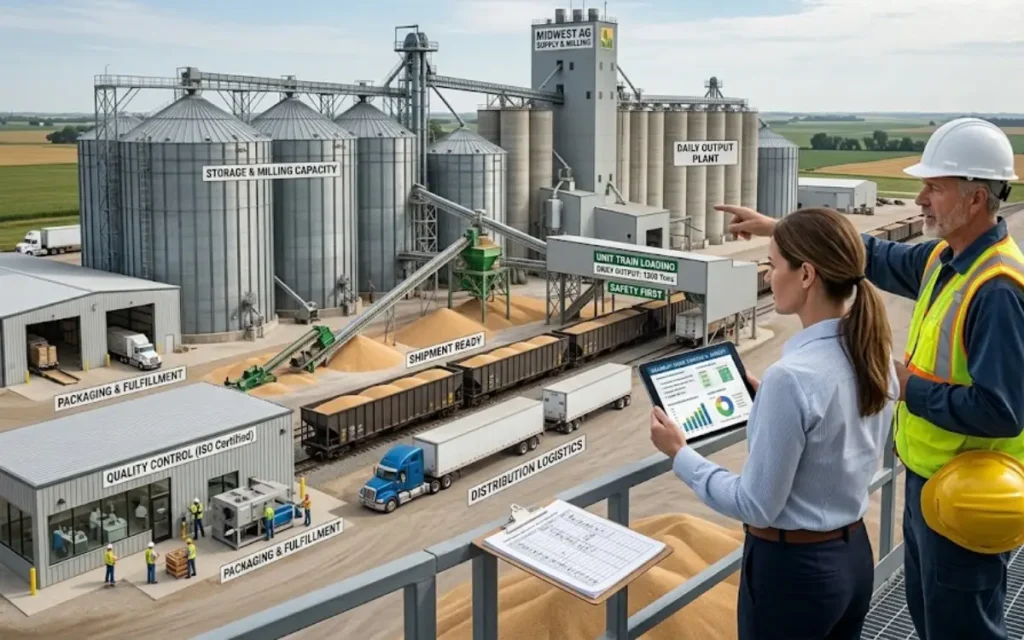
Iowa importers can evaluate scalability by comparing forecast demand with verified production, milling, storage, packaging, quality, documentation, and shipment capacity, then testing the supplier through samples, commercial orders, records, and measurable delivery performance.
What Evidence Should Importers Request?
A practical evaluation examines:
- Historical shipment volumes
- Monthly and annual production capacity
- Milling and processing capacity
- Storage capacity
- Packaging capabilities
- Existing customer commitments
- Quality specifications
- Testing and inspection records
- Lot traceability procedures
- Food-safety documentation
- Export documentation processes
- Previous shipment performance
- Contingency arrangements
The evidence needs to match the proposed contract. A supplier offering 2 containers per month requires a different capacity assessment from a supplier offering 50 containers annually.
How Should Capacity Be Compared With Demand?
Importers can establish a simple capacity ratio:
Available capacity ÷ Required contract volume = Capacity coverage ratio
For example, if an importer requires 6,000 metric tons annually and a supplier has 12,000 metric tons of genuinely available annual capacity after existing commitments, the capacity coverage ratio is 2.0.
The calculation does not guarantee delivery. It provides a starting point for evaluating operational headroom.
What Should a Long-Term Contract Consider?
A long-term contract needs measurable specifications for quantity, quality, packaging, shipment schedules, documentation, inspection, and corrective actions.
Capacity should also be reviewed when the buyer increases volume. A supplier approved for 2,000 metric tons per year is not automatically approved for 8,000 metric tons without reassessing capacity and operational controls.
How Does the 2026 U.S. Rice Market Affect Supplier Capacity Decisions?
The 2026 U.S. rice outlook makes capacity assessment more important because USDA forecasts record imports of 49.8 million hundredweight for 2026/27 while domestic production remains constrained and ending stocks remain below the previous year’s level.
USDA’s August 2026 outlook places U.S. 2026/27 all-rice imports at a record 49.8 million hundredweight, while production is forecast at 158.4 million hundredweight and ending stocks at 36.0 million hundredweight. USDA also forecasts a 2026/27 season-average farm price of $14.90 per hundredweight.
These figures show why import sourcing forms an important part of U.S. rice procurement. For Iowa buyers, the issue is not simply whether imported rice exists in the market. The procurement question is whether a specific supplier can provide the required grade and quantity repeatedly.
For aromatic rice, supplier capacity also connects directly to international sourcing. USDA has identified basmati from India and Pakistan among the major Asian aromatic rice categories entering the U.S. long-grain import market.
This makes scalability a procurement variable alongside price, quality, compliance, lead time, and product specification.
Iowa importers assess supplier scalability because long-term rice procurement depends on repeatable capacity rather than one successful shipment. Production, processing, storage, packaging, quality control, compliance records, and logistics must all scale together to support reliable contracted supply.
Supplier scalability is therefore a risk-control concept. It connects the supplier’s physical operations with the importer’s purchasing forecast.
The strongest assessment compares required volume against verified available capacity. It then examines whether quality, food safety, packaging, documentation, and logistics remain consistent as volume increases.
For Iowa importers purchasing Pakistani basmati or other imported rice, this approach provides a structured basis for supplier evaluation. It also creates a direct connection between current sourcing decisions and future availability.
Frequently Asked Questions
What Is Supplier Scalability in Rice Importing?
Supplier scalability is a rice exporter’s ability to increase or maintain shipment volumes while preserving product quality, processing standards, packaging specifications, documentation, and delivery schedules.
Why Do Iowa Importers Check Supplier Capacity Before Contracting?
Iowa importers check capacity to confirm that a supplier can fulfill both initial orders and future requirements. Capacity assessment reduces risks linked to shortages, shipment delays, inconsistent specifications, and emergency sourcing.
What Factors Determine a Rice Supplier’s Scalability?
Key factors include paddy sourcing, milling capacity, storage facilities, processing equipment, grading, optical sorting, quality testing, packaging capacity, workforce, documentation systems, inventory, and logistics coordination.
Why Is Milling Capacity Important for Rice Importers?
Milling capacity determines how quickly paddy becomes finished rice. A supplier with adequate milling capacity can process larger orders while maintaining agreed grades, kernel specifications, broken percentages, moisture levels, and other quality requirements.
How Does Storage Capacity Affect Rice Supply?
Storage capacity allows suppliers to maintain suitable rice inventory between procurement, processing, and shipment. Proper storage also supports moisture control, pest management, traceability, and preservation of rice quality.