AHK Rice Supplies Licensed Basmati Rice Export Programs to Texas
AHK Rice supplies Texas buyers with a documented Pakistan Basmati rice export program built around exporter credentials, product specifications, phytosanitary documentation, traceability, compliant shipment preparation, and coordinated ocean logistics. For Texas importers, the objective is not simply to find a rice seller. It is to select an exporter whose commercial and regulatory documentation can support repeat U.S. imports.
Before approving a supplier, Texas buyers should understand:
Why Texas rice importers verify export licenses before purchasing. The verification process reduces the risk of incomplete export documentation, inconsistent product identification, shipment delays, and avoidable questions during customs or food import review.
What is the best solution for Texas importers buying Pakistani Basmati rice?
The best solution is a documented export program combining an eligible Pakistani exporter, product specification control, phytosanitary certification, commercial documentation, U.S. food-import requirements, pre-shipment verification, and predictable logistics rather than relying on a supplier’s price or a generic export certificate alone.
A Texas importer should evaluate the complete transaction before issuing a purchase order. The supplier should be able to identify the rice variety, grade, crop or production information where applicable, packing format, quantity, lot details, processing specifications, and export documentation required for the shipment.
AHK Rice approaches the transaction as an export program rather than a one-time commodity sale. Its Basmati offering can be structured around commercial requirements for varieties such as 1121, Super Kernel, and 1509, with specifications agreed before production and loading.
Pakistan’s export process is increasingly digital. The Pakistan Single Window allows traders to submit export declarations electronically and routes relevant information to government agencies. For DPP-regulated commodities, phytosanitary export certificate requests can also be processed through the PSW system.
This matters because a Texas buyer needs a traceable document chain. The exporter’s commercial invoice, packing list, bill of lading, certificate of origin where required, phytosanitary certificate where applicable, and other shipment documents should describe the same commodity consistently.
The U.S. side has a separate compliance layer. FDA states that imported human food must meet U.S. requirements and that food entering the country is subject to requirements including Prior Notice, applicable facility registration, food safety requirements, and labeling rules. FDA also makes clear that it does not pre-approve individual food importers, products, labels, or shipments.
Therefore, a credible “licensed” export program should not be presented as an FDA license for Pakistani rice. It should mean that the exporter can demonstrate its legal export capability and provide the documents needed for the transaction while the U.S. importer and its broker manage their own U.S. obligations.
Why choose the USA service for Texas Basmati rice imports?
Texas buyers benefit from a coordinated USA export service because it connects Pakistani rice processing, documentation, packaging, container loading, ocean freight, and U.S. import preparation into one commercial workflow with specifications agreed before the shipment is released.
AHK Rice provides its USA rice export service for buyers requiring Pakistani rice supply into the American market. The service is designed around bulk procurement rather than consumer parcel shipping.
The first advantage is specification control. A buyer can define the variety, grain length, broken percentage, moisture range, milling requirement, packaging size, private-label requirements, and order quantity before production begins.
The second advantage is documentation coordination. Pakistan’s PSW export system now provides a single electronic interface for export declarations, while relevant government agencies process their regulatory requirements through integrated workflows.
The third advantage is phytosanitary preparation. Pakistan’s Department of Plant Protection states that export procedures can involve inspection, sampling, treatment where required, and issuance of a phytosanitary certificate according to the importing country’s requirements. Required documentation can include the commercial invoice, packing list, container information, import permit or notification where applicable, and other prescribed documents.
The fourth advantage is commercial repeatability. A restaurant distributor or ethnic grocery wholesaler does not want every shipment treated as a new experiment. The stronger model is to establish an approved specification and repeat that specification across purchase orders.
This is where the distinction between an ordinary rice trader and an export-oriented supplier becomes important. A supplier can quote a low FOB price without offering the documentation discipline needed for a U.S. import program. A structured exporter works backward from the buyer’s receiving requirements.
How do Pakistani export licenses and certificates support U.S. import compliance?
Pakistani export documentation supports U.S. import compliance by establishing shipment identity, origin, regulatory clearance, and traceability, while U.S. compliance remains the importer’s responsibility under FDA, CBP, and other applicable requirements.
Texas importers should not treat a Pakistani export certificate as a substitute for U.S. compliance. Instead, they should examine whether the supplier can produce the documents required for the specific shipment and whether all documents identify the same exporter, consignee, commodity, quantity, and container.
Pakistan’s Single Declaration process requires the trader or customs agent to be registered with PSW and provides a digital process for export declarations. The system captures consignment, financial, commodity, package, and document information.
For rice, phytosanitary documentation can be particularly important because rice is a plant product. Pakistan’s Department of Plant Protection describes the phytosanitary certificate as the result of procedures intended to meet the importing country’s phytosanitary requirements.
The buyer should also coordinate with its U.S. customs broker and FSVP personnel. FDA requires Prior Notice for applicable imported food shipments and states that most facilities manufacturing, processing, packing, receiving, or holding food must register unless an exemption applies.
FDA’s current guidance also emphasizes that food facility registration information is confidential. A buyer should therefore verify registration status through appropriate commercial channels rather than expecting a public FDA database containing every facility registration number.
For AHK Rice, the practical objective is document alignment. The purchase contract should identify the product. The packing list should identify the packed quantity. The invoice should identify the commercial quantity and value. The bill of lading should identify the shipment and parties. Certificates should correspond to the same shipment.
This documentation chain gives the Texas buyer stronger evidence when approving a supplier and preparing the shipment for U.S. entry.
What does the sample approval process cost before a Texas bulk order?
A commercial rice sample program normally costs far less than a failed container because the buyer can verify specifications before committing to bulk production, while the final sample budget depends on product quantity, packaging, courier route, laboratory testing, and requested certifications.
AHK Rice can structure sample approval in stages so the buyer does not need to begin with a full container.
The first stage is specification confirmation. The buyer provides the required Basmati variety, grain specification, broken percentage, moisture target, milling requirement, packaging format, quantity, destination, and intended use. There is normally no meaningful freight cost at this stage because the activity is document-based.
The second stage is the physical sample. A practical commercial sample can be prepared in a small retail-style or trade sample pack. The buyer should expect the sample product itself to be a relatively small cost compared with international courier charges.
For budgeting purposes, a Texas buyer can use an illustrative $75–$200 international courier allowance for a small commercial sample shipment, with the exact amount confirmed at booking. This is a planning range, not an AHK Rice tariff or guaranteed courier quotation.
The third stage is laboratory verification if required. Buyers may request analysis for moisture, broken grains, grain dimensions, purity, foreign matter, milling quality, or other parameters relevant to their specification. Laboratory fees vary by laboratory, test panel, sample quantity, and turnaround time, so they should be quoted separately rather than embedded into a generic rice price.
The fourth stage is approval. Once the buyer accepts the sample and specification, the agreed specification becomes the reference for production.
The fifth stage is pre-shipment inspection. For a serious commercial order, the buyer can request inspection or testing before container loading according to the agreed contract. This creates a stronger connection between the approved sample and the bulk shipment.
A simple commercial example is a Texas distributor evaluating 1121 Basmati for a private-label retail program. The buyer receives the sample, confirms cooking performance and grain appearance, reviews the specification sheet, approves packaging artwork, and then authorizes bulk production. The sample cost becomes a small qualification expense instead of discovering a specification problem after a 40-foot container reaches Texas.
How many shipping days should Texas importers plan for?
Texas buyers should budget roughly 36 days for a current Karachi-to-Houston FCL ocean transit example, while actual door-to-door timing can be longer because production, port handling, customs clearance, inspection, transshipment, and inland delivery are separate stages.
Current August 2026 freight-market data shows a Karachi Harbor-to-Houston 40-foot high-cube FCL example at approximately 36 days estimated transit, with a listed base-rate range around $6,344–$6,873 on the quoted sailing. Another routing through Port Qasim was shown at approximately 50 days. These are market examples, not fixed AHK Rice freight quotations, and carrier pricing changes with the cargo-ready date.
For planning, a Texas importer can use the following working schedule:
| Stage | Planning time |
|---|---|
| Specification and commercial approval | 2–5 days |
| Sample preparation and courier | 3–10+ days |
| Production and packing | 7–15 days |
| Export documentation and loading | 2–5 days |
| Karachi–Houston ocean transit | About 36 days current example |
| U.S. clearance and inland delivery | Variable |
The total order cycle is therefore longer than the vessel transit alone. A buyer should avoid promising customers an arrival date based only on the carrier’s port-to-port estimate.
The 2026 shipping environment also requires flexibility. Global container routes have continued to experience disruption, and carriers have adjusted services in response to geopolitical conditions and route changes. Recent reporting indicates that some services have resumed Suez routing while other networks remain exposed to additional fuel, insurance, and routing costs.
AHK Rice can therefore plan the shipment around a cargo-ready date rather than presenting one transit number as a guaranteed delivery date.
What factors determine the final price for Texas buyers?
The final landed cost depends on rice variety and grade, grain specifications, processing, packaging, order quantity, Incoterm, ocean freight, insurance, inspection, documentation, customs brokerage, duties or tariffs where applicable, and inland delivery to the Texas destination.
The rice specification is the first major variable. Extra-long-grain Basmati, lower broken percentages, premium milling, aging, specialized sorting, and custom packaging can increase the product cost.
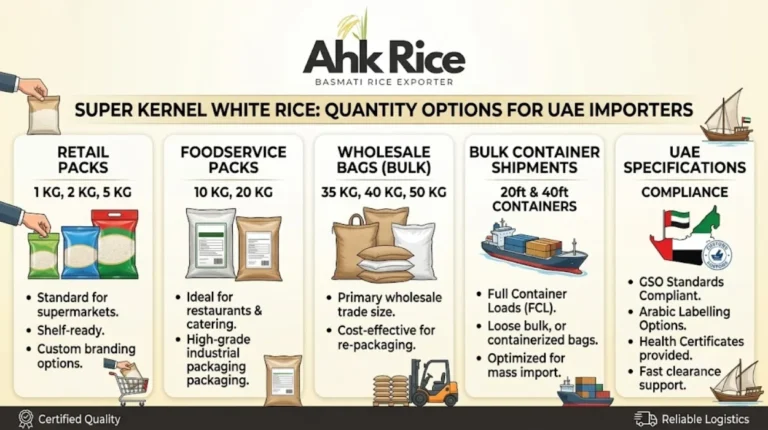
Packaging is another variable. A buyer purchasing 40-pound commercial bags for wholesale distribution will have a different cost structure from a private-label program requiring custom printed retail bags and additional packaging preparation.
Container utilization also affects economics. A full-container program normally produces a different per-kilogram logistics cost from small shipments because freight and handling charges are distributed over more product.
Ocean freight is highly variable. A current market example for a 40-foot high-cube Karachi-to-Houston FCL was approximately $6,344–$6,873 at the time of the quoted August 2026 rate, but the provider explicitly notes that freight depends on cargo-ready date and other shipment variables.
U.S. entry costs must also be separated from the supplier’s product price. Customs brokerage, port charges, examinations, demurrage, detention, inland trucking, and applicable government charges can materially change the final landed cost.
For this reason, AHK Rice should quote against a defined specification and Incoterm instead of publishing one universal Texas price. A professional quote should identify the product, quantity, packing, loading point, destination, trade term, validity period, and included documentation.
What results can Texas buyers expect from a controlled export program?
A controlled export program should produce clearer specifications, fewer documentation surprises, more predictable shipment planning, stronger lot traceability, easier repeat purchasing, and better visibility into landed cost compared with buying rice through an undocumented spot transaction.
The first measurable result is specification consistency. The buyer has an approved product reference before production rather than evaluating the commodity only after arrival.
The second is documentation consistency. The same commercial description can flow through the purchase order, invoice, packing list, certificates, and shipping documents.
The third is better shipment planning. A buyer can work from a production date, cargo-ready date, vessel schedule, estimated Houston arrival, customs process, and inland delivery window.
The fourth is easier repeat ordering. Once a Texas distributor approves a specification, future purchase orders can reference the same quality parameters instead of restarting supplier qualification.
The fifth is lower commercial uncertainty. The buyer can separate product price, freight, documentation, inspection, customs, and inland logistics when calculating landed cost.
AHK Rice’s role is strongest when these elements are treated as one supply program. The exporter is not replacing the buyer’s U.S. customs broker, FSVP responsibilities, or regulatory advisers. Instead, it provides the Pakistan-side documentation and shipment preparation needed for the transaction to move cleanly into the U.S. import process.
How should a Texas importer decide whether AHK Rice is ready for a bulk order?
Approve the supplier when its product specification, export credentials, shipment documentation, sample quality, production capability, packaging, logistics plan, and commercial terms can all be verified before payment and matched against the importer’s U.S. compliance workflow.
A practical decision test is simple.
First, confirm the exact Basmati variety and quality specification. Do not approve a supplier using only the words “premium Basmati.”
Second, request the exporter’s relevant business and export documentation and verify that the company information is consistent across the commercial documents.
Third, approve a physical sample before committing to a container. If the product will carry a private label, approve the final packaging specification separately.
Fourth, confirm the document list before production. This should include the commercial invoice, packing list, shipping documentation, applicable certificates, and any product-specific regulatory documentation required for the shipment.
Fifth, have the U.S. importer or customs broker confirm the entry requirements. FDA makes clear that imported food must comply with U.S. requirements and that Prior Notice is part of the applicable import process.
Sixth, obtain a quotation that separates rice, packaging, freight, inspection, and other charges. This makes the offer easier to compare against another Pakistani supplier.
Finally, compare the supplier’s total execution capability rather than choosing the lowest headline price. The stronger exporter is the one that can reproduce the approved specification and documentation on the next shipment.
AHK Rice is positioned for this decision model because its Pakistan-side export workflow can combine Basmati sourcing, processing, packaging, export documentation, and logistics coordination. For Texas buyers, that creates a more controlled route from supplier approval to container arrival.
How can a Texas importer start an AHK Rice export program?
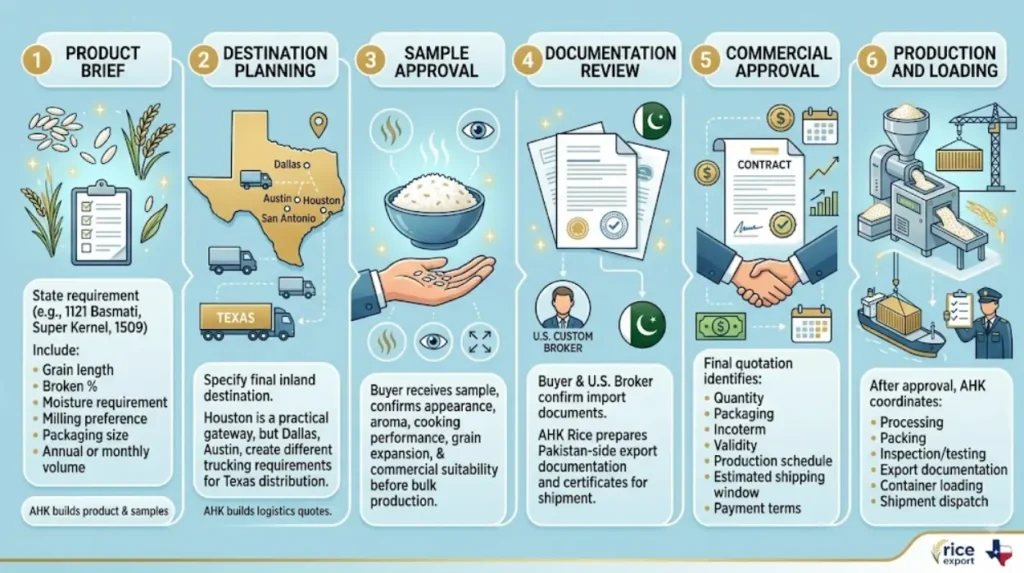
Start by sending the required rice specification, quantity, packaging format, Texas destination, preferred Incoterm, target delivery window, and documentation requirements so AHK Rice can build a product, sample, logistics, and commercial quotation around the actual import program.
The first step is the product brief. State whether the requirement is 1121, Super Kernel, 1509, or another Basmati specification. Include grain length, broken percentage, moisture requirement, milling preference, packaging size, and annual or monthly volume.
The second step is destination planning. Houston is a practical gateway for Texas distribution, but the final inland destination should be stated because Dallas, Austin, San Antonio, Houston, and other Texas receiving points create different trucking requirements.
The third step is sample approval. The buyer should receive the agreed product sample and confirm appearance, aroma, cooking performance, grain expansion, and commercial suitability before bulk production.
The fourth step is documentation review. The buyer and its U.S. broker should confirm the required import documents while AHK Rice prepares the Pakistan-side export documentation and certificates applicable to the shipment.
The fifth step is commercial approval. The final quotation should identify quantity, packaging, Incoterm, validity, production schedule, estimated shipping window, and payment terms.
The sixth step is production and loading. After approval, AHK Rice can coordinate processing, packing, inspection or testing where requested, export documentation, container loading, and shipment dispatch.
For Texas importers, the correct buying decision is therefore not simply “Which exporter has the cheapest Basmati?” It is “Which exporter can repeatedly supply the approved specification with the documentation, logistics coordination, and commercial controls required for U.S. distribution?”
That is the basis of a defensible Pakistan-to-Texas sourcing program, and AHK Rice can structure the process around those requirements. To begin a product-specific quotation and sample discussion, submit your requirements through the rice export quotation request.
Frequently Asked Questions
What does AHK Rice’s Texas export program include?
AHK Rice’s Texas export program can include Basmati rice sourcing, processing, quality specifications, custom packaging, export documentation, container loading, and international shipping coordination.
Does AHK Rice provide licensed Basmati rice for Texas importers?
AHK Rice provides export documentation and compliance support for Pakistan Basmati rice shipments. Texas importers should verify the exporter’s applicable credentials and coordinate U.S. entry requirements with their customs broker.
Which Pakistani Basmati varieties can Texas buyers source from AHK Rice?
Texas buyers can source Pakistani Basmati varieties including 1121, Super Kernel, and 1509, subject to availability, agreed specifications, quantity, packaging, and commercial requirements.
How does the Basmati rice sample process work?
The buyer first provides product specifications and packaging requirements. AHK Rice then prepares a representative sample for evaluation. Buyers can assess grain appearance, aroma, cooking performance, and agreed quality parameters before approving bulk production.
How much does a Basmati rice sample shipment to Texas cost?
A small international commercial sample may require approximately $75–$200 for courier and related shipment costs, depending on weight, destination, service level, and carrier. Laboratory testing, when requested, is normally quoted separately.
How long does shipping from Pakistan to Texas take?
A current Karachi-to-Houston ocean transit example is approximately 36 days port-to-port. Total delivery takes longer when production, export handling, customs clearance, inspections, and inland transportation are included.
What documents are required for importing Pakistani rice into Texas?
Typical documentation can include a commercial invoice, packing list, bill of lading, applicable phytosanitary certificate, certificate of origin where required, and other documents associated with U.S. food-import compliance. Requirements depend on the shipment.
Does FDA approve Pakistani Basmati rice before import?
FDA does not generally pre-approve individual imported food products or shipments. Imported food must comply with applicable U.S. requirements, while the importer is responsible for completing the relevant entry and food-import procedures.
What factors affect the price of Pakistani Basmati rice in Texas?
Price depends on rice variety, grain specifications, broken percentage, processing, aging where applicable, packaging, order quantity, Incoterm, ocean freight, inspection, insurance, customs-related costs, and inland transportation.