Why Do Texas Rice Importers Verify Export Licenses Before Purchasing?
Texas rice importers verify Pakistani exporters’ licenses and shipment documents because legal export authority establishes who can sell the rice, while shipment-specific certificates establish whether the consignment can legally leave Pakistan and enter the United States. The check reduces customs, food-safety, phytosanitary, documentation, and supplier-identity risks.
Pakistan is a major global rice exporter, and the United States imports significant volumes of aromatic rice, including Basmati from Pakistan and India. USDA reports that more than 60% of U.S. rice imports are aromatic varieties from Asia. Texas importers therefore treat supplier documentation as part of commercial due diligence rather than as a formality.
For Pakistani rice, the term export license requires careful definition. Pakistan’s current export system uses the Pakistan Single Window (PSW), Customs registration, export declarations, and regulatory certificates rather than relying on one universal “rice export license.” PSW provides a unified platform for Customs and other government agencies, including electronic processing of licenses, permits, certificates, and other regulatory documents.
What does an export license mean for Pakistani rice shipments?
For Pakistani rice, export authorization is a compliance chain covering exporter registration, Customs access, export declarations, regulatory certificates, and shipment documents. Texas buyers verify this chain to confirm that the supplier is legally established and the specific rice shipment has valid export documentation.
A Pakistani rice exporter begins with business and trade registration. The Pakistan Single Window subscription process captures business information and verifies subscriber details under Know Your Customer procedures. PSW registration then enables traders to conduct cross-border transactions and access Customs and other government-agency services.
The export declaration is another critical component. PSW’s Single Declaration—Export provides one electronic interface for submitting export information. The declaration contains consignment, financial, commodity, package, and document information. The system routes relevant information to Customs and other regulatory agencies.
For rice, phytosanitary documentation is particularly important because rice is an agricultural commodity. Pakistan’s Department of Plant Protection (DPP) issues phytosanitary certificates according to importing-country requirements. Rice export consignments covered by the DPP process use PSW for electronic phytosanitary certification linked to the export declaration.
A Texas buyer therefore should not treat a scanned “license” as the complete compliance record. The stronger verification approach connects the exporter identity, Customs registration, export declaration, phytosanitary certificate, commercial invoice, packing list, certificate of origin where required, and transport documents.
How does the Pakistani rice export process work?
The process starts with registered exporter information, continues through product and consignment declaration, adds required regulatory certificates, completes Customs clearance, and ends with shipment documentation. Each document connects the exporter, rice, quantity, destination, and shipment.
The process follows a defined sequence.
First, the exporter maintains an active PSW profile and Customs registration. PSW describes subscription as the first step for accessing cross-border trade services and regulatory procedures. A trader must complete the required registration process before filing a trade declaration.
Second, the exporter prepares commercial information. This includes the buyer, destination, product description, quantity, packages, financial instrument, delivery terms, and commodity information. The exporter enters these details into the Single Declaration system.
Third, the exporter handles regulatory requirements. For rice, DPP phytosanitary certification forms an important part of the export process. DPP states that export procedures include inspection, sampling, treatment when required, and issuance of a phytosanitary certificate according to the importing country’s requirements.
Fourth, the exporter uploads supporting documents. DPP identifies documents such as the commercial invoice, packing list, container information, treatment certificate when applicable, and other documents prescribed for the shipment.
Fifth, Customs reviews the export declaration and supporting information. The PSW workflow allows the declaration to be reviewed and validated electronically. This creates a structured record linking the shipment to the registered trader.
Sixth, the shipment moves through logistics and document control. The final export file normally includes the commercial invoice, packing list, bill of lading, certificate of origin where applicable, phytosanitary certificate where required, and other certificates requested by the buyer or destination authorities.
This structure explains why an importer checks licensing before purchasing. The buyer is validating the supplier’s ability to produce a legally documented export transaction, not simply checking whether a company has a business name.
Which documents should Texas rice importers verify?
Texas importers should verify exporter identity, Customs and PSW registration status, export declaration details, phytosanitary certification, commercial documents, origin information, and shipment records. The exact document set depends on rice type, destination requirements, transaction terms, and applicable U.S. regulations.
Exporter identity and registration
The exporter name should remain consistent across the quotation, contract, commercial invoice, packing list, export declaration, and shipping documents. Differences between company names create traceability problems.
PSW provides electronic registration and Customs access for traders. Its subscription system also verifies subscriber information through KYC procedures.
Export declaration
The Single Declaration identifies the transaction and commodity. A buyer can use the declaration information supplied by the exporter to cross-check product description, quantity, packages, destination, and shipment details.
Phytosanitary certificate
A phytosanitary certificate confirms that a plant or plant product meets applicable phytosanitary requirements. Pakistan’s DPP states that export certification follows the importing country’s requirements and involves inspection, sampling, treatment when required, and certification.
Commercial invoice and packing list
The commercial invoice establishes the commercial transaction. The packing list identifies package counts and shipment contents. Both documents should agree with the declared quantity and product specification.
Certificate of origin
A certificate of origin identifies the country where the goods originate. Pakistan’s Trade Development Authority of Pakistan (TDAP) module on PSW supports electronic certificates of origin, including digital verification features such as QR codes.
Transport documents
The bill of lading identifies the carrier, shipment, consignee, port information, container information, and cargo movement. It should align with the commercial and regulatory documentation.
Why does license verification matter for U.S. food compliance?
A Pakistani export authorization does not replace U.S. import compliance. Texas buyers verify the Pakistani side of the transaction while separately meeting U.S. requirements covering FDA food facilities, Prior Notice, FSVP responsibilities, Customs entry, labeling, and applicable agricultural controls.
This distinction is essential.
The U.S. Food and Drug Administration (FDA) states that food importers are responsible for ensuring imported foods are safe, sanitary, and properly labeled. FDA does not pre-approve individual food importers, products, labels, or shipments. Instead, imported food remains subject to U.S. regulatory requirements and inspection.
For human food such as rice, the foreign facility handling the food generally needs FDA registration when applicable, and the shipment requires Prior Notice before importation unless an exemption applies.
The Foreign Supplier Verification Program (FSVP) is another U.S. requirement. FSVP places responsibilities on the U.S. importer for verifying that foreign suppliers produce food in a manner that meets applicable U.S. food-safety requirements. FDA maintains information concerning FSVP importers and distinguishes the FSVP importer from the importer of record.
This creates two compliance layers.
The Pakistani exporter must satisfy Pakistan’s export procedures.
The U.S. importer must satisfy U.S. import requirements.
Both sides must provide consistent information.
What are the key components of a compliant Pakistani rice shipment?
A compliant shipment combines legal exporter identity, accurate commodity classification, export declaration, phytosanitary controls, commercial documentation, origin evidence, transport records, and U.S. import requirements. Compliance depends on consistency between these components, not on one certificate alone.
The first component is supplier identity. The company selling the rice must match the registered exporter and documentary record.
The second is commodity identity. Rice varieties such as 1121 Basmati, Super Kernel, and 1509 Basmati need accurate descriptions and appropriate tariff classification.
The third is quality specification. Buyers document grain length, broken percentage, moisture, milling quality, crop year, variety, packaging, and tolerance levels in the purchase specification.
The fourth is phytosanitary control. DPP’s export procedure requires compliance with the importing country’s phytosanitary requirements and provides for inspection, sampling, treatment, and certification.
The fifth is commercial documentation. Invoice, packing list, certificate of origin when applicable, and transport documents establish the commercial and logistical chain.
The sixth is U.S. food compliance. FDA requirements include applicable facility registration, Prior Notice, food safety, and truthful English labeling.
The seventh is entry compliance. U.S. Customs and Border Protection and other applicable agencies assess imported merchandise at entry. Agricultural requirements also depend on the commodity and country of origin. USDA APHIS directs importers to its Agricultural Commodity Import Requirements database for commodity-specific plant and plant-product rules.
What benefits does export-license verification provide?
License verification gives Texas buyers documentary confidence before money, inventory, and shipping capacity are committed. It helps establish supplier legitimacy, improve traceability, identify missing certificates, reduce clearance problems, and create a repeatable compliance process for future rice purchases.
The first benefit is supplier verification. A buyer can confirm that the exporter operates through Pakistan’s formal trade infrastructure.
The second benefit is document consistency. A buyer can compare company names, product descriptions, quantities, container numbers, and origin information before shipment.
The third benefit is risk reduction. Missing regulatory documents can create delays, additional inspection, document correction, or shipment problems.
The fourth benefit is traceability. A documented transaction creates a clearer chain from exporter to buyer to shipment.
The fifth benefit is repeatability. Importers purchasing 10, 20, or 50 containers need a process that works for every shipment rather than a one-time document review.
The sixth benefit is better supplier qualification. License verification becomes one part of a broader supplier assessment covering quality specifications, food-safety controls, production capacity, packaging, documentation, and logistics.
Where do Texas importers use export-license verification?
Texas importers use export-license verification during supplier onboarding, quotation review, contract approval, pre-shipment checks, customs-document preparation, and repeat-order reviews. The process is especially relevant for distributors, wholesalers, food-service suppliers, private-label companies, and ethnic retail channels.
A wholesale distributor verifies the exporter before committing to recurring container purchases.
A food-service supplier checks documentation before importing rice for restaurants, catering companies, and institutional kitchens.
A private-label importer verifies the exporter before approving branded retail packaging and production.
A specialty grocery distributor checks origin and shipment documentation before importing Basmati rice for retail stores.
A procurement team can also make verification part of its supplier approval checklist. The same checklist can then be reused for each new purchase order.
The verification process becomes especially important when the importer buys multiple grades. For example, 1121 Basmati, Super Kernel, and 1509 Basmati can have different specifications, packaging formats, and commercial descriptions. The buyer should ensure that the documents describe the actual product being shipped.
What common misconceptions do buyers have about Pakistani rice export licenses?
The most common misconception is that one Pakistani “rice export license” alone proves U.S. import compliance. In practice, Pakistan export authorization, shipment certificates, and U.S. import requirements are separate compliance layers that must work together.
One misconception is that a company registration equals shipment authorization. It does not. The exporter must complete the applicable export declaration and regulatory procedures for the transaction.
Another misconception is that a Pakistani certificate guarantees U.S. entry. It does not. U.S. authorities apply their own import, food-safety, Customs, and agricultural requirements. FDA specifically states that imported foods must meet U.S. requirements and remain subject to inspection.
A third misconception is that phytosanitary certification is the same as food-safety certification. It is not. Phytosanitary certification addresses plant-health requirements. FDA requirements address food safety, facilities, labeling, Prior Notice, and other applicable controls.
A fourth misconception is that a scanned license is enough. A buyer needs a connected documentary record. The exporter identity, declaration, invoice, packing list, certificate, and shipment information should agree.
A fifth misconception is that Texas has a separate rice-import license that replaces federal compliance. Imported food entering Texas is primarily governed by federal U.S. import and food-safety requirements, while state requirements can apply to business operations and distribution.
How should a Texas importer verify a Pakistani rice exporter?
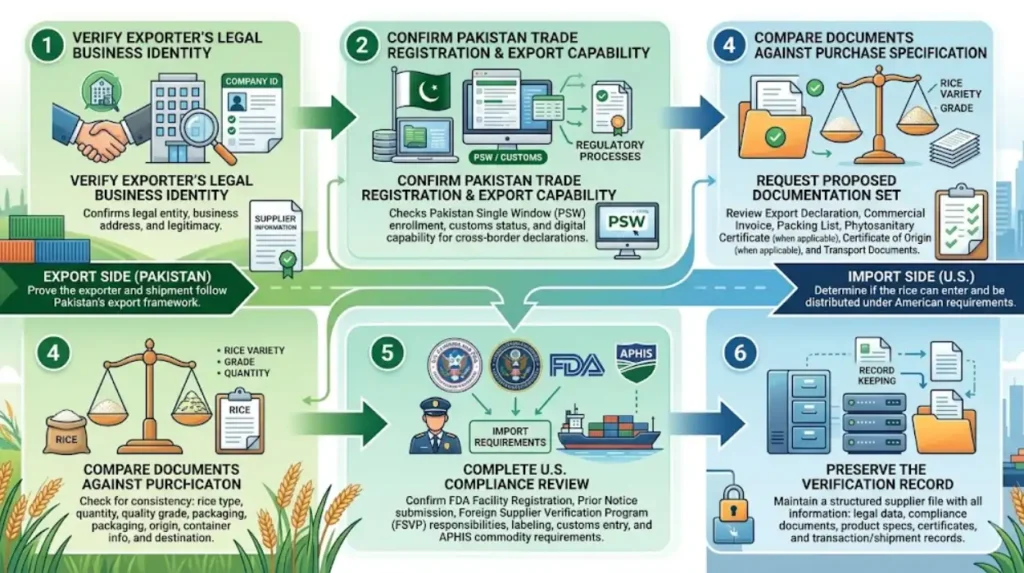
A practical verification sequence starts with exporter identity, confirms Pakistan trade registration and export capability, checks shipment-specific certificates, compares commercial documents, verifies U.S. import requirements, and records every document before approving the purchase order.
Start with the supplier’s legal business identity.
Then verify the exporter’s PSW and Customs trade capability. PSW provides the digital infrastructure for cross-border declarations and regulatory processes.
Next, request the proposed documentation set. Review the export declaration, commercial invoice, packing list, phytosanitary certificate when applicable, certificate of origin when applicable, and transport documents.
Then compare the documents against the purchase specification. Check the rice variety, grade, quantity, packaging, country of origin, container information, and destination.
Next, complete the U.S. compliance review. Confirm applicable FDA facility registration, Prior Notice, FSVP responsibilities, labeling requirements, Customs entry requirements, and any APHIS commodity-specific requirements.
Finally, preserve the verification record. A structured supplier file should contain the legal exporter information, compliance documents, product specifications, certificates, transaction documents, and shipment records.
This approach turns export-license verification into a repeatable procurement control. It also explains the relationship between Pakistani export documentation and U.S. import compliance: the Pakistani side proves that the exporter and shipment follow Pakistan’s export framework, while the U.S. side determines whether the food can enter and be distributed under American requirements.
For the next stage, readers comparing the Pakistani documentation framework with U.S. importer obligations should continue with:
How Pakistani rice export licenses support USA import compliance.
Frequently Asked Questions
Why do Texas rice importers verify Pakistani export licenses?
Texas rice importers verify export documentation to confirm supplier legitimacy, shipment traceability, regulatory compliance, and the accuracy of documents required for U.S. food imports.
Does Pakistan have one specific rice export license?
No. Pakistani rice exports operate through a broader compliance framework involving exporter registration, Pakistan Single Window, Customs procedures, export declarations, and applicable regulatory certificates.
What documents should a Texas importer request from a Pakistani rice exporter?
Common documents include the commercial invoice, packing list, export declaration, phytosanitary certificate when required, certificate of origin when applicable, and bill of lading.
Is a Pakistani export license enough for U.S. import compliance?
No. Pakistani export compliance and U.S. import compliance are separate requirements. U.S. importers must also meet applicable FDA, Customs, food-safety, labeling, Prior Notice, and FSVP requirements.
What is the Pakistan Single Window?
Pakistan Single Window is Pakistan’s digital trade platform for submitting import and export information and accessing services from Customs and other government regulatory agencies.
Why is a phytosanitary certificate important for rice exports?
A phytosanitary certificate demonstrates compliance with applicable plant-health requirements for the importing country. Rice shipments can require inspection, sampling, treatment, and certification before export.
Do Texas rice importers need to verify the exporter before placing an order?
Yes. Verification before purchase helps identify missing documents, inconsistent supplier information, and compliance issues before payment, production, and shipment arrangements are completed.
What U.S. requirements apply to imported Pakistani rice?
Applicable requirements include FDA food regulations, Prior Notice, facility registration where required, Foreign Supplier Verification Program responsibilities, Customs entry procedures, labeling rules, and applicable agricultural controls.
Does an export certificate guarantee that rice will enter the United States?
No. Pakistani export documents demonstrate compliance with Pakistan’s export procedures. U.S. authorities separately apply federal import, food-safety, Customs, and agricultural requirements.
What should importers check on rice export documents?
Importers should compare the exporter name, rice variety, grade, quantity, packaging, country of origin, container information, consignee, destination, and shipment details across all documents.