Why Are Scottish Food Buyers Looking for Transparent Rice Supply Chains?
Scottish food buyers want transparent rice supply chains because traceability connects the farm, rice mill, exporter, importer, warehouse, and retail shelf. This visibility supports food safety, authenticity, stock control, supplier verification, and faster recalls across Scotland’s food distribution network. UK food businesses must maintain traceability records covering suppliers, customers, products, quantities, and transaction dates.
Basmati rice needs traceability because buyers need evidence about variety, origin, processing, testing, packaging, and movement. UK authorities also classify rice according to processing state, grain characteristics, and product type.
What Is a Transparent Rice Supply Chain?
A transparent rice supply chain records the identity, origin, processing, testing, packaging, ownership, and movement of rice from cultivation through import, distribution, and retail sale.
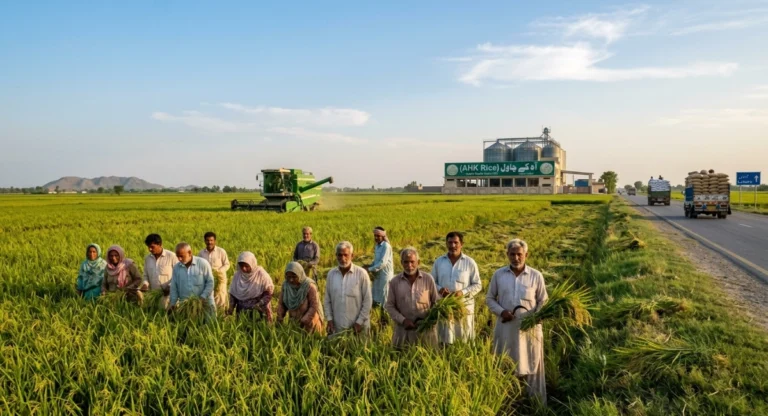
Rice traceability begins at cultivation. Farmers cultivate paddy in recognised rice-growing regions. Pakistan produces Basmati rice mainly across Punjab’s irrigated agricultural areas. The crop moves from farms to collection points and rice mills.
The mill records the incoming paddy, crop information, processing activity, and finished rice specification. Export documentation then connects the processed batch with packaging, shipment, and destination information.
The Scottish buyer receives a product with a traceable commercial history. That history can include supplier identity, product description, batch number, quantity, processing details, certificates, and shipping documents.
UK food businesses must keep traceability information available for inspection. Records include supplier details, customer details, product type, quantity, and transaction dates.
Transparent supply chains therefore convert a rice shipment from an anonymous commodity into an identifiable food product.
With the definition established, the next question is how this traceability moves through each supply-chain stage.
How Does Basmati Rice Move From Farm to Scottish Shelf?
Basmati rice moves through cultivation, harvesting, milling, grading, testing, packaging, dispatch, import clearance, warehousing, distribution, and retail before reaching Scottish consumers.
How Is Basmati Rice Cultivated and Harvested?
Farmers cultivate Basmati rice in suitable agricultural regions using irrigation, crop management, and seasonal harvesting. Paddy contains the rice grain inside its protective husk.
Harvesting removes mature paddy from the field. Farmers then transport the harvested paddy for controlled handling and milling.
Farm-level records establish the first traceability point. These records identify the agricultural source and connect the crop with later processing activities.
How Is Paddy Processed Into Export Rice?
Rice mills transform paddy into finished rice through controlled mechanical operations. A typical sequence includes cleaning, dehusking, polishing, grading, sorting, and packing.
The process follows these steps:
- Clean the paddy to remove stones, dust, straw, and other foreign material.
- De-husk the grain to remove the outer husk.
- Polish the grain to achieve the required surface appearance.
- Grade the rice according to grain size and quality characteristics.
- Sort the rice to remove defective grains and unwanted material.
- Test the batch against agreed physical and food-safety specifications.
- Pack the rice into the selected retail or wholesale packaging.
UK tariff guidance recognises husked, milled, polished, glazed, parboiled, and broken rice categories. Grain length and length-to-width ratio also influence classification.
How Does Rice Reach Scotland?
Exporters load finished rice into shipping containers with commercial and shipping documentation. The shipment then moves through international freight channels toward the UK.
Importers clear the consignment through the applicable UK import process. Rice can also fall under specific agricultural licensing and quota arrangements. Current UK notices continue to regulate certain rice import quotas.
The importer then receives the shipment into a warehouse. Distribution connects the imported stock with wholesalers, food manufacturers, restaurants, caterers, and retailers across Scotland.
The complete movement creates a chain of linked records rather than a single supplier invoice.
What Are the Key Components of Rice Supply Chain Transparency?
The core components are origin records, batch identification, processing records, laboratory testing, certificates, packaging information, shipping documents, warehouse records, and customer traceability.
What Does Origin Traceability Show?
Origin traceability identifies where rice originates and connects the finished product with its agricultural and processing source.
For Basmati rice, origin matters because the product name carries specific expectations around variety and authenticity. UK surveillance found authenticity failures in Basmati samples, including products exceeding the 7% non-Basmati rice limit specified by the cited BRC Code of Practice.
What Does Batch Traceability Show?
Batch traceability connects a defined quantity of rice with processing, testing, packaging, and dispatch records.
A batch number allows an importer to identify affected stock during a quality investigation. The same identifier can connect warehouse inventory with customer deliveries.
What Do Certificates and Tests Show?
Certificates and laboratory reports provide evidence about defined product characteristics. Testing can cover moisture, broken grains, foreign matter, pesticide residues, microbiological parameters, and authenticity.
Certification schemes can include HACCP-based food-safety systems, ISO 22000 food-safety management, and BRCGS certification. Their applicability depends on the supplier, facility, customer specification, and commercial contract.
UK food imports must comply with applicable food-law requirements. Imported food placed on the GB market must meet UK requirements or recognised equivalent conditions.
What Does Packaging Traceability Show?
Packaging connects the physical bag with the commercial product specification. Labels can identify the product name, variety, net weight, origin, batch information, importer details, and required consumer information.
Packaging therefore acts as a visible traceability point between warehouse stock and the retail shelf.
These components establish the records needed to understand why Scottish buyers value supply-chain visibility.
Why Does Transparency Benefit Scottish Food Buyers?
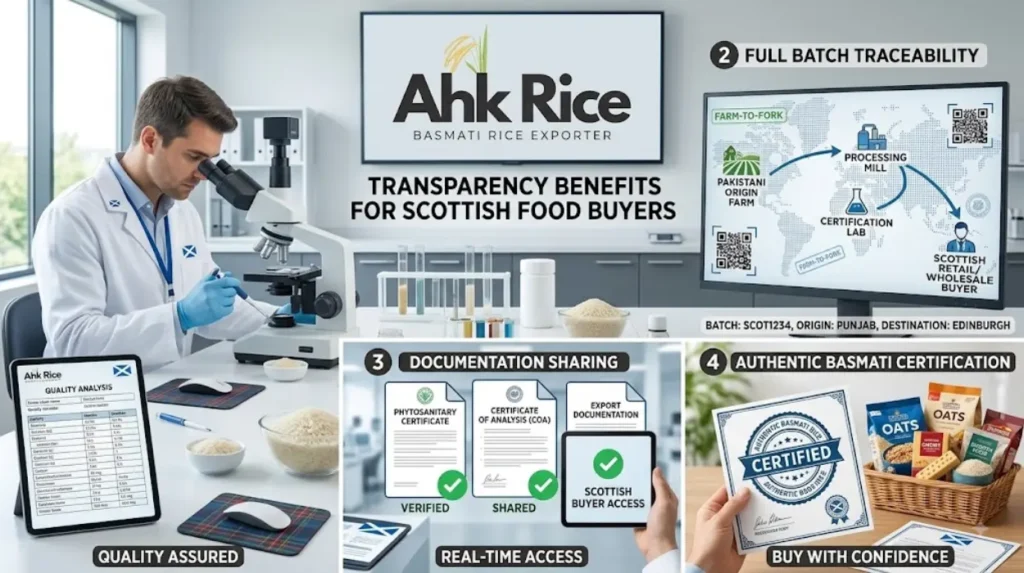
Transparent supply chains improve supplier verification, product authenticity, food-safety control, inventory management, recall speed, purchasing decisions, and communication between Scottish buyers and international rice suppliers.
How Does Transparency Improve Food Safety?
Traceability allows businesses to identify affected products quickly. UK guidance states that traceability records support rapid withdrawal or recall of unsafe food.
A rice buyer can therefore connect a quality issue with a defined product quantity instead of investigating every shipment.
How Does Transparency Support Authenticity?
Basmati authenticity depends on accurate variety identification. A transparent chain records the declared variety and supports verification through appropriate testing.
The Food Standards Agency’s 2024/25 retail surveillance programme tested 30 Basmati samples. The programme reported an 87% compliance rate for the authenticity testing reviewed.
This demonstrates why variety verification remains commercially important.
How Does Transparency Improve Stock Control?
Batch-level records help warehouses identify exactly which rice entered stock and where that stock was distributed.
A wholesaler can distinguish 1121 Basmati from Super Kernel or 1509 Basmati through product and batch records. This reduces confusion during replenishment and customer fulfilment.
How Does Transparency Support Supplier Decisions?
A buyer can compare suppliers using documented evidence instead of product claims alone. Relevant evidence includes processing records, laboratory reports, certificates, packaging specifications, and shipment documentation.
Businesses can then evaluate supply-chain performance using measurable criteria.
These benefits explain the commercial value of transparency; the next question is where Scottish buyers use these records.
Where Are Transparent Rice Supply Chains Used?
Transparent rice supply chains support retail, wholesale, food manufacturing, catering, restaurants, ethnic food distribution, private-label packaging, and institutional food procurement across Scotland.
How Do Scottish Retailers Use Traceability?
Retailers need product records that connect incoming stock with individual batches. Private-label rice also requires controlled information across the processor, packer, importer, and retailer.
A retailer can use batch information during quality investigations and product withdrawals.
How Do Food Manufacturers Use Traceability?
Food manufacturers use rice as an ingredient in prepared foods, frozen meals, sauces, snacks, and ready-to-eat products. Ingredient records connect the rice batch with finished-food production.
This connection supports controlled production and targeted investigation.
How Do Caterers Use Traceability?
Caterers purchase rice in larger quantities for restaurants, hotels, schools, hospitals, and event operations. Their purchasing records need clear product identification and supplier information.
Transparent records help purchasing teams maintain consistent specifications across repeated deliveries.
How Do Private-Label Buyers Use Traceability?
Private-label buyers require stronger control because the finished package carries their commercial identity. They need clear specifications covering rice variety, processing grade, packaging, labelling, and batch identification.
The supply chain therefore becomes part of the private-label quality system.
These use cases show that transparency operates across several commercial models rather than one retail channel.
What Are the Main Rice Supply Chain Problems and Misconceptions?
Common problems include incomplete records, unclear batch numbers, unsupported origin claims, inconsistent specifications, weak supplier documentation, and confusion between certification, testing, traceability, and legal compliance.
Is Traceability the Same as Certification?
Traceability and certification are different controls. Traceability records show where a product came from and where it moved.
Certification confirms conformity with a defined standard or system. A certified facility still needs effective batch and transaction records.
Does a Certificate Prove Basmati Authenticity?
A general food-safety certificate does not automatically prove rice variety authenticity. Variety authenticity requires appropriate verification and testing.
The FSA surveillance results show that Basmati authenticity testing can identify non-compliant products.
Does Packaging Alone Create Transparency?
Packaging provides an important identification point, but packaging alone does not establish complete traceability. The supporting supply-chain records must connect the package with its source, processing batch, testing, and commercial movement.
Is Every Rice Shipment Subject to the Same Import Controls?
Rice import requirements depend on the product, origin, quantity, tariff classification, and applicable UK rules. UK guidance identifies rice licensing and quota arrangements, while specific notices establish current quota procedures.
Scottish buyers therefore need product-specific import documentation rather than a generic compliance assumption.
These misconceptions show why transparent records need clear links between physical rice and documented evidence.
How Can Businesses Track Basmati Rice Movement From Farm to Shelf?
Businesses can track Basmati rice by linking farm origin, batch identification, mill records, laboratory tests, packaging codes, shipping documents, warehouse entries, and customer deliveries into one traceable chain.
A practical tracking system starts with the agricultural source. The next record identifies the processing batch at the rice mill.
The mill then links processing activities with quality tests and finished-product specifications. Packaging records connect the finished rice with individual bags or cartons.
Shipping documents connect the batch with container and dispatch information. Import records connect the shipment with the UK importer.
Warehouse records then identify quantities received and distributed. Customer records complete the chain by showing where the product moved after import.
For businesses developing this system, a detailed guide on [how businesses can track Basmati rice movement from farm to shelf]([Insert Link to MOFU Article]) provides the logical next step into operational traceability.
The result is a continuous evidence chain from cultivation through Scottish distribution.
What Rice Grades and Varieties Can Scottish Buyers Encounter?
Common Pakistani Basmati varieties include 1121, Super Kernel, and 1509, while processing formats include white, steam, and parboiled rice such as Sella grades.
What Is 1121 Basmati Rice?
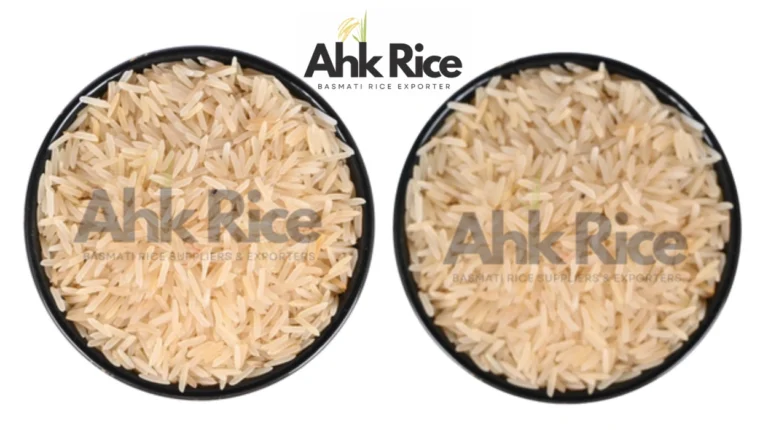
1121 Basmati is a long-grain Pakistani Basmati variety recognised for its slender grain profile and strong elongation after cooking.
Buyers can source it in different processing formats according to cooking, packaging, and market requirements.
What Is Super Kernel Basmati Rice?
Super Kernel Basmati is a Pakistani Basmati variety used across retail, food-service, and wholesale channels.
Its specification can vary by processing grade, broken percentage, moisture level, and packaging requirement.
What Is 1509 Basmati Rice?
1509 Basmati is another Pakistani long-grain variety used for export markets. It is available in processing formats selected according to buyer specifications.
Processing categories can include white rice, steam rice, and Sella rice.
What Processing Grades Are Relevant?
Processing grades describe how the paddy is treated after harvest. White rice undergoes milling and polishing. Steam rice receives controlled steaming before drying and milling. Sella rice undergoes parboiling before drying and milling.
UK tariff classification recognises parboiled rice separately from other milled rice categories.
The variety and processing grade together create the product specification that buyers need to trace.
Why Is Supply Chain Transparency Becoming a Core Buying Requirement?
Supply-chain transparency gives Scottish food buyers documented control over origin, authenticity, quality, compliance, inventory, and product movement from Pakistani cultivation through UK import and Scottish distribution.
The demand for transparency follows practical food-business requirements. Scottish buyers need to know who supplied food, what product entered their premises, how much arrived, and where that product moved.
UK traceability guidance explicitly requires records covering suppliers, customers, product types, quantities, and transaction dates.
Basmati authenticity adds another layer because the product name depends on varietal identity. Recent FSA surveillance demonstrates that authenticity failures remain detectable in the UK market.
A transparent rice supply chain therefore combines agricultural origin, mill processing, quality testing, certification, packaging, shipping, import, warehousing, and distribution records.
For Scottish food buyers, that information creates a measurable connection between the rice they purchase and the supply chain that produced it.
Frequently Asked Questions
Why do Scottish food buyers need rice traceability?
Scottish food buyers need traceability to identify suppliers, products, quantities, transaction dates, and distribution routes. UK food businesses must maintain traceability records for food supplied and received.
What information should a Basmati rice batch contain?
A Basmati rice batch should connect the product with origin, variety, processing records, quality tests, packaging identification, shipment documents, and distribution records.
How is Basmati rice authenticity checked?
Basmati authenticity can be checked through laboratory methods that identify rice varieties. The FSA’s 2024/25 surveillance programme used PCR microsatellite markers to test Basmati authenticity.
Which Pakistani Basmati varieties are commonly exported?
Pakistani export varieties include 1121, Super Kernel, and 1509 Basmati. Each variety can be supplied in different processing formats and commercial specifications.
What certifications apply to rice supply chains?
Applicable certifications include food-safety and management standards such as HACCP-based systems, ISO 22000, and BRCGS. The required certification depends on the facility, buyer, market, and contract.
Does UK law require traceability records for imported rice?
UK food businesses must maintain traceability records for food products. These records include supplier, customer, product, quantity, and transaction information.