UAE Rice Import Market Growth and Demand for Pakistani Basmati in 2026
The UAE rice import market in 2026 depends on international sourcing, consumer demand, foodservice requirements, and reliable food supply chains. Pakistani Basmati serves retail, restaurant, catering, and wholesale markets through varieties such as 1121, Super Kernel, and 1509 Basmati rice. Here is why: domestic rice cultivation does not meet the country’s full consumption needs, making imports central to market supply.
The United Arab Emirates connects Asian rice-producing countries with supermarkets, hospitality businesses, distributors, and regional re-export networks. Pakistani Basmati competes through grain length, natural aroma, cooking performance, processing grades, and price specifications. Understanding these factors helps readers explain market demand without confusing overall rice imports with demand for Basmati alone.
What Is the UAE Rice Import Market in 2026?
The UAE rice import market connects international rice producers with local wholesalers, supermarkets, restaurants, hotels, catering companies, and re-export businesses. Pakistan and India supply rice to this market, while Thai and US suppliers serve additional segments. (Source: World Bank WITS, 2024.)
Rice imports include Basmati and non-Basmati varieties. Basmati is an aromatic long-grain rice valued for its fragrance, grain separation, and elongation during cooking. Non-Basmati rice serves other requirements, including economical daily consumption and high-volume foodservice.
Dubai, Abu Dhabi, Sharjah, and other emirates create demand through different retail and hospitality channels. Dubai also connects importers with regional distribution and re-export operations. These channels make the UAE relevant to exporters seeking access to Gulf markets.
What Do the Latest Trade Figures Show?
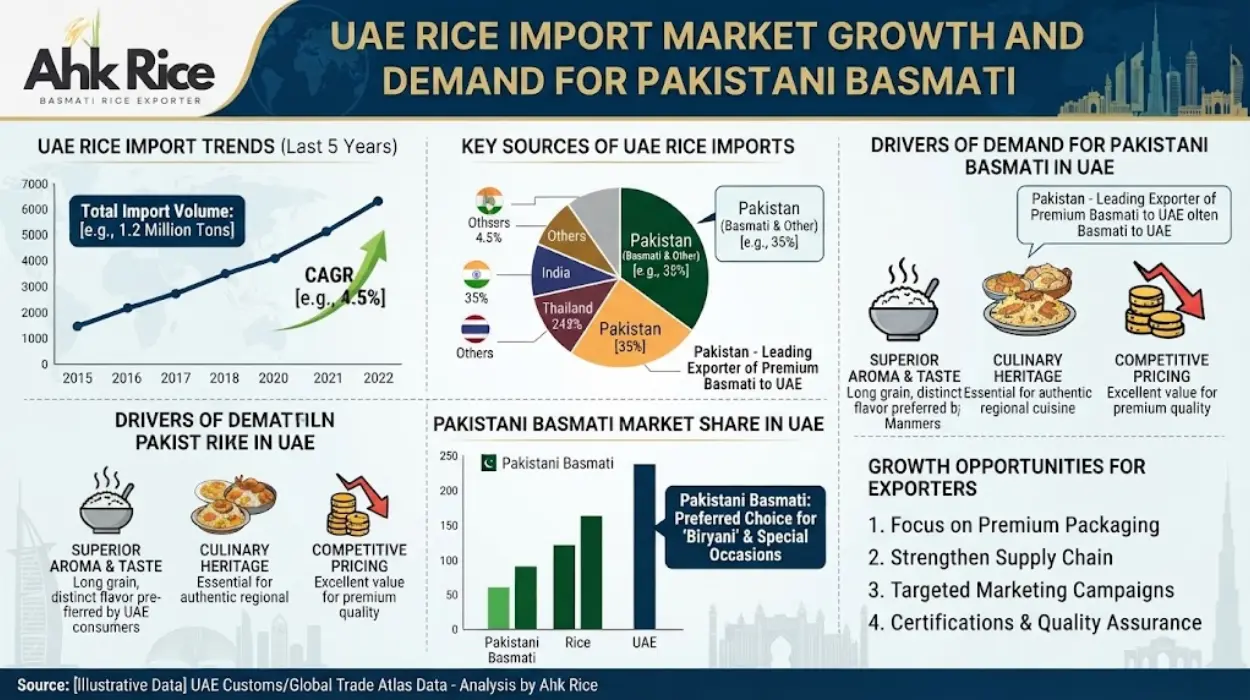
World Bank WITS data records approximately 205,315 tonnes of rice exports from Pakistan to the UAE in 2024, valued at US$173.99 million. India supplied approximately 598,411 tonnes, valued at US$487.88 million, during the same year. These figures cover rice overall, not Basmati alone. (Source: World Bank WITS, 2024.)
Pakistan’s export figures also show the importance of Basmati within its wider rice industry. During FY2024–25, Pakistan exported 808,643 tonnes of Basmati rice, worth approximately US$830.57 million. These are global export figures, not UAE-specific sales. (Source: Rice Exporters Association of Pakistan.)
The figures establish the scale of bilateral rice trade and Pakistan’s Basmati supply capacity. The next step is understanding which demand factors influence UAE purchasing decisions.
What Is Driving Demand for Pakistani Basmati Rice in the UAE?
Demand for Pakistani Basmati comes from aromatic rice consumption, South Asian food preferences, hospitality operations, retail distribution, and wholesale procurement. These channels require different combinations of grain length, processing grade, packaging, cooking performance, and landed cost.
Pakistani Basmati has established culinary relevance in dishes such as biryani, pulao, kabsa-style rice meals, and steamed rice. South Asian households and restaurants value its aroma and long cooked grains. Hotels and catering businesses also purchase rice in commercial quantities for buffet service, banquets, and large events.
Retail distributors require consistent product specifications and packaging suitable for different customer groups. A supermarket may stock small consumer packs alongside 5 kg and 10 kg bags. A wholesale distributor typically evaluates larger sacks, pallet handling, container quantities, and the consistency of repeat shipments.
Price also shapes demand. Importers compare the rice price per metric tonne, freight, insurance, customs charges, handling, and local distribution costs. A lower FOB price does not automatically produce a lower landed cost.
These demand drivers explain why UAE buyers evaluate specific Basmati grades rather than purchasing solely by country of origin.
Which Pakistani Basmati Rice Grades Serve the UAE Market?
The principal Pakistani Basmati options include 1121, Super Kernel, and 1509, supplied in white, steamed, parboiled, and other commercially specified forms. Each variety has distinct grain characteristics and processing requirements.
1121 Basmati Rice
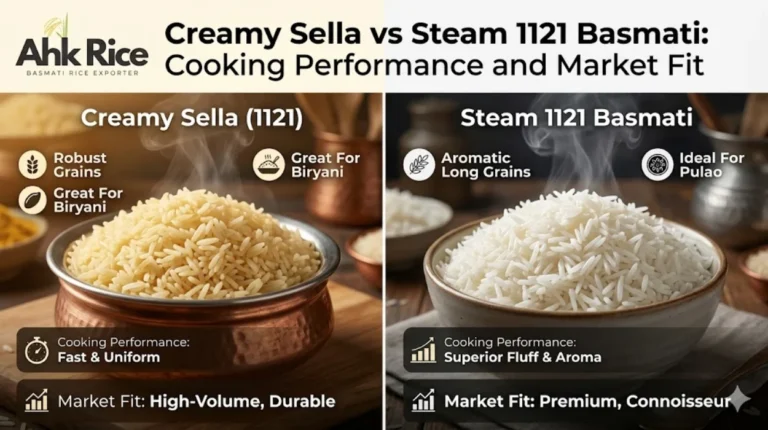
1121 Basmati is a long-grain variety known for substantial grain elongation after cooking. Exporters supply white, Steam, Golden Sella, Creamy Sella, and Brown forms. Buyers select grades according to colour, texture, cooking requirements, and retail positioning.
1121 Steam suits applications requiring a relatively white appearance and elongated cooked grains. Golden Sella and Creamy Sella undergo parboiling before milling, producing different colours and cooking characteristics. Brown 1121 retains its bran layer.
Super Kernel Basmati Rice
Super Kernel is a traditional Pakistani Basmati variety associated with natural aroma and a characteristic long, slender grain. Importers evaluate its aroma, grain uniformity, broken percentage, moisture, and cooking performance.
White and parboiled Super Kernel serve different product specifications. Retailers and distributors use these differences to establish price points and meet customer expectations. Buyers should confirm the agreed grade instead of treating every Super Kernel shipment as identical.
1509 Basmati Rice
1509 is a Basmati variety valued in commercial supply chains for its long grain and comparatively short crop duration. Export specifications can include white, Steam, and Golden Sella forms.
Foodservice buyers assess 1509 against cooking yield, grain appearance, serving requirements, and procurement budgets. Grain length, broken percentage, and moisture should appear in the purchase specification rather than remain informal expectations.
For a closer examination of these varieties, the related guide on popular Pakistani Basmati rice grades exported to the UAE in 2026 can explain their differences and market applications. Replace the placeholder destination with the published MOFU article URL.
How Is Pakistani Basmati Rice Processed for Export?
Export processing converts harvested paddy into cleaned, graded, tested, and packed rice that meets the agreed commercial specification. The process includes cleaning, dehusking, milling, sorting, quality checks, packing, and shipment preparation. Processing choices affect appearance, grain integrity, and cooking performance.
- Clean the paddy: Remove straw, dust, stones, and other foreign materials.
- De-husk the grain: Remove the outer husk to produce brown rice.
- Mill the rice: Remove bran layers for the required white-rice finish.
- Parboil selected grades: Soak, heat, and dry paddy before milling for parboiled products.
- Grade the rice: Separate grains by length, broken percentage, and agreed quality criteria.
- Sort the grains: Use appropriate sorting equipment to remove discoloured grains and remaining foreign material.
- Test the product: Check moisture, broken grains, appearance, purity, and applicable safety parameters.
- Pack the shipment: Fill approved bags, seal them, and apply the required labels.
- Prepare export documents: Match the commercial invoice, packing list, origin details, and applicable certificates to the consignment.
The processing method determines the final grade. White rice receives a polished finish, while brown rice retains bran. Steam and Golden Sella differ according to the heat treatment and drying process.
Importers should approve a representative sample and written specification before loading. The next consideration is how packaging and quality controls protect rice during distribution.
What Packaging and Quality Standards Matter to UAE Rice Importers?
UAE rice importers need packaging that protects grain quality and labels that meet applicable food requirements. Product registration, accurate descriptions, traceability, and relevant inspection documents form part of compliant market entry. Requirements depend on the product and shipment circumstances.
Packaging Options
Common commercial formats include 1 kg, 5 kg, 10 kg, 20 kg, and 40 kg bags, depending on the supplier and buyer specification. Smaller packs suit supermarkets and household consumption. Larger bags support restaurants, catering operators, and wholesale distributors.
Packaging materials include woven polypropylene bags, laminated bags, and retail pouches. Importers should specify bag weight, inner lining, printing, closure, pallet requirements, and destination-market labelling before production.
Quality Checks
Commercial quality specifications commonly define:
- Grain length and uniformity.
- Moisture content and broken-grain percentage.
- Foreign matter and discoloured grains.
- Crop year, origin, and processing grade.
- Food-safety test parameters and inspection requirements.
A certificate of analysis (COA) records test results against agreed parameters. A phytosanitary certificate addresses applicable plant-health requirements. These documents serve different purposes and are not interchangeable.
Food Safety and Certifications
The UAE government states that food products must be registered in the relevant electronic food-registration system before market handling. Food packages also require appropriate labelling and supporting import documentation. Municipal authorities oversee food safety within their respective jurisdictions. (Source: UAE Government Portal.
Applicable documents depend on the product, importing emirate, and current rules. Importers should confirm requirements with the relevant authority before dispatch.
HACCP and ISO 22000 relate to food-safety management systems. Their relevance depends on the supplier’s certification scope and the buyer’s requirements. Neither certification automatically replaces UAE registration or mandatory shipment documents.
With the product and compliance requirements established, importers can assess the practical uses of each grade.
How Is the UAE Rice Import Market Changing in 2026?
The 2026 market reflects changing export volumes, supplier competition, and demand across retail and foodservice channels. Pakistan’s shipments to the UAE and its global Basmati exports provide useful indicators, but full-year 2026 results are not yet available.
Trade reporting published in January 2026 identified the UAE as Pakistan’s leading rice destination during December 2025. Pakistan shipped 74,897 tonnes of rice to the UAE that month, including 16,850 tonnes of Basmati. These monthly figures describe a specific period, not the entire 2026 market. (Source: Gulf News, January 18, 2026.)
Competition remains an important market factor. In 2024, India exported more total rice to the UAE than Pakistan, according to World Bank WITS data. Pakistani suppliers therefore compete through product specifications, pricing, processing consistency, packaging, and shipment reliability.
For importers, market growth is not simply an increase in tonnage. Changes in grade mix, consumer pack sizes, restaurant demand, and re-export activity also affect procurement. Buyers should compare current customs data with their own sales records before making annual purchasing forecasts.
What Are the Main Uses of Pakistani Basmati Rice in the UAE?
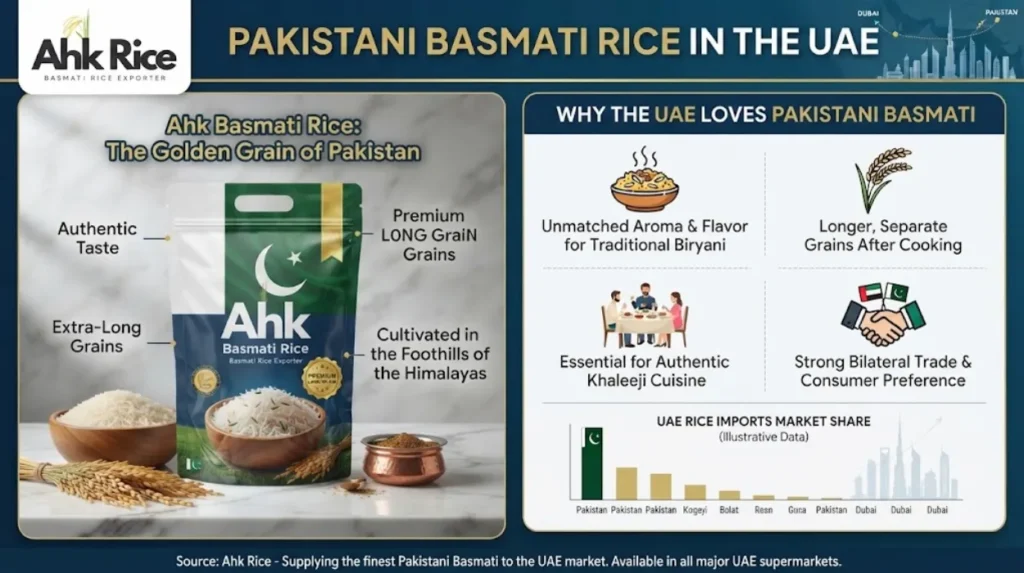
Pakistani Basmati serves household consumption, supermarket retail, restaurant kitchens, hotel buffets, catering operations, and wholesale distribution. Each application requires a defined balance of grain appearance, cooking behaviour, packaging, and purchase cost.
- Retail: White 1121 and Super Kernel suit consumers seeking aromatic rice for home cooking.
- Restaurants: 1121 and 1509 support dishes such as biryani, pulao, and steamed rice.
- Hotels: Premium long-grain grades serve buffet presentations and banquet menus.
- Catering: Commercial sacks support wedding meals, corporate events, and institutional kitchens.
- Wholesale: Bulk shipments supply retailers, independent distributors, and foodservice businesses.
These applications describe common commercial uses rather than guaranteed preferences across every UAE buyer. The appropriate grade depends on the recipe, target customer, kitchen process, and agreed product specification.
What Problems and Misconceptions Affect UAE Rice Imports?
Import problems often arise from unclear specifications, incomplete documentation, incorrect labelling, inconsistent grain quality, and misunderstandings about market statistics. Buyers reduce these risks through written specifications, approved samples, document checks, and destination-specific compliance reviews.
Common Import Mistakes
- Confusing total rice imports with Basmati imports: Overall trade statistics include non-Basmati rice.
- Comparing prices without matching specifications: Different grades, broken percentages, and packing weights produce different quotations.
- Treating every certificate as interchangeable: A COA, phytosanitary certificate, and food registration record serve separate purposes.
- Ignoring label requirements: Importers need compliant product information and applicable approvals before selling packaged rice.
- Assuming all Basmati cooks identically: Variety, processing method, storage conditions, and preparation affect the final result.
The UAE government identifies food registration and correct labelling as important parts of food compliance. Dubai Municipality also provides services for food-item registration and imported consignment release. Importers should verify the requirements applicable to their emirate and shipment.
With these risks addressed, the market outlook becomes easier to interpret through verified trade figures and product-level purchasing decisions.
What Is the Outlook for Pakistani Basmati Demand in the UAE?
Pakistani Basmati remains an established part of UAE rice trade, supported by documented shipments, established culinary uses, and several commercially distinct grades. Its future demand depends on pricing, product quality, import compliance, competition, and purchasing activity across retail and foodservice channels.
The available evidence confirms bilateral trade activity and the UAE’s importance to Pakistani rice exporters. It does not establish a definitive full-year 2026 growth rate for Pakistani Basmati specifically. Importers and researchers should distinguish verified historical results from projections and market expectations.
For readers studying the product range, the next step is to compare 1121, Super Kernel, and 1509 Basmati by processing grade, grain characteristics, intended use, and buyer requirements. This comparison provides a more practical foundation for understanding how Pakistani Basmati serves the UAE market.
Frequently Asked Questions
Why does the UAE import Pakistani Basmati rice?
The UAE imports Pakistani Basmati for retail, restaurants, hotels, catering, and wholesale distribution. Its natural aroma, long grains, and cooking characteristics suit dishes such as biryani and pulao.
Which Pakistani Basmati varieties are supplied to the UAE?
The principal varieties include 1121, Super Kernel, and 1509. Exporters supply different processing grades, including white, Steam, and Golden Sella, according to buyer specifications.
How much rice did Pakistan export to the UAE in 2024?
World Bank WITS records approximately 205,315 tonnes, valued at US$173.99 million, in Pakistan’s rice exports to the UAE during 2024. This figure includes rice overall, not Basmati alone.
What documents are required to import rice into the UAE?
Requirements depend on the product and destination emirate. Relevant documents and procedures include a commercial invoice, packing list, certificate of origin, applicable health or phytosanitary certificates, food registration, and compliant labels. Importers should confirm the exact requirements with the competent authority.
What is the difference between 1121 and 1509 Basmati rice?
1121 is known for its long grain and substantial elongation during cooking. 1509 is valued for its long grain and commercial supply characteristics. Buyers should compare actual specifications, processing grades, cooking performance, and price before selecting either variety.
Does the UAE rice import market have a confirmed growth rate for 2026?
A definitive full-year growth rate for Pakistani Basmati imports in 2026 is not established by the cited data. Monthly shipments and previous-year trade statistics provide useful context, but they do not replace complete annual figures.