How Do Rice Exporters Scale Production During Peak Demand Periods?
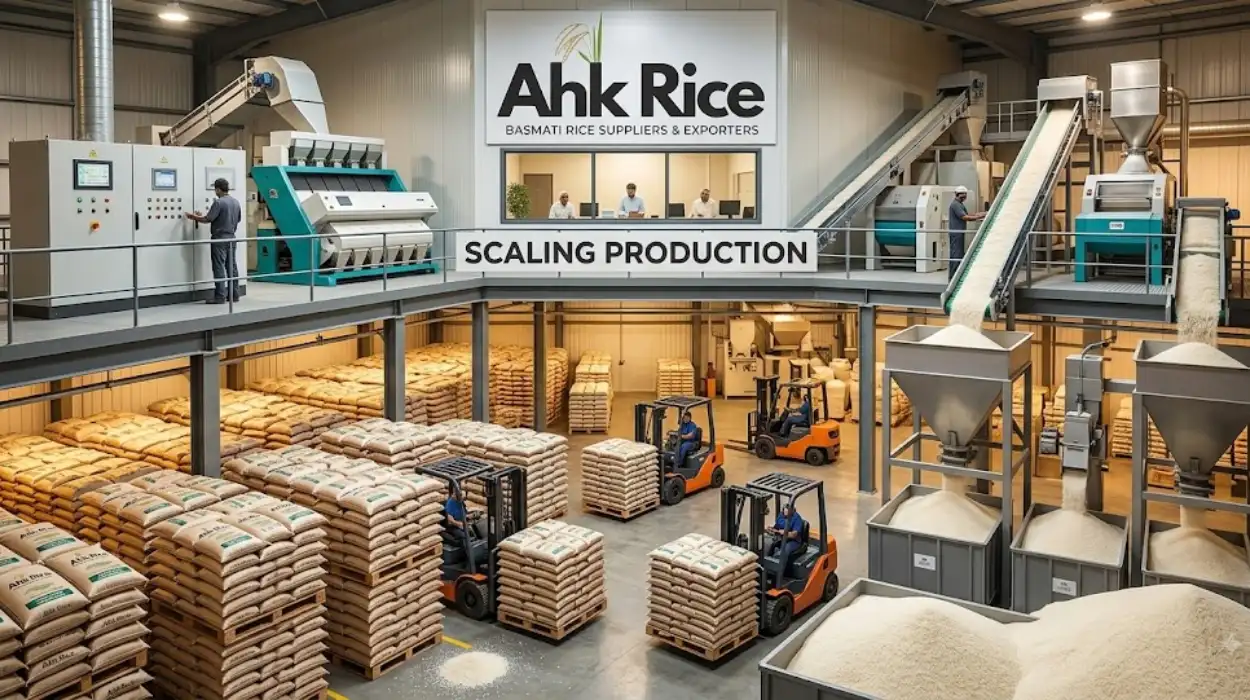
Rice exporters scale production most reliably through planned raw-material procurement, multi-stage milling capacity, controlled inventory, flexible labor, preventive maintenance, and shipment scheduling rather than by simply running one factory harder. The strongest model combines owned processing with qualified backup capacity while protecting the same specifications across every production batch.
Large import programs create a different operational problem from ordinary rice orders. A buyer may require hundreds or thousands of metric tons within a defined shipment window. The exporter must secure paddy, process the required grade, complete quality checks, arrange packaging, book containers, and prepare export documentation without changing the agreed specification.
Understanding:
Why production capacity is critical for large rice import programs helps buyers evaluate capacity before placing a peak-season contract. Production capacity is not only the rated output of a rice mill. It includes raw-material access, milling efficiency, sorting, packing, storage, quality control, labor availability, and logistics coordination.
Pakistan remains a major rice-exporting origin. USDA data for 2025/26 places Pakistan’s milled rice production at about 9.4 million metric tons, with exports around 4.7 million metric tons in the latest 2026 forecast. The 2026/27 new-post forecast raises production to 9.8 million metric tons and exports to 5.0 million metric tons.
This scale means peak-demand management is a supply-chain discipline. Exporters serving international buyers must maintain production continuity even when procurement, labor, container availability, or competing orders become more difficult.
What are the available solutions for scaling rice production during peak demand?
Rice exporters can scale peak production through capacity expansion, additional shifts, contracted milling, strategic inventory, parallel processing lines, and better production scheduling. The most reliable solution combines several methods because each method controls a different supply constraint during high-demand periods.
1. Increase operating shifts
The simplest method is to increase mill utilization. A facility operating one shift can move toward two or three shifts when demand rises.
This approach uses existing machinery more efficiently. It also avoids immediate capital expenditure on another processing plant.
The limitation is that longer operating hours increase maintenance requirements. Equipment such as destoners, huskers, whiteners, polishers, graders, color sorters, and packing machines experience greater wear.
A practical exporter therefore schedules preventive maintenance before the peak period instead of waiting for a breakdown.
2. Maintain strategic paddy and finished-rice inventory
Inventory provides a buffer between procurement and customer demand.
An exporter can purchase suitable paddy during the procurement season, process part of it, and maintain finished rice against confirmed specifications. This reduces dependence on last-minute raw-material purchases.
Inventory must remain controlled. Excess stock increases storage costs and exposure to moisture, insects, contamination, aging, and working-capital pressure.
The correct inventory level depends on the product, expected orders, storage conditions, procurement cycle, and shipment schedule.
3. Use qualified contract or partner mills
Contract milling adds capacity without requiring the exporter to build another complete factory.
A qualified partner mill can process specific grades according to documented specifications. The exporter remains responsible for controlling the purchase specification, processing requirements, inspection, packaging, traceability, and shipment release.
This model works best when the partner has already been audited and can reproduce the required grain length, broken percentage, moisture range, milling quality, color, purity, and packaging requirements.
4. Run parallel processing and packing operations
Peak production becomes easier when processing and packing are not dependent on a single bottleneck.
For example, rice can complete milling and sorting while another approved line prepares packaging. Separate packing equipment can also handle different bag sizes or private-label requirements.
The objective is to keep the slowest production stage from controlling the entire order.
5. Improve production scheduling
Production scheduling converts customer orders into daily manufacturing requirements.
A 1,000 MT contract cannot be treated as one production event. The exporter can divide it into daily or weekly production lots, assign raw material, reserve machinery, schedule quality checks, and coordinate container loading.
This makes production measurable.
If a plant needs to produce 1,000 MT in 20 working days, the average requirement is 50 MT per working day. Actual planning must also account for yield losses, cleaning, changeovers, quality holds, maintenance, and packaging delays.
How do different rice production scaling approaches compare?
No single scaling method is best for every exporter. Extra shifts provide fast capacity, inventory improves supply continuity, contract milling adds volume, and new machinery increases long-term capacity; the strongest option depends on order size, lead time, product complexity, and quality-control requirements.
| Attribute | Extra Shifts | Strategic Inventory | Contract Milling | New Processing Capacity |
|---|---|---|---|---|
| Speed to deploy | High | High if stock exists | High after qualification | Low |
| Capital requirement | Low–medium | Medium | Low–medium | High |
| Peak-volume potential | Medium | Medium | High | Very high |
| Quality-control complexity | Low | Medium | High | Medium |
| Best use | Short demand spikes | Planned seasonal demand | Large temporary orders | Sustained growth |
| Main risk | Equipment fatigue | Stock deterioration | Specification variation | Underutilized investment |
| Scalability | Medium | Medium | High | Very high |
The table shows why mature exporters normally use a combination rather than one method.
Extra shifts are effective when the factory has unused installed capacity. Inventory is effective when demand is predictable. Contract milling becomes useful when confirmed orders exceed internal production capacity. New processing equipment becomes logical when high demand continues across multiple seasons.
The key distinction is between rated capacity and usable capacity.
A mill may advertise a nominal output of 10 MT per hour. That does not mean an exporter can promise 10 MT of finished export-grade rice every hour. Cleaning, product changes, rejected lots, machine downtime, sorting losses, packing, inspection, and maintenance reduce practical output.
Buyers should therefore ask for demonstrated production capacity rather than relying only on installed machinery specifications.
Which method works best for different rice-import cases?
Short peak orders usually favor additional shifts and existing inventory, while large recurring programs require integrated procurement and production capacity. Multi-country exporters benefit from a combination of owned processing, qualified backup mills, finished-stock planning, and shipment scheduling.
For a buyer requiring 100–200 MT, an exporter may handle the order through normal production scheduling and existing stock.
For a 500–1,000 MT order, production planning becomes more important. The exporter must allocate raw material and production slots while preventing the order from competing with earlier commitments.
For recurring monthly programs above 1,000 MT, capacity planning becomes a strategic function. The exporter needs predictable procurement, multiple production lines or approved processing partners, adequate storage, quality-control resources, and logistics capacity.
Product complexity also changes the calculation.
A standard white rice specification can be easier to schedule than a highly controlled Basmati specification involving strict grain length, broken percentage, moisture, purity, aging, sorting, and customized packaging.
Pakistan’s principal export varieties include Basmati and non-Basmati categories. AHK Rice supplies 1121, Super Kernel, and 1509 varieties and operates an end-to-end processing and export model from Punjab.
For premium Basmati programs, scaling cannot mean mixing output from unrelated sources without control. Every additional production source must be capable of reproducing the buyer’s approved specification.
What are the production advantages and disadvantages during peak demand?
Scaling production creates higher output and better order continuity, but it also increases pressure on procurement, machinery, labor, quality control, storage, and logistics. Exporters that scale without process controls can increase volume while reducing specification consistency.
Additional shifts
Pros: Fast deployment, limited new investment, and direct control over production.
Cons: Higher labor costs, greater machine wear, maintenance pressure, and greater risk of operator fatigue.
For example, a mill with spare daily capacity can add an evening shift during a 600 MT order rather than invest in another complete processing line.
Strategic inventory
Pros: Faster shipment response, protection against raw-material price movements, and reduced dependence on immediate procurement.
Cons: Working-capital requirements, storage costs, moisture risks, and inventory aging.
Inventory works particularly well when the exporter knows which grades will be required during the peak season.
Contract milling
Pros: Large additional capacity without building another facility and better flexibility during temporary demand increases.
Cons: More difficult quality control, coordination requirements, and potential variation between processing facilities.
A buyer should require the same product specification, approved sample, testing protocol, packaging standard, and inspection process across every approved production source.
New machinery or factory expansion
Pros: Higher long-term output, improved automation, better process control, and lower dependence on external capacity.
Cons: High capital expenditure, commissioning time, maintenance requirements, and the risk of excess capacity when demand falls.
This approach is appropriate for exporters with sustained order growth rather than a single seasonal spike.
Which market regions require different scaling strategies?
Middle Eastern markets generally favor consistent premium Basmati specifications and dependable container replenishment, while North American and European buyers place stronger emphasis on documented specifications, traceability, packaging compliance, and repeatable quality across extended supply programs.
Middle East
Saudi Arabia, the UAE, Qatar, Kuwait, Oman, and neighboring markets represent established destinations for South Asian rice.
Premium long-grain Basmati grades such as 1121 and Super Kernel are suitable for buyers seeking long grains, aroma, cooking performance, and premium retail or food-service positioning. 1509 can serve programs focused on long-grain Basmati with different commercial positioning.
Peak demand can create rapid requirements for replenishment. Exporters therefore benefit from finished-stock planning and reserved production capacity.
North America and Europe
North American and European buyers typically operate through distributors, wholesalers, retailers, ethnic-food channels, and food-service businesses.
The specification remains important, but documentation and consistency become equally important. Buyers may require defined packaging, ingredient declarations, traceability records, certificates, laboratory reports, and shipment documentation.
For these markets, production scaling must preserve the approved specification across multiple lots rather than simply increasing tonnage.
How do price and shelf life differ between major market programs?
FOB price is primarily determined by rice variety, grade, broken percentage, processing type, crop, packaging, order size, and market conditions, while shelf life depends on product condition and storage. Destination-market freight and compliance costs should be added separately to compare landed economics.
Public July 2026 Pakistan export indications show premium Basmati FOB Karachi pricing around $1,135–$1,205 per MT for 1121 Basmati and Super Kernel, depending on grade and specification. These figures are indicative market benchmarks, not fixed AHK Rice quotations.
| Market region | Common premium grades | Indicative FOB benchmark | Typical commercial shelf-life target* | Scaling priority |
| Middle East | 1121 Sella/Steam, Super Kernel, 1509 | ~$1,135–$1,205/MT for comparable premium Basmati benchmarks | 12–24 months | Stock + rapid production |
| North America & Europe | 1121, Super Kernel, 1509 according to buyer specification | ~$1,135–$1,205/MT for comparable premium Basmati benchmarks | 12–24 months | Traceability + specification control |
*Shelf-life figures are commercial planning ranges and must follow the product label, packaging specification, storage conditions, and buyer contract. They should not be treated as a universal guarantee.
The same FOB benchmark can serve different markets because the rice originates from the same export base. The final landed cost changes after ocean freight, insurance, destination charges, customs, testing, and other market-specific costs.
This distinction matters during peak demand. A buyer should compare the landed cost per MT, not only the exporter’s FOB price.
What decision factors should buyers use when evaluating a scalable rice exporter?
Buyers should evaluate usable production capacity, raw-material security, specification control, backup capacity, inventory policy, quality systems, and shipment execution. Capacity claims become meaningful only when the exporter can connect production resources to a documented plan for the buyer’s actual volume and delivery schedule.
| Decision factor | What the buyer should verify | Why it matters |
| Usable capacity | Actual MT/day after processing losses and downtime | Prevents unrealistic delivery commitments |
| Raw-material access | Procurement sources and grade availability | Protects production continuity |
| Backup capacity | Approved secondary processing resources | Reduces single-factory risk |
| Quality control | Sampling, laboratory testing, sorting, inspection | Protects specification consistency |
| Inventory | Finished stock and storage conditions | Supports urgent replenishment |
| Packaging | Bagging capacity and private-label capability | Prevents packing bottlenecks |
| Logistics | Container booking and loading process | Connects production to shipment |
| Documentation | Commercial, quality, and export records | Supports customs and buyer compliance |
A scalable exporter should also explain how production is allocated between customers.
If one buyer suddenly increases an order by 500 MT, the exporter must know which raw material will be used, which line will process it, when quality inspection will occur, how packaging will be scheduled, and when containers will be loaded.
This is where operational transparency becomes more valuable than a simple statement such as “we have high capacity.”
How should exporters protect quality while increasing production volume?
Quality must remain specification-driven during peak production, with approved raw material, controlled processing parameters, batch testing, traceability, and final inspection applied at the same scale as normal production. Increasing output without increasing quality-control capacity creates avoidable shipment and rejection risks.
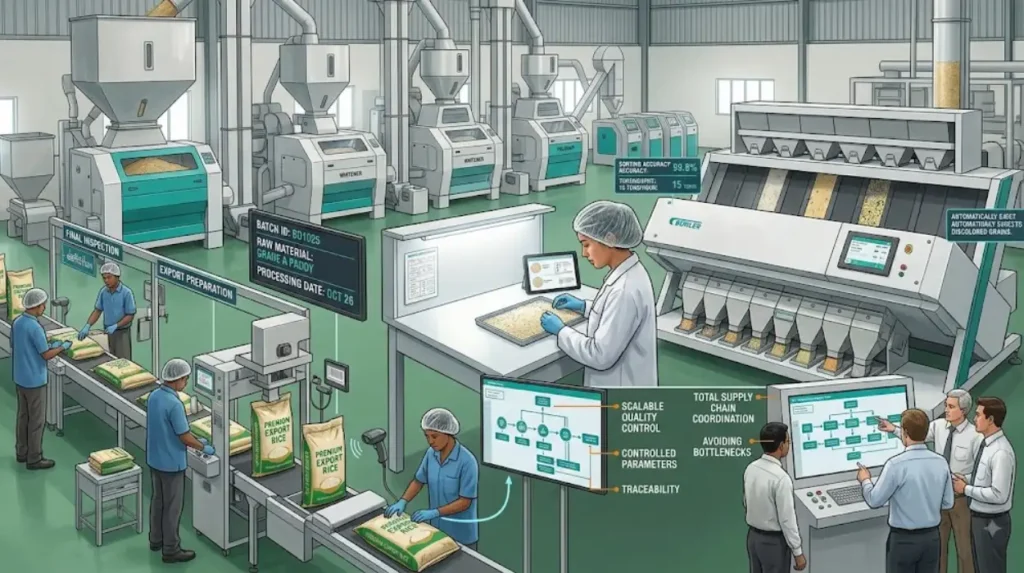
A scalable quality system starts before milling.
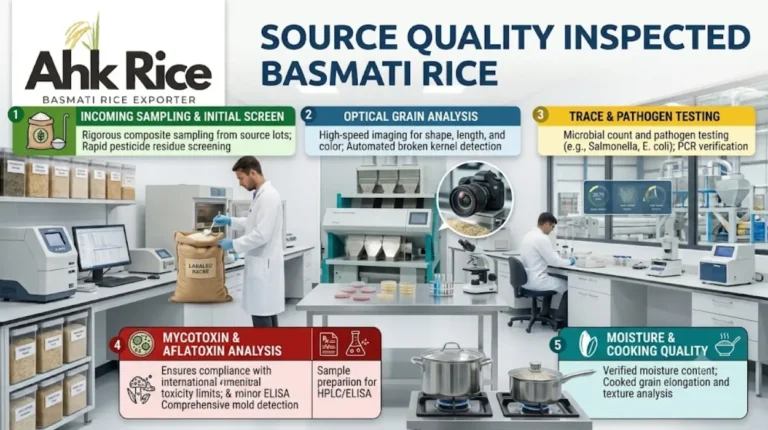
Raw paddy must meet the defined procurement specification. Cleaning removes foreign material. Destoning separates stones. Husking removes the outer husk. Whitening and polishing establish the required appearance. Grading separates grains by size. Color sorting removes discolored grains. Final inspection verifies the finished product.
Each stage creates a potential bottleneck.
If a color sorter processes less volume than the milling line, it becomes the capacity constraint. If packing machines operate below the processing output, finished rice accumulates before shipment.
This is why production scaling should be planned around the constraint, not simply the total machinery installed.
AHK Rice’s end-to-end model is relevant to this approach because production, custom packaging, quality control, and export preparation can be coordinated as one supply chain rather than treating milling and shipment as separate activities.
What is the most reliable production-scaling model for large rice import programs?
The most reliable model combines planned procurement, controlled inventory, optimized factory shifts, qualified backup processing, batch-level quality control, and advance logistics planning. This hybrid structure provides capacity during demand spikes without sacrificing the specification consistency required by international rice buyers.
The best model also changes according to demand duration.
A temporary demand spike does not justify permanent factory expansion. Additional shifts and strategic inventory usually provide better flexibility.
A recurring large-volume program requires deeper capacity planning. The exporter needs stable procurement, dedicated production slots, backup processing, and predictable logistics.
For Georgia buyers evaluating these factors, a:
Consistent Basmati rice supply for Georgia becomes the next step from capacity evaluation to supplier selection.
For a multinational buyer, the strongest supplier is therefore not necessarily the exporter with the largest advertised factory. It is the exporter that can demonstrate how its available capacity converts into consistent finished rice, documented quality, packed product, and loaded containers within the required schedule.
Pakistan’s 2026 export outlook confirms the importance of this discipline. USDA’s April 2026 global grain update reduced Pakistan’s rice export forecast to 4.5 million MT because of stronger competition and lower recent shipment volumes.
That environment makes capacity planning more important, not less. Exporters competing for international orders must secure supply before peak periods, allocate production intelligently, and protect customer specifications when demand increases.
For buyers, the evaluation should therefore move from “How many tons can you produce?” to “How many tons of my exact specification can you consistently produce, inspect, pack, and ship within my required schedule?”
That is the more useful measure of scalable rice-export capacity.
Frequently Asked Questions
How do rice exporters increase production during peak demand?
Rice exporters scale production by adding shifts, optimizing existing machinery, maintaining strategic inventory, using qualified backup mills, and improving production scheduling.
Why is production capacity important for large rice import programs?
Production capacity determines whether an exporter can process, pack, inspect, and ship large quantities within the buyer’s required delivery schedule.
What methods can rice exporters use to handle peak demand?
Common methods include additional production shifts, strategic paddy inventory, finished-rice inventory, contract milling, parallel processing lines, and factory expansion.
Is contract milling suitable for large rice export orders?
Contract milling can provide additional capacity without major capital investment, provided the partner mill follows the exporter’s approved specifications and quality-control procedures.
How does inventory help rice exporters during peak demand?
Strategic inventory gives exporters immediate access to suitable raw materials or finished rice, reducing dependence on last-minute procurement and production scheduling.