Import Licensed Pakistani Basmati Rice into New Jersey with AHK Rice
Importing Pakistani Basmati rice into New Jersey is safest when the buyer verifies the exporter’s legal credentials, product specifications, U.S. food-import documentation, sample quality, shipping schedule, and landed-cost structure before committing to a container. AHK Rice combines these requirements into one export workflow, reducing the risk of documentation gaps, inconsistent rice specifications, and avoidable shipment delays.
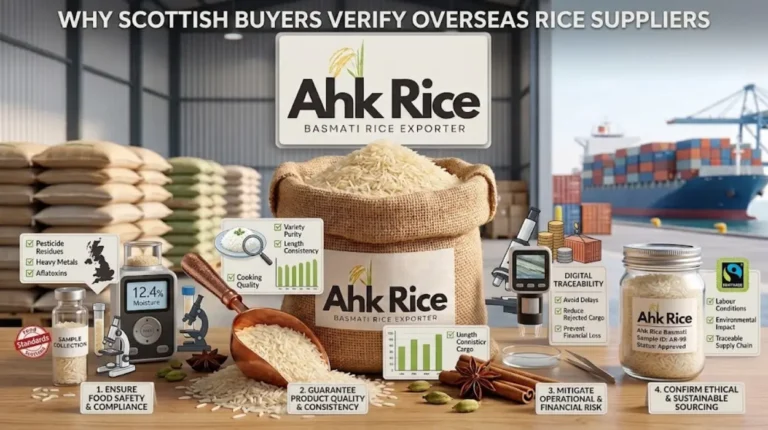
New Jersey importers should first understand why export credentials matter in practice. A valid exporter identity does not replace U.S. import compliance, but it gives the buyer a traceable commercial counterparty and a stronger documentation trail. For background, review:
Why New Jersey importers review export license credentials before comparing suppliers.
For U.S. food imports, FDA requirements remain separate from Pakistan-side export documentation. FDA states that imported food must meet U.S. safety, sanitation, and labeling requirements, while food facilities that manufacture, process, pack, or hold regulated food generally need FDA registration. FDA also requires Prior Notice before covered food shipments arrive in the United States.
What is the best solution for importing licensed Pakistani Basmati rice into New Jersey?
The best solution is a documented supplier-to-port process covering exporter credentials, product specifications, sampling, production, inspection, export documents, vessel booking, FDA Prior Notice, customs entry, and final delivery into New Jersey. This approach gives buyers measurable checkpoints before payment and shipment.
A New Jersey importer should not evaluate a rice exporter only by FOB price. The commercial decision should begin with the exact product specification.
For example, a buyer may require 1121 Basmati with an agreed grain length, moisture level, broken-grain percentage, purity, polishing grade, packing format, and private-label artwork. A different buyer may need Super Kernel or 1509 Basmati for restaurants, ethnic grocery stores, wholesalers, or foodservice distribution.
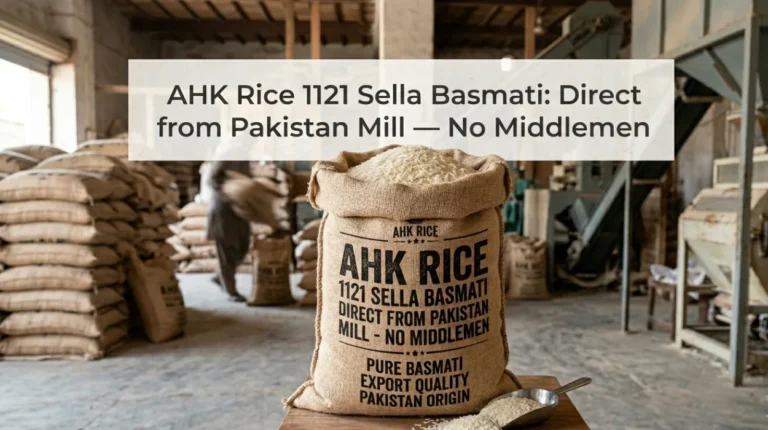
AHK Rice supplies Pakistani Basmati varieties including 1121, Super Kernel, and 1509 and provides processing, grading, sorting, packaging, and export documentation from Pakistan. Its published USA service information also identifies wholesale supply for U.S. importers and distributors.
The first decision checkpoint should therefore be a written specification sheet. It should identify variety, processing type, grain size, moisture, broken grains, foreign matter, packaging, quantity, Incoterm, destination port, inspection requirements, and acceptable tolerances.
The second checkpoint is the supplier’s ability to reproduce that specification. A sample is useful only when the bulk shipment is contractually tied to the approved specification.
The third checkpoint is documentation. Pakistan-side export paperwork and U.S. import requirements should be coordinated before loading rather than corrected after the vessel has sailed.
Why should New Jersey buyers choose AHK Rice for Pakistani Basmati?
New Jersey buyers should choose AHK Rice when they need one export partner to coordinate rice sourcing, milling, grading, quality control, customized packing, documentation, container preparation, and shipment execution while maintaining the approved commercial specification throughout the order.
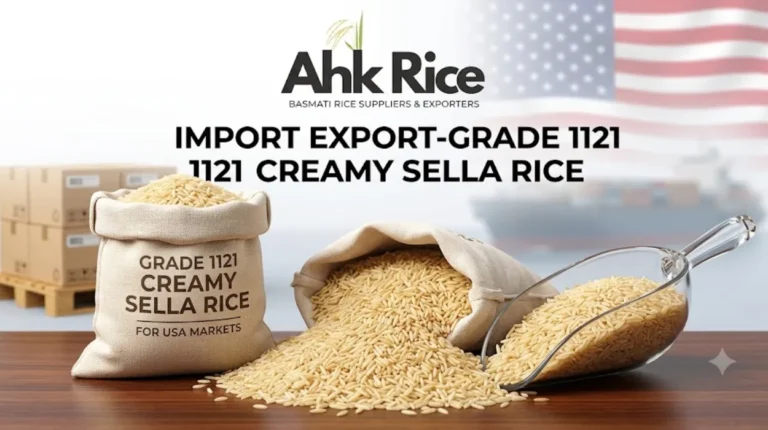
The [USA Basmati rice export service] page provides the conversion-stage overview of AHK Rice products and export support for U.S. buyers. The company states that it handles Pakistani Basmati varieties such as 1121, Super Kernel, and 1509 and supports bulk export requirements.
For a New Jersey importer, the practical benefit is coordination. A buyer does not want one party responsible for rice, another for milling, another for packaging, and another for export paperwork when a shipment is already scheduled.
AHK Rice operates from Bucheki, Nankana Sahib, Punjab, and describes its process as covering paddy sourcing through container loading. Its published company information also lists USA among its export markets and identifies quality systems including ISO 22000:2018, HACCP, ISO 9001:2015, GMP, and Halal certification.
The buyer should still independently confirm which certification, inspection, or document applies to the specific shipment. Certification should never be treated as a substitute for product testing or U.S. import compliance.
The comparison principle discussed in:
How Do Export Licenses Support Reliable International Rice Trade? is also important here: an export credential is useful because it supports supplier traceability, but reliability ultimately depends on the entire transaction chain.
How does the sample process work before a New Jersey rice order?
A commercial rice sample should confirm the physical specification before production, followed by documented approval, production against that specification, optional third-party inspection, packing verification, and final document review before container loading and shipment to the United States.
The sample process should be controlled rather than informal.
First, the New Jersey buyer sends the required specification. This should include the rice variety, processing method, grain-length target, moisture requirement, broken percentage, packaging preference, quantity, destination, and intended market.
Second, AHK Rice prepares the requested sample. Its USA product information states that samples up to 20 kg can be supplied, while the buyer covers courier and phytosanitary certificate costs. It also states that an approved sample can be followed by bulk production against the agreed requirement.
Third, the buyer evaluates the sample for appearance, aroma, grain uniformity, cooking behavior, elongation, breakage, and packaging suitability. For restaurant or foodservice buyers, cooking tests should be performed using the intended commercial cooking method.
Fourth, the approved specification should be recorded. A simple sample approval email is better than verbal approval because it creates a reference point for production and inspection.
Fifth, AHK Rice schedules production. Its published USA product information gives a production window of approximately 7–10 days for one 1121 Basmati parboiled product, depending on order volume. Actual production time should therefore be confirmed against the selected variety, quantity, packaging, and current factory schedule.
Sixth, the buyer can request pre-shipment inspection where appropriate. AHK Rice states that internationally recognized inspection organizations such as SGS and Bureau Veritas can be used for pre-shipment inspection.
A practical sample-cost structure is therefore:
| Sample cost item | Typical commercial treatment |
|---|---|
| Rice sample up to 20 kg | Product may be supplied without a separate rice charge |
| International courier | Paid by buyer or buyer’s courier account |
| Phytosanitary certificate for sample | Paid by buyer |
| Laboratory testing | Additional if specifically requested |
| Third-party inspection | Additional if requested |
| Bulk sample charges after successful order | May be credited or waived subject to quotation |
These are commercial guidelines, not fixed government fees. Courier, certificate, laboratory, and inspection costs should be confirmed for the individual shipment.
How many shipping days should New Jersey importers expect?
For Karachi-to-New York/New Jersey ocean freight, a realistic planning window is roughly 23–35 days for ocean transit, followed by customs, FDA processing, terminal handling, and inland delivery; buyers should therefore plan the complete supply chain rather than rely on vessel transit alone.
Current public freight data provides useful planning evidence. A Karachi-to-New York FCL lane has recently shown approximately 27 days of estimated transit, while another Port Qasim service shows approximately 23–33 days. These figures are transit estimates, not guaranteed delivery dates.
For a New Jersey buyer using the New York/New Jersey port complex, the working timeline can be structured as follows:
| Stage | Planning time |
| Order confirmation and specification | 1–2 days |
| Production and packing | 7–10+ days |
| Inspection and document completion | 1–3 days |
| Vessel booking and origin handling | 3–7 days |
| Ocean transit Karachi–New York/New Jersey | 23–35 days |
| U.S. clearance and terminal handling | Variable |
| Inland delivery within New Jersey | Variable |
This means a buyer should generally plan around 35–55+ days from production authorization to final warehouse receipt, depending on vessel availability, port conditions, customs processing, inspection, and inland trucking.
FDA Prior Notice is an important part of the U.S. arrival process. For food arriving by water, FDA guidance states that Prior Notice must be received and confirmed at least eight hours before arrival, with submission windows depending on the filing method.
The importer also needs to address FSVP responsibilities where applicable. FDA identifies the U.S. owner or consignee as the FSVP importer in the normal case and requires covered importers to maintain an FSVP for each food and foreign supplier, subject to applicable exemptions or modified requirements.
This distinction matters. AHK Rice can support export documentation, but the New Jersey importer remains responsible for its own U.S. import obligations and should work with its customs broker and FSVP professional where required.
What results can New Jersey buyers expect from this process?
A controlled export process should produce four measurable outcomes: specification consistency, stronger documentation, predictable shipment planning, and lower commercial risk because the buyer approves the product before committing the full container value.
The first result is specification control. The approved sample becomes the commercial reference for production.
The second is documentation readiness. AHK Rice states that it provides full export documentation support, while U.S. requirements remain the responsibility of the importer and its customs or compliance partners.
The third is shipment visibility. A buyer can plan inventory around production, vessel departure, ocean transit, customs clearance, and New Jersey delivery rather than receiving an uncertain arrival estimate.
The fourth is repeatability. For recurring orders, the same specification can be used as the baseline for subsequent containers.
For example, a New Jersey distributor ordering 100 MT of 1121 Basmati should not approve only the first sample and then accept an undefined bulk grade. The purchase order should connect the sample, specification sheet, packaging artwork, inspection requirements, and shipping documents.
AHK Rice can also support customized packaging and private-label requirements, which is useful when the importer sells under its own retail or foodservice brand.
What determines the price of Pakistani Basmati rice delivered to New Jersey?
The final New Jersey cost depends on rice variety, grade, quantity, packing, milling specification, inspection, Incoterm, ocean freight, insurance, destination charges, customs treatment, brokerage, inland trucking, and any applicable U.S. taxes or duties.
FOB Karachi is not the same as landed New Jersey cost.
For example, a quotation for 1121 Basmati may look attractive on an FOB basis but become less competitive after freight, port charges, customs brokerage, terminal fees, and trucking are added.
Current public freight data recently showed approximately US$5,252–US$5,691 for a standard 40-foot-high-cube FCL shipment from Karachi to New York, although such figures are time-sensitive and should not be treated as a fixed quotation.
U.S. tariff classification should also be confirmed for the exact product and entry date. The U.S. International Trade Commission published 2026 HTS Revision 12 on July 21, 2026, so importers should use the current HTS rather than an old tariff schedule when calculating landed cost.
A buyer should request a quotation showing:
- Rice price per MT
- Quantity and container configuration
- Packaging cost
- FOB Karachi or selected Incoterm
- Ocean freight basis
- Insurance, if required
- Inspection charges
- Export documentation charges
- Destination charges where applicable
- Customs brokerage and inland delivery assumptions
- Applicable U.S. duties or other government charges
AHK Rice publishes USA pricing as dependent on variety, quantity, and current market conditions rather than presenting one universal price. That is the correct commercial approach because rice prices and freight rates change with specification and shipping conditions.
How should a New Jersey importer start the first order?
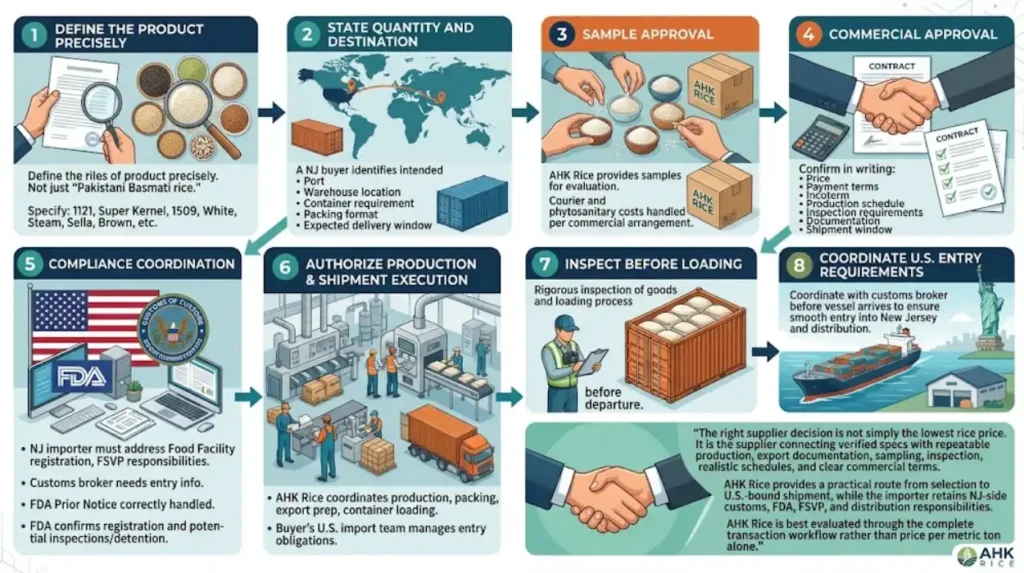
Start with a written product specification, request the commercial quotation, approve the physical sample, verify supplier and import documentation, confirm the Incoterm and destination, authorize production, inspect before loading, and coordinate U.S. entry requirements before the vessel arrives.
The first step is to define the product precisely. Do not request only “Pakistani Basmati rice.” State whether the requirement is 1121, Super Kernel, 1509, white, steam, sella, brown, or another specification.
The second step is to state quantity and destination. A New Jersey buyer should identify the intended port, warehouse location, container requirement, packing format, and expected delivery window.
The third step is sample approval. AHK Rice can provide samples for evaluation, with courier and phytosanitary costs handled according to the commercial arrangement.
The fourth step is commercial approval. Confirm price, payment terms, Incoterm, production schedule, inspection requirements, documentation, and shipment window in writing.
The fifth step is compliance coordination. The importer should ensure its food facility and FSVP responsibilities are addressed, its customs broker has the necessary entry information, and FDA Prior Notice is correctly handled. FDA confirms that covered food facilities must meet registration requirements and that imported foods can be inspected or detained when requirements are not met.
The sixth step is shipment execution. AHK Rice coordinates production, packing, export preparation, and container loading while the buyer’s U.S. import team manages entry-side obligations.
For a New Jersey importer, the right supplier decision is therefore not simply the lowest rice price. It is the supplier that can connect a verified product specification with repeatable production, export documentation, sampling, inspection, realistic shipping schedules, and clear commercial terms.
AHK Rice gives buyers a practical route from Pakistani Basmati selection to U.S.-bound container shipment, while the importer retains responsibility for its New Jersey-side customs, FDA, FSVP, and distribution requirements. AHK Rice is therefore best evaluated through the complete transaction workflow rather than price per metric ton alone.
To begin a specification-based New Jersey import discussion, request a quote.
Frequently Asked Questions
What makes AHK Rice suitable for New Jersey Basmati rice importers?
AHK Rice provides Pakistani Basmati rice varieties, including 1121, Super Kernel, and 1509, with processing, grading, packaging, export documentation, and shipment coordination for U.S. buyers.
What Pakistani Basmati rice varieties can New Jersey importers buy?
New Jersey importers can source varieties such as 1121 Basmati, Super Kernel, and 1509 Basmati. The exact processing style, grade, grain specifications, moisture, and packaging should be confirmed before ordering.
How does the rice sample process work?
The buyer first provides product specifications. AHK Rice then prepares a sample for evaluation. Buyers can assess grain appearance, aroma, purity, cooking performance, and packaging before approving bulk production.
How much does a Pakistani Basmati rice sample cost?
Sample arrangements depend on the order and product. AHK Rice states that samples up to 20 kg can be supplied, while the buyer covers courier and phytosanitary certificate costs. Laboratory testing or third-party inspection may create additional charges.