What Moisture Test Reports Do Saudi Arabian Rice Importers Request from Pakistan Suppliers?
Saudi Arabian rice importers generally accept suppliers faster when moisture testing is supported by internationally recognized laboratory reports, calibrated inspection methods, and export documentation that matches Saudi food import requirements. The quality of the report often influences purchasing decisions as much as the moisture percentage itself.
Moisture testing is one of the most important quality verification procedures in Pakistan’s Basmati rice export industry. It helps buyers determine whether rice will remain stable throughout storage, transportation, customs clearance, and retail distribution. Importers in Saudi Arabia use moisture reports to reduce the risks of mold development, insect activity, broken grains, weight loss, and shortened shelf life.
If you want to understand how laboratories determine moisture levels before shipment, first read our guide explaining:
How Is Moisture Content Tested in Pakistan Basmati Rice Before Export to Saudi Arabia?
Saudi Arabia remains one of the largest destinations for Pakistani Basmati rice in 2026. Buyers increasingly request documented moisture verification because food distributors, wholesalers, hotel chains, and supermarket procurement departments require objective quality evidence before approving imports.
AHK Rice supplies Pakistani Basmati rice to international markets through complete processing, laboratory testing, custom packaging, and export documentation while following internationally accepted moisture control practices.
What moisture test reports do Saudi Arabian rice importers usually request?
Saudi Arabian buyers typically request moisture analysis certificates, laboratory test reports, inspection certificates, pre-shipment quality reports, sampling documentation, calibration records, and export quality certificates because these documents verify storage stability, product consistency, compliance, and transportation safety before rice enters the Saudi food supply chain.
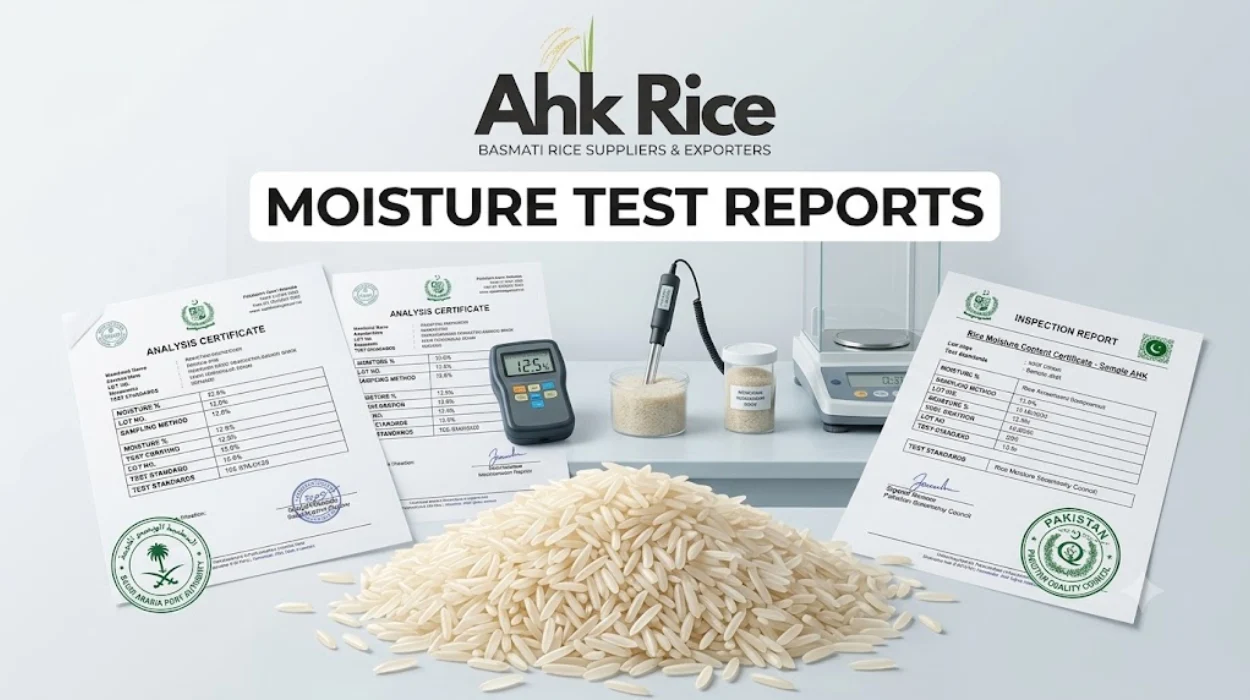
A moisture test report is a laboratory document showing the exact percentage of moisture present in a rice sample. It also explains the testing method, sample identification, testing date, laboratory details, equipment used, and measured results.
Most Saudi importers ask suppliers to provide multiple supporting documents rather than only one laboratory certificate.
The most frequently requested reports include:
| Report Type | Purpose |
|---|---|
| Moisture Analysis Report | Confirms moisture percentage |
| Laboratory Test Certificate | Verifies laboratory testing results |
| Pre-Shipment Inspection Report | Confirms product condition before loading |
| Quality Control Report | Summarizes production quality checks |
| Sampling Record | Demonstrates representative sample collection |
| Calibration Verification | Confirms testing equipment accuracy |
| Export Inspection Certificate | Supports customs and buyer verification |
Each report reduces uncertainty during procurement.
Large retail chains often require complete documentation before issuing final payment.
Food service distributors usually combine moisture reports with grain length, broken percentage, purity, chalkiness, damaged kernels, and foreign matter analysis.
How do moisture testing methods compare?
Different moisture testing methods vary in accuracy, testing speed, equipment cost, and international acceptance. Laboratory oven drying remains the reference standard, while digital moisture meters provide rapid production monitoring and near-instant operational decisions during processing and packaging.
Several testing methods are used across Pakistan’s rice industry.
Each serves a different operational purpose.
Moisture Testing Method Comparison
| Attribute | Oven Dry Method | Digital Moisture Meter | Infrared Moisture Analyzer |
|---|---|---|---|
| Accuracy | Very High | High | Very High |
| Testing Time | 3–24 hours | Under 2 minutes | 5–15 minutes |
| Laboratory Acceptance | Excellent | Moderate | High |
| Production Use | Limited | Excellent | Good |
| Equipment Cost | Medium | Low | High |
| Repeatability | Excellent | Good | Excellent |
| Best Application | Final certification | Factory monitoring | Laboratory quality control |
The oven drying method remains the international reference because it measures actual moisture loss after controlled heating.
Digital moisture meters are widely used during production because they allow continuous monitoring.
Infrared analyzers balance speed with laboratory-grade precision.
Exporters commonly combine rapid factory measurements with laboratory confirmation before shipment.
What moisture level is preferred by Saudi Arabian importers?
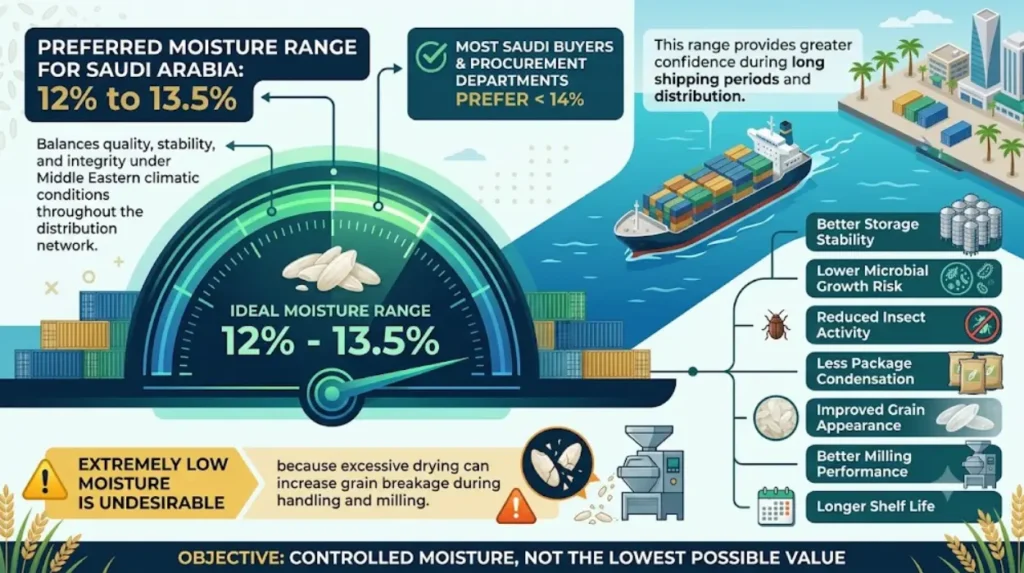
Most Saudi Arabian buyers prefer moisture levels between 12% and 13.5% because this range balances transportation stability, cooking quality, storage performance, grain integrity, and commercial shelf life under Middle Eastern climatic conditions throughout the distribution network.
Although contract specifications vary, many procurement departments request moisture below 14%.
This provides greater confidence during long shipping periods.
Rice with lower moisture generally experiences:
- Better storage stability
- Lower microbial growth risk
- Reduced insect activity
- Less package condensation
- Improved grain appearance
- Better milling performance
- Longer shelf life
Extremely low moisture is also undesirable because excessive drying can increase grain breakage during handling and milling.
The objective is controlled moisture rather than the lowest possible value.
How do Saudi Arabia and other export markets compare in moisture expectations?
Different importing regions evaluate moisture reports according to local regulations, storage conditions, distribution systems, and customer expectations. Saudi Arabia generally prioritizes shipment stability, while other regions may emphasize processing performance or retail shelf presentation.
Regional Comparison
| Market Region | Preferred Grades | Typical Moisture Preference | Estimated 2026 Price Range (USD/MT)* | Shelf Life Expectation |
|---|---|---|---|---|
| Saudi Arabia | 1121 Steam, Super Kernel, 1509 Steam | Around 12–13.5% | 980–1,350 | Up to 24 months with proper storage |
| UAE | 1121 Steam, 1121 Sella, Super Kernel | Around 12–14% | 970–1,320 | Up to 24 months with proper storage |
*Prices vary according to crop season, packaging, freight, quality grade, and contract volume.
Saudi buyers often request comprehensive laboratory documentation because large importers distribute products across wholesalers, retailers, restaurants, and institutional buyers.
UAE importers frequently prioritize rapid logistics and flexible packaging alongside moisture verification.
What available solutions help suppliers produce reliable moisture reports?
Reliable moisture reporting depends on combining standardized laboratory procedures, calibrated equipment, representative sampling, trained quality inspectors, documented quality management systems, and traceable production records instead of relying upon a single testing instrument or isolated inspection.
Several complementary quality systems improve report reliability.
Laboratory Testing
Independent laboratory testing increases buyer confidence.
Accredited laboratories follow recognized analytical procedures.
Representative Sampling
A laboratory result only reflects the collected sample.
Proper sampling techniques ensure the tested grains accurately represent the entire shipment.
Equipment Calibration
Moisture meters require periodic calibration.
Calibration records demonstrate measurement consistency.
Batch Traceability
Each production lot should be identifiable.
Traceability allows importers to connect laboratory reports with individual shipment batches.
Production Quality Monitoring
Continuous moisture monitoring throughout drying, polishing, grading, and packaging reduces variation between production lots.
Combining these systems produces stronger documentation than laboratory testing alone.
What are the advantages and disadvantages of different moisture reporting approaches?
Every moisture verification approach offers specific operational benefits while presenting practical limitations. Importers evaluate documentation quality by considering testing accuracy, laboratory independence, reporting speed, production efficiency, traceability, and shipment reliability rather than focusing only on moisture percentage values.
Internal Factory Testing
Advantages
- Fast results
- Continuous monitoring
- Immediate production adjustments
- Lower operating costs
Limitations
- Lower buyer confidence without third-party verification
- Depends on calibration quality
Independent Laboratory Testing
Advantages
- High credibility
- International acceptance
- Strong contract support
- Reliable documentation
Limitations
- Higher testing costs
- Longer reporting time
Combined Verification
Many exporters perform internal monitoring throughout production and confirm final results through independent laboratories.
This approach balances speed with credibility.
For example, a processor may monitor moisture every production shift using calibrated digital meters before sending final shipment samples for laboratory certification.
Which moisture verification approach works best for different importing situations?
The best moisture verification strategy depends on shipment size, buyer requirements, procurement policies, retail distribution plans, food service applications, certification expectations, and contractual documentation rather than using one identical reporting system for every export order.
Decision Framework
| Buyer Situation | Recommended Verification | Reason |
|---|---|---|
| New Importer | Independent laboratory report | Builds purchasing confidence |
| Long-term Partner | Factory testing plus periodic laboratory verification | Efficient monitoring |
| Government Tender | Full laboratory documentation | Higher compliance requirements |
| Retail Chain | Comprehensive quality reports | Consumer quality assurance |
| Food Service Distributor | Moisture report with complete quality analysis | Supports consistent cooking performance |
Different commercial situations require different documentation depth.
Understanding buyer expectations improves communication before shipment.
What factors should importers evaluate when reviewing moisture reports?
Importers should evaluate laboratory credibility, testing method, sampling process, calibration records, reporting date, traceability information, product identification, and consistency between laboratory results and shipment specifications before approving export documentation for international procurement.
Several checkpoints improve document evaluation.
First, verify the testing laboratory.
Second, confirm the sampling date.
Third, compare batch numbers with packing lists.
Fourth, review calibration information.
Fifth, compare moisture results with contractual specifications.
Finally, ensure all supporting documents reference the same shipment.
Complete consistency across documents reduces customs questions and purchasing delays.
How does moisture documentation support better purchasing decisions?
Well-documented moisture analysis reduces commercial uncertainty, strengthens supplier transparency, improves shipment consistency, supports regulatory compliance, minimizes storage risks, and enables buyers to compare competing suppliers using measurable quality evidence instead of assumptions or marketing claims.
Moisture reports provide measurable information that can be verified independently.
They help procurement teams compare suppliers using standardized criteria.
Documented quality data also supports warehouse planning, inventory management, and long-term storage decisions.
As Saudi Arabia continues modernizing food supply chains in 2026, documented quality assurance has become an important purchasing requirement rather than an optional value-added service.
For buyers evaluating exporters, the next step is understanding:
Pakistan Basmati Rice Exporter Providing Moisture Analysis Reports for Saudi Buyers.
Frequently Asked Questions
Why do Saudi Arabian rice importers require moisture test reports?
Saudi importers require moisture test reports to verify that rice meets contract specifications, maintains quality during shipping, and complies with food safety and storage requirements.
What is the ideal moisture content for Pakistani Basmati rice exported to Saudi Arabia?
Most buyers prefer moisture levels between 12% and 13.5%, as this range helps maintain grain quality, shelf life, and cooking performance during transport and storage.
Which moisture test report is most commonly requested?
The Moisture Analysis Report is the primary document requested. Buyers may also ask for laboratory certificates, pre-shipment inspection reports, and quality control documentation.
Are third-party laboratory reports better than in-house reports?
Yes. Third-party laboratory reports provide greater credibility and independent verification, making them more acceptable for international procurement and contract compliance.
How is moisture in rice measured before export?
Moisture is measured using calibrated digital moisture meters for production monitoring and confirmed with laboratory methods such as the oven-dry method or infrared moisture analyzers.
How often should moisture be tested during processing?
Export-quality rice should be tested at multiple stages, including after drying, before milling, after polishing, before packaging, and prior to container loading.
Can high moisture levels affect rice during shipment?
Yes. Excess moisture can increase the risk of mold growth, insect infestation, grain discoloration, unpleasant odor, and reduced shelf life during international shipping.
What additional quality reports are usually requested with moisture certificates?
Many Saudi buyers also request reports for broken grain percentage, purity, foreign matter, damaged kernels, grain length, chalkiness, and pesticide residue where applicable.
Do different rice varieties require different moisture specifications?
The acceptable moisture range is generally similar across varieties such as 1121, Super Kernel, and 1509 Basmati rice, although contract specifications may differ depending on the buyer.
How do moisture reports help buyers compare suppliers?
Standardized moisture reports allow buyers to compare suppliers based on verified laboratory data, ensuring consistent product quality, lower storage risks, and greater confidence before purchasing.