How Do Audit Reports Demonstrate Rice Processing Quality Controls?
Audit reports demonstrate rice processing quality controls by connecting documented procedures with measurable production evidence, while third-party audits provide stronger independent verification than internal records alone. For importers, the best approach combines facility audits, batch testing, traceability, corrective-action records, and shipment inspection.
Why do audit reports matter when evaluating rice processing quality?
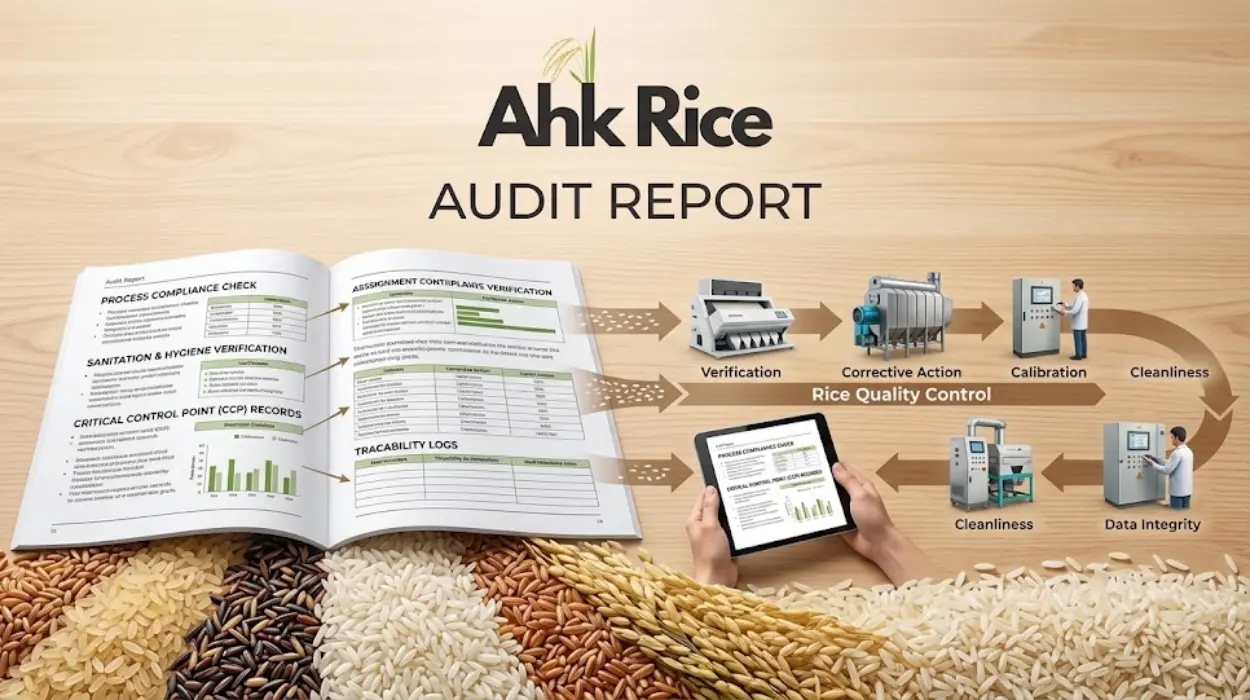
Audit reports matter because they show whether a rice processor actually controls receiving, drying, milling, sorting, testing, sanitation, storage, packing, traceability, and corrective actions instead of relying only on supplier claims or product samples. A documented audit gives buyers evidence across the production system.
For rice importers, this distinction is important because a good sample represents one batch. An audit evaluates the controls that can influence many batches. FDA’s Foreign Supplier Verification Program (FSVP) requires covered U.S. importers to evaluate foreign suppliers and use appropriate verification activities. These activities can include onsite audits, sampling and testing, and review of supplier food-safety records.
Importers should therefore understand:
Why factory compliance standards are important for rice importers rather than treating an audit certificate as a standalone quality guarantee. A useful audit report identifies the facility, audit scope, production areas examined, records reviewed, nonconformities found, corrective actions, and verification of closure.
For Pakistani Basmati rice, the report should connect controls with measurable specifications such as moisture, broken grains, grain length, foreign matter, purity, milling yield, packaging integrity, and storage conditions. These measurements show whether processing controls translate into commercial product consistency.
What are the available solutions for demonstrating rice processing quality?
The main solutions are internal quality-control records, independent facility audits, certification audits, laboratory testing, pre-shipment inspection, and batch traceability; the strongest supplier evaluation combines these methods because each proves a different part of processing control. No single document covers every operational risk.
An internal quality-control report records checks performed by the processor. It can cover incoming paddy inspection, moisture measurement, milling performance, optical sorting, broken-grain percentage, packaging weight, and final product release. Its advantage is frequency because the processor can document controls for every production run.
A third-party facility audit evaluates the processing operation independently. The auditor examines equipment, sanitation, personnel practices, pest control, records, production flow, storage, and corrective-action systems. This provides stronger evidence of actual facility conditions.
A certification audit evaluates the facility against a defined standard. Examples include HACCP-based systems and ISO 22000 food-safety management systems. Certification demonstrates conformity with the requirements of that particular standard. It does not automatically prove that every shipment meets a buyer’s commercial specification.
A laboratory report verifies measurable product characteristics. Testing can cover moisture, pesticide residues, microbiological parameters, mycotoxins, and other buyer-defined requirements. Laboratory evidence is particularly useful when the importer needs batch-specific verification.
A pre-shipment inspection checks a defined shipment before loading. It can verify quantity, packaging, appearance, grade, moisture, broken grains, foreign matter, and other contractual specifications.
A traceability record connects the finished lot to processing and packing information. It allows an importer to identify the relevant production batch if a quality deviation occurs.
How do different audit and quality-control approaches compare?
Internal records provide frequent operational evidence, third-party audits provide independent facility verification, laboratory reports prove measurable product characteristics, and pre-shipment inspections confirm contractual shipment quality; combining them creates stronger evidence than relying on one method. Their purposes are complementary rather than interchangeable.
| Attribute | Internal QC Records | Third-Party Facility Audit | Laboratory Report | Pre-Shipment Inspection |
|---|---|---|---|---|
| Primary purpose | Daily process control | Independent facility assessment | Product measurement | Shipment verification |
| Independence | Processor-controlled | Independent auditor | Independent or qualified laboratory | Independent inspector |
| Timing | Every production run | Periodic | Batch-specific | Before loading |
| Main evidence | Process records | Facility controls and records | Analytical results | Quantity and specifications |
| Best use | Continuous monitoring | Supplier qualification | Safety and specification verification | Contract compliance |
| Main limitation | Limited independence | Periodic snapshot | Does not assess full facility | Does not prove long-term process control |
| Buyer value | High for consistency | High for supplier risk | High for measurable quality | High before shipment |
The comparison shows why audit reports should not be treated as laboratory certificates. An audit can show that moisture testing is part of the production-control system. A laboratory report shows the actual moisture result for a specific sample or lot.
The same distinction applies to sanitation. An audit can examine cleaning schedules, sanitation procedures, pest-control records, and corrective actions. A laboratory test may confirm microbiological results from a particular batch. Both provide evidence, but they answer different questions.
The USDA Agricultural Marketing Service maintains U.S. standards for milled rice, giving importers a reference point for evaluating rice grades and quality characteristics.
How do audit reports demonstrate controls from paddy receiving to finished rice?
A strong audit report follows the rice through each processing stage and verifies the control applied at that stage, creating a chain of evidence from raw paddy receiving through drying, milling, sorting, testing, packaging, storage, and container loading. This process-based structure makes reports commercially useful.
At paddy receiving, auditors review supplier records, incoming inspection procedures, moisture checks, varietal identification, and acceptance criteria. The purpose is to prevent unsuitable raw material from entering production.
During drying, the report should identify drying procedures, moisture targets, equipment controls, and monitoring records. Moisture is critical because rice is hygroscopic and responds to surrounding humidity. FAO explains that rice equilibrates with ambient relative humidity, making storage conditions important to grain stability.
During milling, auditors examine equipment condition, process settings, cleaning, milling yield, and separation of broken grains. For Basmati, milling control directly affects appearance, head-rice yield, and commercial grade.
During optical sorting, the report can verify sorting equipment, inspection frequency, rejected-product handling, and calibration records. Optical sorting reduces defective, discolored, or foreign material from the finished stream.
During grading and testing, auditors review sampling methods and test records. A report becomes stronger when it identifies who performed the test, what instrument was used, when the test occurred, and what specification was applied.
During packing, auditors check packaging material, net weight controls, sealing, labeling, lot identification, and storage conditions. Lot codes are important because they connect retail or wholesale inventory with a defined production record.
During container loading, the report should verify inspection of the container, loading conditions, packaging integrity, quantity, and relevant export documentation. This creates evidence that the product leaving the facility corresponds to the approved production lot.
Which rice grades benefit most from documented processing controls?
Extra-long Basmati grades benefit most from documented processing controls because buyers pay for measurable characteristics such as grain length, low breakage, purity, moisture stability, appearance, and cooking performance, making process consistency commercially important across repeated shipments. The controls should match the intended market.
For 1121 Basmati, grain length and breakage control are major commercial attributes. Published 2026 export specifications commonly place raw grain length around 8.3 millimetres, with premium grades often targeting 0–2% broken grains.
For Super Kernel, the target is a slightly shorter but still long, slender grain. Current 2026 export references place Super Kernel around 7.0–7.5 millimetres depending on specification and processing grade.
For 1509, audit evidence is useful when buyers need consistent grain length, moisture, milling recovery, and cooking behavior across high-volume orders. The audit should demonstrate that the processor controls these attributes rather than simply testing them after production.
AHK Rice operates as a Pakistani Basmati rice exporter based in Punjab and supplies 1121, Super Kernel, and 1509 varieties to international buyers. Its processing model covers stages from paddy procurement through processing and container loading.
How do USA and UAE buyers evaluate audit evidence differently?
USA buyers generally place greater emphasis on documented supplier verification, food-safety controls, traceability, and records that support FSVP responsibilities, while UAE buyers emphasize consistent grade, processing quality, packaging, shipment readiness, and suitability for fast regional distribution. The same audit can support both markets when properly structured.
What grades and prices suit USA buyers?
USA buyers commonly evaluate 1121 Steam, 1121 White, 1121 Sella, and Super Kernel according to retail, restaurant, wholesale, and private-label requirements. Long grain, low breakage, aroma, clean appearance, and repeatable cooking performance are important commercial attributes.
As a July 2026 reference, indicative FOB Karachi prices for 1121 White were approximately $1,165–$1,205 per MT, while 1121 Steam was approximately $1,160–$1,200 per MT. Super Kernel was also reported around $1,165–$1,205 per MT. These are FOB reference ranges, not delivered Virginia prices. Freight, insurance, port charges, customs costs, and inland transportation must be added to calculate landed cost.
For Virginia importers, audit evidence should therefore support the supplier’s food-safety documentation and product specifications. FDA states that FSVP importers must evaluate supplier performance and conduct appropriate verification activities based on food and supplier risk.
What grades and prices suit UAE buyers?
UAE buyers frequently evaluate 1121 Basmati and Super Kernel for wholesale, retail, foodservice, and regional distribution. Sella and Steam grades provide strong options where firmer grain structure and storage durability are important.
July 2026 indicative FOB Karachi references placed 1121 Sella around $1,135–$1,175 per MT, 1121 Steam around $1,160–$1,200 per MT, and Super Kernel around $1,165–$1,205 per MT. The UAE destination does not change the FOB price by itself; Jebel Ali freight and other landed costs create the destination difference.
For both markets, a useful audit report should show whether the same specification was maintained across production lots instead of proving quality through one sample.
How do shelf life and processing methods compare between the two markets?
Shelf life depends on processing, moisture, packaging, storage temperature, and infestation control rather than destination alone; commercially packaged dry rice commonly carries a 24-month best-before target, while proper storage conditions can preserve quality beyond that period. Buyers should evaluate the supplier’s declared shelf-life specification.
USDA guidance lists rice and dried pasta at 2 years as a general shelf-stable storage period. Commercial Basmati specifications also commonly state 24 months when packed and stored under controlled dry conditions.
Parboiled grades such as Sella have a processing advantage for long-distance distribution because parboiling creates a firmer grain structure. AHK Rice’s published processing guidance describes Sella as having an 18–24 month shelf-life range compared with 12–18 months for raw Basmati under its stated storage assumptions.
| Market | Preferred Grades | Indicative FOB Price/MT | Typical Commercial Shelf-Life Target | Audit Priority |
| USA / Virginia | 1121 Steam, White, Sella, Super Kernel | $1,135–$1,205 | Up to 24 months | FSVP evidence, food safety, traceability, batch testing |
| UAE / Jebel Ali | 1121 Sella, Steam, Super Kernel | $1,135–$1,205 | Up to 24 months | Grade consistency, packaging, moisture, storage and shipment controls |
These price ranges are based on July 2026 indicative FOB Karachi references and should be reconfirmed for the actual crop, packing, quantity, inspection requirements, and shipment date.
What are the pros and cons of relying on audit reports?
Audit reports provide broad evidence of process control, but they are periodic documents and cannot replace batch-specific laboratory testing or shipment inspection; the strongest evaluation uses audit findings to assess the system and test reports to verify the actual rice supplied. This distinction prevents overreliance.
The main advantages are broader visibility, documented corrective actions, supplier comparison, traceability review, and evidence of operational discipline. For example, an audit may identify that a mill calibrates moisture meters at defined intervals and retains calibration records.
The main limitation is timing. A facility audit conducted several months before shipment cannot prove that every later production lot meets the buyer’s specification. Production conditions can change.
A laboratory certificate solves part of this limitation by testing a defined sample. However, it cannot prove that sanitation, pest control, maintenance, or traceability systems operate correctly throughout the facility.
Pre-shipment inspection provides another layer. It can confirm the shipment before loading but still does not demonstrate long-term supplier capability.
For a Virginia importer, this layered approach also aligns better with the risk-based structure of FSVP, where supplier evaluation and verification activities depend on the food, hazards, supplier performance, and available evidence.
Which method works best for different rice-importing cases?
The best method depends on the purchasing risk: new suppliers require independent facility verification, repeat suppliers require periodic audits and batch records, high-value contracts require layered verification, and regulatory-sensitive U.S. imports require documentation that supports the importer’s supplier-verification responsibilities. Buyers should match evidence to risk.
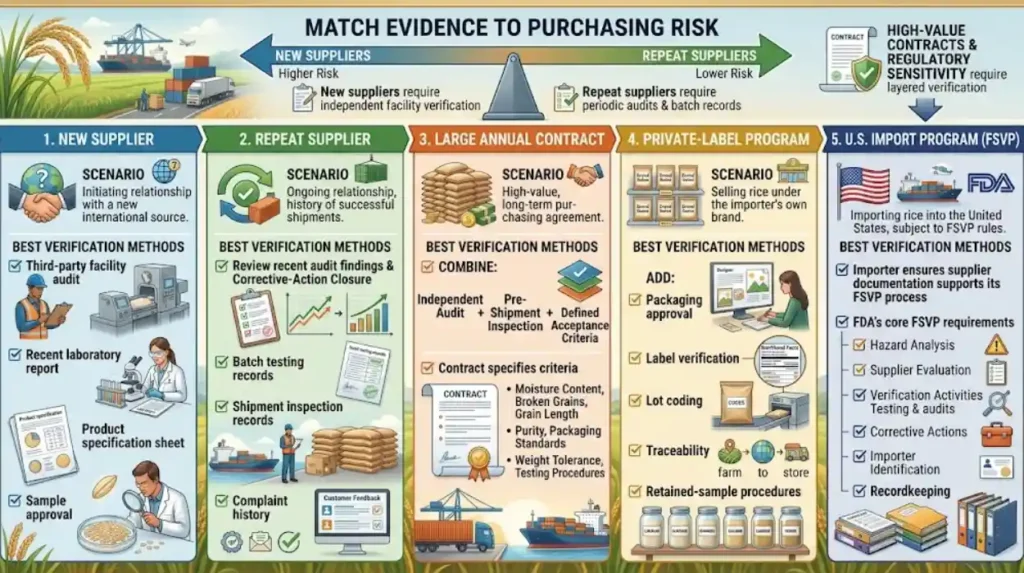
For a new supplier, start with a third-party facility audit, recent laboratory report, product specification sheet, and sample approval.
For a repeat supplier, review recent audit findings, corrective-action closure, batch testing, shipment inspection records, and complaint history.
For a large annual contract, combine an independent audit with pre-shipment inspection and defined acceptance criteria. The contract should specify moisture, broken grains, grain length, purity, packaging, weight tolerance, and testing procedures.
For a private-label program, add packaging approval, label verification, lot coding, traceability, and retained-sample procedures.
For a U.S. import program, the importer should ensure that the supplier documentation supports its FSVP process. FDA identifies hazard analysis, supplier evaluation, verification activities, corrective actions, importer identification, and recordkeeping as core FSVP requirements.
What five decision factors should rice importers use when reviewing audit reports?
Rice importers should score audit evidence against facility control, product specifications, independent verification, corrective-action performance, and market-specific compliance requirements because these five factors reveal whether a supplier can maintain quality beyond a single successful shipment. A structured scorecard improves supplier comparisons.
| Decision Factor | What to Verify | Why It Matters |
| Facility control | Hygiene, pest control, equipment, calibration, storage | Shows process discipline |
| Product specification | Moisture, grain length, broken grains, purity | Connects controls with buyer requirements |
| Independent verification | Auditor, laboratory, inspection body, audit date | Establishes evidence credibility |
| Corrective actions | Finding, root cause, action, closure date | Shows how problems are managed |
| Market compliance | FSVP records, food-safety documents, export documentation | Reduces regulatory and entry risk |
An audit report becomes more valuable when every finding has evidence. A statement such as “moisture is controlled” is weaker than a record showing the testing procedure, instrument, specification, result, date, and responsible person.
The same principle applies to corrective actions. A nonconformity is not necessarily evidence of poor supplier performance. The stronger indicator is whether the supplier identifies the cause, implements an action, documents completion, and verifies that the problem has not repeated.
How should buyers use audit reports when selecting an audited Basmati supplier?
Buyers should treat audit reports as supplier-performance evidence, then combine them with current samples, batch laboratory results, specifications, shipment inspection, and commercial terms before approving a long-term Basmati rice supplier. This approach evaluates both the processing system and the rice delivered.
AHK Rice’s Punjab-based operation is relevant to this evaluation because an integrated exporter can connect processing, quality control, packaging, documentation, and loading records within one supply workflow. Its stated international market coverage includes the USA, UAE, Saudi Arabia, UK, Germany, China, Malaysia, Indonesia, Qatar, Turkey, Morocco, Ivory Coast, the Philippines, and Vietnam.
For buyers comparing audited suppliers, the most useful evidence package includes the latest facility audit, food-safety documentation, product specification sheet, current laboratory report, batch or lot traceability, corrective-action records, packaging specification, and pre-shipment inspection procedure.
For U.S. buyers evaluating an audited Pakistani supplier for Virginia distribution, the decision should then move from general supplier qualification to the actual commercial program. This includes the required Basmati grade, annual volume, packaging format, FOB or landed pricing, sampling requirements, inspection terms, and shipment schedule.
The next decision-stage resource should be placed immediately after this section:
Choose AHK Rice for Audited Basmati Rice Supply in Virginia, USA, because readers reaching this point have already learned how audit evidence works and are ready to evaluate a supplier-specific option.
Frequently Asked Questions
What is a rice processing audit report?
A rice processing audit report is a documented assessment of a rice mill’s production, quality, food-safety, sanitation, storage, testing, traceability, and corrective-action controls. It provides evidence that documented procedures are implemented and monitored.
How do audit reports demonstrate rice processing quality?
Audit reports demonstrate quality by reviewing measurable controls such as moisture testing, grain sorting, milling performance, broken-grain levels, equipment calibration, sanitation records, packaging checks, and batch traceability. Auditors also verify supporting records.
What should a rice processing audit report contain?
A useful report should identify the processing facility, audit date, audit scope, production areas reviewed, documents examined, observations, nonconformities, corrective actions, responsible personnel, and closure status. The report should also identify the applicable audit standard.
Are audit reports the same as laboratory test reports?
No. An audit report evaluates the processing system and facility controls, while a laboratory report measures specific product characteristics. Importers can use both because they provide different types of evidence.
What quality controls are checked during rice milling audits?
Common controls include paddy receiving, moisture measurement, drying, milling, polishing, grading, optical sorting, foreign-material removal, equipment maintenance, sanitation, pest control, packaging, storage, and container-loading procedures.
Why is moisture control important in rice processing?
Moisture control helps maintain rice quality during processing and storage. Excessive moisture can increase the risk of quality deterioration, while excessively low moisture can contribute to grain breakage during milling. Audit records verify how moisture is measured and controlled.
How do audits verify Basmati rice quality?
Audits verify whether the processor has consistent procedures for controlling Basmati characteristics such as grain length, broken grains, purity, moisture, appearance, sorting, milling, packaging, and traceability. Product testing is then used to confirm the actual batch specification.
What is the difference between an internal and third-party rice audit?
An internal audit is conducted by the company or its internal quality team, while a third-party audit is performed by an independent organization. Third-party audits generally provide stronger independent evidence for supplier qualification.
Do audit reports guarantee that every rice shipment meets specifications?
No. An audit evaluates the supplier’s quality-control system at the time of assessment. Importers should combine audit evidence with current samples, batch laboratory reports, product specifications, and pre-shipment inspection to verify individual shipments.