Why Should Kentucky Importers Reduce Procurement Risks Early?
Kentucky rice importers should reduce procurement risks before placing commercial orders because imported Basmati rice involves product specification, supplier capability, food-safety compliance, documentation, shipping, customs clearance, and inland delivery. A failure at any stage increases the delivered cost or delays inventory availability.
Rice procurement risk means the possibility that an imported rice order fails to meet its agreed specification, arrives late, creates regulatory problems, or cannot be replenished at the required volume. Early risk reduction means checking these conditions before production and shipment rather than correcting them after the cargo reaches the United States.
This approach matters for Kentucky distributors, wholesalers, restaurants, retailers, food manufacturers, and foodservice operators. U.S. rice imports remain structurally important. USDA’s August 2026 outlook projects record U.S. all-rice imports of 49.8 million hundredweight for the 2026/27 marketing year.
What does procurement risk mean for Kentucky rice importers?
Procurement risk is the combined exposure created by product inconsistency, supplier failure, regulatory non-compliance, documentation errors, shipping delays, and landed-cost changes during an imported rice purchase. Early controls reduce these risks before inventory leaves the exporting country.
A Kentucky importer does not purchase only rice. The importer purchases a defined specification and an international supply process.
For example, a buyer ordering 1121 Basmati must define grain length, broken percentage, moisture, foreign matter, damaged grains, purity, milling condition, aroma, cooking performance, packaging, and quantity. The commercial specification becomes the reference point for sampling and inspection.
Supplier risk is separate from product risk. A supplier can provide an acceptable sample but fail to reproduce the same specification across 10 or 20 containers. Production capacity, milling controls, sorting equipment, laboratory testing, packaging capability, and export experience therefore become procurement variables.
Logistics create another risk layer. A shipment moves through production, inspection, export documentation, port handling, ocean transportation, U.S. entry procedures, customs clearance, and inland transportation before reaching a Kentucky warehouse.
The buyer therefore needs an order-to-arrival plan instead of relying only on an estimated ocean transit time.
How does Pakistani Basmati rice move from crop to export shipment?
Pakistani Basmati rice moves from paddy cultivation through harvesting, drying, cleaning, milling, aging or conditioning, sorting, grading, laboratory inspection, packaging, container loading, export documentation, and shipment before reaching a U.S. importer. Each stage affects the final commercial specification.
Basmati rice is an aromatic long-grain rice associated with the Himalayan foothill region of the Indian subcontinent. Pakistani Basmati production is concentrated mainly in Punjab, where climate, soil, water availability, and traditional varieties support aromatic rice production.
The commercial process begins with paddy procurement. Paddy is the harvested rice grain with its outer husk still attached. Mills receive paddy from growers or approved procurement channels and assess its condition before processing.
The main processing stages are:
1. Paddy cleaning
Incoming paddy passes through cleaning equipment that removes stones, dust, straw, metal, and other unwanted material. Pre-cleaning protects milling equipment and establishes a cleaner raw material stream.
2. Drying and moisture control
Rice requires controlled moisture before milling and storage. Excess moisture increases storage and microbial risks, while excessive drying increases breakage during milling. Moisture therefore becomes a core specification for export procurement.
3. Milling
Milling removes the husk and, depending on the product, the bran layers. White rice receives a different milling treatment from parboiled or steam-processed rice.
4. Steam or parboiling treatment
Steam Basmati receives controlled steam treatment before drying and milling. This process changes the physical structure of the grain and improves resistance to breakage during subsequent handling.
Sella rice is parboiled rice. Creamy Sella refers to a commercially recognized appearance and processing style within parboiled Basmati products.
5. Aging or conditioning
Basmati rice is commonly aged to develop cooking and physical characteristics. Aging affects moisture balance, grain firmness, aroma expression, and cooking behavior.
6. Sorting and grading
Modern rice plants use mechanical and optical sorting systems to separate discolored, damaged, immature, foreign, and off-specification grains. Grading establishes the commercial quality category.
7. Laboratory inspection
The finished rice is checked against agreed specifications. Tests can include moisture, broken grains, foreign matter, damaged kernels, chalkiness, grain dimensions, purity, and other quality parameters.
8. Packaging and container loading
Rice is packed into bags according to the buyer’s packaging specification. Packaging can include private-label retail bags, foodservice sacks, bulk formats, and custom printed packaging.
The exporter then prepares the export documentation and loads the approved cargo into containers for shipment.
What Basmati varieties and grades should Kentucky buyers understand?
Kentucky buyers should distinguish rice varieties from commercial grades because variety identifies the rice type, while grade describes measurable quality characteristics such as grain length, broken percentage, purity, processing method, moisture, appearance, and cooking performance.
Three important Pakistani Basmati varieties in international trade are 1121, Super Kernel, and 1509.
1121 Basmati is an extra-long-grain variety recognized for long cooked grains and strong market demand. It is commonly sold as White and Steam Basmati.
Super Kernel Basmati is another long-grain Pakistani Basmati variety used across retail, foodservice, wholesale, and restaurant applications. It is commonly supplied as White Rice and can be specified according to grain, broken, purity, moisture, and appearance requirements.
1509 Basmati is an early-maturing Basmati variety with long grain characteristics. Commercial formats include White, Steam, and Creamy Sella products.
Commercial grades can therefore be organized around several attributes:
| Grade attribute | What the buyer evaluates |
|---|---|
| Variety | 1121, Super Kernel, or 1509 |
| Processing | White, Steam, Sella, or Creamy Sella |
| Grain length | Average and maximum grain dimensions |
| Broken percentage | Percentage of broken kernels |
| Purity | Presence of other grains and unwanted material |
| Moisture | Moisture percentage at shipment |
| Appearance | Color, chalkiness, damaged and discolored kernels |
| Packaging | Bag size, material, printing, and labeling |
There is no single worldwide Basmati grade that replaces a written buyer specification. Importers should therefore place measurable requirements in the purchase contract.
Which markets import Pakistani Basmati rice?
Pakistani Basmati rice serves international markets across the Middle East, North America, Europe, Africa, and other regions where aromatic long-grain rice has established retail, restaurant, wholesale, and foodservice demand. Market requirements differ by product and buyer segment.
The Middle East is an important destination for Pakistani rice, particularly Saudi Arabia and the United Arab Emirates. Buyers in these markets frequently purchase long-grain Basmati products for retail, foodservice, wholesale, and institutional consumption.
North America is another significant market. U.S. demand includes Basmati rice used by restaurants, ethnic grocery retailers, distributors, food manufacturers, and households.
Kentucky buyers also operate within the broader U.S. regulatory system rather than a separate state food-import framework. Imported food entering U.S. interstate commerce must comply with applicable FDA requirements. FDA states that imported food must meet the same legal requirements that apply to domestically produced food.
The FSVP requirement is especially important for U.S. food importers. The Foreign Supplier Verification Program requires covered importers to perform risk-based activities that verify foreign suppliers produce food in compliance with applicable U.S. food-safety requirements and that imported food is not adulterated or misbranded.
This makes supplier documentation part of procurement risk management rather than an administrative task completed after purchasing.
What certifications and documents apply to imported Basmati rice?
Rice import documentation should establish product identity, supplier identity, shipment details, food-safety compliance, commercial terms, and traceability. The exact documents depend on the transaction, destination, product, buyer, and applicable U.S. import requirements.
FDA requires food facilities involved in manufacturing, processing, packing, or holding food for U.S. consumption to meet applicable registration requirements, while imported food shipments require Prior Notice before arrival.
For a Kentucky importer, the procurement file should therefore be built before shipment around documents such as:
- Commercial invoice
- Packing list
- Bill of lading
- Certificate of origin
- Product specification sheet
- Certificate of analysis where required
- Food-safety or laboratory documentation
- FDA facility registration information where applicable
- Prior Notice information
- FSVP records where applicable
- Phytosanitary or other certificates where specifically required
- Insurance documents where required by the sales contract
Certifications and third-party standards are different from mandatory government documents. Buyers should identify the certification actually required by their customer, retail channel, foodservice program, or internal food-safety policy.
Examples include HACCP-based food-safety systems, ISO 22000, BRCGS, and other recognized food-safety schemes. A certification should be checked for scope, validity, issuing body, facility name, and expiration date rather than accepted only from a supplier’s marketing material.
How should Kentucky importers reduce procurement risks before ordering?
Kentucky importers should reduce risk through specification approval, supplier verification, sample testing, document review, production confirmation, pre-shipment inspection, shipment planning, and contingency inventory. These controls move procurement decisions from price comparison toward measurable supply performance.
The first control is a written product specification.
The second is supplier verification. Buyers should examine production capacity, processing capability, export history, quality-control procedures, facility documentation, packaging capability, and the supplier’s ability to maintain the approved specification.
The third is sample approval. The buyer should request a representative sample and test it against the commercial specification. A sample should represent the actual product configuration, not an exceptional production lot.
The fourth is production confirmation. Once an order is placed, the supplier should confirm the production quantity, packing format, expected completion date, inspection schedule, and shipment plan.
The fifth is pre-shipment inspection. The inspection should compare the finished cargo with the approved specification before containers leave the exporting country.
The sixth is document verification. Names, quantities, lot information, container numbers, weights, product descriptions, and shipment dates should be consistent across the export documents.
The seventh is logistics planning. Kentucky buyers should calculate the complete transit cycle from production readiness to final warehouse delivery. The plan should include ocean transit, port handling, customs processing, and inland transportation.
The eighth is inventory protection. A buyer with recurring demand should maintain sufficient safety stock to cover normal replenishment time plus a defined disruption buffer.
This process also explains why buyers researching supplier selection should understand:
How buyers identify reliable rice export partners. Supplier reliability is not established by a quotation alone. It is established through measurable evidence across product, production, compliance, documentation, and delivery.
What are the main benefits of early procurement risk reduction?
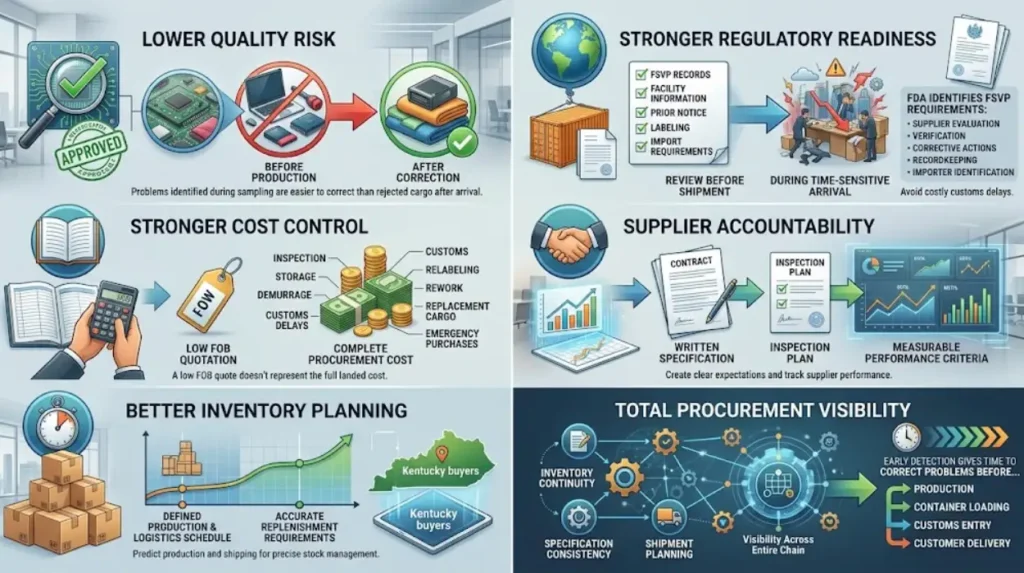
Early risk reduction improves specification consistency, regulatory readiness, shipment planning, inventory continuity, supplier accountability, and total procurement visibility. It also gives buyers time to correct problems before production, container loading, customs entry, or customer delivery.
The first benefit is lower quality risk. Problems identified during sampling or production are easier to correct than rejected cargo after arrival.
The second benefit is stronger cost control. A low FOB quotation does not represent the complete procurement cost. Inspection, storage, demurrage, customs delays, relabeling, rework, replacement cargo, and emergency purchases can increase the landed cost.
The third benefit is better inventory planning. A defined production and logistics schedule allows Kentucky buyers to calculate replenishment requirements more accurately.
The fourth benefit is stronger regulatory readiness. FSVP records, facility information, Prior Notice, labeling, and other import requirements can be reviewed before shipment instead of during a time-sensitive arrival process. FDA identifies supplier evaluation, verification, corrective actions, recordkeeping, and importer identification among FSVP requirements.
The fifth benefit is supplier accountability. A written specification and inspection plan create measurable performance criteria.
What procurement problems and misconceptions should Kentucky buyers avoid?
The most common procurement mistakes are choosing the lowest quotation, approving an unrepresentative sample, treating variety as a complete specification, ignoring documentation, calculating only ocean transit, and assuming one successful shipment proves long-term supplier reliability.
A low price is not automatically a low procurement cost. The correct comparison is based on specification compliance and total landed cost.
A sample is not automatically proof of production consistency. Buyers should verify that the supplier can reproduce the approved sample at commercial volume.
A variety name is not a complete specification. “1121 Basmati” does not define broken percentage, moisture, purity, milling condition, packaging, or inspection requirements.
A certification is not a substitute for verification. Buyers should confirm certificate scope and validity.
Ocean transit is not the complete lead time. Production, inspection, documentation, port handling, customs clearance, and inland delivery must be included.
A successful first shipment is not proof of long-term supply reliability. Recurring procurement requires evidence that the supplier can maintain quality and volume across multiple production cycles.
Early procurement risk reduction therefore starts before the purchase order. Kentucky importers that define the product, verify the supplier, test samples, confirm documentation, inspect production, and plan logistics create a measurable procurement system instead of relying on assumptions.
Frequently Asked Questions
Why should Kentucky importers reduce rice procurement risks early?
Early risk reduction helps Kentucky importers verify rice specifications, supplier capability, food-safety compliance, documentation, shipping schedules, and inventory requirements before committing to a commercial shipment.
What procurement risks do Kentucky rice importers face?
Key risks include inconsistent rice quality, supplier capacity problems, incorrect documentation, regulatory non-compliance, shipment delays, customs issues, damaged cargo, and unexpected increases in landed costs.
Which Pakistani Basmati rice varieties are commonly available to importers?
Major Pakistani Basmati varieties include 1121 Basmati, Super Kernel Basmati, and 1509 Basmati. These varieties are supplied in different processing formats, including White, Steam, and Sella rice.
What should Kentucky buyers include in a Basmati rice specification?
A specification should define variety, processing type, grain length, broken percentage, moisture, purity, foreign matter, damaged grains, appearance, packaging format, quantity, and applicable inspection requirements.
How can importers verify a Pakistani rice supplier?
Importers should review production capacity, processing facilities, quality-control systems, export history, certifications, laboratory documentation, packaging capability, sample consistency, and the supplier’s ability to meet recurring shipment volumes.
Why is sample approval important before placing a rice order?
Sample approval establishes a physical quality reference before commercial production. Buyers can compare the sample with agreed specifications for grain length, moisture, broken percentage, purity, appearance, and cooking performance.