How Do Buyers Identify Reliable Rice Export Partners?
Buyers identify reliable rice export partners by comparing specification control, processing capacity, quality verification, documentation, shipment performance, market compliance, and landed cost rather than selecting the exporter with the lowest initial price. A reliable partner must reproduce the approved rice specification across repeat shipments and support the buyer through procurement, export, and delivery.
For Kentucky importers, supplier evaluation should begin before a purchase order is issued. The procurement team should define grain variety, grade, moisture, broken percentage, packaging, crop year, quantity, inspection method, documentation, and delivery requirements. This early evaluation approach is explained in:
Why Kentucky importers should reduce procurement risks early, because supplier reliability is determined before the container reaches a U.S. port.
Pakistan remains an important source for Basmati rice. USDA’s April 2026 Pakistan Grain and Feed Annual forecasts Pakistan rice production at 9.8 million metric tons for 2026/27 and rice exports at about 5.0 million metric tons. The 2025/26 export forecast is 4.7 million metric tons. This supply base gives international buyers access to multiple Basmati grades, but it also makes supplier-level evaluation important.
What are the available solutions for evaluating rice export partners?
The main supplier-evaluation solutions are specification audits, sample approval, factory verification, third-party inspection, documentation review, shipment-history analysis, and structured supply contracts. Combining these controls gives buyers stronger evidence than relying on quotations, sales claims, or one successful sample shipment alone.
Specification-based evaluation
A specification-based evaluation starts with the product rather than the supplier. The buyer defines the required variety, grain length, moisture, broken percentage, purity, processing type, packaging, crop year, and cooking characteristics.
For example, a buyer requiring 1121 Basmati should distinguish between 1121 White, 1121 Steam, and 1121 Sella. These are different processing forms with different cooking performance, appearance, durability, and commercial applications.
A supplier that cannot provide a stable written specification creates procurement risk. A supplier that can provide a detailed specification gives the buyer a measurable acceptance standard.
Sample approval
Sample approval verifies whether the physical product matches the commercial specification. Buyers should test grain appearance, aroma, moisture, broken grains, foreign matter, cooking elongation, texture, and packaging performance.
The approved sample should become the reference for the purchase contract. The contract should state the acceptable tolerance for each important attribute.
Factory and process verification
Factory verification examines whether the exporter can reproduce the approved product at commercial volume. The review should cover paddy sourcing, milling, aging, steaming or parboiling, drying, sorting, grading, metal detection, packing, storage, quality control, and container loading.
This matters because a strong sample does not prove production consistency. The exporter must demonstrate that the same process controls apply to the shipment.
Third-party inspection
Third-party inspection provides independent verification before loading. SGS, Bureau Veritas, and Intertek are examples of international inspection organizations used in commodity trade.
Inspection can verify quantity, packaging, grain characteristics, moisture, broken percentage, foreign matter, and other agreed specifications. The inspection scope should be written into the sales contract.
Documentation review
A reliable exporter should provide complete commercial and regulatory documents appropriate to the destination market. Typical export documentation includes the commercial invoice, packing list, certificate of origin, bill of lading, phytosanitary documentation where required, health or conformity documents where applicable, and inspection certificates.
For U.S. buyers, regulatory responsibility also extends to the importer. FDA states that imported food must meet U.S. legal requirements, and applicable facilities must be registered while Prior Notice requirements must be fulfilled.
How do different rice export approaches compare?
A quotation-only approach provides the least evidence of supplier reliability, while sample approval adds product verification and factory audits add process verification. A structured supplier program combining specifications, testing, documentation, inspection, and shipment records provides the strongest commercial control.
| Attribute | Quotation-Only Supplier | Sample-Approved Supplier | Audited Export Partner |
|---|---|---|---|
| Product specification | Basic | Detailed | Contract-controlled |
| Physical sample | Optional | Required | Required and retained |
| Factory verification | None | Limited | Process and capacity review |
| Third-party inspection | Usually absent | Optional | Defined before shipment |
| Documentation | Basic commercial set | Reviewed | Destination-specific |
| Repeat-order control | Weak | Moderate | Strong |
| Shipment performance | Unverified | Partly established | Measured through records |
The table shows why price alone is a weak supplier-selection method. A quotation measures commercial value at one point in time. It does not establish whether the exporter can maintain grain length, moisture, broken percentage, packaging quality, or shipment timing over multiple orders.
A sample provides stronger evidence because the buyer can test the actual rice. Its limitation is scale. A supplier can produce an acceptable sample without demonstrating the same result across a high-volume order.
An audited export partner provides broader evidence. The buyer can examine the processing system, quality controls, production capacity, storage practices, inspection procedures, and export documentation.
For Kentucky buyers, the strongest approach is therefore a controlled supplier qualification process followed by repeat performance monitoring.
Which rice export method works best for different buyer cases?
The best evaluation method depends on purchase volume, market requirements, product complexity, and supply continuity needs. Small buyers can begin with specification and sample approval, while distributors, restaurant groups, and retailers should add factory verification, third-party inspection, documentation controls, and shipment-performance monitoring.
A small wholesaler placing an occasional 20–25 metric ton order can use a specification sheet, representative sample, laboratory testing, packaging review, and pre-shipment inspection.
A distributor importing multiple containers needs stronger controls. The supplier should demonstrate commercial production capacity and provide repeat-order records. The buyer should also compare production schedules with its own inventory requirements.
A restaurant group needs cooking consistency as much as laboratory specifications. The procurement team should test cooked grain length, separation, texture, aroma, and yield. 1121 Steam Basmati can suit foodservice programs requiring long, separate grains and consistent cooking.
A private-label retailer requires another layer of control. Packaging artwork, label declarations, bag material, net weight, lot identification, shelf-life information, and destination-market compliance must be reviewed before production.
A U.S. importer also needs to understand Foreign Supplier Verification Program requirements. FDA explains that FSVP requires covered importers to evaluate food and foreign suppliers, conduct appropriate verification activities, maintain records, and take corrective action when necessary. Verification can include supplier records, sampling and testing, and on-site audits depending on the risk evaluation.
How do Middle East and North American buyers compare rice requirements?
Middle Eastern buyers commonly prioritize Sella and Steam grades for firm cooking and foodservice applications, while North American buyers place greater emphasis on FDA compliance, FSVP documentation, retail specifications, traceability, and consistent cooking performance across longer shipping routes.
For comparison, the Middle East can be represented by the GCC market, particularly Saudi Arabia and the UAE. North America can be represented by the United States, including Kentucky distribution and foodservice demand.
| Market region | Common grade preference | Indicative FOB price/MT in 2026 | Typical shelf-life planning | Key evaluation priority |
| GCC — Saudi Arabia/UAE | 1121 Sella, 1121 Steam, Super Kernel | $1,135–$1,205 | Up to 24 months for suitable packed grades | Cooking strength, grain appearance, compliance |
| North America — USA | 1121 Steam, 1121 Sella, 1121 White | $1,135–$1,205 | Commonly up to 24 months when correctly packed and stored | FDA, FSVP, labeling, traceability |
The 2026 FOB ranges are indicative Karachi benchmarks rather than fixed destination prices. Current published August 2026 references place 1121 Sella around $1,135–$1,175/MT, 1121 Steam around $1,160–$1,200/MT, and 1121 White around $1,165–$1,205/MT. Destination freight, insurance, port charges, inspection, customs-related costs, and inland transportation must be added to determine landed cost.
The GCC has a shorter shipping profile from Karachi. Current market references place Karachi-to-Jebel Ali sailing around 4–10 days. U.S. services to New York or Los Angeles are commonly around 24–40 days, creating a greater need for shipment planning and inventory buffer.
Shelf life should not be treated as one universal number. Commercial specifications commonly state up to 24 months from packaging when rice is stored in cool, dry conditions. Parboiled Sella has strong storage characteristics because the processing increases grain durability. The final shelf-life claim must follow the supplier specification and destination labeling requirements.
What are the pros and cons of each supplier evaluation approach?
Quotation comparison is fast but exposes buyers to quality and delivery risk. Sample approval improves product confidence but does not prove factory consistency. Factory audits improve process visibility but require time and cost. Third-party inspection adds independent evidence and reduces shipment-level uncertainty.
A quotation-first method is useful for creating an initial market benchmark. Its weakness is that a low FOB figure can exclude inspection, packaging, freight, testing, or destination charges.
Sample approval gives buyers direct product evidence. Its weakness is that the sample represents one production point rather than the complete supply chain.
Factory audits provide visibility into processing capacity. They are particularly useful for buyers planning recurring container programs. Their limitation is that an audit represents conditions at the time of assessment, so shipment-level inspection remains useful.
Third-party inspection creates independent evidence before loading. Its limitation is that it cannot replace supplier qualification. Inspection confirms the inspected shipment; it does not automatically prove future shipment performance.
A structured supply agreement combines these methods. It can define product specifications, tolerances, sampling procedures, inspection requirements, packaging, shipment windows, documentation, claims procedures, and corrective actions.
For example, a Kentucky importer ordering 100 MT per month should not qualify a supplier only from a 25 kg sample. The buyer should confirm that the supplier can process the required volume, maintain the approved grade, pack according to the agreed specification, complete documentation, and meet shipment windows repeatedly.
What decision factors should buyers use before selecting a rice exporter?
Buyers should score suppliers against five commercial factors: specification consistency, production capacity, compliance capability, shipment reliability, and total landed cost. A supplier that performs strongly across all five factors provides more procurement value than one that wins only on the initial FOB quotation.
| Decision factor | What buyers should verify | Example evidence |
| Specification consistency | Same grade and tolerances across shipments | COA, sample, inspection report |
| Production capacity | Ability to meet planned monthly volume | Factory capacity and production schedule |
| Compliance | Destination-market requirements | FDA, FSVP support documents, certificates |
| Shipment reliability | Ability to meet agreed loading windows | Previous shipment records |
| Landed cost | Full delivered procurement cost | FOB/CFR/CIF plus destination costs |
Specification consistency should receive the highest attention for branded retail and foodservice programs. A buyer who changes grain appearance or cooking performance between shipments can lose customer confidence even when the price remains competitive.
Production capacity matters when demand is recurring. Pakistan’s 2026/27 rice production forecast of 9.8 million metric tons and export forecast of 5.0 million metric tons indicate a substantial national supply base, but individual exporter capacity still needs separate verification.
Compliance is especially important for U.S. procurement. FDA places responsibility on importers to ensure imported food is safe, sanitary, properly labeled, and compliant with applicable requirements. FSVP adds a formal supplier-verification framework for covered food imports.
Shipment reliability should be measured through performance rather than promises. Buyers should record planned loading date, actual loading date, vessel departure, arrival, documentation completion, and any deviations.
Landed cost should combine the rice price with logistics and procurement costs. A $20/MT FOB saving can disappear when additional inspection, repacking, port charges, delays, or inland transportation increase the final cost.
How can buyers use this framework to compare AHK Rice with other exporters?
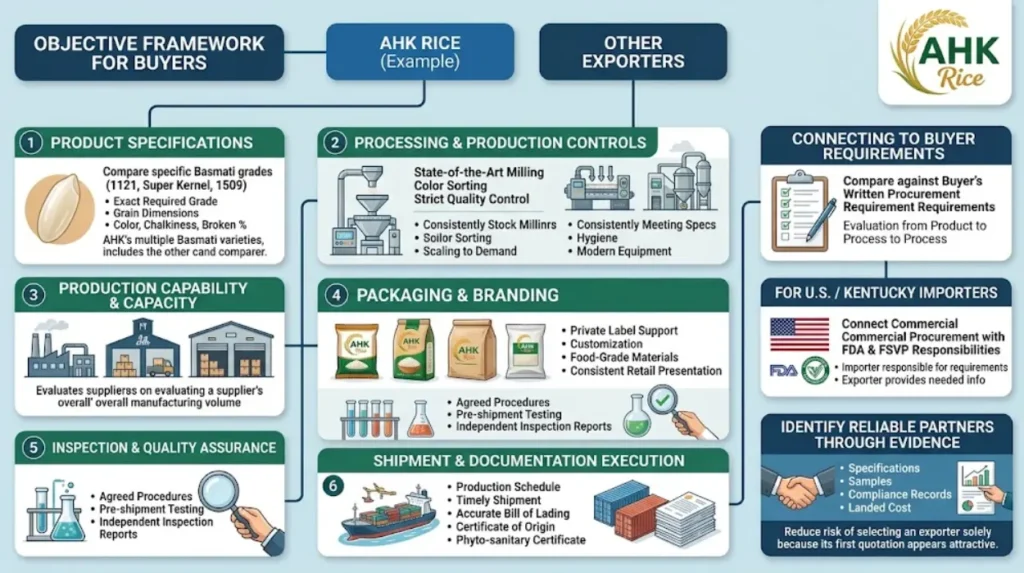
AHK Rice can be evaluated using the same objective framework applied to every Pakistani exporter: product specifications, processing controls, production capability, documentation, packaging flexibility, inspection procedures, shipment execution, and repeat-order performance should be compared against the buyer’s written procurement requirements.
AHK Rice is a Pakistan-based Basmati rice exporter operating from Punjab and supplying 1121, Super Kernel, and 1509 varieties to more than 15 countries. Its product range allows buyers to compare multiple Basmati grades within one sourcing program.
For a Kentucky importer, evaluation should begin with the exact required grade. A buyer may compare 1121 Steam against 1121 White when cooking performance and grain appearance are the priority. Super Kernel can be evaluated where aroma and traditional Basmati characteristics fit the target market. 1509 can be considered where the buyer requires a specific combination of elongation, price positioning, and processing style.
The evaluation should then move from product to process. Buyers should request the agreed specification, sample, packing format, inspection arrangement, production schedule, documentation list, and shipment plan.
End-to-end processing and custom packaging are relevant when the buyer sells under a private label or needs consistent retail presentation. The exporter should be evaluated on its ability to reproduce the approved specification, not simply on its ability to provide one shipment.
For U.S. buyers, supplier evaluation should also connect commercial procurement with FDA and FSVP responsibilities. The importer remains responsible for applicable U.S. requirements, while the exporter must provide accurate product and facility information needed for the import program.
The practical conclusion is straightforward: reliable rice export partners are identified through evidence. Buyers should compare specifications, samples, processing controls, inspection results, compliance records, capacity, shipment history, and landed cost before approving a supplier. This method reduces the risk of selecting an exporter solely because its first quotation appears attractive.
For Kentucky procurement teams moving from supplier evaluation toward a defined sourcing program, the next decision stage is:
Reducing import risks through an AHK Rice supply program in Kentucky.
Frequently Asked Questions
How do buyers identify a reliable rice export partner?
Buyers should compare product specifications, sample quality, processing capacity, factory controls, certifications, documentation, inspection procedures, shipment history, and total landed cost.
What should buyers check before selecting a rice exporter?
Buyers should verify the rice variety, grade, moisture, broken percentage, purity, packaging, crop year, production capacity, export documents, inspection process, and previous shipment performance.
Why is a rice sample important before placing an order?
A sample allows buyers to evaluate grain appearance, aroma, moisture, broken grains, purity, cooking performance, texture, and elongation before approving a commercial specification.
How can buyers verify rice quality before shipment?
Buyers can use pre-shipment inspections, laboratory testing, certificates of analysis, retained samples, and agreed contractual specifications to verify that the shipment matches the approved product.
Why should rice importers evaluate production capacity?
Production capacity shows whether an exporter can process, grade, pack, inspect, and prepare the required quantity within the buyer’s shipment schedule. It is critical for recurring and high-volume orders.
What documents should a rice exporter provide?
Common export documents include the commercial invoice, packing list, certificate of origin, bill of lading, phytosanitary documentation where applicable, inspection certificates, and other destination-specific compliance documents.
What should U.S. buyers check when importing Pakistani rice?
U.S. buyers should evaluate FDA compliance, applicable facility registration requirements, Prior Notice procedures, labeling, importer responsibilities, and Foreign Supplier Verification Program requirements.
Which Pakistani Basmati rice grades are commonly evaluated by importers?
Common grades include 1121 Basmati, Super Kernel, and 1509. Buyers may compare White, Steam, and Sella processing types according to cooking performance, market positioning, and customer requirements.
How do buyers compare rice exporter prices?
Buyers should compare landed cost rather than only FOB price. The calculation should consider rice cost, packaging, inspection, freight, insurance, port charges, customs-related costs, inland transportation, and other procurement expenses.
How important are third-party inspections for rice imports?
Third-party inspections provide independent verification of agreed shipment specifications, quantity, packaging, and selected quality parameters before loading. They strengthen shipment-level quality control.
What is the difference between sample approval and a factory audit?
Sample approval verifies the physical product, while a factory audit evaluates the processes and controls used to produce that product. Both provide different types of supplier evidence.