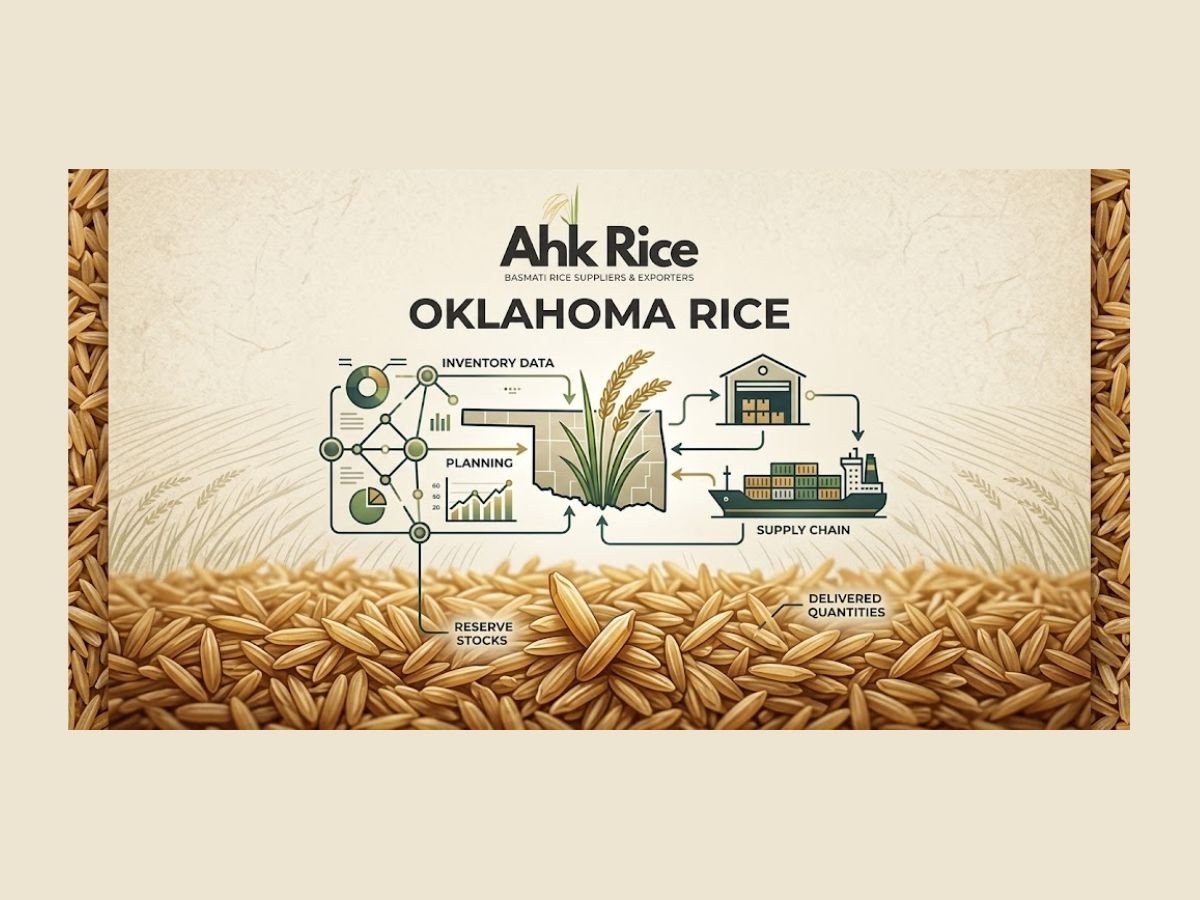
AHK Rice Supports Oklahoma Rice Inventory Planning Requirements
Oklahoma rice distributors need inventory planning that accounts for purchase quantities, ocean transit, inland delivery, customs clearance, quality release, and reorder timing rather than relying only on a supplier’s estimated arrival date. For a broader explanation of why these controls matter, see:
Why inventory planning matters for rice distributors. For Oklahoma buyers, the practical objective is simple: maintain enough Pakistan-origin Basmati rice to meet customer demand without tying up excessive working capital or creating avoidable stockout risk.
For distributors comparing shipment timing against stock levels,
Balancing inventory levels with delivery schedules provides the framework for deciding when to reorder and how much safety stock to maintain.
AHK Rice supports this approach by connecting product specifications with production planning, packaging, documentation, shipment coordination, and delivery scheduling. A buyer can therefore plan inventory around an agreed shipment window instead of treating the container arrival as an isolated event. This matters particularly for distributors serving restaurants, wholesalers, retailers, and foodservice accounts where a delayed replenishment can interrupt customer supply.
What is the best solution for Oklahoma rice inventory planning?
The best solution is a demand-led replenishment program that combines forecast volume, safety stock, production lead time, ocean transit, inland delivery, customs clearance, and reorder points. This approach converts an uncertain import cycle into measurable inventory milestones for Oklahoma distributors.
Oklahoma buyers should begin with monthly consumption rather than container size. For example, a distributor selling 20 metric tons of Basmati rice per month should first calculate normal demand, seasonal peaks, promotional demand, and the minimum stock level required to protect customers during shipment delays.
A practical planning model separates four quantities: cycle stock, safety stock, shipment quantity, and reorder stock. Cycle stock covers normal sales between replenishments. Safety stock absorbs delays or unexpected demand. Shipment quantity reflects the commercial order. Reorder stock triggers the next purchase before available inventory reaches a critical level.
For Pakistan-origin rice delivered to Oklahoma, the supply chain normally includes milling and packing in Pakistan, container loading, ocean transportation, U.S. port handling, customs clearance, and inland transportation to the distributor. Actual transit depends on vessel schedules, port conditions, routing, customs, and final delivery location, so buyers should use a planning range rather than a single guaranteed number.
For budgeting purposes, an Oklahoma importer can initially model approximately 35–50 days from Pakistan port departure to an Oklahoma warehouse under a conventional ocean-and-inland scenario, while allowing additional contingency for congestion or documentation issues. This is a planning range, not a carrier guarantee. Buyers should confirm the shipment-specific schedule before releasing purchase orders.
A useful reorder calculation is:
Reorder point = average daily demand × replenishment lead time + safety stock.
If an Oklahoma distributor sells 0.67 MT per day and plans around 45 days of replenishment exposure, baseline lead-time demand is approximately 30 MT. If the buyer wants another 10 MT as safety stock, the reorder point becomes about 40 MT. When available and committed inventory approaches that level, the next shipment should already be entering the procurement process.
AHK Rice can structure the commercial discussion around these variables so that the buyer is not simply purchasing rice but planning a repeatable supply cycle.
How should Oklahoma buyers plan shipping days and delivery windows?
Oklahoma buyers should plan imported rice in stages: Pakistan production and loading, ocean transit to the selected U.S. gateway, customs and port handling, inland transportation to Oklahoma, and warehouse receiving. Each stage needs buffer time before calculating the usable inventory date.
The United States is not one delivery market operationally. A shipment destined for Oklahoma may use different U.S. gateways and inland routes depending on freight availability, carrier schedules, container positioning, and the importer’s logistics arrangement.
For planning, an Oklahoma distributor should distinguish between port arrival and warehouse availability. A container reaching a U.S. port does not necessarily mean the rice can immediately enter the distributor’s inventory. Entry processing, examination if applicable, release, drayage, rail or truck movement, and warehouse appointment scheduling can extend the effective lead time.
A practical 2026 planning framework is:
| Supply-chain stage | Planning allowance |
|---|---|
| Product preparation and export readiness | 7–15 days |
| Ocean movement and port arrival | 25–40 days |
| U.S. port, customs and release exposure | 3–7+ days |
| Inland movement to Oklahoma | 2–7 days |
| Receiving and inventory release | 1–2 days |
| Recommended planning buffer | 5–10 days |
These figures are planning allowances rather than promised transit times. A buyer should obtain the actual vessel schedule, estimated time of departure, estimated time of arrival, inland routing, and expected delivery appointment before committing the stock to a customer.
The same principle applies to other U.S. markets. Buyers close to a major port may have shorter inland exposure, while inland destinations such as Oklahoma require a separate transportation allowance after port arrival. That difference should be included in the purchase-order timeline.
U.S. food imports also require compliance planning. FDA states that imported food must meet U.S. requirements, including applicable food facility registration, Prior Notice, safety, sanitation, and labeling requirements. Prior Notice must be received and confirmed before arrival, with the timing depending on the transportation mode.
That means documentation is part of inventory planning. A physically available container is not equivalent to released inventory if an import requirement has not been completed.
Why choose AHK Rice for Oklahoma rice inventory requirements?
AHK Rice is suitable for Oklahoma distributors that need Pakistan-origin Basmati rice coordinated around specifications, production, packaging, documentation, shipment timing, and repeat purchasing rather than treating every container as a separate transaction.
AHK Rice supplies Pakistani Basmati rice for international buyers and can structure product discussions around grade, packing format, order quantity, quality specifications, and shipment requirements. Oklahoma buyers can review the broader USA rice supply service when evaluating a Pakistan-to-U.S. sourcing program.
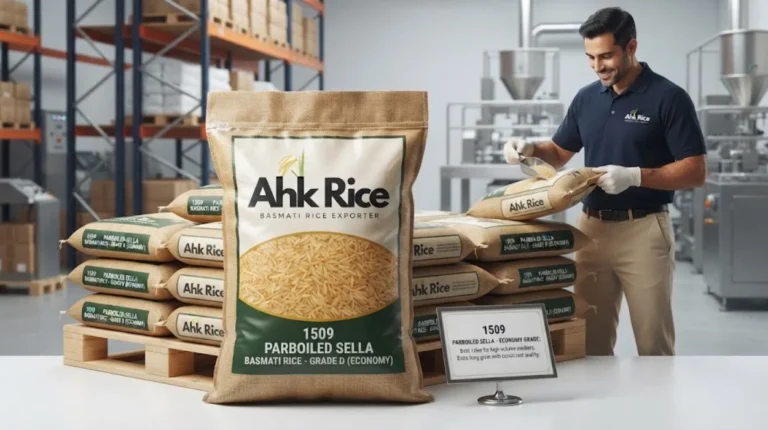
The decision should begin with the exact product specification. A distributor may require 1121 Basmati, Super Kernel, or 1509 Basmati depending on its customer base, cooking requirements, price positioning, and packaging program. Product selection should therefore be fixed before inventory calculations are finalized.
For example, a restaurant-focused distributor may prioritize long-grain appearance, elongation, aroma, cooking consistency, and repeatable specifications. A wholesale program may place greater emphasis on landed cost, packaging, pallet configuration, monthly volume, and continuity of supply.
AHK Rice should be evaluated against the same commercial criteria used for any serious exporter: specification consistency, production capacity, sample approval, packaging control, quality documentation, export documentation, communication, shipment execution, and ability to support repeat orders.
For U.S. imports, the importer also retains important regulatory responsibilities. FDA states that importers are responsible for ensuring imported food is safe, sanitary, and properly labeled, while applicable facilities must satisfy FDA registration requirements. A supplier relationship therefore needs to support the importer’s compliance process rather than operate independently from it.
AHK Rice provides value when these requirements are discussed before the purchase order instead of after the container has already been packed.
What sample process should an Oklahoma rice importer follow?
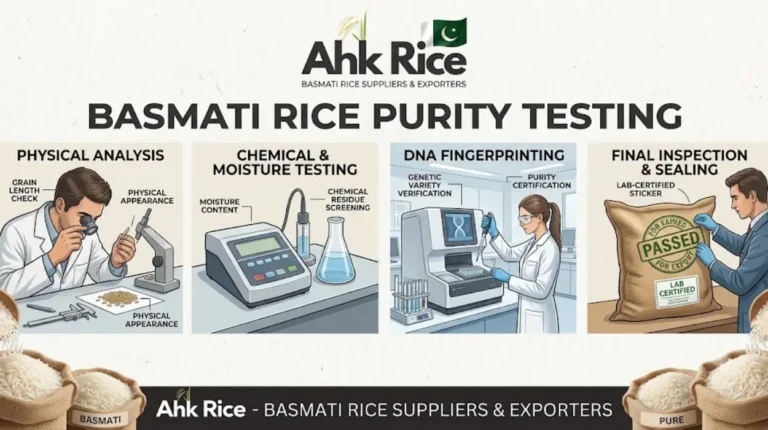
A controlled sample process should confirm product identity, grade, appearance, cooking performance, packaging, documentation expectations, and commercial specifications before bulk production. Sample costs vary by courier, destination, quantity, testing, and requested packaging.
The first step is a written product specification. The buyer should state the variety, grain requirements, moisture target, broken percentage, foreign matter tolerance, crop or harvest expectations where relevant, packing size, packaging material, private-label requirements, and required certificates or reports.
The second step is sample selection. A supplier can prepare a representative sample for buyer evaluation. For a commercial decision, the sample should match the proposed bulk specification as closely as practical.
The third step is dispatch. A small international rice sample commonly involves courier, handling, and packaging charges. As a budgeting example, an Oklahoma buyer can allow approximately US$50–150 for a basic international sample shipment, depending on weight, courier service, destination, and packaging. This is an illustrative planning range, not an AHK Rice quotation.
The fourth step is buyer evaluation. The importer should check appearance, aroma, grain uniformity, broken grains, cooking expansion, texture, taste, and overall conformity with the intended customer application. If laboratory verification is required, testing should be priced separately.
A commercial laboratory or independent inspection can add approximately US$100–300 or more depending on the analytical panel and service provider. Again, this is an indicative budgeting range rather than a fixed supplier charge.
The fifth step is approval. The buyer should issue written confirmation of the approved specification before bulk production. The approved sample should become the reference point for subsequent production discussions.
The sixth step is pre-shipment verification. Depending on the purchase agreement, the importer may request a quality inspection, laboratory report, packing verification, or other evidence before shipment. This step reduces the risk of discovering a specification problem after the container has left Pakistan.
AHK Rice can use this sequence to move the buyer from sample approval to a defined bulk order rather than treating sampling as an informal exchange of product.
What results can Oklahoma distributors expect from planned rice inventory?
A properly planned import program can reduce emergency purchasing, improve warehouse availability, stabilize customer fulfillment, and make working-capital requirements more predictable. The greatest benefit comes from linking demand forecasts with shipment milestones and reorder decisions.
Consider an Oklahoma distributor consuming 60 MT of Basmati rice each month. If the importer waits until warehouse stock becomes critically low before placing the next order, the business may face a gap created by production, ocean transit, customs, and inland delivery.
A better model maintains a planned pipeline. One shipment may be in production, another may be at sea, and a third may represent the next approved purchase. This creates inventory visibility beyond the physical warehouse.
For example, if the distributor wants 45 days of lead-time coverage and 15 days of safety stock, it needs to plan for approximately 60 days of demand exposure. At 60 MT per month, that represents roughly 120 MT of planned coverage. The actual safety stock should be adjusted using demand volatility, supplier lead-time reliability, customer commitments, and cash-flow constraints.
The result is not necessarily higher inventory. The objective is better-timed inventory.
AHK Rice can support this commercial model by discussing recurring quantities and shipment timing rather than focusing only on the first purchase. For distributors with predictable demand, repeat shipment planning can also reduce the pressure to place large emergency orders.
What factors affect the cost of importing rice into Oklahoma?
The landed cost of rice depends on product grade, order volume, packaging, processing, inspection, ocean freight, insurance, U.S. port charges, customs-related expenses, inland transportation, and destination handling. Inventory cost must therefore be evaluated beyond the rice price per metric ton.
Rice price is only one component of the final inventory cost. A buyer should request a commercial quotation that clearly identifies the agreed Incoterm and which costs are included.
Product grade affects the base price. Packaging also changes cost because retail bags, wholesale sacks, custom printed packaging, and different pack weights require different materials and production arrangements.
Order volume affects both purchasing economics and freight utilization. Larger commercial volumes may improve unit economics, but the buyer must ensure that additional stock can be sold within its planned inventory cycle.
Freight is another major variable. Ocean freight changes according to carrier pricing, routing, equipment availability, fuel-related charges, port conditions, and booking timing. Inland delivery to Oklahoma adds another cost layer after U.S. port arrival.
Testing, inspection, special labeling, private packaging, documentation, storage, and demurrage or detention exposure can also affect landed cost.
AHK Rice should therefore be compared using landed cost and supply reliability, not simply the lowest quoted FOB or product price. A slightly higher purchase price may be commercially preferable if it provides better specification control, documentation, shipment planning, and lower risk of inventory interruption.
How can Oklahoma importers start an AHK Rice supply program?
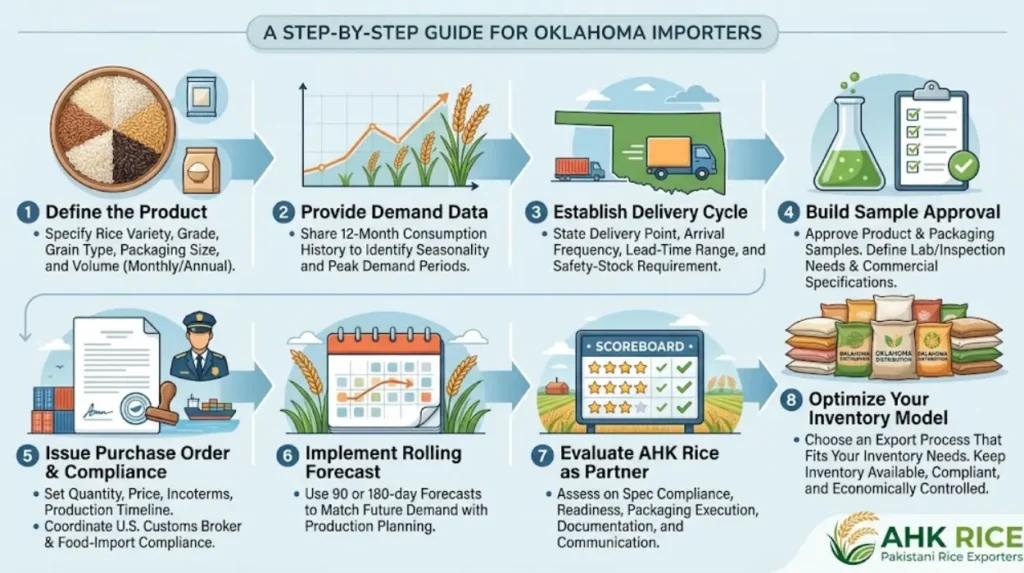
Oklahoma importers should begin with demand data, product specifications, target packaging, required monthly volume, desired inventory coverage, destination details, and compliance requirements. These inputs allow the exporter to build a commercially realistic quotation and shipment plan.
Start by defining the product. State the variety, grade, grain specification, packaging size, branding requirement, and expected annual or monthly volume.
Next, provide demand information. A simple 12-month consumption history is valuable because it reveals seasonality and identifies periods when inventory should be increased before demand rises.
Then define the target delivery cycle. An importer should specify the preferred delivery point in Oklahoma, desired arrival frequency, acceptable lead-time range, and minimum safety-stock requirement.
The sample should follow before bulk production. The buyer can approve the product and packaging, identify any laboratory or inspection requirements, and establish the commercial specification that will govern the purchase.
After approval, the purchase order should identify quantity, product specification, packaging, agreed price basis, Incoterm, documentation, production timeline, shipment window, and destination requirements. The importer should also coordinate its U.S. customs broker and food-import compliance responsibilities.
For recurring programs, the buyer should establish a rolling forecast. A 90-day or 180-day planning view can help the exporter understand future demand while allowing the importer to adjust orders as actual sales develop.
AHK Rice can then be evaluated as a supply partner against measurable criteria: specification compliance, production readiness, sample approval, packaging execution, documentation, shipment coordination, communication, and repeat-order capability.
For Oklahoma distributors, the strongest decision is not simply choosing a rice exporter. It is choosing an export process that fits the distributor’s inventory model. AHK Rice can support that decision by connecting Pakistani rice sourcing with the commercial planning required to keep Oklahoma inventory available, compliant, and economically controlled.
For a shipment-specific quotation and inventory planning discussion, submit your requirements through Request a Quote.
Frequently Asked Questions
What rice varieties can AHK Rice supply to Oklahoma distributors?
AHK Rice supplies Pakistani Basmati rice varieties including 1121, Super Kernel, and 1509, with specifications and packaging options determined according to the buyer’s requirements.
How long does Pakistan Basmati rice take to reach Oklahoma?
A practical 2026 planning allowance is approximately 35–50 days from Pakistan port departure to an Oklahoma warehouse, depending on ocean routing, U.S. port processing, customs clearance, and inland transportation.
How should Oklahoma distributors calculate rice safety stock?
Distributors should calculate safety stock based on average demand, shipment lead time, demand fluctuations, customer commitments, and potential logistics delays. Safety stock should be added to normal lead-time demand.
What sample process does AHK Rice use for Oklahoma buyers?
The process typically begins with product specifications, followed by sample preparation, courier dispatch, buyer evaluation, optional laboratory testing, written approval, and bulk production against the approved specification.
How much does a rice sample cost for Oklahoma importers?
A basic international sample shipment may cost approximately US$50–150, while laboratory testing can add around US$100–300 or more depending on the testing requirements. These are planning estimates, not fixed AHK Rice charges.
What factors affect the landed cost of Pakistani rice in Oklahoma?
Landed cost can include rice grade, processing, packaging, order volume, ocean freight, insurance, U.S. port charges, customs-related expenses, inland transportation, inspection, testing, and destination handling.
Why is inventory planning important for Oklahoma rice distributors?
Inventory planning helps distributors avoid stockouts, reduce emergency purchasing, improve warehouse availability, manage working capital, and coordinate replenishment before existing inventory reaches a critical level.