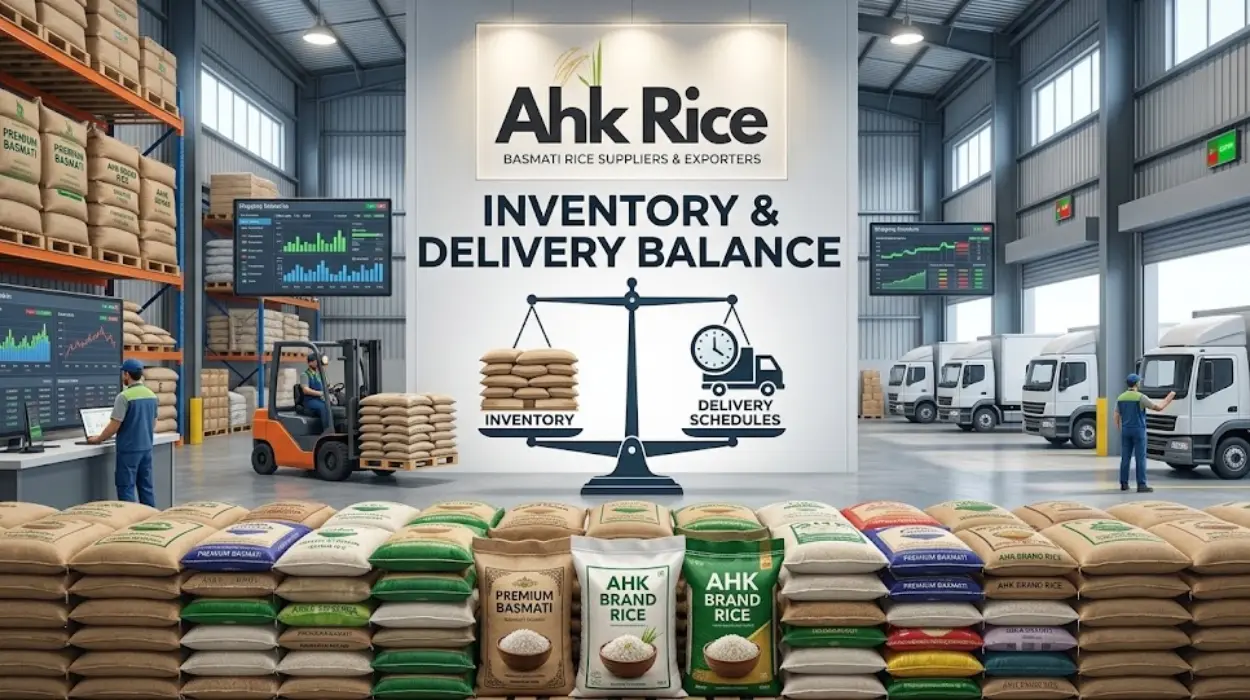
How Do Importers Balance Inventory Levels and Delivery Schedules?
Importers balance inventory levels and delivery schedules by matching expected consumption with confirmed supplier lead times, transit duration, safety stock, purchase quantities, and reorder points. The objective is simple: maintain enough rice to serve customers without holding excessive stock that increases storage costs, working capital, and quality-control requirements.
For rice importers, inventory planning connects procurement with physical product movement. A buyer purchasing Pakistani Basmati rice must account for production, milling, packaging, export documentation, port handling, ocean transit, customs clearance, inland transportation, and warehouse receiving. Each stage affects when usable inventory becomes available.
This planning becomes more important in 2026 because U.S. rice supply conditions remain closely monitored. USDA’s August 2026 outlook projects 2026/27 U.S. all-rice imports at a record 49.8 million hundredweight, while ending stocks are projected at 36.0 million hundredweight, 33% below the previous year. Importers therefore need inventory decisions that reflect both their own consumption patterns and wider market conditions.
What Is Inventory and Delivery Schedule Balancing?
Inventory and delivery schedule balancing is the process of matching rice stock with forecast demand and shipment timing so buyers avoid shortages, excessive storage, emergency purchasing, and delayed customer fulfillment while maintaining planned service levels throughout each procurement cycle.
Inventory is the quantity of usable rice available to a buyer at a specific point in time. It includes warehouse stock, allocated stock, stock in transit, and confirmed production depending on the planning system.
Delivery scheduling determines when each shipment is ordered, processed, dispatched, transported, cleared, and received.
For example, a distributor selling 100 metric tons (MT) of Basmati rice each month needs to know whether its warehouse contains 100 MT, whether another 100 MT is already on the water, and when the next shipment will arrive.
A basic inventory balance is:
Projected closing inventory = opening inventory + confirmed receipts − forecast consumption
Suppose an importer starts a month with 180 MT, receives 120 MT, and sells 100 MT. The projected closing inventory is 200 MT.
The calculation becomes more useful when the importer separates physical stock from committed stock. A warehouse can contain 200 MT while 80 MT is already allocated to customers. The available quantity is therefore 120 MT.
How Does Inventory Planning Work for Imported Rice?
Rice inventory planning works by forecasting consumption, calculating lead time, setting safety stock, establishing reorder points, scheduling shipments, monitoring goods in transit, and updating purchase quantities whenever demand, production, transport, or customs timing changes.
The process begins with demand forecasting. Demand forecasting estimates how much rice customers will consume during a defined period. Examples include monthly restaurant demand, distributor sales, supermarket orders, and seasonal foodservice requirements.
The importer then calculates supplier lead time. Lead time is the number of days between placing an order and receiving usable inventory.
For an international rice shipment, lead time contains several stages:
- Purchase-order confirmation.
- Rice sourcing and procurement.
- Milling and processing.
- Sorting and grading.
- Quality inspection.
- Packaging.
- Export documentation.
- Container loading.
- Port handling.
- Ocean transportation.
- Destination customs clearance.
- Inland delivery.
- Warehouse receiving.
A buyer should not treat ocean transit as the complete lead time. A container that spends 30 days at sea still requires processing before departure and clearance after arrival.
Safety stock provides protection against normal demand variation and schedule variation. If an importer consumes 20 MT per week and requires 6 weeks to replenish inventory, expected lead-time demand equals 120 MT.
If the buyer establishes 40 MT as safety stock, the reorder point becomes:
Reorder point = lead-time demand + safety stock
120 MT + 40 MT = 160 MT
When projected available inventory reaches 160 MT, the next shipment should already be scheduled.
This approach prevents purchasing decisions based only on today’s warehouse balance.
For importers comparing procurement methods, the relationship between inventory requirements and supplier delivery performance is also important. A detailed comparison of:
Rice inventory planning requirements and supply considerations helps connect warehouse needs with procurement decisions.
What Are the Key Components of Rice Inventory Planning?
The key components are demand forecasts, lead time, safety stock, reorder points, order quantities, shipment schedules, inventory in transit, warehouse capacity, product specifications, shelf-life controls, and supplier performance records maintained against measurable delivery and quality requirements.
Demand Forecast
Demand forecasting converts customer orders and historical sales into expected consumption. A distributor with monthly demand of 250 MT should build its procurement plan around expected consumption rather than the previous shipment size.
Forecasts should identify seasonal patterns. Examples include Ramadan demand, holiday demand, restaurant peaks, promotional periods, and annual purchasing cycles.
Lead Time
Lead time defines how long inventory remains unavailable after an order is placed.
A buyer should record actual lead time for each shipment. If five previous shipments required 48, 52, 50, 55, and 49 days, the average is 50.8 days. Planning should use the observed range rather than an assumed fixed number.
Safety Stock
Safety stock protects against demand increases and normal supply variation.
A buyer consuming 300 MT monthly should not automatically keep 300 MT as safety stock. The appropriate level depends on demand variability, lead time, warehouse capacity, supplier reliability, and the financial cost of holding inventory.
Reorder Point
The reorder point identifies when another purchase should enter the procurement process.
For example, an importer with 25 MT weekly consumption, 7 weeks of total replenishment lead time, and 50 MT safety stock has a reorder point of:
25 × 7 + 50 = 225 MT
Order Quantity
Order quantity determines how much rice enters each shipment.
Large orders reduce the frequency of procurement but increase warehouse requirements and working capital. Smaller orders reduce average inventory but increase ordering and transportation frequency.
Inventory in Transit
Inventory in transit consists of purchased rice that has left the supplier but has not reached the buyer’s warehouse.
An importer with 200 MT in its warehouse and 300 MT on the water has 500 MT of physical and committed pipeline inventory, but only 200 MT is immediately available.
Warehouse Capacity
Warehouse capacity determines how much inventory the importer can physically receive.
A 500 MT warehouse cannot safely operate as though it has 500 MT of usable capacity. Receiving space, aisles, pallet configuration, segregation requirements, damaged stock, and loading areas consume operational space.
Why Does Product Specification Affect Inventory Planning?
Product specifications affect inventory planning because different rice varieties, grades, packaging formats, moisture requirements, grain characteristics, and customer specifications are not always interchangeable, so buyers must forecast and replenish each stock-keeping unit separately.
Pakistani Basmati rice illustrates this issue clearly.
Basmati is an aromatic long-grain rice traditionally associated with the Indian subcontinent. Pakistan produces Basmati primarily in Punjab, where suitable soil, climate, irrigation, and cultivation conditions support the crop.
Common Pakistani commercial varieties include 1121 Basmati, Super Kernel, and 1509.
1121 Basmati is known for its exceptionally long grain and expansion after cooking. Super Kernel is a premium long-grain Basmati type used across retail, foodservice, and wholesale channels. 1509 is an early-maturing Basmati variety used in export markets and available in processing formats such as steam and parboiled products.
Processing normally follows a controlled sequence:
- Paddy is procured from approved sources.
- Paddy is cleaned to remove foreign material.
- Husks are removed during milling.
- Rice passes through whitening and polishing stages according to specification.
- Broken grains are separated.
- Color sorting removes discolored grains.
- Length grading separates grain categories.
- Quality testing verifies defined parameters.
- Rice is packed into the required bag format.
- Finished goods are stored before dispatch.
Different grades therefore require separate inventory records. A buyer needing 1121 Steam cannot simply replace a shortfall with Super Kernel White without changing the product specification approved by the customer.
This is why inventory planning should operate at the stock-keeping-unit level rather than treating all rice as one commodity.
What Are the Benefits of Balancing Inventory With Delivery Schedules?
Balanced inventory reduces stockouts, emergency freight decisions, excess storage, working-capital pressure, customer delays, and obsolete stock while giving importers a structured method for coordinating procurement, production, shipping, customs clearance, and warehouse availability.
The first benefit is improved service continuity. A distributor with sufficient stock can fulfill customer orders while the next shipment is moving through the supply chain.
The second benefit is better working-capital control. Excess inventory ties cash to goods that have not yet generated sales.
The third benefit is lower emergency purchasing risk. Buyers who monitor reorder points can place orders before inventory reaches a critical level.
The fourth benefit is stronger warehouse utilization. Planned receipts prevent several containers from arriving simultaneously when warehouse space is limited.
The fifth benefit is better supplier evaluation. Importers can compare promised delivery dates with actual receiving dates and identify recurring delays.
The sixth benefit is stronger quality control. Planned inventory turnover helps buyers manage production batches, packaging formats, storage periods, and product segregation.
Where Do Importers Use Inventory and Delivery Balancing?
Importers use inventory and delivery balancing across food distribution, restaurant supply, retail, wholesale, institutional purchasing, private-label programs, and multi-location operations where rice demand continues while international replenishment requires advance procurement planning.
Restaurant and Foodservice Distribution
Restaurants consume rice continuously. A foodservice distributor therefore plans replenishment around recurring weekly or monthly demand.
For example, 50 restaurant customers consuming 2 MT each month generate 100 MT of monthly demand. A 60-day international replenishment cycle requires procurement decisions well before warehouse inventory reaches zero.
Retail Distribution
Retailers require additional planning because consumer demand changes with promotions, holidays, and packaging formats.
A retailer selling 5 kg bags needs different inventory planning from a wholesaler selling 25 kg commercial sacks, even when both products contain the same rice variety.
Wholesale Programs
Wholesale buyers often purchase containers or multiple containers at defined intervals. Their planning focuses on container capacity, order frequency, customer allocation, and warehouse turnover.
Private-Label Programs
Private-label programs require packaging lead time in addition to rice processing and transportation. Printed bags, labels, artwork approvals, packaging quantities, and production scheduling become part of the delivery timeline.
Multi-Location Distribution
A distributor serving several states needs location-level demand forecasts. Oklahoma demand, for example, should be tracked separately from Texas, Illinois, or California demand because customer concentration and replenishment requirements differ by distribution territory.
What Common Problems and Misconceptions Affect Inventory Planning?
The most common inventory planning problems are relying on warehouse stock alone, ignoring goods in transit, using fixed lead times, mixing rice grades, overestimating safety stock, underestimating customs time, and ordering according to price instead of actual consumption requirements.
One common misconception is that a full warehouse means the buyer is protected. That is incorrect when a large portion of stock is already committed to customers.
Another problem is treating every shipment as having the same lead time. International logistics involve multiple stages, so actual receiving dates should be recorded for every order.
A third problem is using sales history without considering future demand. A distributor that sold 200 MT monthly during the first half of the year cannot automatically use 200 MT as the forecast for a seasonal peak.
A fourth problem is treating different grades as interchangeable. A specification-controlled supply program requires separate records for variety, processing type, grain length, packaging, and quality parameters.
A fifth problem is ignoring inventory in transit. The buyer needs visibility from production through shipment and customs clearance rather than counting only warehouse stock.
A sixth problem is keeping excessive safety stock without measuring its purpose. Safety stock should protect against defined demand and supply variation. It should not become a permanent substitute for accurate forecasting.
Current U.S. market conditions reinforce the need for disciplined planning. USDA’s August 2026 outlook places projected U.S. all-rice imports at a record 49.8 million hundredweight and projected 2026/27 ending stocks at 36.0 million hundredweight. USDA also reports that U.S. imports of aromatic rice include Basmati from India and Pakistan, while U.S. long-grain rice imports from those two countries remained robust through March 2026.
For importers, these figures demonstrate why procurement planning must connect market demand, available inventory, international supply, and delivery schedules.
How Should Importers Build a Practical Rice Inventory Schedule?
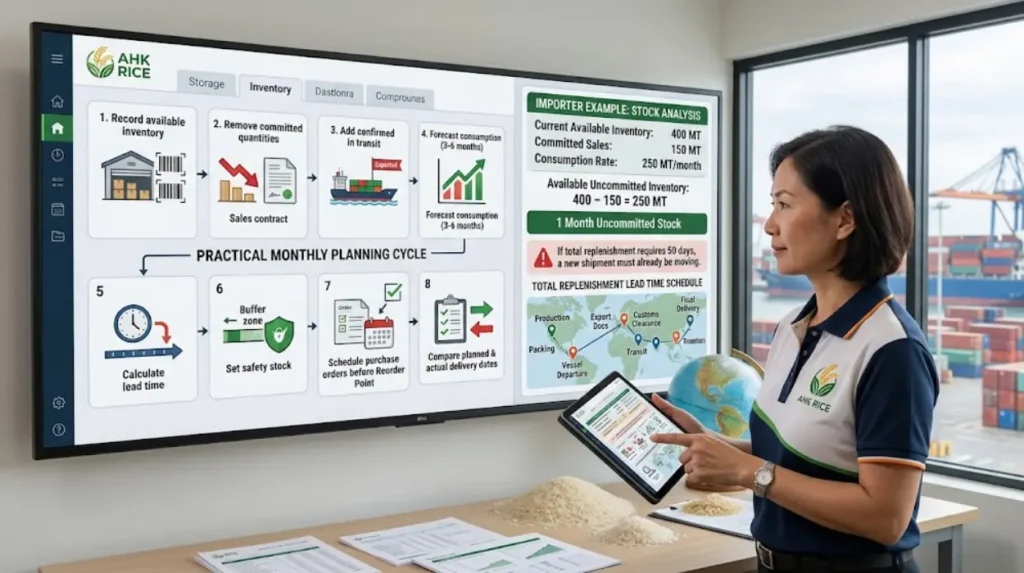
Importers should build schedules by calculating monthly demand, mapping total replenishment lead time, setting safety stock, defining reorder points, assigning shipment quantities, monitoring goods in transit, and reviewing actual delivery performance after every completed shipment.
A practical monthly planning cycle can follow 8 steps:
- Record current available inventory.
- Remove quantities already committed to customers.
- Add confirmed inventory in transit.
- Forecast consumption for the next 3 to 6 months.
- Calculate replenishment lead time.
- Set the required safety stock.
- Schedule purchase orders before the reorder point.
- Compare planned and actual delivery dates after receipt.
Consider an importer with 400 MT available inventory, 150 MT committed sales, and 250 MT expected monthly consumption.
Available uncommitted inventory is:
400 − 150 = 250 MT
At a consumption rate of 250 MT per month, the buyer has only 1 month of uncommitted stock. If total replenishment requires 50 days, a new shipment must already be moving through the procurement process.
The schedule should then include production, packing, export documentation, vessel departure, transit, customs clearance, and final delivery.
This approach transforms inventory management from a warehouse-counting activity into a supply-chain control system.
How Does 2026 Market Data Influence Inventory Decisions?
2026 market data influences inventory decisions by giving importers current evidence about production, imports, stocks, prices, and trade flows, allowing procurement teams to adjust forecasts and shipment timing instead of relying only on historical warehouse consumption.
USDA’s August 2026 Rice Outlook is the latest monthly market outlook and provides current U.S. and global supply-and-use estimates.
The August outlook reports that projected U.S. 2026/27 all-rice supply is 262.0 million hundredweight, while projected ending stocks are 36.0 million hundredweight. Imports are projected at 49.8 million hundredweight.
For an importer, these figures do not replace company-level forecasting. They provide market context for procurement decisions.
The same principle applies to Pakistani Basmati procurement. A buyer should combine customer consumption with supplier production capacity, processing schedules, shipment frequency, destination requirements, and available inventory.
Inventory planning therefore works best when the buyer knows what product is required, how much is required, when it is required, how long replenishment takes, and which stock is already committed.
The result is a controlled relationship between inventory and delivery scheduling rather than a cycle of buying only after stock becomes critically low.
Frequently Asked Questions
How do importers balance inventory levels and delivery schedules?
Importers balance inventory by comparing forecast demand with available stock, inventory in transit, safety stock, supplier lead times, and expected delivery dates. This prevents stockouts while limiting excess warehouse inventory.
What is the ideal inventory level for a rice importer?
The ideal inventory level depends on monthly consumption, replenishment lead time, safety stock, warehouse capacity, and customer commitments. Importers should calculate inventory requirements using actual demand rather than a fixed stock target.
What is a reorder point in rice inventory planning?
A reorder point is the inventory level that triggers a new purchase order. It is commonly calculated as lead-time demand plus safety stock. For example, 120 MT of lead-time demand plus 40 MT of safety stock creates a 160 MT reorder point.
Why is safety stock important for rice importers?
Safety stock protects against normal demand increases and supply delays. It gives importers additional inventory while the next shipment is being processed, transported, cleared through customs, and delivered.
How does international shipping affect rice inventory planning?
International shipping extends replenishment time because rice passes through processing, packaging, documentation, port handling, ocean transportation, customs clearance, and inland delivery. Importers must include all stages in their lead-time calculation.
Should rice inventory include goods in transit?
Yes. Goods in transit should be tracked separately from warehouse inventory. A shipment on the water is part of the supply pipeline but is not immediately available for customer orders.
Why should importers track different rice grades separately?
Different varieties and processing types are not always interchangeable. Importers should maintain separate inventory records for products such as 1121 Basmati, Super Kernel, and 1509, including their processing type, packaging, and customer specification.
How does demand forecasting improve rice procurement?
Demand forecasting estimates future rice consumption using sales history, customer orders, seasonal patterns, and planned promotions. Accurate forecasts help determine shipment quantities and prevent both shortages and excessive inventory.
What happens when a rice importer holds too much inventory?
Excess inventory ties up working capital, increases warehouse requirements, raises handling costs, and increases the period during which the product remains in storage. It can also complicate stock rotation and batch management.