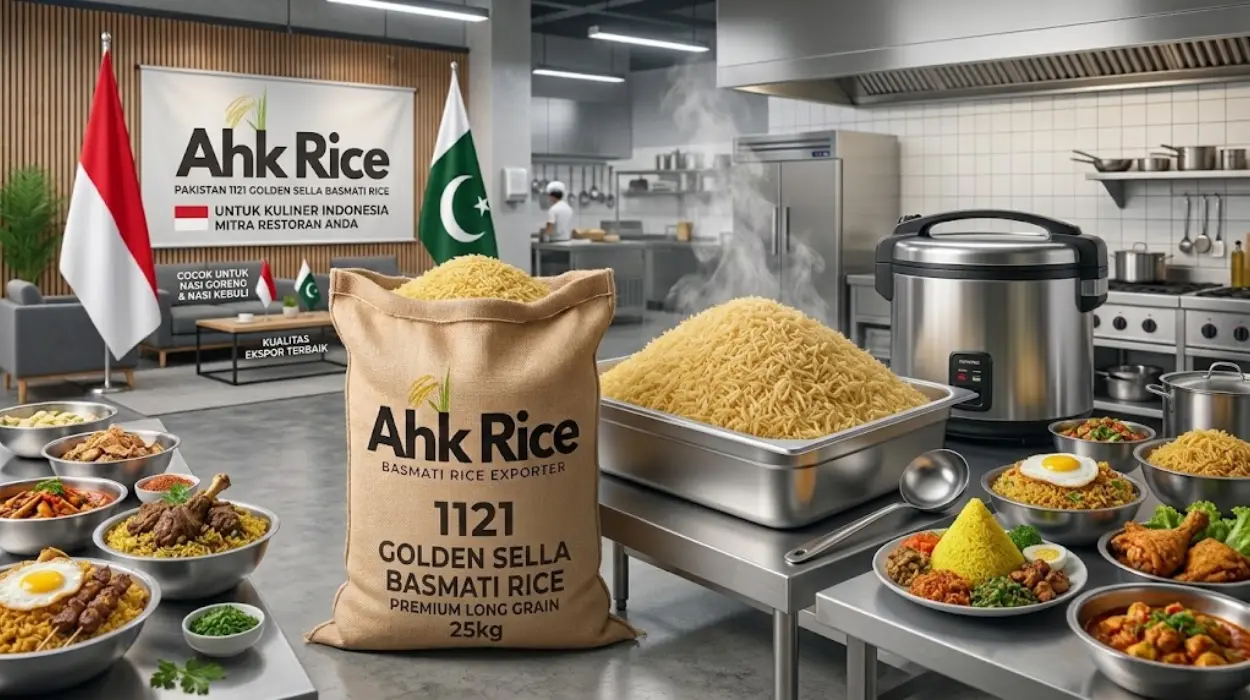
Why Is Pakistan 1121 Golden Sella Rice Used for Indonesian Catering?
1121 Golden Sella is a parboiled Pakistani Basmati rice with extra-long grains and a golden colour. Indonesian caterers use it for biryani, nasi-style banquet dishes, and large-volume meals because cooked grains stay separate, firm, aromatic, and visually consistent during service.
The main reason is cooking performance at scale. Indonesian catering operations often prepare rice in large batches. Grain separation matters during cooking, holding, portioning, and plating. Golden Sella also provides a distinctive golden appearance that suits biryani and other spiced rice dishes. Indonesian retail listings also show Golden Sella Basmati products in 1 kg, 5 kg, and 20 kg formats, confirming market availability for household and foodservice use.
The product comes from 1121 Basmati cultivated in Punjab, Pakistan. The 1121 designation identifies a long-grain Basmati variety. Golden Sella identifies its parboiled processing style. Commercial specifications commonly show an average grain length around 8.2–8.3 mm, with elongation after cooking.
What Is 1121 Golden Sella Rice?
1121 Golden Sella is a parboiled Pakistani Basmati rice with extra-long grains and a golden colour. Indonesian caterers use it for biryani, nasi-style banquet dishes, and large-volume meals because cooked grains stay separate, firm, aromatic, and visually consistent during service.
1121 Golden Sella begins with Basmati paddy cultivated in Punjab. The paddy undergoes controlled parboiling before milling. Parboiling changes the grain structure and produces the characteristic golden colour associated with Golden Sella. The process also creates a firmer grain that handles large-scale cooking effectively.
Commercial specifications vary by exporter and contract. Published 1121 Golden Sella specifications show average lengths of 8.30 mm, moisture below 12.5%, and broken grain below 1%. Other suppliers specify moisture up to 13%, showing why buyers should establish exact specifications before procurement.
The golden colour does not mean artificial colouring. It results from the parboiling process. The grain also retains the characteristic long, slender form associated with Basmati. Indonesian product listings demonstrate that Golden Sella is already available within the local rice market.
With the product defined, the next question is how its processing creates these catering properties.
How Is 1121 Golden Sella Processed?
1121 Golden Sella starts as mature Basmati paddy cultivated in Punjab. The paddy is cleaned, soaked, steamed, dried, dehusked, polished, graded, sorted, tested, packed, and shipped. Each stage controls grain strength, appearance, cleanliness, moisture, cooking performance, and consistency for export.
How does the processing sequence work?
Clean the paddy. Remove stones, dust, straw, immature grains, and other field material before further processing.
Soak the paddy. Hydrate the paddy under controlled conditions so moisture reaches the grain before steaming.
Steam the paddy. Apply controlled heat to parboil the grain while it remains inside the husk.
Dry the paddy. Reduce moisture to a controlled level before milling and storage.
De-husk the grain. Remove the outer husk while preserving the rice kernel.
Polish the grain. Remove remaining bran layers according to the required commercial finish.
Grade the grain. Separate kernels by length, broken percentage, and other contractual specifications.
Sort the grain. Use mechanical and colour sorting to remove discoloured or unwanted kernels.
Test the rice. Inspect moisture, broken percentage, foreign matter, grain length, and other agreed parameters.
Pack the rice. Fill approved packaging according to the buyer’s required weight and material.
Ship the rice. Load the finished consignment for export after documentation and inspection requirements are completed.
This sequence explains why Golden Sella behaves differently from raw or steam-processed Basmati. Parboiling strengthens the kernel before milling. Sorting then improves visual and dimensional consistency. The result suits kitchens that require repeatable cooking across multiple batches.
What Are the Key Components of 1121 Golden Sella?
Key components include extra-long 1121 grain, parboiling, controlled drying, polishing, length grading, colour sorting, moisture control, and quality inspection. Together, these components produce firm grains with low breakage, strong visual uniformity, and cooking behaviour suited to large-scale catering production operations.
What grain specifications matter?
Grain length is a central specification. Published 1121 Golden Sella products show average lengths around 8.30 mm. Some specifications also state cooked elongation around 15 mm. Buyers should define whether the contract measures raw grain length, cooked length, or both.
Broken percentage is another important parameter. Commercial specifications commonly show 1% maximum broken grain. Lower broken percentages support a cleaner visual presentation and improve the proportion of whole grains in cooked batches.
Moisture also requires a defined contractual limit. Published specifications show values below 12.5% and up to 13% maximum. The buyer should use one agreed specification for inspection and acceptance.
Which 1121 grades are available?
The broader 1121 Basmati range includes several processing grades:
- 1121 White Basmati — milled white rice without the Golden Sella parboiling treatment.
- 1121 Steam Basmati — steam-processed rice with a different appearance and cooking profile.
- 1121 Golden Sella — golden-coloured parboiled Basmati.
- 1121 Creamy Sella — creamy-coloured parboiled Basmati.
- 1121 Brown Basmati — rice retaining more of the bran layer.
The main distinction between Golden Sella and Creamy Sella is colour and processing presentation. The detailed comparison belongs in the consideration-stage article: [how 1121 Golden Sella compares with Creamy Sella for Indonesia](Insert Link to MOFU Article).
With the processing and specifications established, the next issue is why these properties matter inside Indonesian catering kitchens.
Why Is 1121 Golden Sella Suitable for Indonesian Catering?
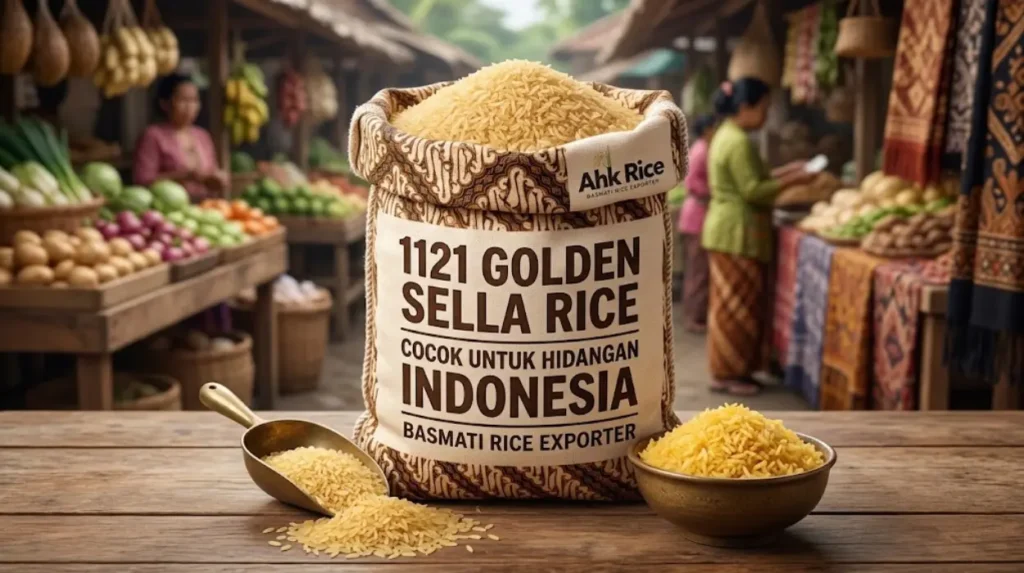
Golden Sella provides predictable cooking, separate grains, strong elongation, spice absorption, visual appeal, and handling strength. These properties support catering kitchens serving biryani and pulao at scale. The parboiled structure also improves resistance to breakage during cooking, portioning, and service.
How does grain separation help catering?
Separate cooked grains improve presentation and portion control. Biryani requires visible individual grains rather than a sticky mass. Large kitchens also need consistent portions across serving trays. Whole, elongated grains support this requirement.
How does Golden Sella handle spices?
Golden Sella works well with heavily seasoned rice dishes. Its firm cooked structure allows spices, sauces, oil, and other ingredients to distribute around the grain. Indonesian catering menus that include biryani-style dishes benefit from this structure.
Why does appearance matter?
Golden Sella has a visible golden colour before cooking. The colour distinguishes it from white Basmati and supports a premium visual presentation. Indonesian retailers currently list Golden Sella products from several brands, demonstrating consumer recognition of the category.
The combination of structure, appearance, and cooking behaviour explains the product’s relevance to foodservice operations.
Where Is 1121 Golden Sella Used?
Indonesian catering uses 1121 Golden Sella for biryani, pulao, nasi-style banquet menus, wedding meals, hotel buffets, restaurant kitchens, and institutional catering. Large kitchens value consistent grain size and cooked separation because these traits simplify batch cooking, portion control, and presentation.
Which catering formats use it?
Restaurant kitchens use Golden Sella for biryani and rice-based main dishes. Hotels use it for buffet trays and banquet service. Caterers use it for weddings, corporate functions, religious gatherings, and large private events.
Institutional kitchens also benefit from repeatable batch cooking. Examples include staff cafeterias, event kitchens, educational catering, and large foodservice operations.
Which other markets use Golden Sella?
Golden Sella products are sold across Gulf and Middle Eastern markets, including Saudi Arabia, Kuwait, UAE, Oman, Bahrain, Iraq, Jordan, and Yemen. Export specifications also identify markets such as the United States, Australia, Egypt, Turkey, and Libya.
Indonesia represents a distinct Southeast Asian market where imported Basmati products are available through retail channels. Indonesian listings include Golden Sella in several pack sizes and brands.
Market selection depends on cuisine, buyer specification, packaging, price, and regulatory requirements. The rice itself remains the same product category, while the commercial specification changes by buyer.
Which Certifications and Documents Apply to Indonesian Imports?
Indonesia requires importers to follow applicable food, customs, quarantine, and halal rules. Rice itself has specific regulatory treatment, while packaging and supply-chain controls require attention. Imported food requirements also depend on retail packaging, intended use, and current Indonesian regulations today.
What about halal requirements?
Indonesia’s halal framework requires careful attention for imported food products and their supply chains. BPJPH states that halal requirements apply to imported products covered by mandatory certification rules. The government has also announced expanded implementation for imported food products from 18 October 2026.
Rice itself has specific treatment. BPJPH states that natural products such as rice are excluded from product-level halal certification. Direct-contact packaging, storage, transportation, and contamination controls still require compliance with applicable halal requirements.
Does rice require BPOM registration?
BPOM distinguishes processed food from fresh or minimally processed commodities. Its guidance states that rice is among food categories for which BPOM does not issue the standard import certificate for processed foods. Retail and processed products can follow different requirements.
Therefore, the importer should identify the exact product classification before shipment. Packaging format and intended use influence the applicable documentation.
Typical export documentation also includes commercial invoices, packing lists, shipping documents, certificates of origin, inspection records, and phytosanitary documentation where required. The exact document set depends on the shipment and current Indonesian import rules.
Regulatory compliance connects product quality with successful market entry, making documentation part of the rice specification rather than a separate administrative issue.
What Are Common Problems and Misconceptions About Golden Sella?
Golden Sella is not simply coloured rice, and Sella does not mean a separate Basmati species. Sella identifies parboiled processing, while Golden describes the resulting colour. Another misconception treats all long-grain rice as 1121, although 1121 identifies a Basmati variety.
Is Golden Sella artificially coloured?
No. Golden colour results from parboiling the paddy before milling. Commercial descriptions identify Golden Sella through its golden hue and parboiled processing method.
Does every Golden Sella have identical specifications?
No. Exporters publish different contractual specifications. Grain length, moisture, broken percentage, purity, packaging, and crop year can differ. A buyer should therefore approve a written specification before shipment.
Is Golden Sella the same as Creamy Sella?
No. Both are Sella-style parboiled Basmati products, but their colour and commercial presentation differ. Golden Sella has a stronger golden appearance. Creamy Sella has a lighter creamy appearance. The Indonesian buyer should compare the two against the intended dish and presentation.
Does long grain automatically mean 1121?
No. Grain length alone does not establish the variety. 1121 is a specific Basmati variety. Published specifications show 1121 Golden Sella around 8.30 mm average length, but length should be verified through the agreed specification.
Frequently Asked Questions
Why is 1121 Golden Sella used for Indonesian catering?
1121 Golden Sella provides long grains, firm texture, cooked separation, and a golden appearance. These properties suit biryani, pulao, buffets, weddings, restaurants, and large catering operations.
What is the average grain length of 1121 Golden Sella?
Published specifications commonly show an average raw grain length of about 8.30 mm. Some suppliers publish 8.2 mm specifications. Exact limits should appear in the purchase contract.
Is 1121 Golden Sella parboiled?
Yes. Golden Sella is produced through parboiling. The paddy is processed before dehusking and polishing. This process creates its characteristic golden appearance and firmer grain structure.
What is the difference between Golden Sella and Creamy Sella?
Both are parboiled Basmati products. Golden Sella has a golden colour, while Creamy Sella has a lighter creamy appearance. Buyers should compare colour, grain specifications, cooking performance, and intended menu use.
Which Indonesian dishes suit Golden Sella?
Golden Sella suits biryani, pulao, banquet rice, buffet rice, and other spiced long-grain dishes. Its firm structure supports large-batch cooking and separate-grain presentation.
What should an Indonesian buyer specify before importing?
The buyer should specify variety, grade, grain length, broken percentage, moisture, purity, packaging, crop year, inspection method, documentation, and applicable Indonesian regulatory requirements.