Secure Contract-Based Basmati Rice Supply for Arkansas Markets
Arkansas importers and distributors seeking dependable Pakistani Basmati should favor a contract-based supply program over repeated spot purchases because it locks product specifications, shipment schedules, packaging, quality tolerances, and commercial terms before recurring orders begin. For a broader explanation of the procurement model, see:
Why importers prefer contract-based rice supply agreements.
For Arkansas buyers, the issue is not simply finding a supplier that can quote Basmati rice. The commercial requirement is maintaining the same specification across multiple containers while coordinating ocean freight, U.S. import compliance, inland transportation, and inventory planning.
Pakistan remains a major rice-exporting origin. USDA’s April 2026 Pakistan Grain and Feed Annual forecasts 2026/27 rice production at 9.8 million metric tons and exports at approximately 5.0 million metric tons, compared with projected exports of 4.7 million metric tons in 2025/26.
That production base supports long-term procurement, but Arkansas buyers still need a controlled specification and delivery structure. A contract converts a supplier relationship from individual transactions into a measurable supply program.
What is the best solution for securing Basmati rice supply in Arkansas?
The strongest Arkansas supply solution is a contract-based program that fixes rice specification, shipment cadence, quality tolerances, documentation, packaging, and commercial terms before harvest and production. It reduces spot-buying risk while giving distributors and foodservice buyers predictable monthly replenishment windows.
A commercial contract should begin with the physical rice specification. The buyer should identify the variety, processing grade, grain length, moisture requirement, broken percentage, foreign matter tolerance, milling finish, packaging format, and acceptable quality deviations.
For Arkansas wholesalers, 1121 Basmati is often appropriate when the sales proposition depends on extra-long grain appearance and premium cooking performance. Super Kernel can be evaluated for premium positioning with different commercial economics, while 1509 may suit buyers comparing Basmati characteristics against a lower-cost procurement target.
The contract should also specify the shipment cadence. A buyer requiring 20 MT every month should not rely on a supplier that only confirms availability after receiving each purchase order. Production capacity must be reserved around the expected schedule.
AHK Rice structures its export operation around sourcing, processing, grading, packaging, documentation, and container loading. This integrated approach allows the commercial specification to remain connected to the physical rice throughout preparation.
The best contract therefore defines measurable acceptance criteria instead of relying on terms such as “premium quality.” A stronger specification states the exact product and tolerance the buyer expects.
For example, an Arkansas distributor could contract 240 MT annually, divided into twelve 20 MT shipments. The agreement could establish the product specification, approved packaging, shipment window, inspection process, documentation package, payment terms, and procedure for handling deviations.
This model makes procurement easier to forecast. It also gives the exporter a clearer production requirement.
Why should Arkansas buyers choose the USA service from AHK Rice?
AHK Rice is suited to Arkansas buyers when procurement requires Pakistani Basmati origin, defined grain specifications, repeatable milling, export documentation, custom packaging, and coordinated commercial shipment planning. The service connects product preparation with U.S. import requirements and scheduled replenishment.
The USA export service from AHK Rice USA service is designed around container-scale Pakistani rice procurement. The program supports Basmati varieties including 1121, Super Kernel, and 1509, together with different processing and packaging requirements.
The advantage is origin control. Rice is processed in Pakistan before container loading. Cleaning removes unwanted material. Dehusking removes the outer husk. Whitening and polishing establish the requested finished appearance. Grading separates kernels by size and quality. Length sorting and optical sorting can improve uniformity before packing.
AHK Rice also supports custom packaging for buyers that operate their own retail, wholesale, restaurant, or private-label channels. Packaging should be treated as part of the product specification because bag size, material, artwork, labeling, palletization, and carton configuration can affect the final landed cost.
For U.S. imports, the importer remains responsible for ensuring that imported food complies with applicable U.S. requirements. FDA states that imported food must meet the same legal requirements as domestically produced food, while applicable facilities must be registered and Prior Notice must be provided before arrival.
That means the supplier and importer should establish documentation responsibilities before the first container is dispatched. A contract should identify who supplies commercial invoices, packing lists, certificates, shipping documents, applicable certificates, product records, and information needed by the U.S. customs broker or importer.
AHK Rice can function as the origin-side commercial coordinator, while the Arkansas importer remains responsible for its U.S. entry obligations and importer-side compliance program.
What shipping time should Arkansas importers plan for?
Arkansas buyers should normally budget roughly 30–45 days for a Pakistan-to-Arkansas commercial shipment, including ocean movement, U.S. port handling, clearance, and inland transportation. Actual delivery varies with port selection, vessel schedules, congestion, customs processing, and trucking or rail availability.
Shipping time should be planned as a range rather than promised as one fixed number. Karachi-to-U.S.-port ocean movement commonly forms the largest portion of the schedule, followed by port handling and inland transportation into Arkansas.
A practical 2026 planning framework is:
| Arkansas supply route | Planning range | Main consideration |
|---|---|---|
| Karachi → Houston → Arkansas | 30–42 days | Gulf routing plus inland truck or rail |
| Karachi → New York/New Jersey → Arkansas | 32–45 days | East Coast arrival plus long inland movement |
| Karachi → Baltimore → Arkansas | 32–45 days | Port handling and Midwest/Southbound inland movement |
| Karachi → Los Angeles/Long Beach → Arkansas | 35–48 days | Longer inland movement after West Coast arrival |
| Port arrival only | 25–35 days | Excludes final Arkansas delivery |
These are planning ranges, not guaranteed arrival dates. AHK Rice’s published U.S. service information uses approximately 25–35 days as a broad door-to-door planning range for major U.S. destinations, while specific inland routes can require additional time.
For Arkansas, the contract should therefore contain a shipment window rather than an unrealistic fixed arrival date.
A distributor carrying 60 MT of safety stock may tolerate a wider delivery range than a restaurant supplier operating with only two weeks of inventory. The correct shipping schedule depends on consumption rate and warehouse capacity.
A contract can also divide annual volume into planned shipments. For example, 240 MT could be split into twelve 20 MT releases, while a larger importer might schedule 40–80 MT at defined intervals.
The important decision is to align shipping frequency with Arkansas inventory turnover instead of waiting until warehouse stock becomes critical.
What does the full Basmati rice sample process cost?
The sample process should verify physical quality, cooking performance, packaging, documentation, and commercial suitability before contract approval. A practical buyer budget can range from about $50 to $300 for courier and related sample costs, depending on destination, sample size, and certification requirements.
Sampling should be treated as a commercial qualification stage rather than a simple product giveaway.
A typical process begins with the buyer sending the required specification. This should include variety, processing grade, desired grain characteristics, broken tolerance, moisture target, packaging preference, quantity, and intended Arkansas delivery point.
AHK Rice can then prepare a representative sample. Its U.S. product pages state that samples of up to 20 kg can be provided, with clients generally covering courier and applicable phytosanitary certificate costs.
A practical sample workflow is:
| Sample stage | Typical buyer consideration |
| Product sample | Often supplied without product charge |
| International courier | Approximately $40–$120 |
| Phytosanitary/documentation cost | Approximately $20–$80 where applicable |
| Independent laboratory testing | Approximately $50–$150 if requested |
| Custom sample packaging | $0–$100 depending on requirement |
| Indicative total | Approximately $50–$300+ |
These figures are planning allowances, not fixed 2026 tariffs or supplier charges. Courier rates, laboratory fees, certificate requirements, sample weight, destination, and packaging specifications can change the final amount.
The buyer should inspect the sample in three ways.
First, evaluate physical characteristics. Check grain appearance, uniformity, broken kernels, foreign material, color, and packaging condition.
Second, conduct a cooking test. Measure elongation, aroma, texture, separation, cooking time, and consistency. The same preparation method should be used for competing samples.
Third, compare documentation. The approved sample should become the physical reference for the commercial specification.
This final step is important. If the buyer approves one sample but the contract describes the rice only as “premium Basmati,” the supplier and importer can still interpret the specification differently.
A better contract states that future shipments must conform to the approved specification and agreed tolerances.
What factors determine the final Arkansas Basmati rice price?
Contract pricing should be evaluated as total landed cost, not simply FOB value. Rice variety, grade, aging, processing, packaging, order volume, freight route, insurance, destination handling, customs charges, inspection, financing, and delivery terms can materially change the final Arkansas cost.
The first factor is rice variety. 1121, Super Kernel, and 1509 can carry different commercial values because of grain characteristics, processing requirements, crop availability, and buyer demand.
The second factor is processing. White, Steam, Sella, Creamy Sella, polished, semi-polished, and other specifications require different processing decisions and may produce different prices.
The third factor is packaging. A 50 kg PP export bag has a different cost structure from branded 10 kg or 5 kg retail packaging. Private-label artwork, printing, packaging materials, pallets, and special labeling can add cost.
The fourth factor is volume. A recurring container program can provide better production planning than fragmented small orders. However, the buyer should not commit to more volume than its sales forecast can support.
Freight is another major variable. Ocean freight changes according to route, carrier, equipment availability, season, port conditions, and booking timing. Inland transportation from the U.S. port to Arkansas must also be included.
The final commercial comparison should therefore look like:
Rice value + origin charges + packaging + export documentation + ocean freight + insurance where applicable + U.S. port costs + customs/brokerage + inland Arkansas delivery = landed cost.
Pakistan Customs valuation references may also provide useful context for trade valuation, but a customs reference value should not be confused with a supplier’s negotiated commercial quotation. The actual contract price depends on the agreed specification and Incoterm.
AHK Rice should therefore quote against the buyer’s exact destination, quantity, packaging, product grade, and Incoterm instead of offering an unexplained single price.
What results can Arkansas buyers expect from a contract?
A contract should deliver more predictable quality, fewer specification disputes, planned inventory coverage, and clearer landed-cost budgeting. For Arkansas buyers, the result is dependable rice availability aligned with warehouse capacity, sales forecasts, and replenishment schedules.
The first expected outcome is specification consistency. Every shipment is evaluated against an agreed standard rather than a new interpretation of quality.
The second is supply visibility. If annual demand is known, production and shipment planning can begin before the buyer reaches a shortage position.
The third is inventory stability. A distributor can establish minimum stock levels and reorder points around the agreed shipment schedule.
The fourth is commercial transparency. Instead of comparing every shipment against a new spot quotation, the buyer has predetermined commercial rules and a process for reviewing changes.
The fifth is operational accountability. A shipment can be checked against purchase-order quantity, approved sample, quality records, packaging, documentation, vessel schedule, arrival, and final delivery.
For example, an Arkansas wholesaler selling 20 MT per month could contract 240 MT annually and maintain a 30–45-day logistics planning window. If its warehouse target is 40 MT, the buyer can schedule the next container before inventory reaches the reorder threshold.
This does not eliminate market risk. Freight rates can change. Crop conditions can change. Currency movements can affect negotiations. U.S. port conditions can also change.
The purpose of the contract is to establish which variables are fixed, which are adjustable, and how changes are handled.
AHK Rice can provide greater value when the agreement is built around measurable specifications and scheduled supply rather than only a low initial price.
How should an Arkansas importer start a contract-based rice program?
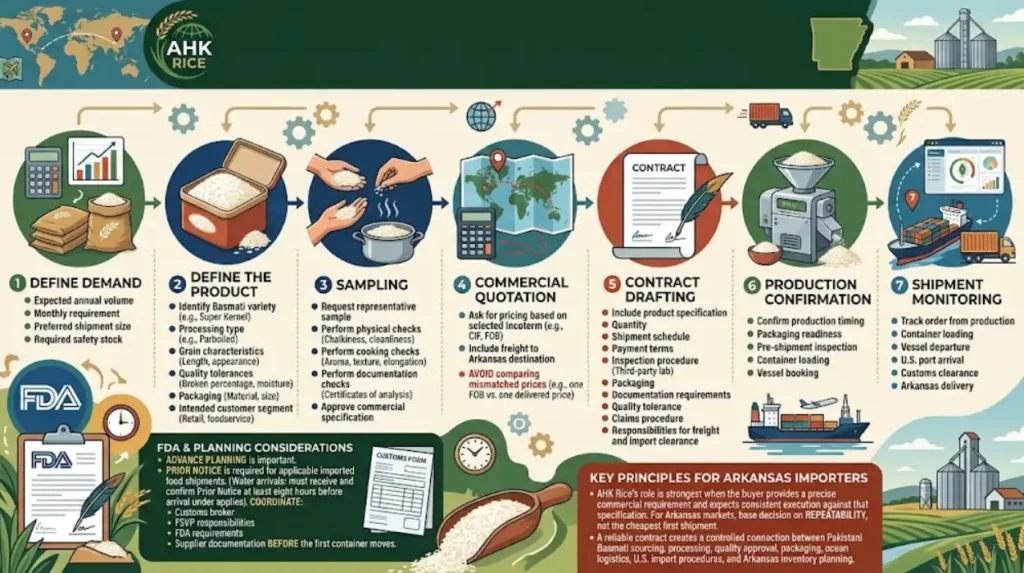
The buying process should begin with a written specification, target volume, packaging requirement, destination, and delivery schedule. A supplier can then quote samples, testing, production, freight, documentation, and shipment milestones, allowing the Arkansas importer to approve one repeatable commercial specification.
The first step is to define demand. State the expected annual volume, monthly requirement, preferred shipment size, and required safety stock.
The second step is to define the product. Identify the Basmati variety, processing type, grain characteristics, quality tolerances, packaging, and intended customer segment.
The third step is sampling. Request a representative sample and perform physical, cooking, and documentation checks before approving the commercial specification.
The fourth step is commercial quotation. Ask for pricing based on the selected Incoterm and Arkansas destination. Avoid comparing one supplier’s FOB price with another supplier’s delivered price.
The fifth step is contract drafting. Include product specification, quantity, shipment schedule, payment terms, inspection procedure, packaging, documentation, quality tolerance, claims procedure, and responsibilities for freight and import clearance.
The sixth step is production confirmation. Once the contract and purchase order are approved, the exporter should confirm production timing, packaging readiness, inspection, container loading, and vessel booking.
The seventh step is shipment monitoring. Track the order from production through container loading, vessel departure, U.S. port arrival, customs clearance, and Arkansas delivery.
FDA’s current framework also makes advance planning important. Prior Notice is required for applicable imported food shipments, and for food arriving by water, FDA must receive and confirm Prior Notice at least eight hours before arrival under the applicable rules.
The importer should therefore coordinate its customs broker, FSVP responsibilities, FDA requirements, and supplier documentation before the first container moves.
AHK Rice’s role is strongest when the buyer provides a precise commercial requirement and expects the exporter to execute against that specification consistently.
For Arkansas markets, the decision should ultimately be based on repeatability rather than the cheapest first shipment. A reliable contract creates a controlled connection between Pakistani Basmati sourcing, processing, quality approval, packaging, ocean logistics, U.S. import procedures, and Arkansas inventory planning. For deeper insight explore:
How Do Long-Term Supply Contracts Improve Procurement Stability?
AHK Rice provides this origin-side structure for buyers that want to move from transactional purchases toward a defined long-term supply program. Buyers ready to specify their Arkansas volume, product grade, packaging, destination, and shipment schedule can request a quote.
Frequently Asked Questions
What Basmati rice varieties are suitable for Arkansas markets?
1121 Basmati, Super Kernel, and 1509 Basmati are suitable for Arkansas wholesalers, distributors, restaurants, retailers, and foodservice buyers.
How does contract-based Basmati rice supply work?
A supply contract defines the rice variety, grade, quantity, packaging, quality specifications, shipment schedule, pricing terms, documentation, and delivery responsibilities before orders are fulfilled.
Why should Arkansas buyers use a contract for Basmati rice procurement?
A contract helps Arkansas buyers secure agreed specifications, planned volumes, shipment schedules, quality requirements, and commercial terms for more predictable procurement.
What quality specifications should Arkansas rice buyers include?
Buyers should specify grain length, broken percentage, moisture, foreign matter, purity, milling quality, aroma, packaging format, and applicable inspection requirements.
Can Basmati rice be supplied in private-label packaging?
Yes. Contract programs can include customized bags, branding, package sizes, labeling requirements, and export-ready packaging according to the buyer’s specification.