Source Compliant Pakistani Basmati Rice for Connecticut Distribution
Connecticut distributors buying Pakistani Basmati rice need more than a low FOB price. They need a supplier with controlled product specifications, export documentation, sampling, shipment planning, and a process aligned with U.S. food-import requirements. For background, buyers can first review:
Why import compliance is essential for rice purchasing decisions.
A commercial shipment then needs a clear specification, approved sample, documented production, compliant packaging, and a defined delivery route into Connecticut.
AHK Rice supplies Pakistani Basmati rice from Punjab for U.S. importers, wholesalers, distributors, retailers, restaurants, and private-label buyers. Its USA export program covers Basmati varieties, processing, grading, packaging, inspection coordination, export documentation, and container shipment support.
What is the best solution for Connecticut Basmati rice distribution?
The best solution is a specification-controlled Pakistani Basmati supply program that combines approved samples, documented quality, compliant packaging, export records, container logistics, and U.S. importer coordination before the shipment leaves Pakistan. This structure reduces procurement uncertainty and supports repeat distribution across Connecticut.
Connecticut distributors normally require consistent rice rather than an occasional spot shipment. The supplier must reproduce the approved grain profile across commercial orders. This includes variety, grain length, broken percentage, moisture, processing grade, packaging, and quantity.
AHK Rice operates from Bucheki, Nankana Sahib, Punjab, and identifies Basmati 1121, Super Kernel, and Basmati 1509 among its principal export varieties. Its processing model covers paddy sourcing, cleaning, dehusking, whitening, polishing, grading, length sorting, and export packing.
For Connecticut distribution, 1121 Basmati is a strong premium specification because its extra-long grain and aromatic profile support South Asian retail, restaurant, foodservice, and private-label channels. Super Kernel provides another premium positioning, while 1509 provides a different price and cooking-performance profile.
The commercial specification needs to be approved before production. A buyer can define:
| Specification | Commercial decision |
|---|---|
| Variety | 1121, Super Kernel, 1509 or another approved grade |
| Processing | White, Steam, Sella, Golden Sella or Brown |
| Grain profile | Defined minimum grain length and appearance |
| Broken percentage | Contract-specific tolerance |
| Moisture | Contract-specific maximum |
| Packing | Bulk, retail or private-label |
| Quantity | Container-based commercial volume |
| Destination | Connecticut warehouse or nominated U.S. port |
This specification becomes the reference point for sampling, production, inspection, packing, and shipment release.
Why choose the USA export service for Connecticut distribution?
The USA export service is valuable because it connects Pakistani Basmati sourcing with processing, grading, packaging, documentation, inspection coordination, and shipment planning through one commercial workflow, giving Connecticut distributors greater control over product consistency, landed cost, and replenishment timing.
AHK Rice’s USA Basmati rice export service is structured for U.S. importers purchasing container-scale Pakistani rice. The service lists USA-oriented Basmati products, packaging options, destination information, shipping support, and customized quotations.
The principal commercial advantage is origin-side control. The rice is processed before container loading rather than purchased through an unidentified chain of intermediaries. Cleaning removes foreign material. Dehusking removes the husk. Whitening and polishing establish the finished rice appearance. Grading separates kernels according to specification. Sorting supports uniformity before packing.
AHK Rice also states that third-party inspection is available and identifies internationally recognized inspection organizations including SGS and Bureau Veritas.
For a Connecticut distributor, this matters because the physical product and the documentation must tell the same story. A purchase order for 1121 Steam Basmati needs to correspond with the approved sample, production specification, packing list, commercial invoice, container records, and shipment documentation.
How rice importers meet USA regulatory requirements, buyers should understand the relationship between FDA requirements, FSVP verification, Prior Notice, labeling, customs entry, and supplier documentation.
FSVP also applies broadly to food imported into the United States unless an exemption or modified requirement applies. The U.S. FSVP importer must evaluate the food and foreign supplier, perform applicable verification activities, maintain records, and provide the required importer identification information at entry.
U.S. compliance remains an importer responsibility. For a detailed explanation of
Therefore, the supplier and importer roles need to be defined before the first commercial order. Export documentation from Pakistan does not transfer the U.S. importer’s legal responsibilities to the exporter.
How does the sample process work before a Connecticut bulk order?
The sample process starts with a written rice specification, continues through sample preparation and courier dispatch, then moves to buyer testing and approval before production. AHK Rice offers samples up to 20 kilograms, while the client covers applicable courier and phytosanitary costs.
The first step is specification confirmation. The buyer identifies the required variety, processing grade, packing format, destination, and commercial quantity. AHK Rice then prepares the corresponding sample.
AHK Rice states that up to 20 kg of rice is available as a sample without a product charge, while the client pays related sample shipping costs. Its USA service information also states that the client pays the phytosanitary certificate cost associated with the sample shipment.
Sample cost structure
| Sample cost item | Buyer cost position |
| Rice sample, up to 20 kg | $0 product charge |
| International courier | Quoted according to destination and courier |
| Phytosanitary certificate | Client-paid applicable charge |
| Laboratory testing, if requested | Buyer-selected testing cost |
| Sample packaging | Standard packing available; custom requirements quoted |
| Commercial shipment after approval | Separately quoted |
A useful commercial reference is the rice value represented by a 20 kg sample. At an illustrative FOB value of $1,180 per metric ton, 20 kg represents approximately $23.60 of rice value. That value is waived under the stated sample policy; courier and phytosanitary charges remain separate.
The buyer then evaluates the sample against the intended retail or foodservice specification. Testing can cover moisture, broken kernels, grain characteristics, contaminants, and other parameters required by the buyer’s procurement program.
Once approved, the sample becomes the commercial quality reference. The purchase order should identify the same product description, grade, tolerances, packaging, quantity, and destination.
This prevents a common procurement problem: approving a sample based on appearance but placing a purchase order using a broader description such as “premium Basmati rice.” A narrow specification produces a stronger purchasing control.
How many shipping days are needed for Connecticut and other U.S. markets?
Connecticut buyers should plan around the U.S. East Coast route through New York-area ports, while West Coast and Gulf destinations require different transit assumptions. Current August 2026 ocean benchmarks show roughly 25–40 days port-to-port depending on destination and routing.
Connecticut is strategically suited to an East Coast import route because New York-area port infrastructure provides access to the Northeast distribution market. Current August 2026 freight data shows Karachi to New York ocean FCL transit around 23–33 days on some Port Qasim services, with another current benchmark showing approximately 27 days for a Karachi-New York 40-foot high-cube shipment.
For planning purposes, distributors should separate ocean transit from customs clearance, terminal handling, inland transportation, and warehouse receiving.
| U.S. market | Current ocean planning range | Distribution implication |
| Connecticut / Northeast via New York | 23–33 days | Strong option for Northeast distribution |
| Southeast via Savannah | Around 33 days | Suitable for Southeast networks |
| Gulf via Houston | Around 40–45 days | Longer replenishment cycle |
| West Coast via Los Angeles/Long Beach | Around 35–40 days | Suitable for Western distribution |
| Inland after port arrival | Additional days | Depends on warehouse location |
Current carrier-market data places Karachi-to-Savannah FCL transit at about 33 days and Karachi-to-Los Angeles FCL transit at approximately 35–40 days. Karachi-to-Houston services are currently showing approximately 40–45 days on available FCL lanes.
These are transportation benchmarks, not guaranteed delivery dates. Vessel schedules, transshipment, port congestion, customs examination, documentation issues, and inland trucking change the final delivery date.
For a Connecticut distributor, a practical inventory model therefore starts replenishment planning before the warehouse reaches its minimum stock level. A distributor relying on a 30-day ocean cycle without safety inventory creates avoidable stockout exposure.
What product specifications deliver the strongest Connecticut distribution value?
The strongest Connecticut distribution specification balances grain appearance, cooking performance, target retail price, packaging format, and repeat-order consistency. Premium 1121 Basmati fits higher-value channels, while other Pakistani Basmati grades provide alternatives for price-sensitive wholesale programs.
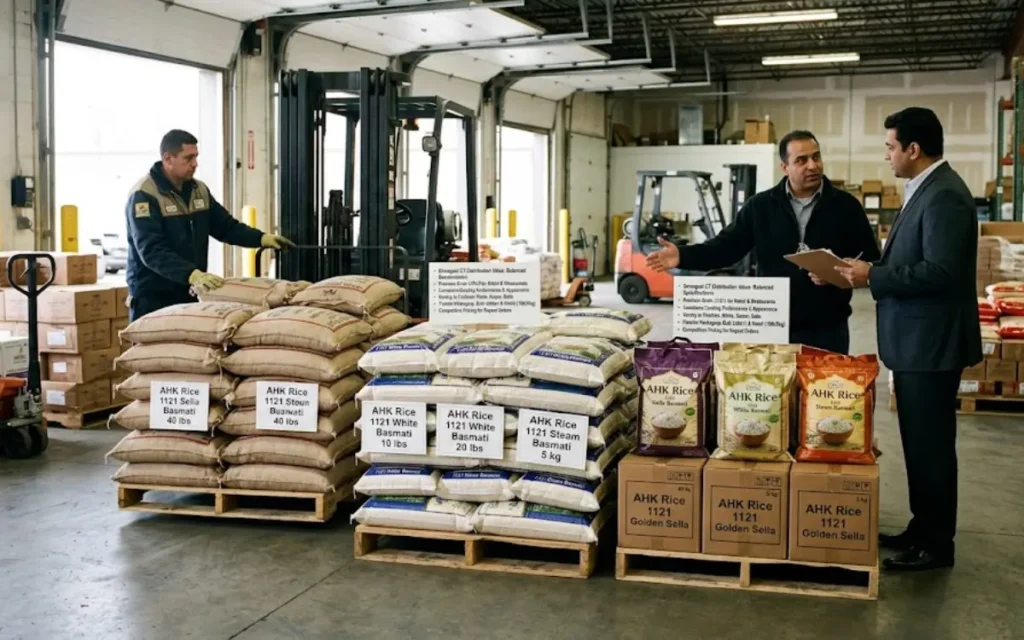
AHK Rice supplies Pakistani Basmati varieties including 1121, Super Kernel, and 1509. Its USA product information positions 1121 around extra-long grain characteristics and identifies white, steam, Sella, Golden Sella, and Brown variants across its USA product range.
A Connecticut distributor serving specialty grocery stores can position 1121 White or Steam Basmati as a premium everyday product. A restaurant distributor can prioritize cooking consistency and bulk packing. A private-label buyer can specify retail bags and brand artwork.
The commercial decision should therefore start with the sales channel rather than the cheapest available rice.
For example, a distributor supplying 50 retail stores needs repeatable bag appearance, stable cooking quality, barcode-ready packaging, and predictable replenishment. A foodservice distributor supplying restaurants needs larger pack sizes, consistent cooking behavior, and efficient pallet handling.
AHK Rice’s private-label capability also allows the commercial specification to include buyer packaging requirements rather than treating packaging as an afterthought.
What pricing factors determine the delivered cost to Connecticut?
The Connecticut landed cost is the sum of rice value, export handling, freight, insurance where applicable, inspection, destination charges, customs-related costs, inland transportation, and warehousing. Comparing FOB quotations alone does not provide an accurate distribution margin.
Current 2026 market references place premium 1121 Pakistani Basmati around US$1,135–$1,205 per metric ton FOB Karachi, although the actual exporter quotation depends on variety, grade, packaging, volume, crop, payment terms, and shipment date.
A commercial buyer can use this framework:
Landed cost = FOB rice price + ocean freight + origin charges + inspection/testing + insurance where applicable + destination charges + customs-related costs + inland delivery + warehousing.
For illustration, a 26 MT purchase at $1,180/MT creates an FOB rice value of $30,680. Freight is then added separately. Current public freight indications vary substantially by equipment, routing, carrier, and validity period. For example, one current Karachi-New York 40-foot high-cube benchmark is approximately $7,519–$8,155, while Karachi-Los Angeles is approximately $7,542–$8,183. These figures are live market indications, not an AHK Rice quotation.
The correct purchasing decision is therefore based on landed cost per metric ton, not simply FOB price.
Tariff classification also needs to be confirmed against the current U.S. Harmonized Tariff Schedule for the exact product and applicable trade measures. The USITC published 2026 HTS Revision 16 on August 14, 2026, so importers need to use the current schedule when calculating customs exposure.
What results can Connecticut distributors expect from a compliant supply model?
A controlled sourcing model delivers measurable procurement outcomes: consistent rice specifications, clearer landed-cost forecasting, fewer documentation gaps, defined replenishment timing, stronger supplier verification, and a repeatable process for scaling from one approved shipment into recurring Connecticut distribution.
The first result is specification consistency. The buyer approves a sample before commercial production, creating a physical reference for subsequent orders.
The second result is improved documentation control. Product, packing, inspection, and export records are coordinated before dispatch. This supports the U.S. importer’s own compliance and supplier-verification process.
The third result is better inventory planning. A Connecticut buyer can build replenishment schedules around current East Coast transit benchmarks instead of using an undefined “Pakistan to USA” shipping estimate.
The fourth result is purchasing transparency. The buyer can separate FOB rice value from freight, destination, customs, inland transportation, and warehouse costs.
The fifth result is scalable distribution. Once the first shipment establishes an approved specification, subsequent orders can repeat the same commercial parameters instead of restarting supplier evaluation from zero.
AHK Rice states that it supplies international markets including the USA and provides end-to-end processing and export support.
How should a Connecticut distributor decide whether AHK Rice is the right supplier?
Choose AHK Rice when the buying requirement prioritizes documented Pakistani Basmati specifications, origin-side processing control, sample approval, export documentation, inspection support, packaging flexibility, and structured USA shipment coordination rather than a lowest-price commodity transaction.
The decision can be reduced to five procurement tests:
| Decision test | Required evidence |
| Product consistency | Approved sample and written specification |
| Compliance readiness | Export records and supplier documentation |
| Commercial value | FOB plus complete landed-cost calculation |
| Logistics | Destination-specific transit planning |
| Scalability | Repeatable production and container supply |
AHK Rice passes the commercial logic when the buyer needs a Pakistani Basmati exporter rather than a broker supplying an unspecified product. Its stated model integrates sourcing, processing, grading, packaging, documentation, and shipment coordination.
The buyer still controls U.S. import compliance. FDA requirements, FSVP obligations, labeling, Prior Notice, customs entry, and importer records remain part of the U.S. importer’s responsibility.
That division of responsibility is important. A compliant exporter supports the importer with documentation and supplier information. The importer remains responsible for its own regulatory program.
How can a Connecticut distributor get started?
Start by submitting the exact Connecticut distribution requirement: Basmati variety, processing grade, packaging, quantity, destination, Incoterm, target shipment month, and sample requirement. The supplier can then prepare a specification-based commercial quotation instead of a generic rice price.
The recommended sequence is direct.
Step 1: Define the product
Select 1121, Super Kernel, 1509, or another required Pakistani Basmati grade. Specify white, steam, Sella, Golden Sella, or Brown processing.
Step 2: Define the commercial pack
State whether the shipment requires bulk sacks, wholesale packaging, retail bags, or private-label packaging. Include package weight and artwork requirements.
Step 3: Request the sample
AHK Rice offers up to 20 kg as a product sample, with the buyer paying applicable courier and phytosanitary costs. Evaluate the sample against the final purchasing specification before approving production.
Step 4: Confirm compliance responsibilities
Identify the U.S. importer, FSVP importer, customs broker, FDA-related responsibilities, Prior Notice process, labeling requirements, and supplier-verification records before shipment.
Step 5: Compare landed cost
Request the FOB or agreed Incoterm price, freight basis, destination port, shipment schedule, packaging cost where applicable, inspection requirements, and other applicable charges. Calculate the final Connecticut warehouse cost per metric ton.
Step 6: Confirm the shipment schedule
For Connecticut, use the New York-area East Coast route as the primary planning reference and add customs, terminal, and inland delivery time to the ocean transit estimate.
Step 7: Approve the commercial order
Once product, sample, documentation, price, packing, quantity, Incoterm, and delivery schedule are confirmed, issue the purchase order against the approved specification.
AHK Rice is positioned for this model because its USA program already combines Pakistani Basmati sourcing with processing, packaging, export documentation, sampling, and shipment coordination.
For a Connecticut distributor, the strongest purchasing decision is therefore not the lowest rice quotation. It is the supplier and specification combination that produces compliant documentation, consistent Basmati quality, predictable logistics, and a landed cost that protects the distributor’s margin. To begin a specification-based Connecticut supply discussion, submit the required product, quantity, packaging, destination, and shipment details through AHK Rice’s Request a Quote process.
Frequently Asked Questions
What Pakistani Basmati rice does AHK Rice supply for Connecticut distributors?
AHK Rice supplies Pakistani Basmati varieties including 1121, Super Kernel, and 1509, with processing options such as White, Steam, Sella, Golden Sella, and Brown Basmati.
Why is 1121 Basmati suitable for Connecticut distribution?
1121 Basmati offers extra-long grains, aromatic characteristics, and strong cooking performance, making it suitable for premium grocery, restaurant, foodservice, wholesale, and private-label distribution.
Does AHK Rice provide rice samples before commercial orders?
Yes. AHK Rice offers product samples up to 20 kg. The rice sample itself carries no product charge under its stated sample policy, while applicable courier and phytosanitary costs are paid by the buyer.
How long does Pakistani Basmati rice take to reach Connecticut?
Ocean transit from Karachi to the New York-area port currently takes roughly 23–33 days on available services. Customs clearance, port handling, and inland transportation add additional time before Connecticut warehouse delivery.
What documents are required for importing Pakistani rice into Connecticut?
The shipment requires appropriate commercial and export documentation, while the U.S. importer manages applicable FDA, FSVP, Prior Notice, customs, labeling, and supplier-verification requirements.