How Do Long-Term Supply Contracts Improve Procurement Stability?
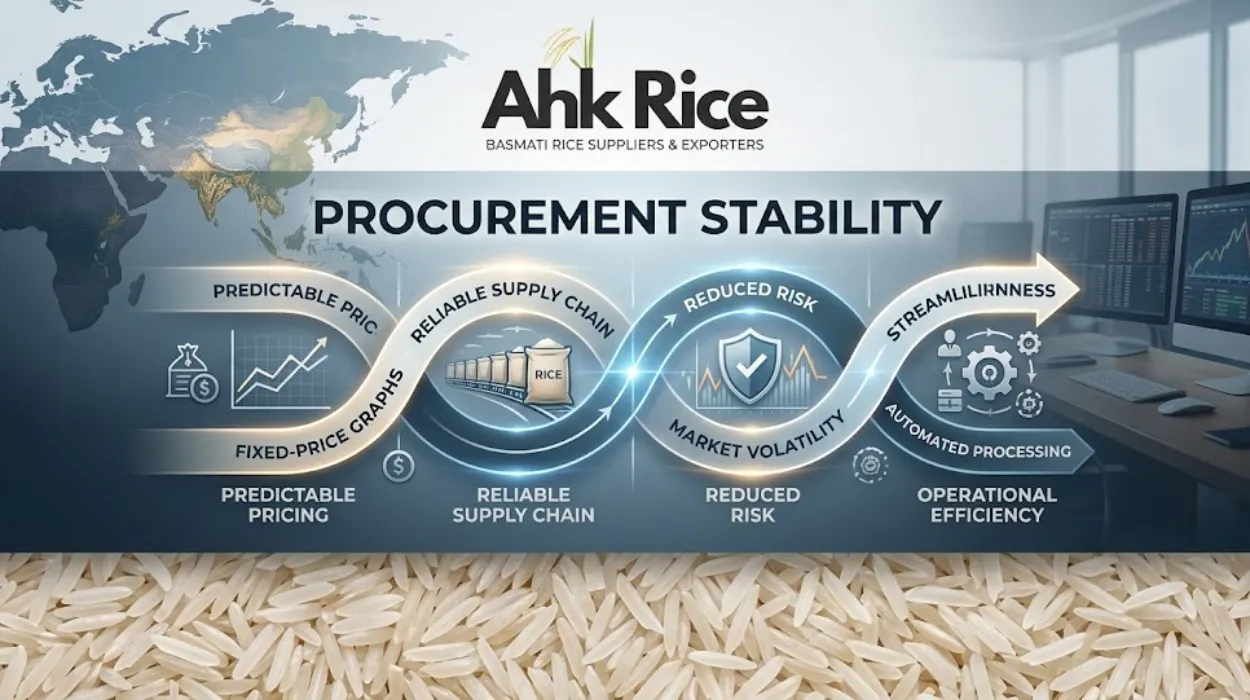
Long-term rice supply contracts improve procurement stability by converting uncertain spot purchasing into a planned supply program with agreed specifications, volumes, pricing rules, delivery schedules, quality controls, and documentation requirements. For importers, this reduces exposure to sudden supplier changes, inconsistent grades, production delays, and unplanned landed-cost movements.
Contract-based procurement becomes more important as international rice trade remains competitive in 2026. USDA’s August 2026 Rice Outlook continues to track changing global rice production, trade, stocks, and import demand, while Pakistan’s 2026/27 rice production is forecast at about 9.8 million metric tons and exports at 5.0 million metric tons.
Importers evaluating this model should first understand:
Why importers prefer contract-based rice supply agreements, because a contract is more than a fixed purchase order. It creates a commercial framework that connects supplier capacity, product specifications, shipment timing, quality verification, and replenishment planning.
What are the available solutions for stabilizing rice procurement?
Procurement stability can be created through spot buying, framework agreements, annual contracts, multi-year contracts, or scheduled blanket orders. Each model balances price flexibility, supply certainty, inventory control, quality consistency, and buyer commitment differently for importers managing recurring rice demand.
Spot purchasing
Spot purchasing means the buyer negotiates each shipment independently. The importer can compare several suppliers before every order and take advantage of favorable market prices.
The weakness is planning uncertainty. Rice specifications, freight costs, supplier availability, and shipment schedules can change between orders. A distributor that needs 100 MT every month may therefore face different commercial and quality conditions across the year.
Spot purchasing works best for occasional buyers, market testing, emergency replenishment, or buyers whose demand changes sharply.
Framework agreements
A framework agreement establishes the commercial rules without necessarily fixing every shipment quantity and price. It can define approved varieties, quality tolerances, packaging, inspection procedures, payment terms, and delivery expectations.
The buyer then issues purchase orders under the framework.
This model provides more control than spot buying while preserving some purchasing flexibility.
Annual supply contracts
An annual contract normally establishes a planned quantity over a 12-month period. It can divide that quantity into monthly or quarterly shipment schedules.
For example, an importer planning 1,200 MT annually could contract 100 MT per month rather than negotiating 12 separate transactions.
The contract can also establish a pricing mechanism instead of one fixed annual price. This is useful when paddy, milling, packaging, ocean freight, or currency costs change during the contract period.
Multi-year supply contracts
Multi-year contracts extend the same planning principle over two or more crop or procurement cycles.
They are appropriate when the importer has established demand and needs stronger production allocation. The supplier can plan paddy procurement, milling capacity, packaging materials, laboratory testing, and container schedules around the buyer’s expected requirements.
The trade-off is reduced flexibility if the buyer’s demand falls or market prices move significantly lower.
How do different procurement approaches compare?
The main difference between procurement approaches is the level of commitment exchanged for supply certainty. Spot buying provides maximum flexibility, while annual and multi-year contracts provide greater volume, specification, scheduling, and replenishment control when demand is predictable.
| Attribute | Spot Purchase | Framework Agreement | Annual Contract | Multi-Year Contract |
|---|---|---|---|---|
| Supply commitment | Low | Medium | High | Very high |
| Price control | Shipment-based | Formula or negotiated | Fixed or indexed | Indexed or formula-based |
| Volume planning | Low | Medium | High | Very high |
| Specification consistency | Order-specific | Defined framework | Contract specification | Long-term specification |
| Shipment scheduling | Flexible | Planned | Scheduled | Programmed |
| Supplier capacity allocation | Limited | Moderate | Strong | Strongest |
| Best use case | Irregular demand | Developing program | Recurring demand | Strategic sourcing |
The table shows why long-term contracts are not simply cheaper versions of spot purchasing. Their principal value is coordination.
A supplier can reserve production capacity when the buyer provides reliable forecasts. The buyer can reserve inventory inflow when the supplier commits to agreed shipment windows.
This creates a procurement system rather than a sequence of individual transactions.
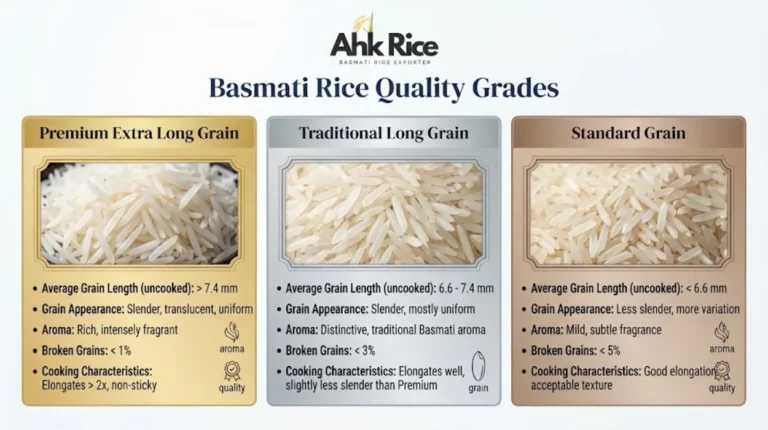
A strong contract should therefore define the rice variety, processing grade, grain length, broken percentage, moisture level, foreign matter tolerance, packaging format, crop requirement, inspection method, shipment quantity, delivery schedule, Incoterm, payment terms, documentation, and claim procedure.
These specifications should remain measurable. “Premium quality” is not an adequate contract specification because it cannot establish an objective acceptance standard.
For Pakistani Basmati, the contract can identify varieties such as 1121, Super Kernel, and 1509. AHK Rice’s USA export service provides these product categories for U.S. buyers and supports processing, packaging, documentation, and export coordination.
Which market regions benefit most from long-term rice contracts?
Gulf and North American markets both benefit from contract procurement, but their commercial priorities differ. Gulf buyers commonly emphasize Basmati cooking performance and recurring foodservice demand, while North American buyers place greater emphasis on specification consistency, labeling, documentation, and predictable replenishment.
Gulf markets: UAE and Saudi Arabia
The Gulf region is a major destination for Pakistani Basmati. UAE importers purchase rice for supermarkets, wholesalers, hotels, restaurants, catering operations, and re-export channels.
UAE buyers commonly evaluate 1121 Basmati, Super Kernel, and 1509 grades according to grain length, aroma, cooking performance, broken percentage, moisture, packing format, and price.
For example, AHK Rice’s current UAE specification for 1121 identifies an average grain length of 8.35 mm+, moisture below 12.5%, and broken grains below 1% on the listed specification. Its UAE service information also states a published starting benchmark of about $1.20/kg FOB for 1121, equivalent to approximately $1,200 per MT FOB, although actual contract pricing changes with specification, packing, quantity, crop, and logistics.
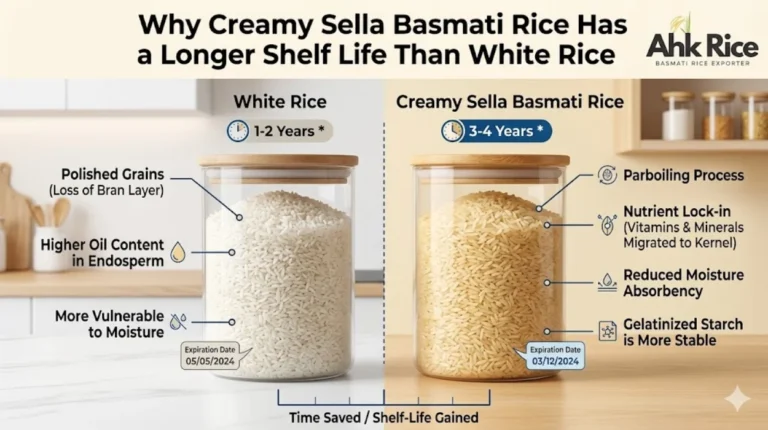
Shelf-life planning also matters. A contract should specify the minimum remaining shelf life at shipment and the required storage conditions rather than relying only on a generic expiry period. White and parboiled Basmati normally support longer commercial storage than brown rice when properly packed and stored.
Saudi buyers similarly purchase 1121 white, steam, and Sella grades. AHK Rice’s Saudi specifications include 1121 white at approximately 8.25–8.4 mm average grain length, maximum 12% moisture, and maximum 2% broken grains on its listed specification.
North American markets: USA
U.S. procurement programs require a different level of operational planning because the shipment passes through international logistics, U.S. import procedures, inland transportation, warehousing, and distribution networks.
U.S. buyers can source 1121, Super Kernel, and other Pakistani Basmati grades for wholesale, retail, foodservice, and private-label programs. AHK Rice currently publishes a starting benchmark of approximately $1,100 per MT FOB Karachi for 1121 Basmati for USA buyers, while actual prices depend on grade, packaging, order size, freight, and delivery terms.
| Market region | Common procurement focus | Representative grade preference | Indicative price benchmark | Shelf-life planning |
| Gulf | Foodservice, wholesale, retail, re-export | 1121 Steam, 1121 Sella, 1509 | ~US$1,200/MT FOB for listed UAE 1121 benchmark | Set minimum remaining life at shipment |
| North America | Wholesale, retail, foodservice, private label | 1121 Steam, 1121 White, Super Kernel | ~US$1,100/MT FOB for listed USA 1121 benchmark | Set minimum remaining life plus warehouse conditions |
These figures are supplier-published reference points, not universal 2026 market prices. Contract negotiations should use the buyer’s exact specification and Incoterm.
The important comparison is not simply $1,200 versus $1,100. Freight, insurance, port charges, customs-related costs, inland delivery, packaging, inspection, and inventory carrying costs can change the landed-cost result.
How does a long-term contract improve procurement stability?
A long-term contract improves stability by linking expected demand with supplier production, quality specifications, shipment windows, inventory replenishment, and commercial pricing rules. This allows both parties to plan resources earlier and reduces repeated negotiation across the procurement cycle.
The first benefit is volume security. A buyer can establish an annual requirement instead of competing for supply every month.
The second benefit is specification stability. The contract can require the same grain length, broken percentage, moisture range, milling grade, packaging, and inspection standard for every shipment.
The third benefit is production planning. A supplier receiving reliable forecasts can allocate paddy, processing capacity, sorting, packaging materials, laboratory testing, and container loading.
The fourth benefit is replenishment planning. A distributor can connect contract shipment dates with warehouse inventory and customer demand.
The fifth benefit is commercial predictability. Instead of accepting whatever price is available when inventory becomes urgent, the buyer can negotiate a fixed price, indexed price, or formula tied to defined cost components.
A practical contract might specify 600 MT annually, delivered in 50 MT monthly shipments. It could require a nominated Basmati variety, a defined moisture maximum, a defined broken-grain tolerance, approved packaging, pre-shipment inspection, and shipment within an agreed delivery window.
The buyer then knows when the next inventory is expected before current stock reaches its reorder threshold.
What are the advantages and disadvantages of long-term supply contracts?
Long-term contracts provide stronger supply continuity, specification control, capacity planning, and budget visibility, but they also create volume commitments and reduce purchasing flexibility. Their value increases when demand is predictable and the contract contains clear adjustment mechanisms.
Advantages
Supply continuity: A recurring importer can reduce dependence on last-minute purchases.
Quality consistency: Contract specifications establish measurable standards for every shipment.
Production allocation: Suppliers can plan processing and packaging capacity around forecasted demand.
Inventory control: Scheduled arrivals make safety-stock calculations more reliable.
Commercial planning: Buyers can budget using fixed or indexed pricing mechanisms.
Relationship efficiency: Procurement teams spend less time renegotiating basic commercial conditions for every shipment.
Disadvantages
Volume commitment: A buyer may still be obligated to purchase contracted quantities when demand falls.
Price risk: A fixed-price contract can become unfavorable if market prices decline substantially.
Specification rigidity: A highly restrictive specification can reduce the buyer’s ability to substitute grades.
Supplier concentration: Relying heavily on one supplier creates concentration risk.
Contract administration: Long-term agreements require forecasting, performance monitoring, quality records, and formal claim procedures.
For example, a retailer with stable monthly demand may benefit from a 12-month agreement. A new distributor with uncertain demand may be better served by a framework agreement with flexible call-off volumes.
Which method works best for different procurement cases?
Annual contracts work best for predictable recurring demand, multi-year contracts suit strategic high-volume programs, framework agreements fit developing demand, and spot purchasing remains useful for trials or irregular requirements. The correct method depends on demand certainty, volume, cash flow, and supply risk.
A spot purchase fits a buyer testing Pakistani Basmati for the first time. The importer can purchase one container, evaluate customer response, and establish actual demand.
A framework agreement fits a growing wholesaler that expects repeat orders but cannot accurately forecast the full year. The agreement establishes quality and commercial rules while purchase orders determine actual quantities.
An annual contract fits a distributor with stable customer demand. A forecast can be divided into monthly or quarterly shipments.
A multi-year contract fits a large retailer, foodservice distributor, or private-label program where consistency is commercially important. The buyer can establish a core specification and review pricing periodically.
A hybrid strategy often provides the strongest control. A buyer can contract its base demand while retaining a percentage of annual purchasing for spot opportunities.
For example, a distributor expecting 1,000 MT annually could contract 700 MT and leave 300 MT flexible. The contracted volume protects core supply while the flexible volume allows the buyer to respond to changing demand and market prices.
This approach avoids making the entire procurement program dependent on one pricing assumption.
What decision factors should buyers evaluate before signing?
Buyers should evaluate demand predictability, annual volume, specification complexity, supplier capacity, pricing structure, delivery performance, quality controls, documentation, inventory requirements, and exit provisions before committing to a long-term rice supply contract.
| Decision factor | What to evaluate | Why it matters |
| Demand forecast | Monthly and annual consumption | Prevents over- or under-contracting |
| Product specification | Variety, grain length, moisture, broken percentage, packing | Protects product consistency |
| Supplier capacity | Processing, sorting, packing, inspection, container capability | Prevents production bottlenecks |
| Price mechanism | Fixed, indexed, formula-based, review periods | Controls price exposure |
| Logistics | Shipment windows, ports, Incoterms, inland delivery | Protects replenishment timing |
Supplier capacity should be evaluated against peak demand rather than average demand alone. A supplier that can process the average monthly requirement may still fail during seasonal peaks.
Quality should also be verified before the contract starts. Samples establish commercial acceptance, while pre-shipment inspection confirms that each production batch meets the agreed specification.
The contract should define what happens when a shipment fails inspection. Options include replacement, price adjustment, reprocessing, rejection, or another agreed remedy.
Documentation should also be part of the specification. Depending on the destination, this can include commercial invoices, packing lists, certificates of origin, phytosanitary documentation, fumigation certificates, inspection reports, bills of lading, and food-import documentation.
For U.S. programs, the importer should also account for applicable FDA and customs requirements before setting the shipment schedule. The commercial contract should clearly assign responsibilities for documentation and import compliance.
What should a stable long-term rice supply program look like?
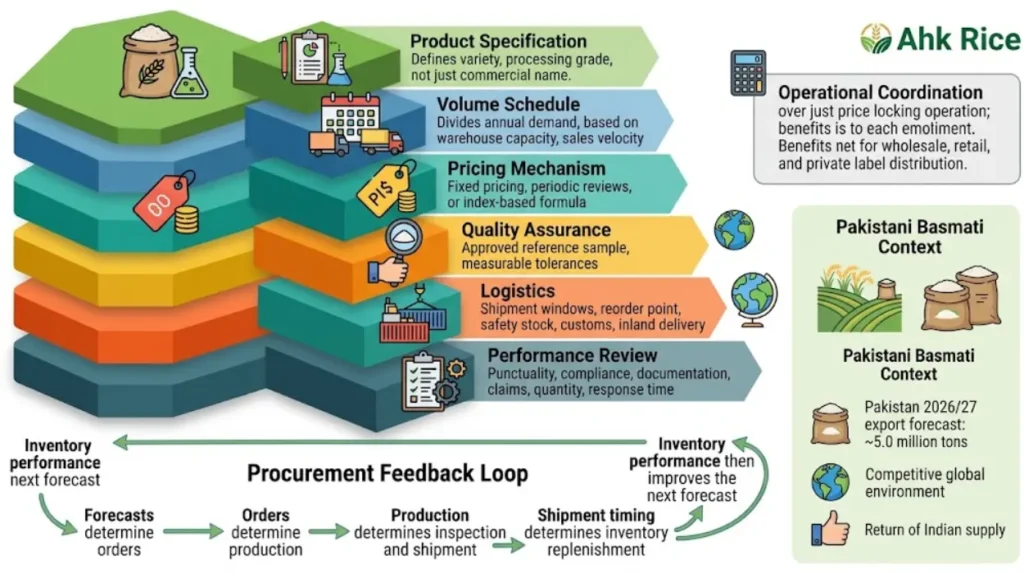
A stable rice supply program combines a defined product specification, forecasted volume, scheduled shipments, measurable quality controls, transparent pricing rules, documentation responsibilities, inventory targets, and supplier performance reviews into one repeatable procurement process.
The strongest structure begins with a product specification sheet. It should identify the variety and processing grade instead of using only a commercial name.
The second layer is the volume schedule. Annual demand should be divided into realistic shipment quantities based on warehouse capacity and sales velocity.
The third layer is the pricing mechanism. Buyers can choose fixed pricing for a defined period, periodic price reviews, or an index-based formula that responds to agreed cost movements.
The fourth layer is quality assurance. The buyer should approve a reference sample and require production to remain within measurable tolerances.
The fifth layer is logistics. Shipment windows should connect with the buyer’s reorder point, safety stock, port availability, customs processing, and inland delivery.
The sixth layer is performance review. Buyers should monitor shipment punctuality, specification compliance, documentation accuracy, claims, quantity fulfillment, and response time.
This creates a procurement feedback loop. Forecasts determine orders. Orders determine production. Production determines inspection and shipment. Shipment timing determines inventory replenishment. Inventory performance then improves the next forecast.
For Pakistani Basmati procurement, this structure is particularly relevant because Pakistan’s 2026/27 export forecast is approximately 5.0 million tons, while the industry is operating in a competitive global environment influenced by the return of Indian rice supply.
Long-term contracting therefore should not be viewed simply as a way to lock in a rice price. Its greater value is operational coordination.
A buyer that needs consistent Basmati for wholesale, retail, restaurant, or private-label distribution should compare suppliers on their ability to maintain the complete specification across repeated shipments. A supplier’s ability to process, grade, pack, inspect, document, and load according to a recurring schedule is more important than a single attractive quotation.
For buyers moving from evaluation into execution, the next logical resource is:
Secure Contract-Based Basmati Rice Supply for Arkansas Markets, which should be used when the reader is ready to evaluate a contract-based supply program specifically for Arkansas.
Frequently Asked Questions
How do long-term rice supply contracts improve procurement stability?
Long-term rice supply contracts provide predictable volumes, agreed specifications, scheduled shipments, and defined pricing mechanisms. This helps importers reduce supply interruptions and improve inventory planning.
What is a long-term rice supply contract?
A long-term rice supply contract is a commercial agreement covering recurring purchases over a defined period, often 12 months or longer. It establishes product specifications, quantities, delivery schedules, pricing, quality controls, and payment terms.
How do long-term contracts compare with spot purchasing?
Spot purchasing provides maximum flexibility but exposes buyers to changing prices, availability, specifications, and delivery schedules. Long-term contracts provide greater supply and specification stability in exchange for stronger purchasing commitments.
What rice specifications should a supply contract include?
A contract should define rice variety, grain length, processing type, moisture level, broken percentage, foreign matter tolerance, packaging, crop requirements, inspection standards, and acceptable quality tolerances.
Can rice prices be adjusted during a long-term contract?
Yes. Contracts can use fixed pricing, periodic price reviews, or an agreed pricing formula. The chosen mechanism should clearly define when prices can change and which cost factors affect the adjustment.
Which Pakistani Basmati varieties can be included in long-term contracts?
Common contract varieties include 1121 Basmati, Super Kernel, and 1509 Basmati. Buyers can specify white, steam, Sella, or other processing formats according to their target market and customer requirements.
Are long-term rice contracts suitable for small importers?
They can be suitable when demand is recurring and predictable. Smaller importers can use framework agreements or shorter annual contracts with flexible call-off quantities instead of committing to large multi-year volumes.