How Is Purity Tested in Pakistan Basmati Rice Before Export?
Pakistan Basmati rice purity is tested through variety identification, grain-length analysis, foreign-matter inspection, admixture measurement, milling checks, moisture testing, and laboratory verification. Exporters use these controls to confirm that a shipment matches its declared variety and agreed commercial specification before loading.
What is purity testing in Pakistan Basmati rice?
Purity testing measures whether a Basmati rice lot contains the declared rice variety at the required level, with controlled admixture, foreign matter, damaged grains, broken grains, moisture, and milling defects. The process connects field identity, processing controls, laboratory analysis, and shipment specifications before export documentation.
Rice purity does not mean that every grain looks identical. In export trade, purity describes conformity with a defined specification. The specification identifies the rice variety, processing type, grade, tolerance limits, and quality parameters.
Pakistan produces Basmati rice mainly in Punjab. Traditional Basmati and improved Basmati types are grown in irrigated rice-producing areas. Commercial exporters also handle long-grain Basmati varieties such as 1121, Super Kernel, and 1509.
Each variety has different physical characteristics. These include grain length, width, shape, cooking behavior, aroma, and elongation after cooking. A purity test therefore starts by identifying the variety before examining individual defects.
A shipment declared as 1121 Basmati, for example, requires controls that distinguish 1121 from other long-grain rice. A shipment declared as Super Kernel requires the same principle but uses the specifications agreed for that variety.
Purity also relates to admixture. Admixture means grains from another variety or type that enter the lot. A small amount of admixture can change the commercial classification when the buyer specifies a strict purity level.
How is Pakistan Basmati rice purity tested before export?
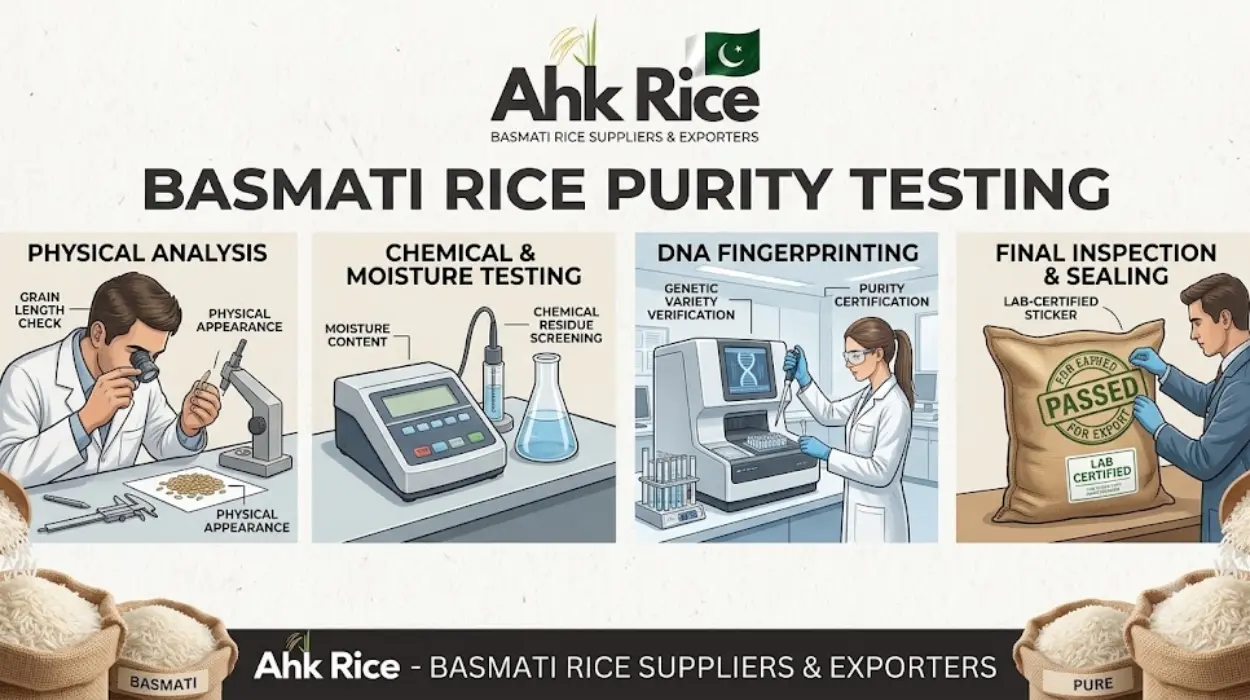
Purity testing starts with representative sampling and continues through physical separation, weighing, grain measurement, visual inspection, laboratory analysis, processing checks, and final quality verification. The results are compared against the purchase specification before the shipment is approved for packing and export.
The process normally follows a controlled sequence.
1. How is the rice sample collected?
A representative sample is essential because one bag cannot describe an entire commercial lot. Samples are collected from multiple bags or points within a batch. The portions are combined into a working sample for analysis.
Sampling controls prevent a buyer or laboratory from judging purity from an unusually clean or defective section.
For bulk export preparation, the sample identifies the lot, variety, processing type, quantity, and testing date. Traceability connects the test result to the actual production batch.
2. How are impurities separated?
The sample is examined for foreign material and unwanted grains. Foreign material includes substances that are not rice, such as stones, husk fragments, straw, soil particles, or other field material.
The analyst separates these materials and measures their quantity. The result is recorded as a percentage or according to the relevant inspection specification.
The rice itself is then examined for admixture. Different-looking grains are separated when their appearance indicates another variety or quality category.
3. How are grain dimensions checked?
Grain dimensions provide one of the strongest physical indicators of Basmati identity and grade.
Measurements include:
- Kernel length
- Kernel width
- Length-to-width ratio
- Average grain size
- Broken-kernel percentage
- Head-rice percentage
- Cooked grain elongation where required
Long-grain varieties such as 1121 are evaluated against their defined physical specification. A grain-length result does not establish purity by itself. It works with variety identification, admixture, milling quality, and other parameters.
4. How are defective grains identified?
The sample is sorted to identify damaged, discolored, immature, chalky, red, yellow, insect-damaged, or otherwise defective kernels according to the applicable specification.
These defects matter because purity and quality are connected but are not identical.
A rice lot can contain the correct variety while still failing a quality specification because of excessive damaged grains. A lot can also have excellent appearance while containing admixture from another variety.
5. How is milling quality checked?
Milling quality determines how much of the rice remains as whole kernels after processing.
The sample is separated into whole kernels and broken kernels. The percentages are calculated against the total sample.
Commercial grades use terms such as 100% broken, 5% broken, or other contractual broken-grain limits. The exact specification depends on the product and buyer contract.
This step is important because milling changes the physical appearance of rice. Properly controlled milling produces a more uniform commercial lot and reduces unwanted broken grains.
What are the key components of a Basmati purity test?
The core components are variety identity, admixture percentage, foreign matter, grain dimensions, broken kernels, damaged grains, moisture, milling quality, and processing condition. Laboratory documentation then connects these measurements to the specific export lot and contractual specification.
What does variety identity mean?
Variety identity confirms that the rice belongs to the declared commercial variety. This is critical when a buyer purchases 1121 Basmati instead of another long-grain variety.
Variety identity relies on physical characteristics and, where required, laboratory methods. A reliable test does not depend on grain appearance alone.
What is admixture percentage?
Admixture is the proportion of grains that do not conform to the declared variety or specification.
For example, a lot sold under a defined 1121 specification is checked for grains that differ from the required characteristics. The result is recorded against the permitted tolerance.
The contractual tolerance is more important than a generic purity number. Different buyers specify different limits.
What is foreign matter?
Foreign matter covers non-rice material found in the sample. Examples include stones, husk, straw, soil, and other extraneous material.
Cleaning equipment removes much of this material before milling and packing. Inspection confirms that the final lot remains within the specified tolerance.
Why is moisture included?
Moisture measures the water content of rice. It affects storage stability, milling performance, and shipment condition.
Moisture is not a direct measurement of varietal purity. It is included in pre-export quality control because a rice lot must meet multiple specifications at the same time.
What role does broken rice play?
Broken rice measures the percentage of kernels that do not remain whole after milling.
A premium whole-kernel specification requires tighter control than a product intentionally sold with a higher broken percentage. The broken percentage therefore helps define the commercial grade.
What are the available grades of Pakistan Basmati rice?
Pakistan Basmati rice is traded in multiple varieties and processing forms rather than one universal purity grade. Common commercial categories include 1121, Super Kernel, and 1509, with white, steam, and parboiled or Sella processing specifications depending on the product.
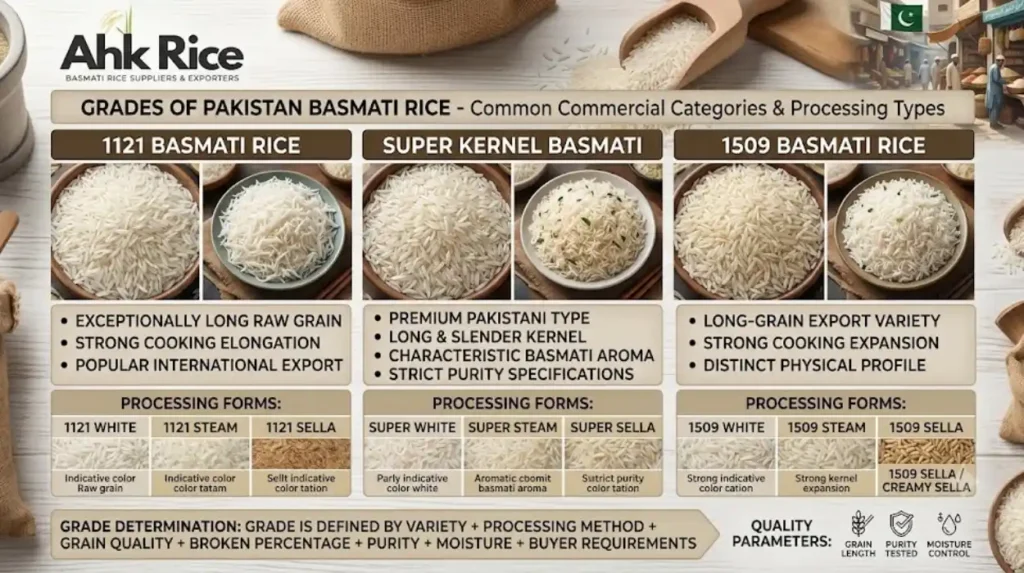
The grade is determined by the combination of variety, processing method, grain quality, broken percentage, purity, moisture, and buyer requirements.
What is 1121 Basmati rice?
1121 is a long-grain Basmati type widely traded in international markets. It is known for its exceptionally long raw kernel and strong elongation after cooking.
Export specifications distinguish between products such as 1121 White, 1121 Steam, and 1121 Sella. Each processing type has different physical and cooking characteristics.
What is Super Kernel Basmati rice?
Super Kernel is a premium Pakistani Basmati type with a long, slender kernel and characteristic Basmati aroma.
It is commonly processed as white rice, steam rice, or Sella depending on market demand. Purity testing confirms that the shipment conforms to the specified Super Kernel profile.
What is 1509 Basmati rice?
1509 is a long-grain Basmati variety used extensively in export markets. It offers long kernels and strong cooking expansion.
Commercial forms include 1509 White, 1509 Steam, and 1509 Sella or Creamy Sella. Processing changes the grain’s color, texture, and cooking behavior but does not change the underlying variety.
Which certifications and laboratory checks apply to exported Basmati rice?
Export certification depends on the destination market, buyer contract, shipment requirements, and applicable Pakistani and importing-country regulations. Common controls include laboratory analysis, phytosanitary certification, food-safety documentation, fumigation records, certificate of origin, and inspection reports.
Purity itself is generally demonstrated through a quality or laboratory report rather than one universal international “Basmati purity certificate.”
A shipment can require several documents because each document proves a different attribute.
Phytosanitary certification addresses plant-health requirements for the importing country.
Certificate of origin identifies the country where the product originates.
Fumigation documentation records treatment when required by the destination or shipping terms.
Laboratory reports document analytical parameters such as moisture, broken grains, foreign matter, and other agreed quality characteristics.
Food-safety certifications depend on the buyer and market. Examples include HACCP-based systems, ISO 22000-based food-safety systems, and destination-specific compliance requirements.
For Saudi Arabia, import requirements also involve the applicable Saudi food-control and customs framework. The exact document set should be confirmed against the shipment date, product, packaging, and importer requirements.
The important distinction is that certification and purity testing are related but different. A food-safety certificate does not replace a variety-purity analysis. A phytosanitary certificate does not establish grain purity. Each document serves a specific regulatory or commercial purpose.
Which markets import Pakistani Basmati rice?
Pakistani Basmati rice is exported to markets across the Middle East, Europe, North America, Africa, and other regions. Saudi Arabia, the United Arab Emirates, the United States, the United Kingdom, and European markets are important destinations where buyers specify product, packaging, documentation, and quality requirements.
Market requirements differ because importers serve different consumer segments.
Saudi Arabia has strong demand for Basmati rice across retail, food service, catering, and distribution. Importers focus on grain length, cooking performance, appearance, packaging, food safety, and documented quality.
United Arab Emirates functions as both a consumer market and a regional trading hub. Importers commonly evaluate grain specifications, packaging formats, documentation, and consistency between shipments.
United States buyers place emphasis on food-safety compliance, labeling, traceability, packaging, and consistent product specifications.
European markets apply strict food-safety and traceability requirements. Buyers also define product specifications for grain quality, contaminants, residues, packaging, and labeling.
The purity report therefore becomes part of a broader export quality file. The report gives the buyer measurable evidence that the lot corresponds to the agreed specification.
Why does purity testing matter before export?
Purity testing protects the buyer from variety substitution, excessive admixture, foreign matter, inconsistent grain quality, and specification failures. It also gives exporters measurable evidence for quality documentation, lot traceability, inspection, dispute prevention, and destination-market compliance.
The first benefit is product identity. A buyer purchasing 1121 needs evidence that the shipment conforms to the contracted variety.
The second is commercial consistency. Importers often sell rice under a specific variety and grade. Variation between shipments creates problems in retail, food service, and distribution.
The third is quality control. Purity testing identifies defects before containers leave Pakistan. Corrective processing is easier before loading than after arrival.
The fourth is traceability. A documented sample links the analytical result to a production lot, packaging batch, and shipment.
The fifth is dispute reduction. A pre-shipment report creates measurable evidence of the condition of the rice at the testing stage.
For buyers comparing suppliers, the quality report is useful because it turns terms such as “premium” or “high purity” into measurable specifications.
Where is purity testing used in the Pakistan Basmati rice export process?
Purity testing is used from processed-lot approval through final shipment inspection. It supports procurement, milling control, grading, packaging approval, pre-shipment inspection, buyer verification, and export documentation for retail, wholesale, food-service, and distribution channels.
At the milling stage, testing confirms whether cleaning and sorting have produced the required quality.
At the grading stage, the rice is classified according to variety and physical specifications.
At the packing stage, the approved lot is matched with the correct packaging and product declaration.
At the pre-shipment stage, final inspection confirms that the shipment meets the agreed specifications.
At the destination stage, importers can use the report as a reference when receiving and checking the shipment.
This is particularly important for large commercial orders. A container contains a much larger quantity than the laboratory sample. Sampling therefore has to represent the complete lot.
For a structured view of the documentation buyers request after these quality controls, the next stage is covered in:
The purity reports Saudi Arabian rice importers request from Pakistan exporters.
What are the common misconceptions about Basmati rice purity testing?
The main misconceptions are that long grain automatically means Basmati, visual appearance alone proves purity, a food-safety certificate proves variety identity, and one laboratory result covers every quality requirement. Export purity requires multiple measurements against a defined specification.
A long grain does not automatically mean Basmati. Grain length is one characteristic. Variety identity requires a broader assessment.
Bright white rice does not automatically mean high purity. Appearance can indicate processing quality, but it does not prove varietal identity.
A certificate does not replace laboratory testing. A phytosanitary certificate, food-safety certificate, or certificate of origin proves a particular requirement. It does not automatically establish grain purity.
Purity is not the same as grade. Purity focuses strongly on conformity and admixture. Grade also considers factors such as broken grains, damaged kernels, moisture, processing type, and other contractual parameters.
One sample does not represent a poorly controlled lot. The sample must be representative. Sampling procedures determine whether the test accurately reflects the commercial shipment.
What should a Basmati rice purity report contain?
A useful purity report identifies the product, lot, sampling information, analytical parameters, measured results, applicable tolerances, testing date, and laboratory or inspector details. These records allow importers to compare actual results against the specification agreed for the shipment.
A practical report can include:
- Product and variety
- Processing type
- Lot or batch identification
- Sampling date
- Sample quantity
- Variety or admixture result
- Foreign matter
- Broken grains
- Moisture
- Damaged or defective kernels
- Grain dimensions
- Milling characteristics
- Laboratory method where applicable
- Pass or fail assessment against the agreed specification
- Testing authority or laboratory
- Report date
The most useful report is not simply a list of numbers. It connects each result to a defined specification.
This matters because a 5% broken specification, for example, has commercial meaning only when the contract defines what “5% broken” means and how it is measured.
The same principle applies to purity. A percentage without a defined test method, sample identity, and tolerance provides limited evidence.
Frequently Asked Questions
How is purity tested in Pakistan Basmati rice before export?
Purity is tested through representative sampling, variety identification, admixture checks, foreign-matter inspection, grain measurement, broken-grain analysis, moisture testing, and laboratory quality assessment.
What does purity mean in Basmati rice?
Purity refers to how closely a rice lot conforms to its declared variety and agreed specification. It includes controls for admixture, foreign matter, defective grains, and other quality parameters.
How is 1121 Basmati rice purity checked?
1121 Basmati purity is checked through representative sampling, physical grain characteristics, admixture analysis, grain dimensions, broken-kernel percentage, foreign matter, moisture, and other contractual quality parameters.
How is Super Kernel Basmati rice tested for purity?
Super Kernel is evaluated through variety identification, grain appearance and dimensions, admixture measurement, milling quality, broken grains, foreign matter, moisture, and applicable laboratory tests.
How is 1509 Basmati rice purity verified?
1509 Basmati purity is verified by examining representative samples for variety conformity, admixture, grain characteristics, broken kernels, foreign matter, moisture, and other agreed export specifications.
What is admixture in Basmati rice?
Admixture is the presence of rice grains that do not conform to the declared variety or specification. Testing separates and measures these grains against the tolerance stated in the purchase specification.
Does grain length prove Basmati purity?
No. Grain length is an important physical characteristic, but it does not independently prove Basmati identity. Purity assessment combines grain characteristics with admixture, processing, and laboratory quality checks.
What laboratory tests are used for exported Basmati rice?
Laboratory testing can cover moisture, foreign matter, broken grains, damaged kernels, grain dimensions, contaminants, residues, and other parameters required by the buyer, destination market, or applicable regulations.
What certifications are required for Pakistan Basmati rice exports?
Requirements depend on the destination and shipment. Common documentation includes phytosanitary certification, certificate of origin, fumigation records, laboratory reports, food-safety documentation, and buyer-specific quality certificates.
Do Saudi Arabian importers require Basmati purity reports?
Saudi Arabian importers can require documented purity and quality results as part of their supplier and shipment verification process. Requirements depend on the product, importer, contract, and applicable Saudi regulations.
Why is purity testing important before exporting Basmati rice?
Purity testing confirms product identity and quality before shipment. It helps control admixture, foreign matter, grain defects, broken kernels, and specification failures while supporting traceability and buyer verification.
What should a Basmati rice purity report contain?
A purity report should identify the variety, processing type, lot, sample, testing date, analytical parameters, measured results, applicable tolerances, testing authority, and pass-or-fail assessment where provided.