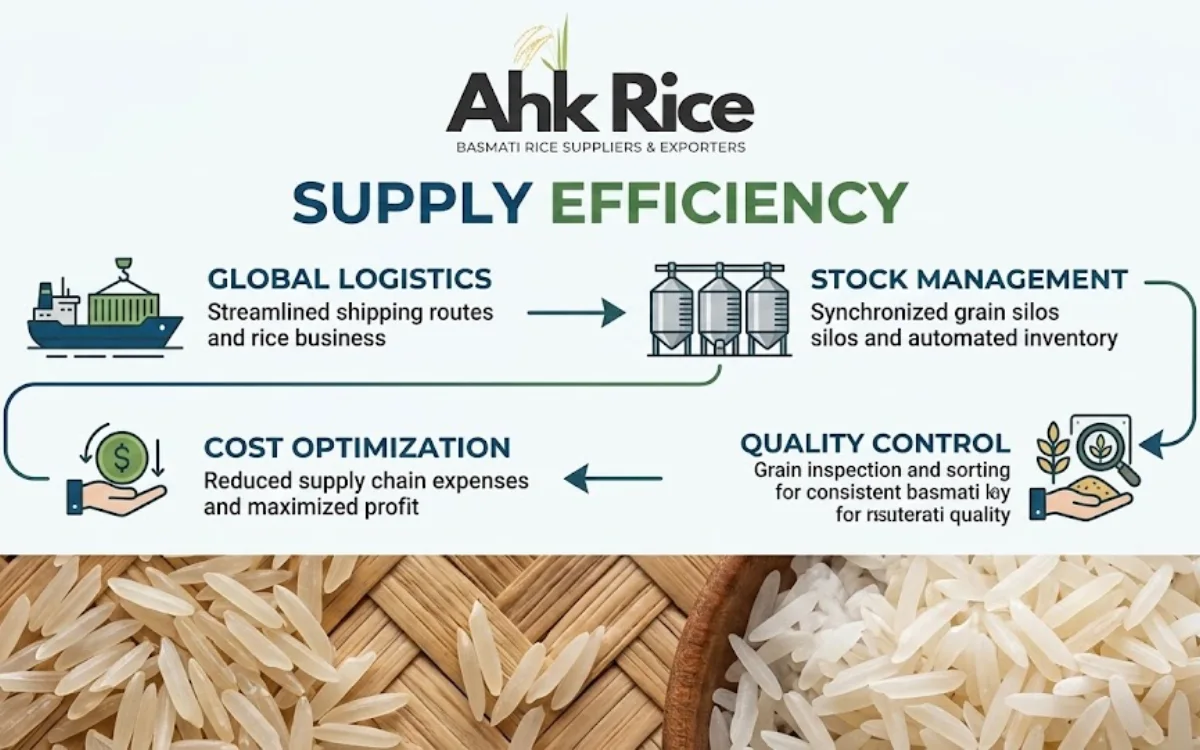
Why Are Procurement Teams Focused on Supply Efficiency?
Procurement teams focus on supply efficiency because international food purchasing depends on predictable quality, controlled costs, compliant documentation, reliable processing, and timely delivery. In rice procurement, efficiency connects farm sourcing, milling, grading, packaging, inspection, export documentation, shipping, customs, and final delivery into one coordinated supply chain.
For Pakistani rice, this focus has become more important in 2026. Pakistan exported 5.82 million metric tonnes of rice in FY2024-25, including 808,643 tonnes of Basmati rice. The total export value reached approximately US$3.35 billion.
Pakistan’s Basmati supply is concentrated in recognised growing areas, with Punjab playing a major role. Basmati specifications cover geographical origin, approved varieties, grain characteristics, processing, and authenticity. Pakistan’s geographical indication framework also provides mechanisms for verifying Basmati origin and compliance.
What Is Supply Efficiency in Procurement?
Supply efficiency is the ability to source the required product at the required specification, quantity, cost, time, and compliance level while reducing avoidable delays, waste, documentation errors, quality failures, and logistics disruptions across the purchasing process.
Supply efficiency is different from simply finding a low purchase price. A procurement team evaluates the complete supply chain cost and performance.
For example, a rice buyer purchasing 20 containers at a low FOB price still faces additional costs if the shipment contains inconsistent grain quality, incorrect documentation, excess broken rice, unsuitable packaging, or delayed inspection.
An efficient procurement model connects five variables:
- Product specification
- Supplier capability
- Quality control
- Export compliance
- Logistics execution
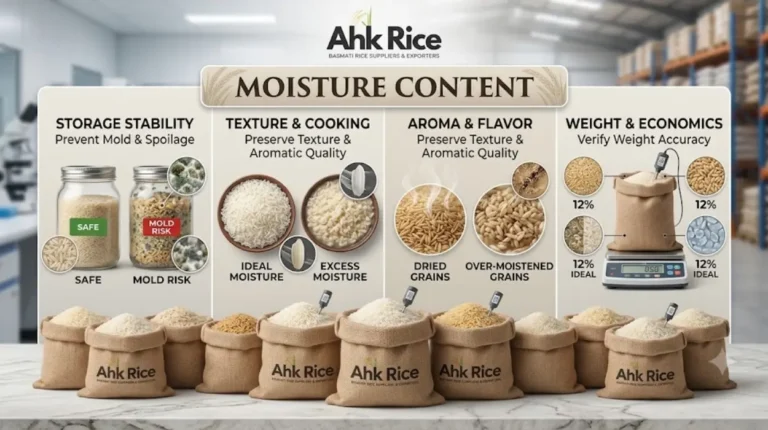
In international rice purchasing, the product specification includes variety, grain length, moisture, broken percentage, milling quality, processing method, packaging format, crop year, and destination requirements.
The supplier then needs to demonstrate that the specification can be reproduced across shipments. A single compliant sample does not establish supply efficiency. Consistent production and documented controls establish it.
Pakistan’s rice export data demonstrates the scale of this procurement environment. REAP recorded 808,643 tonnes of Basmati exports and more than 5 million tonnes of non-Basmati exports during FY2024-25.
How Does an Efficient Rice Supply Chain Work?
An efficient rice supply chain moves through defined stages: crop sourcing, paddy intake, cleaning, drying, milling, grading, sorting, processing, inspection, packaging, documentation, containerisation, shipment, customs clearance, and delivery to the buyer.
How Is Rice Sourced?
Rice begins as paddy cultivated by farmers. Pakistani Basmati production is strongly associated with Punjab and other recognised geographical areas defined under Pakistan’s Basmati specifications.
Procurement starts by identifying the required variety and crop characteristics. A buyer requesting 1121 Basmati has a different specification from a buyer requesting Super Kernel or 1509.
The procurement team defines quantity, variety, processing form, packaging, destination, delivery term, inspection requirements, and acceptable quality parameters before confirming the purchase.
How Is Paddy Processed?
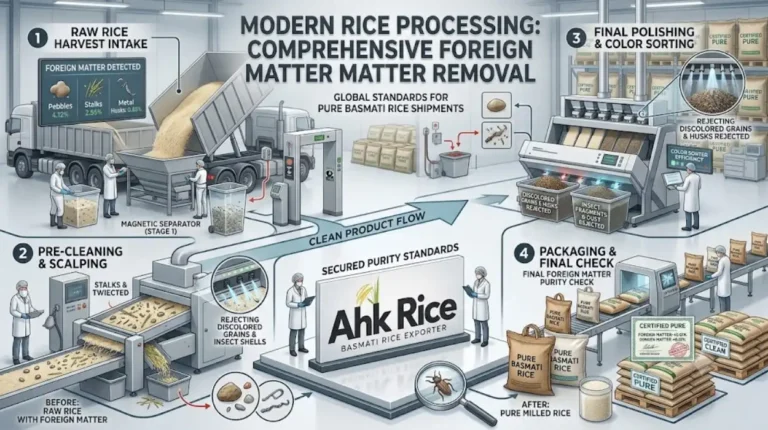
Paddy enters the mill after harvesting and initial handling. Processing removes foreign material and separates usable grain from impurities.
The basic sequence includes cleaning, de-stoning, husking, separation, milling, polishing where required, grading, colour sorting, and final inspection.
Parboiled or Sella rice follows an additional thermal treatment process before milling. Steam processing uses controlled steaming rather than conventional parboiling. These processes affect cooking behaviour, grain appearance, texture, and final market positioning.
How Is Rice Graded and Sorted?
Grading separates rice according to measurable characteristics. These include grain length, broken percentage, moisture, damaged grains, foreign matter, chalkiness, and appearance.
Colour sorting uses optical equipment to identify and remove discoloured or defective grains. This creates greater uniformity within the finished batch.
For procurement teams, grading creates a measurable specification. A buyer can therefore compare supplier samples against documented requirements instead of relying only on visual inspection.
How Is Rice Prepared for Export?
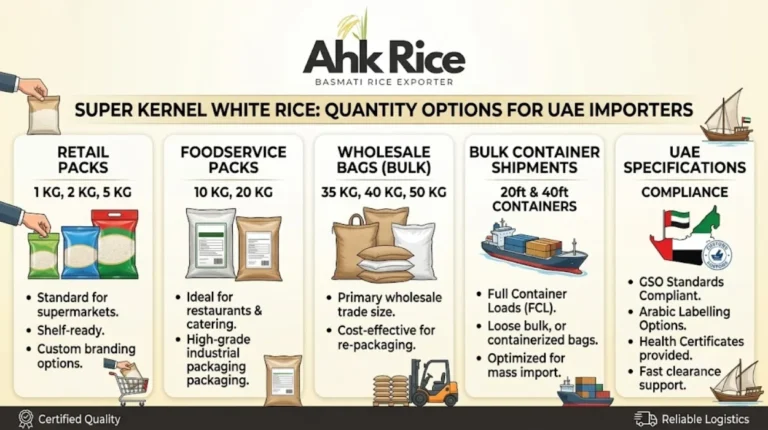
After quality approval, rice is packed according to the buyer’s required format. Export packaging includes bulk sacks, polypropylene bags, laminated bags, retail pouches, and private-label formats.
Container loading follows the shipment specification. The exporter prepares commercial and regulatory documentation before the cargo moves through the export process.
Pakistan’s Department of Plant Protection identifies inspection, sampling, treatment where required, and phytosanitary certification as parts of the export process. Required documentation includes items such as commercial invoices, packing lists, container information, treatment certificates where applicable, and traceability documentation for specified commodities.
Which Components Make Rice Procurement More Efficient?
Efficient rice procurement combines accurate specifications, qualified suppliers, batch-level quality control, documented certifications, suitable packaging, transparent commercial terms, shipment planning, traceability, and post-delivery verification into one measurable purchasing system.
What Role Does Product Specification Play?
A precise specification prevents disputes before production begins.
A rice purchasing specification can define:
- Variety
- Raw grain length
- Broken percentage
- Moisture
- Processing type
- Crop year
- Milling degree
- Foreign matter
- Packaging
- Quantity
- Inspection method
- Destination requirements
For example, 1121 Basmati, Super Kernel Basmati, and 1509 rice represent distinct procurement requirements. Pakistan’s Trade Portal currently lists 1121, Super Kernel, 1509, PK386, IRRI-6, and IRRI-9 among rice products offered for export.
Why Does Supplier Qualification Matter?
Supplier qualification establishes whether a supplier has the production capacity, processing infrastructure, quality controls, export documentation, and logistics capability required for repeated orders.
Procurement teams examine production capacity, milling processes, laboratory testing, inspection procedures, certifications, previous export experience, documentation accuracy, and destination-market compliance.
The purpose is not simply to identify a supplier. It is to identify a supply system capable of producing the required specification repeatedly.
Why Are Quality Controls Important?
Quality control converts product expectations into measurable acceptance criteria.
A buyer can establish inspection points before production, during processing, before loading, and after arrival. This creates traceability between the purchase order and delivered cargo.
Pre-shipment inspection also provides independent evidence where the contract requires it. Testing can address moisture, grain characteristics, broken percentage, contaminants, pesticide residues, microbiological risks, or other destination-specific requirements.
Which Certifications and Documents Apply?
Certification requirements depend on the product, origin, destination, and importing-country rules. Common export documentation includes a certificate of origin, phytosanitary certificate where required, commercial invoice, packing list, bill of lading, fumigation or treatment documentation where applicable, and inspection records.
Pakistan’s Department of Plant Protection issues phytosanitary certificates according to importing-country requirements and ISPM-12 procedures.
For Basmati, authenticity documentation also has a specific role. Pakistan’s Basmati specification framework identifies the Trading Corporation of Pakistan as the authority responsible for verifying compliance with notified specifications and issuing authenticity certificates for importing countries.
Certification schemes such as HACCP, ISO 22000, ISO 9001, GMP, BRCGS, and IFS serve different purposes. Their applicability depends on the supplier, buyer, retailer, and destination-market requirements. A certification logo alone does not replace destination-specific legal compliance.
Why Does Supply Efficiency Reduce Procurement Costs?
Supply efficiency reduces total procurement cost by controlling purchase price, processing losses, quality failures, documentation errors, storage exposure, demurrage, rejected cargo, emergency freight, inventory shortages, and other expenses created by inefficient supply-chain coordination.
The purchase price represents only one component of international procurement cost.
A buyer also manages inspection charges, packaging, inland transport, port handling, ocean freight, insurance, customs-related expenses, warehousing, financing, and potential quality claims.
An inefficient process creates hidden costs. A documentation error can delay customs clearance. A failed inspection can create re-testing costs. Incorrect packaging can require relabelling. A late shipment can disrupt retail inventory.
Supply efficiency addresses these costs before they become operational problems.
How Does Procurement Reduce Waste?
Rice processing produces different grain streams. Broken rice, bran, husk, and other by-products have different commercial uses.
Accurate milling and grading reduce unnecessary losses while ensuring the finished product matches the buyer’s specification.
Inventory efficiency also matters. A buyer that orders according to forecasted demand, lead time, safety stock, and seasonal availability avoids excessive inventory and stockouts.
How Does Better Planning Control Logistics Costs?
Container planning connects order quantity with shipping capacity.
For example, a buyer importing multiple containers needs consistent loading plans, accurate carton or bag counts, container weight compliance, documentation matching, and coordinated vessel schedules.
A shipment that arrives at the destination without complete documentation creates avoidable delays. Procurement efficiency therefore extends beyond supplier selection into logistics execution.
Which Rice Markets Depend on Efficient Procurement?
International rice buyers in the Gulf, Europe, United Kingdom, Africa, Asia, and North America use supply efficiency to maintain consistent product availability while meeting market-specific quality, food-safety, documentation, packaging, and import-control requirements.
Pakistan’s export footprint demonstrates the diversity of rice demand. FY2024 trade data lists the United Arab Emirates, Côte d’Ivoire, United Kingdom, Senegal, Italy, Madagascar, Oman, Mozambique, the Netherlands, Cameroon, Belgium, and Haiti among major destinations for Pakistani rice.
Basmati demand has a particularly strong presence in premium and quality-sensitive markets. USDA reporting for the 2024/25 marketing year identified the EU and UK as important markets for Pakistani Basmati, while also noting demand across other destinations.
December 2025 trade data reported the UAE as Pakistan’s largest rice destination for that month, with China also recording substantial volumes. The same report recorded significant shipments to Saudi Arabia, the EU and UK, Oman, the United States, and Canada.
Each market creates different procurement conditions.
A UK buyer focuses on food safety, documentation, labelling, importer obligations, and retailer specifications. A Gulf buyer can place stronger emphasis on Basmati varieties, packaging, cooking characteristics, and price positioning. African markets often include substantial demand for long-grain non-Basmati varieties.
How Do Rice Varieties Affect Procurement Efficiency?
Rice variety determines grain characteristics, processing requirements, market positioning, specification controls, and buyer expectations, so procurement teams select varieties according to destination demand rather than treating every Pakistani rice shipment as an interchangeable commodity.
What Is 1121 Basmati?
1121 Basmati is a premium extra-long-grain Basmati variety widely used in international markets. It is available in processing forms such as white, Sella, and steam rice.
Its long grain and expansion after cooking make it important for biryani, pulao, catering, foodservice, and retail applications.
What Is Super Kernel Basmati?
Super Kernel is a premium Pakistani Basmati type associated with Punjab’s rice-growing belt. It is used in retail and foodservice markets where aromatic quality and long-grain appearance are important.
The Pakistan Trade Portal lists Super Kernel among Pakistan’s Basmati export products.
What Is 1509 Rice?
1509 is an extra-long-grain rice variety used in export markets in white, steam, and Sella forms.
Its procurement specification depends on the required grain characteristics, processing method, broken percentage, moisture, packaging, and destination requirements.
The Pakistan Trade Portal currently lists both 1509 Sella/parboiled and 1509 steam rice among available export products.
What Are the Main Problems and Misconceptions in Rice Procurement?
The main procurement problems include choosing suppliers only on price, treating varieties as interchangeable, ignoring destination regulations, accepting inconsistent specifications, separating logistics from purchasing, and assuming certification automatically guarantees shipment compliance.
Is the Cheapest Supplier Always the Most Efficient?
No. The lowest unit price does not establish the lowest total procurement cost.
A supplier with a lower quotation can become more expensive after quality claims, delays, inspection failures, demurrage, packaging changes, or rejected cargo.
Procurement teams therefore compare landed cost and operational reliability rather than purchase price alone.
Does One Sample Represent Every Shipment?
No. A pre-contract sample represents a specific batch or production reference.
Repeated purchasing requires batch consistency. Quality specifications need measurable tolerances and inspection procedures that apply to every shipment.
Does Certification Replace Quality Inspection?
No. Certification demonstrates compliance with the scope of a particular standard or scheme. It does not remove the need for shipment-level quality controls.
Destination-country requirements also remain relevant. For grain exports, UK guidance updated in May 2026 specifies procedures covering sampling, inspection, phytosanitary requirements, and disinfestation or fumigation controls for relevant destinations.
Is International Procurement Only a Price Negotiation?
No. International procurement combines commercial negotiation with specification management, supplier qualification, quality assurance, documentation, logistics, regulatory compliance, inventory planning, and risk control.
That is why procurement teams increasingly treat supply efficiency as a complete operating system rather than a purchasing target.
How Can Buyers Improve Supply Efficiency in International Rice Procurement?
Buyers improve supply efficiency by defining specifications before quotations, qualifying suppliers against measurable criteria, confirming destination requirements, testing samples, establishing inspection controls, coordinating documents with logistics, and reviewing supplier performance after every shipment.
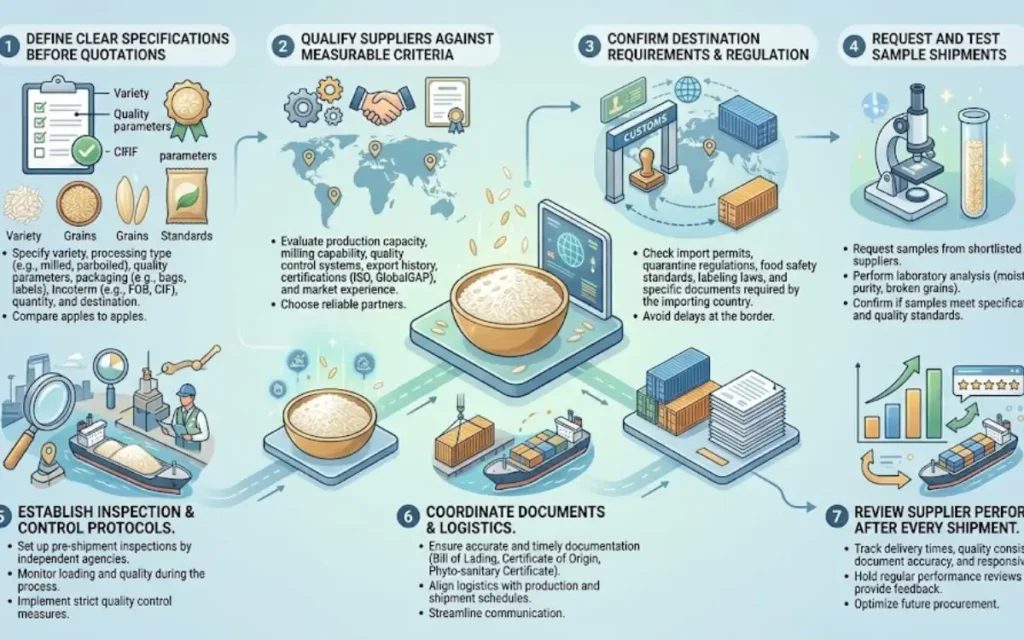
The process starts with a clear purchase specification. The buyer then requests comparable quotations based on the same variety, processing type, quality parameters, packaging, Incoterm, quantity, and destination.
The next stage is supplier qualification. Production capacity, milling capability, quality systems, export documentation, certifications, and market experience become evaluation criteria.
A buyer then validates the product through samples and, where required, laboratory testing or third-party inspection.
After order confirmation, procurement coordinates production, packaging, inspection, documentation, container loading, vessel booking, and shipment tracking.
For buyers developing a repeatable purchasing workflow, understanding:
How international rice buyers can streamline purchasing processes provides the logical next step from supply-efficiency principles into practical procurement execution.
After delivery, procurement reviews quantity received, quality results, documentation accuracy, delivery performance, claims, and total landed cost. This creates supplier-performance data for the next purchasing cycle.
Supply efficiency therefore operates as a continuous process. Each shipment creates information that improves the following procurement decision.
For Pakistani Basmati, this approach is especially relevant because export demand spans premium markets, bulk markets, retail programmes, foodservice buyers, and geographically diverse destinations. Efficient procurement connects the right variety with the right specification, market, documentation, processing method, and delivery plan.
Frequently Asked Questions
What is supply efficiency in rice procurement?
Supply efficiency is the ability to purchase the required rice quality, quantity, and specification at the right cost and time while controlling quality, documentation, logistics, compliance, and delivery risks.
Why are procurement teams focused on supply efficiency?
Procurement teams focus on supply efficiency because inefficient purchasing creates higher landed costs, shipment delays, quality disputes, documentation errors, inventory shortages, and unnecessary logistics expenses.
Which Pakistani rice varieties are commonly used in international procurement?
Common Pakistani export varieties include 1121 Basmati, Super Kernel Basmati, 1509, PK386, IRRI-6, and IRRI-9. Buyers select varieties according to destination-market demand, cooking characteristics, grain specifications, and price requirements.
How does rice processing affect procurement efficiency?
Rice processing affects grain quality, appearance, broken percentage, moisture, and consistency. Cleaning, husking, milling, grading, colour sorting, and packaging must follow defined specifications to produce consistent export batches.
Which certifications apply to Pakistani rice exports?
Applicable certifications and documents depend on the destination and buyer requirements. Common requirements include phytosanitary certification, certificate of origin, inspection documentation, and food-safety certifications such as HACCP, ISO 22000, BRCGS, or IFS where contract or market requirements apply.