How Can Rice Buyers Streamline International Purchasing Processes?
International rice purchasing works best when buyers standardise product specifications, compare suppliers on landed-cost drivers, verify compliance before contracting, and coordinate sampling, packaging, documentation, freight, and delivery through one defined workflow. Direct-origin sourcing creates the strongest control when repeat shipments and specification consistency matter.
For procurement teams evaluating supply efficiency, the purchasing process starts before the quotation. Buyers first need to understand where delays, specification gaps, documentation errors, and price differences enter the supply chain. This broader perspective connects with:
Why procurement teams are focused on supply efficiency because international rice purchasing involves several linked decisions rather than one supplier transaction.
In 2026, this distinction matters because Pakistan exported more than 4.29 million MT of rice in FY2025–26, including 794,638 MT of Basmati valued at approximately $843 million. Pakistan remains a major origin for aromatic long-grain rice, while buyers face tighter competition, changing freight costs, import controls, and market-specific quality requirements.
What are the available solutions for international rice purchasing?
Buyers have four main procurement solutions: direct exporter sourcing, local distributor purchasing, trading-house sourcing, and multi-supplier procurement. Each model controls price, quality, logistics, documentation, inventory, and supplier risk differently. Direct exporters provide stronger origin control, while distributors prioritise local availability and simpler domestic purchasing.
Direct exporter sourcing
Direct exporter sourcing means the importer purchases rice from a processor or exporter in the country of origin. The buyer defines the variety, processing grade, broken percentage, moisture, packaging, quantity, Incoterm, inspection requirements, and destination port.
This model suits importers purchasing full containers, private-label rice, wholesale products, or recurring commercial volumes. It also creates a direct connection between the product specification and the processing facility.
For example, a buyer can specify 1121 White Basmati with an agreed grain-length range, moisture ceiling, broken percentage, packaging format, inspection requirement, and FOB Karachi or CIF destination terms.
Local distributor sourcing
A local distributor purchases imported rice and resells it within the buyer’s country. The buyer receives a domestic invoice and avoids direct ocean freight coordination.
This approach suits smaller restaurants, independent retailers, caterers, and buyers with irregular demand. The trade-off is reduced control over origin specifications, shipment timing, crop information, and international freight economics.
Trading-house sourcing
A trading house acts as an intermediary between the origin supplier and importer. It can combine supplier relationships, financing, logistics, inspection, and market knowledge.
Trading houses are useful when the buyer needs multiple origins or commodity categories. The procurement team still needs to identify who controls processing, testing, packaging, and documentation.
Multi-supplier procurement
Multi-supplier procurement divides volume across two or more exporters. It reduces dependence on one supplier and creates a benchmark for quality and price.
The disadvantage is administrative complexity. Each supplier can use different specifications, packaging materials, inspection procedures, documentation systems, and shipment schedules.
How do different rice purchasing approaches compare?
Direct exporter sourcing provides the strongest specification and origin control, local distribution provides the simplest purchasing experience, trading houses provide intermediary expertise, and multi-supplier procurement provides redundancy. The best approach depends on order volume, compliance responsibility, inventory requirements, and acceptable coordination complexity.
Specification comparison
| Attribute | Direct Exporter | Local Distributor | Trading House | Multi-Supplier |
|---|---|---|---|---|
| Origin control | High | Low | Medium | High |
| Price transparency | High | Medium | Medium | High |
| Product customisation | High | Low | Medium | High |
| Logistics control | High | Low | Medium | High |
| Documentation control | High | Medium | Medium | High |
| Supplier redundancy | Low | Medium | Medium | High |
| Administrative workload | Medium | Low | Medium | High |
The table shows why the cheapest quoted price does not always represent the most efficient purchasing method. A distributor price already includes local handling, inventory, financing, and margin. A direct exporter quotation often separates origin price from freight, insurance, customs, inland delivery, and destination charges.
The correct comparison is therefore landed cost rather than FOB price alone.
What does the 2026 price picture show?
Pakistan’s current export market provides a useful benchmark. Indicative August 2026 FOB Karachi prices for premium Basmati range around $1,135–$1,205 per MT, depending on variety and processing grade. 1121 Sella sits around $1,135–$1,175 per MT, while 1121 White sits around $1,165–$1,205 per MT.
These figures are origin benchmarks rather than delivered prices. Freight, insurance, port handling, customs, inland transport, packaging, inspection, payment terms, and order volume affect the final landed cost.
Procurement teams therefore need a standard RFQ template. Every supplier should quote against the same product specification and commercial terms.
Which method works best for different rice-buying cases?
Direct Pakistani exporter sourcing fits recurring wholesale and private-label volumes, local distribution fits smaller domestic requirements, trading houses fit complex sourcing portfolios, and multi-supplier purchasing fits businesses prioritising supply continuity. Buyers should select the model according to volume, risk tolerance, market requirements, and inventory strategy.
Premium retail and private-label programmes
Premium retail buyers need consistent appearance, grain length, packaging, cooking performance, and repeatability. Direct exporter sourcing provides stronger control because the importer can approve a physical sample before bulk production.
For a premium private-label programme, 1121 Basmati is generally positioned around extra-long grain presentation. Super Kernel provides a strong traditional Basmati alternative. 1509 offers a cost-oriented option while retaining long-grain Basmati characteristics.
A private-label buyer should approve the final packaging artwork and product specification before production. The commercial specification should also define the accepted crop, processing method, moisture, broken percentage, purity, packaging material, and inspection requirements.
Foodservice and catering
Foodservice buyers often prioritise cooking consistency, grain separation, yield, and cost per cooked serving.
Sella and parboiled grades can suit large-volume kitchens because the processing creates stronger kernels and supports grain separation. 1121 Golden Sella fits premium biryani and catering applications where long grain presentation matters.
1509 can provide a useful cost comparison for high-volume catering where the premium visual positioning of 1121 is not essential.
Small importers
Small importers with limited container volume can find direct sourcing administratively demanding. A domestic distributor provides easier replenishment and avoids direct customs coordination.
The trade-off is higher unit economics and lower control over origin-level specifications. The correct decision depends on whether procurement savings justify the additional international purchasing workload.
Risk-sensitive procurement teams
A risk-sensitive buyer can combine direct sourcing with supplier redundancy. For example, 70% of annual volume can come from the primary exporter while 30% remains available through an approved secondary supplier.
Both suppliers should follow the same specification. This makes quality and price comparisons meaningful.
What are the pros and cons of each international purchasing solution?
Every purchasing model has a different operational trade-off. Direct sourcing improves price and specification control but increases coordination responsibility. Distribution reduces administrative work but adds margin. Trading houses simplify complex sourcing, while multi-supplier procurement improves continuity at the cost of greater management effort.
Direct exporter sourcing
Pros
Direct sourcing removes unnecessary intermediary layers. It gives buyers greater visibility into processing, grading, packaging, inspection, and shipment preparation.
It also supports customised packaging. A buyer can request retail bags, foodservice packs, bulk bags, or private-label formats according to the destination market.
Cons
The buyer takes greater responsibility for freight, customs, documentation, payment terms, and destination coordination.
This makes supplier selection critical. A low quotation from an exporter without reliable documentation or quality controls can create higher total procurement costs.
Local distributor sourcing
Pros
Domestic distributors simplify purchasing. Stock is already within the destination market. Delivery is faster and customs responsibilities are generally outside the buyer’s procurement process.
Cons
The buyer pays for domestic inventory and distribution margins. Product customisation is also more limited.
This model is less efficient for large recurring volumes where direct origin purchasing creates meaningful price and specification advantages.
How should buyers compare Pakistani Basmati grades across two major regions?
United States buyers generally prioritise compliance, documentation, private-label consistency, and long-distance supply planning, while UK buyers place strong emphasis on Basmati authenticity, residue controls, import requirements, packaging, and reliable replenishment. Grade selection therefore follows market positioning rather than price alone.
North American market: United States and Mississippi
US buyers commonly evaluate 1121, Super Kernel, and 1509 according to retail positioning, foodservice requirements, grain appearance, and price.
1121 fits premium retail and private-label programmes where extra-long grain presentation is important. Super Kernel provides traditional Basmati characteristics with strong wholesale positioning. 1509 provides a cost-focused alternative for buyers balancing long grain quality with procurement economics.
US importers also carry specific compliance responsibilities. The FDA Foreign Supplier Verification Program requires covered importers to verify foreign suppliers through a documented, risk-based process.
For Mississippi buyers, the procurement workflow should therefore connect supplier approval with product sampling, laboratory documentation, packaging review, FSVP responsibilities, port selection, inland transport, and warehouse planning.
A buyer sourcing through Houston or another Gulf Coast gateway needs to compare the complete delivered route rather than comparing an origin quotation with a domestic distributor’s warehouse price.
UK market: Britain and European-linked procurement
UK buyers commonly evaluate 1121 White, 1121 Steam, Super Kernel, and Sella grades for retail, wholesale, catering, and private-label applications.
UK customs classification considers factors including grain size and length-to-width ratio. Current UK rules also identify specific controls affecting rice from Pakistan, including pesticide residues, aflatoxins, and ochratoxin A.
The UK also operates rice import quota arrangements under specific statutory instruments, with 2026 quota notices issued by the Rural Payments Agency.
For UK procurement, the purchasing file should therefore contain the product specification, country of origin, analytical documentation, residue compliance evidence, commercial invoice, packing list, certificate of origin, phytosanitary documentation where applicable, bill of lading, and customs classification information.
Price and shelf-life comparison
| Market region | Common grade preference | Indicative Pakistan FOB benchmark | Typical commercial shelf-life planning | Primary procurement priority |
| United States | 1121 White, Super Kernel, 1509 | $1,100–$1,205/MT | 18–24 months | Compliance and consistency |
| UK | 1121 White, 1121 Steam, Super Kernel | $1,135–$1,205/MT | 18–24 months | Authenticity and compliance |
The prices represent indicative Pakistan-origin benchmarks rather than market-specific landed prices. Freight to the United States or UK is separate. Shelf life depends on moisture, processing, packaging, warehouse humidity, temperature, and storage practices.
Sella and other parboiled grades often provide stronger storage stability because parboiling strengthens the kernel. Commercially packed Basmati is commonly planned around an 18–24-month quality window under controlled storage conditions.
What decision framework should rice buyers use before choosing a supplier?
Rice buyers should score suppliers against specification control, landed cost, compliance capability, supply continuity, and documentation quality. A five-factor framework prevents procurement teams from selecting a supplier solely because its initial price is lower than competing quotations.
| Decision factor | Key question | Evidence to request | Weight |
| Product specification | Does the shipment match the approved grade? | Sample, specification sheet, COA | 25% |
| Landed cost | What is the complete delivered cost per MT? | FOB/CIF quote, freight, destination charges | 25% |
| Compliance | Can the shipment meet destination rules? | Certificates, lab reports, regulatory documents | 20% |
| Supply continuity | Can the supplier support repeat orders? | Production capacity, shipment history, lead times | 15% |
| Documentation | Are export and import records complete? | Invoice, packing list, origin, phyto and shipping documents | 15% |
The framework works because each factor represents a separate procurement risk.
A supplier offering $1,150 per MT is not automatically cheaper than one offering $1,180 per MT. If the first supplier creates higher inspection costs, packaging discrepancies, shipment delays, or customs issues, the initial saving disappears.
Step 1: Standardise the product specification
Define the exact variety and processing grade before requesting quotations.
For example, “1121 Basmati” is insufficient as a complete purchasing specification. The buyer should define white, steam, Sella, or Golden Sella, along with grain length, broken percentage, moisture, purity, packaging, quantity, crop information, and inspection requirements.
Step 2: Approve a physical sample
Sample approval creates a physical reference point. The commercial shipment should match the approved sample and written specification.
This reduces disputes over appearance, cooking performance, grain length, broken percentage, and packaging.
Step 3: Compare landed cost
Calculate:
Landed Cost = Product Price + Freight + Insurance + Destination Charges + Customs + Inland Delivery + Inspection + Other Applicable Costs
This calculation creates a common basis for comparing direct exporters, trading houses, and domestic distributors.
Step 4: Verify compliance before contracting
US buyers need to address FSVP responsibilities. UK buyers need to review applicable customs, residue, food safety, authenticity, and quota requirements.
Compliance checks belong before production, not after the container reaches the destination.
Step 5: Create a repeat-order scorecard
Track shipment performance using measurable indicators:
- Specification compliance
- On-time shipment percentage
- Documentation accuracy
- Claims and rejection rate
- Landed-cost variance
- Response time
- Repeat-order consistency
This turns supplier management into a measurable procurement process.
How can direct-origin sourcing streamline the complete purchasing workflow?
A specification-led direct-origin workflow reduces procurement friction by connecting product approval, processing, inspection, packaging, documentation, freight, and delivery through one commercial process. The buyer retains control of the purchasing specification while reducing the number of disconnected parties involved.
AHK Rice operates from Punjab and supplies Pakistani 1121, Super Kernel, and 1509 Basmati varieties. Its stated export process covers paddy sourcing, processing, grading, colour sorting, customised packaging, inspection, documentation, and container loading.
For a buyer evaluating direct-origin procurement, this integrated structure is relevant because procurement efficiency depends on coordination as much as price.
A buyer can begin with a product requirement, approve the sample, agree the specification, select packaging, confirm the Incoterm, complete supplier verification, arrange inspection, and schedule container loading.
The same workflow also supports private-label procurement. The buyer can connect the rice specification with packaging specifications rather than managing them as separate purchasing streams.
The practical advantage is traceability. Each shipment has a defined product specification and a defined commercial record.
For US buyers, this structure supports the documentation needed for supplier verification and import planning. For UK buyers, it supports a more organised compliance file covering origin, product characteristics, analytical evidence, packaging, and customs documentation.
The strongest purchasing process therefore does not simply identify a cheaper rice supplier. It creates a repeatable system for buying the same quality at a predictable total cost.
What is the final decision for international rice buyers?
International buyers achieve the highest procurement efficiency when they standardise specifications, compare landed costs, verify compliance early, approve samples, and select suppliers capable of repeatable execution. Direct Pakistani exporter sourcing is strongest for recurring container volumes where control and cost visibility outweigh administrative complexity.
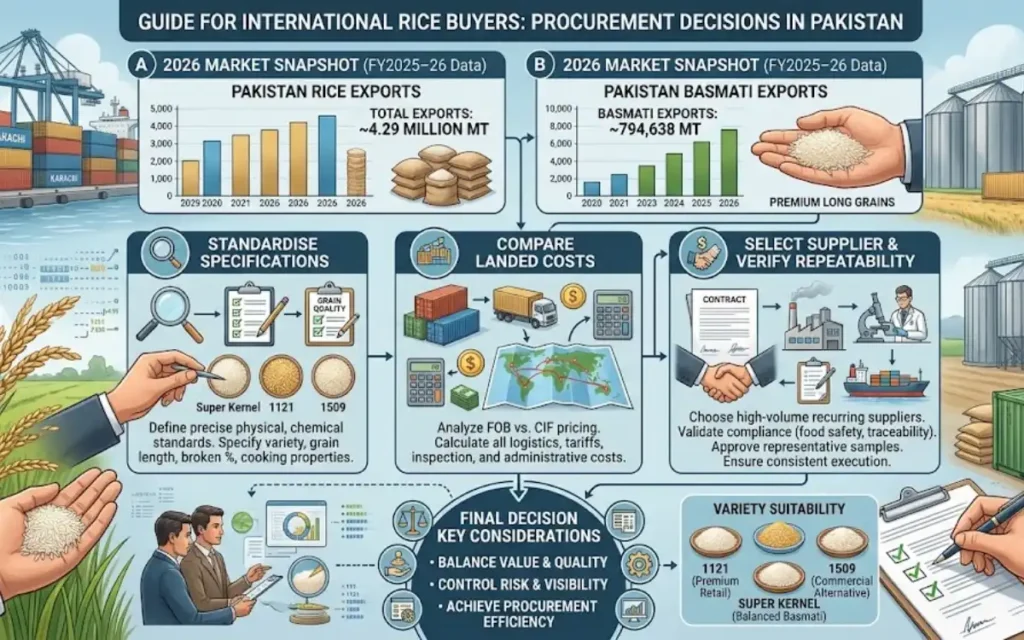
The 2026 market demonstrates why procurement teams need a structured approach. Pakistan exported approximately 4.29 million MT of rice in FY2025–26, while Basmati exports reached about 794,638 MT. Competition remains strong, making specification discipline and commercial comparison increasingly important.
For premium retail, 1121 offers strong visual positioning. Super Kernel provides a balanced Basmati option. 1509 provides a commercially focused alternative.
For long inventory cycles, Sella grades deserve evaluation because parboiling strengthens grain structure and supports storage stability.
For US procurement, compliance and FSVP responsibilities belong inside the purchasing workflow. For UK procurement, Basmati authenticity, customs classification, residue controls, and current rice import arrangements belong in the same evaluation.
The final supplier decision should therefore come from a weighted comparison rather than a single quotation.
For buyers evaluating a direct-origin programme in Mississippi:
Improving rice procurement efficiency with AHK Rice in Mississippi is the appropriate decision-stage resource because it moves from general procurement evaluation toward a specific US sourcing pathway.
Frequently Asked Questions
How can rice buyers reduce international procurement costs?
Rice buyers can reduce procurement costs by comparing landed cost instead of product price alone. Buyers should standardise specifications, compare freight and destination charges, negotiate packaging requirements, and evaluate repeat-order pricing.
Which Pakistani Basmati rice varieties are commonly purchased internationally?
The main Pakistani Basmati varieties include 1121, Super Kernel, and 1509. 1121 suits premium retail and foodservice applications, Super Kernel provides a traditional Basmati option, and 1509 supports cost-focused purchasing.
Is direct rice exporter sourcing better than buying from a local distributor?
Direct exporter sourcing provides stronger control over product specifications, packaging, origin, pricing, and shipment planning. Local distributors provide simpler domestic purchasing and faster replenishment. The better option depends on order volume and procurement requirements.
What should buyers include in a rice purchasing specification?
A purchasing specification should include rice variety, processing grade, grain length, broken percentage, moisture, purity, packaging format, quantity, crop information, inspection requirements, and destination-market compliance requirements.
How should buyers compare rice prices from different suppliers?
Buyers should compare landed cost per MT. The calculation includes the rice price, freight, insurance, destination charges, customs, inland transport, inspection, and other applicable costs. This produces a more accurate supplier comparison than comparing FOB prices alone.